

This blog’s “Stuff for free” page has had its download links updated. The three main free models are now together in a master .ZIP file, which is on Dropbox. This .ZIP should be operating in ‘shared’ mode, and thus be downloadable for anyone who follows the link.
Category Archives: Freebies
New free Bridges from DAZ to C4D and Blender
DAZ now has a new open-source DAZ to Cinema 4D Bridge, and it’s free. It transfers “Genesis 8 and 3 content” from DAZ 4.10 onwards, into seemingly any version of Cinema 4D from R15 onwards. It will also “Transfer Figures/Props/Environments”, but judging by the description it sounds like the poses don’t get sent. Facial morphs do, though. With the Poser equivalent, the whole scene is sent to C4D, poses and all.
Scrolling down the page a bit reveals a family of such plugins, also free. Maya, Blender, 3DS Max.

The Blender one is interesting, potentially making a DAZ figure real-time in Eevee? Yes, it seems so…
“Supported Blender Render Engines: Eevee …”
There’s no manual download of these new Bridge plugins, and the install has to be done through the DAZ Install Manager. Once installed they’re then found under: Scripts > Bridges. YouTube has new tutorials on their use.
Freebie: Ronk and roll
Ronk Aednik, Nursoda’s free add-on pack for his new Ronk figure. Commercial use.

Millennium Cat animations packs
Two unique animation packs for DAZ’s Millennium Cat are currently discounted by 55% at Renderosity. Both packs have a .ZIP of Poser .CR2s and a .ZIP of AniBlocks for DAZ Studio.
Animations for Millennium Cat for Poser and DAZ. Video demo.

There’s also more dramatic animations (prance, a jump up, an arch back and arch back and walk away) as Animations and aniBlocks for Millennium Cat 2. Meaning the second such pack, not that there was a version 2 of Millennium Cat.

Even if you don’t want to do animations, there are effectively hundred of static poses to be had here, currently for just $9 for the two packs.
Lots more animated animal pack-demos at AnnieMation’s YourTube channel.
The latter pack is also stated to be “Also compatible with DAZ House Cat with dForce Hair”. I wonder if the first is also? I’ll have to test that, and also see what else can take these animations.
It appears that DAZ have removed the original Millennium Cat from sale in favour of the DAZ House Cat, but I see that the Millennium Cat LE is still listed as being in the 3D Starter Pack. LE offered the same cat but without so many morphs embedded. Many will however already have the original Millennium Cat in the runtimes. While now somewhat superseded for close-ups by the DAZ House Cat and the Hivewire House Cat, Millennium Cat is still useful for artist reference, painterly Sketch renders and Poser Comic Book renders, and it can of course also take Poser dynamic fur and has two Look At My Hair presets. Incidentally, this LAMH presets link also has presets for House Mouse, Squirrel, Lyne’s Fox, an Arctic Rabbit for Lyne’s Domestic Rabbits, Silverkey’s Giraffe and others. All free.

MilCat with LAMH preset, 3Delight render.
Freebie: Dody for Aiko 3
There’s a quality new free Aiko 3 character. Dody Character Preset For Aiko 3. This requires the Aiko 3 base figure, which most people will have in their runtime, and also the Aiko 3 Morphs and Maps pack (also found in various Aiko 3 bundles and Anime bundles). Also its dependent, Capsces’s Kioki morphs and faces pack for Aiko 3. If you have all those, you’re set.
Once installed this is what you do in Poser…
1) Figure | CDI Koiki (not Aiko 3!) | load.
2) Poses | CDI Koiki | and inject head and then body into the CDI Koiki figure. (You thought you just loaded Koiki in Step 1? Nope, think again…)
3) Then go find Dody under Poses | Ethin. Inject the Head first, then Body.
4) Select body, apply an Aiko skin MAT of your choice.
5) Head dials | ‘OpenMouth’ slightly, so you get an inked line in Poser’s Comic Book mode under flat lighting.
Looking good already in Poser’s real-time comic book inks…

Nursoda’s Kali hair fits well, with just a little scaling. But it does not toon well. Nursoda’s Fehn Hat proved to be better, but is difficult to position. Nursoda’s Anceata hat/hair combo was the best and needed only minimal fitting for a ‘Brian Froud look’.

A storybook combo, combining a saturated Sketch render from Poser using my custom Incredulize! preset, and an inks-only Comic Book render from Poser that was faded out to look like pencil…

Total render time for both renders at 1800px, about 20 seconds.
Yes, I know, “this is 3d, so where are the shadows?” They can be put in too (and there’s an ugly spodgy one on her neck already, ouch), but they weren’t for this quick demo. She probably also needs a more mud-rolled and rain-dropped skin MAT to be a convincing forest spirit.
Poser: how to toggle all scene lights when making Preview renders
Selecting GROUND in a Poser scene is a handy trick that does not, in every single instance, make the guide-wires of Lights invisible in a scene. I’ve seen instances where spotlights don’t toggle off when GROUND is selected.
Why would we want to toggle the lights? Well, when working with lights the last-selected light leaves ‘guide wires’ showing in PREVIEW, and these will mess up a comic-book render. This picture of a live scene in OpenGL shows the problem…

If one were to render this in real-time, the picture would have the light’s ‘guide wires’ arrows and circle on it. Easy to miss, easy to forget until it’s too late and you’re dropping it into a panel on a comics page.
Willyb53’s free Light Toggle script can be hacked to do this for us. Willy’s script was set up to turn all the scene lights off and on, but a few simple tweaks keeps them shining while only their guide-wires are turned off in the scene. To do this we simply open his script with Notepad++ and change it to read…
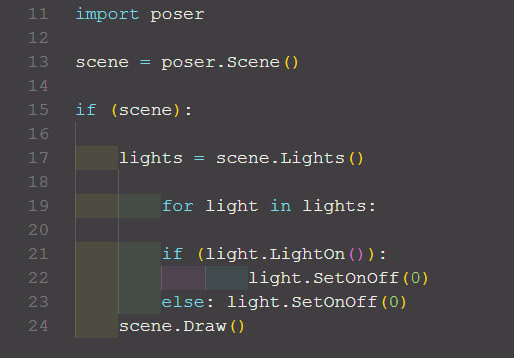
… then save, rename Toggle_Visibility_All_Lights.py and place the new script wherever you keep your Python scripts. Mine are in…
C:\Program Files\Smith Micro\Poser 11\Runtime\Python\poserScripts\ScriptsMenu\FavoriteScripts
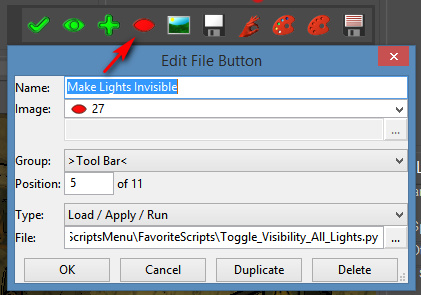
You can then iconise the new script using Dimension3D’s $10 eXtended Access. This runs fine so long as you have the AVFix for it, and I load it at every Poser startup. Attached to a meaningful icon (here a red closed eye), the new script then becomes one-click and it can be handily positioned near the Poser lights control panel.

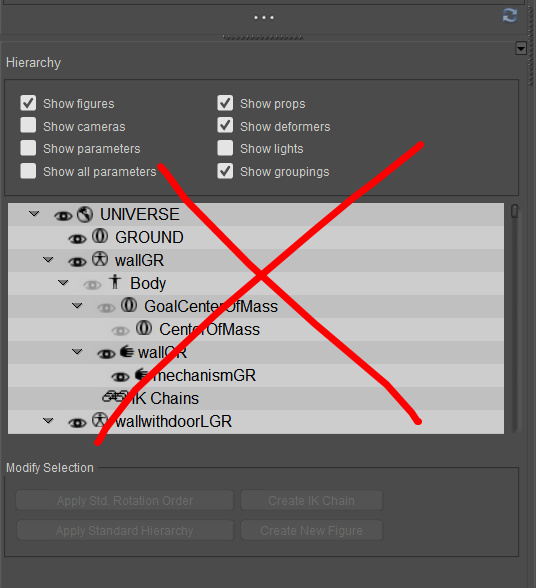
If you have the neat and attractive Scene Toy addon for Poser, and if all you mostly use the Hierarchy Editor for is to click on GROUND to get rid of the guide-wires, then this script lets you hide that window and reclaim a little more screen space in the Poser UI. “Begone, ‘o great space-wasting panel of grey ugliness”…
Finally, the other thing to keep in mind, re: lights and Preview renders, is that OpenGL is limited to eight lights in a scene. This is an OpenGL limitation, not a Poser limitation. In practice, that “eight lights limit” may be even less, because your PCs’ hardware may not be able to support that many interacting lights and their shadows. For working in Comic Book Preview mode it’s probably best to try to stay at three or four lights in a scene. Sketch only supports three, in terms of having the strokes follow the light directions.
Poser to Clip Studio – the solution
Hurrah, I found a viable solution for the massive problems encountered in trying to go from Poser 11 to the latest Clip Studio.
It’s a 2010s Python script from Smith Micro, specifically designed to get .OBJs out of Poser in a format that the old Anime Studio understood. It works in Poser 11 and without placing impenetrable and un-rememberable export-settings dialogues in front of the user. It just quickly saves the posed .OBJ, conformed clothing, and textures.
So I figured… since Anime Studio was the sister software of Manga Studio, they’re going to require the exact same .OBJ settings. They do indeed, the evidence suggests. The script’s export .OBJ loads into the current Clip Studio (formerly Manga Studio) fine. The existence of this script, and its official status, suggests I wasn’t the only one who had problems in getting Poser to talk with Anime Studio / Manga Studio via .OBJ files. Idle YouTube blather about “just do any OBJ export, Clip Studio doesn’t care” is obviously wrong.
The Python script is, of course, long gone from the Smith Micro site. But the WayBack Machine has a copy of the Web page, and the .ZIP download for the script is still live on it. Download, un-zip, pop it in your Python scripts directory.
The script appears to have another nice advantage: perfect front-and-centre sizing to the canvas on import of the .OBJ to Clip Studio, with basic rotation tools and ground-shadow….
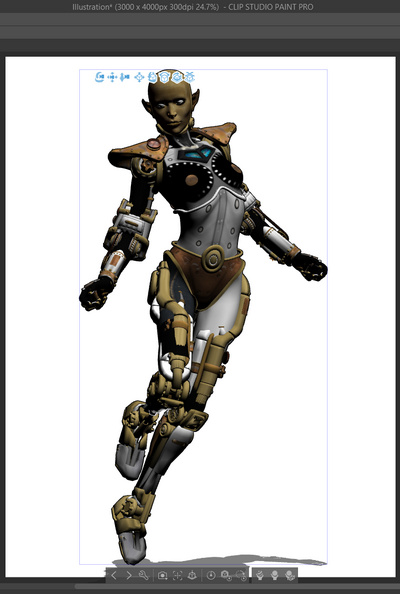
… and several non-skin textures seem to load fine too. As you can see, some grey bits. But you’re going to ink over it, right? Using it more like an artists’ reference image.
Phew, ok… well that’s enough for today. I’m not going to wrestle with Clip Studio to get Poser Steambetty looking tooned. At least I now have a viable Poser-to-Clip Studio workflow, and it’s blissfully un-fiddly.
Release: MeshMolder 2020
Added to the sidebar links on this blog, the free MeshMolder. A new 2020 64-bit version has just been released, in a fairly fully-featured freeware version, and also a $5-by-PayPal Professional version. It’s perpetual desktop software for Windows. A quick test shows there are a lot of ‘Professional version only’ alerts on using the freeware version, but at a mere $5 it’s easy enough to unlock.

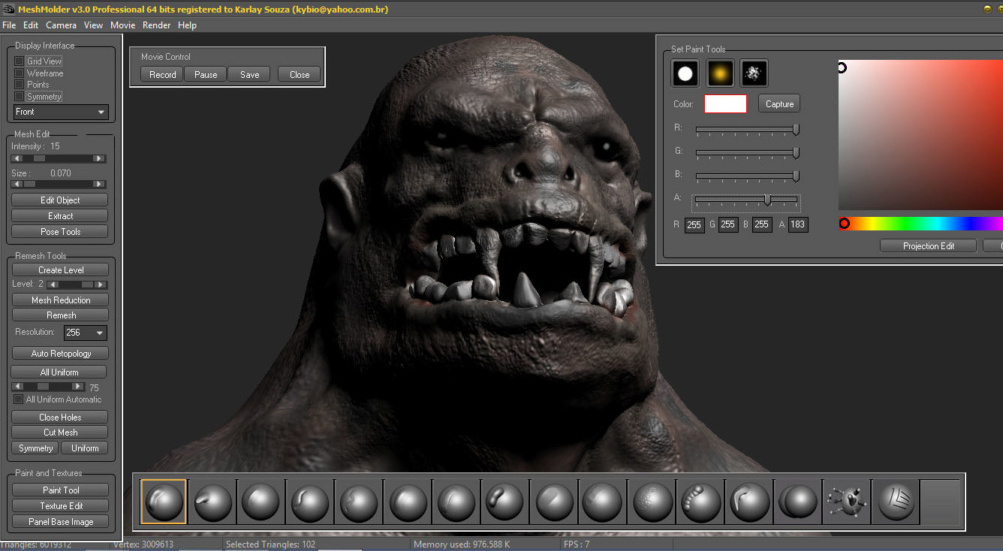
Update: Meshmolder 2024 Pro, now available. Freeware in the 2022 version or $6 for the latest Pro.
Release: MeshLab 2020

Decimation of a model is done as follows: Top Menu / Filter / Remeshing > Simplification: Quadric Edge Collapse decimation. Set target poly count, tick ‘Preserve Normal’. Save.
ZBrushCoreMini
ZBrushCoreMini is a new entry-level free version of Zbrush, sitting below its budget ZBrushCore in the Zbrush range. It’s relatively confusion-free, with just eight sculpting brushes and a few basic materials. There’s also .OBJ export, with no watermarks. Downloading ZBrushCoreMini requires a sign-up, and it appears to be perpetual free desktop software.
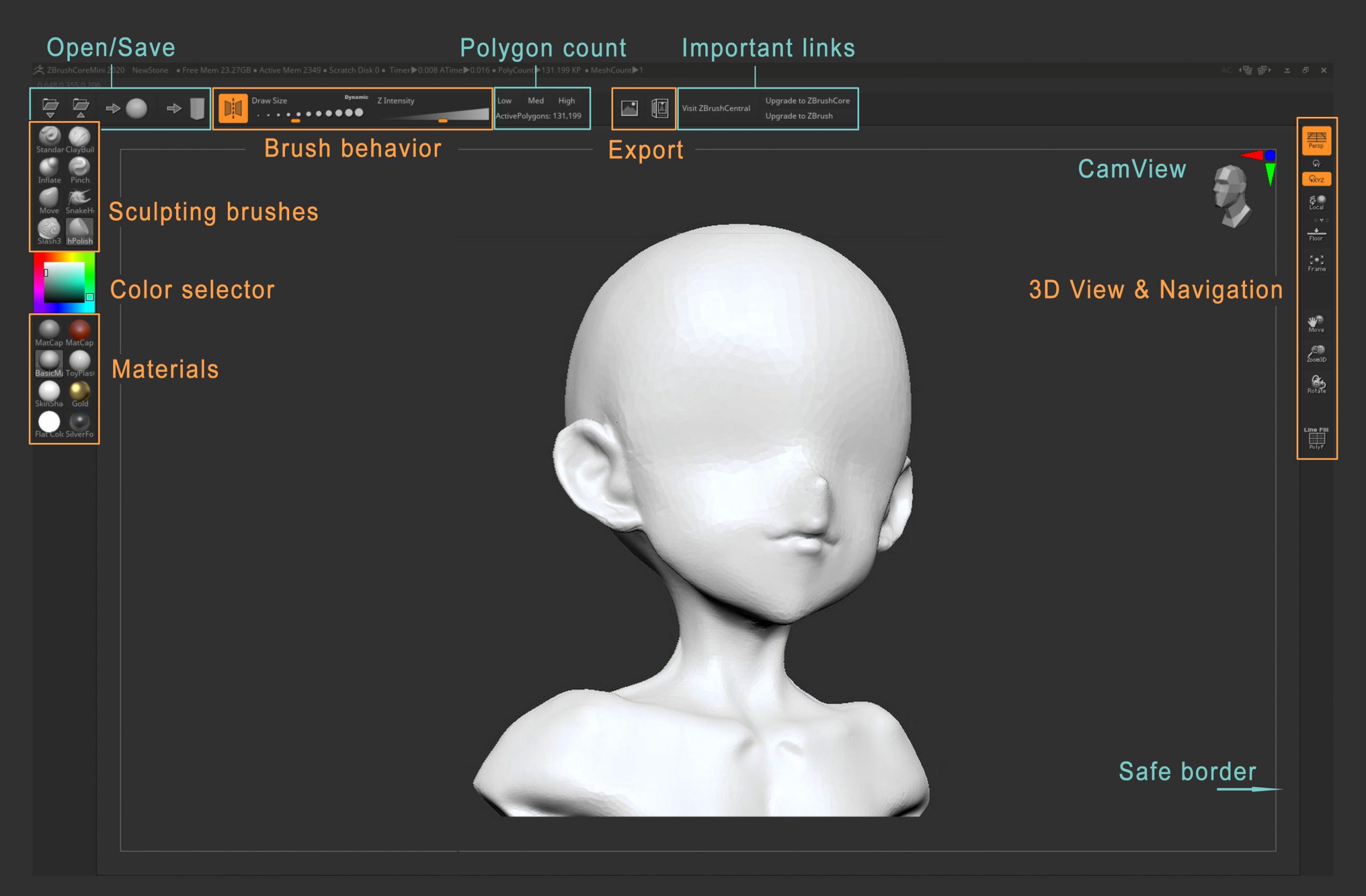
It would be interesting to see if this could be hooked into GoZ or an equivalent, for round-trip calling from DAZ Studio, Poser etc like the big ZBrush.
Free cute cats
Free cute cats, delivered to your home! Nope, not an April Fools’ Day prank. HiveWire are giving away their high-quality Housecat for free until 31st May 2020, along with other goodies.
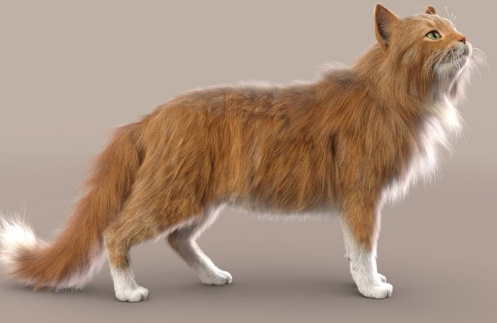
For fur also get their free LAMH Presets for the HiveWire House Cat, which are not on the new freebies page, but are free on the general store.
Sweet Apple
The Apple macOS version of CrazyTalk Animator 3 Pro (now Cartoon Animator 4) is free until the 1st of April 2020. Note that Pro is a limited version, compared to the full top-of-the-line Pipeline version. Pro lacks .PSD import/export, and vector .SWF loading.
I don’t imagine that there are many poor people with Macs. But for those who are short of cash, such as school students, then it’s a nice bit of creative software and is not tied to a subscription. Those who know schools that run on Macs might also point them in the direction of this offer, with a warning that Reallusion’s content-packs can be expensive.
Magic Object Mover for Vue
At last, there’s a simple “object mover” script for Vue! It’s the equivalent to Poser’s vital SnapTo script.
Select any two objects, run the script. With one click the second object moves to the location of the first, with a slight offset… so that it doesn’t land on top of the camera or inside a building/tree etc. The offset can be precisely adjusted in the script. Optionally you can also have the object scaled up at the same time, which may be useful if it’s a tiny object in a vast landscape.
Download Magic Object Mover for Vue v1.0. If you find it regularly useful, please note that it’s donationware.
TurboVNC – free, 3D friendly ‘remote desktop’ software
TurboVNC, “high-speed, 3D-friendly, TightVNC-compatible remote desktop software”, including mouse and keyboard control of the remote PC. Free, open-source, mature but also in active development. “3D friendly” here means things like Poser, Cinema 4D, Vue etc, not videogames.
Those who’ve used the business-friendly Team Viewer will be familiar with the basic principle of the ‘Remote Desktop’, aka ‘Virtual Desktop’. You install some software on both PCs, then with the aid of a ‘crossover’ Ethernet cable and a Local Network set up in Windows, you can seamlessly view and operate a remote PC from the comfort of your main PC. A use-case might be that you want to run Vue 2016 directly on your 12-core dual-Xeon render-farm ‘beast’ PC, rather than just sending its rendering work to that PC. But you don’t want to have to swop seats, cables etc to do so. Windows also has a similar feature built-in, which may be enough for those not doing advanced modelling with real-time rendering.
I also looked at the similarly free TigerVNC, also 3D-friendly, but TurboVNC seems the best choice for such things as it has high throughput and also ‘visual glitch’ error correction designed for 3D software work. Though it has a User’s Guide that only a techie could love, and badly needs a focused and user-friendly 6-minute YouTube video offering a quickstart on its setup and use.
Still, making a .BAT file should relive you of the need to type in a half dozen tedious commands, which are needed before you start up the Viewer component…
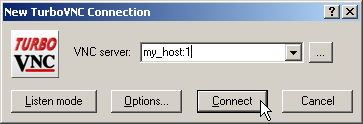
Note that, to download TurboVNC you may also want to know how to get direct downloads from SourceForge, if the EU’s cookies-crap stops your download from starting.
Top 5 Python scripts for new Poser users
There are quite a few new Poser 11 users since Black Friday 2019, and by now they may be wanting to get their first small handful of helper Python scripts. I’d suggest the following are the “top five” for new users…
1. “Scene Toy Pro” (2016 version), available paid at Renderosity and Hivewire. An absolutely vital scene helper, in a slick user interface.
2. “Eye-target” in the Poser Python tools with source code pack, also paid at Renderosity. A non-rendering cube that the character looks at. The cube can be moved, and the eyes follow it. An advanced user can manually set up such a ‘eye-target’ for a character, but this script hooks it all up automatically in a micro-second and saves some tedium. Does not work with all characters, but works with many. (*)
3. Ockham’s “SnapTo” mover. Free at Ockham’s site. Move the just-loaded item from Wheretheheckizit to somewhere in the scene where it’s visible/useful. He also has a variant that moves the current camera to the clicked location, useful for large scenes. Note that this uses Tkinter as part of the script, which means Mac users cannot run it (take it up with Apple and their fickle support-policies dept., not Poser).
4. The DAZ “DSON Importer” for Poser. Free. I assume this is Python, though I’ve never looked — it just works. Auto-loads older DAZ Studio content into Poser, which means Genesis 1 and 2 and props of the same era, if you also downloaded and installed that content’s PoserCF files.
5. “ChangeGamma”. Free, and it ships with Poser 11. Find it under: Top Menu | Scripts | Material Mods. For quickly making grungy dark textures lighter in tone, without actually replacing them. “1” is a good initial setting to use it with, when it asks for user input, though the photoreal rendering crowd may prefer a more subtle ‘lift’ than that.
* Are you a Python coder with a large runtime stuffed with characters, and are you looking for a nice project? Note that Posers users would benefit greatly from a more sophisticated version of this script, with the addition of a per-character drop-down menu. Each drop-down line in the menu would call some character-specific code and math to adjust the eye-tracking for eye-size and other per-character foibles, thus giving perfect eye-target tracking.
See also my larger page on Python Scripts for Poser 11, including installation location advice.