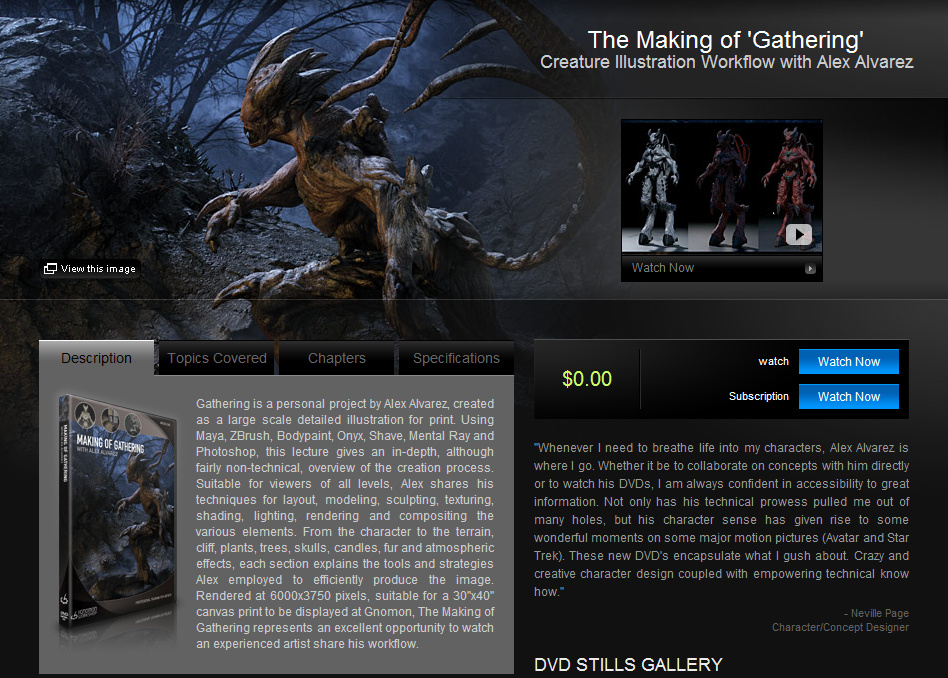
Gnomon has a free 150 video tutorial Making of Gathering, for advanced CG artists interested in monster design. The pipeline is ZBrush / Maya / Photoshop…
Category Archives: Companion software
Reality 2.2 released
The external renderer Reality 2.2 has been released as a free upgrade. Reality works as a plugin for DAZ Studio (not Poser).

DAZ freebies offer extended to April 2012
It looks like the DAZ free software offer is stuck in an infinite loop. It’s now been extended to the end of April 2012…

3D World reviews Reality 2.0 for DAZ
The UK’s 3D World magazine has just posted its review of the Reality 2.0 renderer. Reality is a plug-in to export to the non-biased LuxRender render engine, from DAZ Studio.
PzDB for DAZ Studio and Poser Pro 2012 – review
This review is eight years old now, but still useful.
I went looking for another third-party DAZ/Poser content management system. I remembered the old PzDB (it stands for ‘Poser Database’), and I wondered if it was still around. It turns out that PzDB is now PzDB 1.2.2. It looked good, with lots of interesting features, but… I wasn’t sure if it would work with DAZ Studio and Poser Pro 2012. I’ve now tried it, and it turns out that PzDB still works fine.
After installing PzDB you get a simple Wizard that walks you through finding your main runtime, the one with all your content in it. Indexing the first run may take some hours, but subsequent updating of the index (i.e. after adding new content) is quicker.
Indexing is supposed to automatically fix missing thumbnail-previews, populated the database with keywords taken from file and folder names, and automatically grouped and cross-referenced all the content.
The time taken was reasonable, considering how much 3D content I have been able to build up over the years of cherry-picking bargains, freebies, sale-offers, and group discounts…
I was a little worried that PzDB might be messing with my runtime. But I needn’t have worried. It does not touch the runtimes at all. All PzDB does is build an incredibly useful virtual catalogue of them.
Once it’s finished indexing, I simply closed the Indexing window (scary moment, since there was no indication that the 35 minute trawl had been saved), and then clicked on the “Launch PzDB” button.
You’ll find content for all your main characters already sorted for you. Although I found that PzDB doesn’t seem to know yet about Nursoda’s characters like Dr. Pitterbill. But Vicky 4 and all the other standard characters can be quickly displayed via handy drop-down preset filters.
In my first use of the keyword search-box I was obviously doing something wrong. I searched for “dog”, and had no results. It took about ten minutes of mild puzzling before I managed to figure out how to get out of the Victoria 4 index I was started off in, and to be able to do a proper global search of the runtime (like you can, in a primitive manner, in Poser Pro 2014). Sadly the manual wasn’t any help on this fundamental sticking point. Basically, to do an “all content” search, you do this: make sure all the little tabs over in the search panel are showing colour and not grey (click on any grey ones, to turn them to colour), AND have the top category selection set to All Content, thus…
Once that was sorted out, the software searched perfectly. I quickly had a Catalogue display of search results showing all my Doctor Pitterbill items and characters. This was very comprehensive, and contained pleasingly presented smooth thumbnails without graphical jaggies. My trial of DAZ Studio 4 Pro’s search facility using the same keyword search gave a much poorer result. So PzDB is generally a much better experience for content browsing than the native Poser or DAZ content interfaces. You can also tag, and generally manipulate searches a whole lot more. However, I found that some thumbnails were still missing. That can be fixed by running the free RSR to PNG Converter before indexing.
The moment of truth came when I launched Poser Pro 2014 with PzDB still open. I was easily able to drag-and-drop characters and props straight out of the PzDB database. Clothing works too. Here’s Doctor Pitterbill swiftly dragged and clothed directly from the PzDB interface…
Drag-and-drop works for DAZ Studio 3 too, and DAZ Carrara. Lights won’t work in Carrara, though, since DAZ/Poser light presets are not supported by Carrara. (Note that PzDB is pretty useless at indexing your special runtime for Carrara-only content, as it can’t add thumbnail previews for Carrara content)
Further testing with searches showed that PzDB is very fast even with wide-area searches such as “cat” (I have a lot of cat content) — just four seconds. Everything had beautiful thumbnails. I smiled and said “Hi!” to Poser and DAZ content that I had long since forgotten.
The one problem was that the per- content-item “Launch” button didn’t seem to work. Apparently it used to launch the Poser Remote (pRPC) script to place the prop or character in the scene. But this script failed to launch for me. It seems it’s meant for users of older versions of Poser, ones that don’t support drag-and-drop. So users of Poser Pro 2012 and Daz Studio needn’t bother about this button.
I could have kept on wrestling with Poser’s own 32-bit Content Library, or forced myself to wrestle with the DAZ 4 interface, but working with 3D content will now be so much more pleasant with PzDB. Not to mention a time-saver. An eternal licence for PzDB cost me $39.95 U.S. (about £27 UK). You can buy through Renderosity, which accepts PayPal, and I saw no additional sales tax being added. You get a serial number, and then there’s a one-time Internet activation process.
Update: the new summer 2014 1.3 version of PzDB fixes the “it doesn’t remember the serial number” problem.
Update: At summer 2017, to index Vue 2016 content you may need to have two Vue indexes – one for the shipping content at C:\Program Files\e-on software\Vue xStream 2016 and another for your installed third-party content at C:\ProgramData\e-onsoftware\Vue xStream 2016. You probably want to remove all the .~~ ‘sample’ files before you index, although you can knock such files out of your search by using the “does not contain” search modifier.
Update: Be sure to re-index an index only when Poser is closed, not while it’s running, or PzDB may throw up ‘database error’ messages.
Update: Works fine with Poser 11 and the new Poser 11.2.x
How to 3D model a mad March hare
Want to know how the toon wizards at 3D Universe go about making their lovely animals? Their modelling wizard Steve has just posted a new tutorial on how to model a mad March hare…


Super-quick file search for Poser: Agent Ransack (free)
Update: now overtaken by the Everything freeware.
Poser’s search-by-keyword feature is incredibly useful. But sometimes it shows you a prop that doesn’t have a clickable route back to its folder. That can be frustrating. For instance, you can only remember the name of a prop (cupping glass, from a Wild West doctor’s pack), but want to remember the name of the pack it comes with (Bad Medicine). The prop is sitting there in your search-results, but with no way to get back to its parent folder.
So, is there a better way to search your multi-Gb of runtime? Yes, and it’s free and simple to use. It’s also faster than Poser at search. Agent Ransack to the rescue. This software is a free lite version of a larger professional file search tool called FileLocator Pro. But the Lite version works reliably for simple tasks and is quite fast. It’s completely free, and free of ads or time-bombing. It’s a much lighter and nippier solution than launching the lumbering Google Desktop service, or having Windows File Indexing constantly grinding away in the background.
Once Agent Ransack is installed, simply paste your runtime path into its “Look in:” box (this is remembered each time you launch Agent Ransack), and ensure ‘Subfolders’ is ticked. Then pop a single search word in the “File name:” box and off it goes. Agent Ransack is quick compared to un-indexed Windows Search.
Unfortunately there’s no nice visual thumbnail previews like you see in Windows Explorer, otherwise it would be a perfect content library search-tool. I guess it’s so fast because it ignores all of that.
But once you have your list of results you can highlight the file you think you want, right-click on it and choose ‘Explore Here’…

New 3D models conversion service
I’m pleased to say that I’m now offering a 3D models conversion service. DAZ or Poser to iClone, or visa versa. Or tricky conversions from Maya, 3DS Max, or other formats. Very reasonable rates, payment accepted via PayPal. Visit the page for more information.
Win a free copy of Reality 2.1 for Daz Studio
Two days to go until the deadline for the LuxRender competition…
“1st place will receive a free license to the Reality exporter for Daz Studio.”
Reality is currently in version 2.1 (DS 4 only), costs $60, and renders out to the external open source LuxRender.
How to render with Poser using the GPU, via Octane
Durn it… I missed an extra external Poser render (see yesterday’s blog post on these).
Poser works with Refractive Software’s Octane (Nvidia graphics cards only). What makes Octane interesting is that it uses the GPU for render acceleration. The common advice on Poser forums to the… “I wanna new graphics card, which is best for Poser?” query, seems to be that Poser relies mostly on the main processor. But Octane would seem to change that, passing over the heavy-lifting of rendering to the much faster graphics card.
Octane is still in beta, and is reportedly not wholly stable. But then the same could be said of the similarly crash-prone LuxRender. Octane costs E99 Euros (about $130). There’s a Deviant Art group of Poser2Octane users who can give advice, and there are tutorials from the group on how to use it with Poser Pro 2014.
It appears Poser users need to export an OBJ of the target Poser scene — either directly from Poser, or (for more complex scenes?) via loading the Poser scene in DAZ Studio, then saving out as an OBJ, in order to get an OBJ that Octane won’t reject. Sounds a little clunky.
One alternative route that occurred to me might be to get a Collada export from Poser Pro 2014, then use Meshlab to get the OBJ and textures. Another pipeline might be: Collada – Autodesk’s free FBX convertor – OBJ. In fact, I read on the Octane forums that .dae import is supported, so it may now be a straight Poser – Collada – Octane pipeline.
My guess would be that it would probably also be a good idea to use Photoshop’s batch processing to downsample any really huge 4000px or larger materials/texures, down to 2048px, before you load the scene in Octane. Game cards, especially ones that are no longer cutting-edge (like mine), are geared for handling smaller textures.
The Poser2Octane tutorial doesn’t cover re-lighting the scene in Octane, but there’s a very clearly-presented video tutorial on that here…
I do like what I see, I must say. But it doesn’t look as seamless as Vue.
A survey of external renderers for Poser 9 / Poser Pro 2012
I’ve been looking into external renderers for Poser 9 / Poser Pro 2014, other than the “PoserFusion” plugins that ship with 2012 (and which let you use 3DS Max, Maya, Cinema 4D, and LightWave). Vue 10 seems the best option. But I think I still need to research more, to find out if one of those PoserFusion plugins for Maya or 3DS Max or Lightwave can offer something more seamless and “three-clicks” than Vue. But from my research it seems Vue is the currently preferred choice of many Poser users. Anyway, here’s the survey…
1. Cinema 4D: Interposer ($75) is an alternative to the PoserFusion C4D module that ships with 2012. Fine, if you own Cinema 4D ($1,000+). Personally C4D is not a 3D software I’ve ever touched. I have old versions of 3DS Max and Maya in their educational versions, so one of those — probably 3DS Max — would be my choice over C4D.
Verdict: No.
2. Blender: a Poser importer titled Poser Tools 2 for Blender is actively underway at 2012 — but it seems far from finished. While Blender is free, it has a nightmare of an interface, and I really doubt I’d want to use it unless Poser Tools comes with a “really simple five-click Wizard” or similar.
Verdict: Very unlikely.
3. Pose2Lux ($ free) gives access to the free LuxRender. The disadvantages are…
* still in beta at version 0.8.7.
* download pages and even the quick-start page are presented in “techie developer”-speak that’s likely to have that average hobbyist creative running screaming to the hills.
* getting it to actually work looks to be an incredibly fiddly process.
* LuxRender doesn’t exactly seem stable. The same stability problems appears to affect the Reality 1 LuxRender plugin for DAZ, which negate a Poser-DAZ-Reality-LuxRender pipeline.
Verdict: Unstable. No, but look again at Reality 2 when it arrives.
4. Vue: Vue 10 Frontier ($99) is commercial hobbyist software dedicated to working with DAZ and Poser imports. It’s a cut down version of the more expensive and more complicated Vue software versions. Vue is definitely more affordable than the big beasts such as 3DS Max, Maya, Cinema 4D, and Lightwave. Worth trying. Some drawbacks, though…
* forums say Poser 9 / 2012 character import currently only works with the 64-bit version? And then possibly only with the more expensive Vue 10 Complete or Infinite versions?
Update on the above point: this official page for Vue 10 Studio states…
“Poser SDK from August 2011: This SDK adds support of Poser 9 and Poser Pro 2014. This SDK used on Mac will only work in 64 bit. It will work in both 32 and 64 bit on Windows.”
But it seems this is incorrect. Several different forums users are adamant that a Poser Pro 2014 .pz3 file will only import under the 64-bit version of Vue 10. I’ve tried some 32-bit experiments myself, and it seems the forums users are correct. A 32-bit Vue 10 install will not import a Poser Pro 2014 .pz3 file. Vue’s spec sheets on their Web site are misleading. I also learned from the forum that E-on, the makers of Vue, are notorious for giving out such misleading information on their products.
* import of .pz3 files can be a bit of a nightmare, in terms of getting Vue to accept them.
* model import other than from Poser or DAZ requires the $129 3DImport plugin.
* bump map import can be glitchy, and many other materials may need fiddly tweaking to reduce a likely performance-hit from a scene with characters using massive 4000px textures, and from any texture mess-up that may happen on import to Vue.
* static characters / props only. No animation gets imported.
* Vue really bogs down when importing more than a simple character.
* the ability to render higher than 1920px needs an extra $70 plugin called RenderUp.
* Vue’s rendering is really s…l…o….w……
Despite its many apparent drawbacks Vue looks initially like the best value and simplest option, and comes with a skin shader plugin called SkinVue that’s designed to do a mostly-automatic conversion of the skin materials on the Poser character imports. However, SkinVue requires the purchase of extra per-character modules.
But at a total purchase of $300 for Vue 10 Frontier + RenderUp + 3DImport this version of Vue is not as cheap as it first looks. You might was as well buy Vue 10 Studio. Even then, I’d have to be prepared to shell out for Windows 8 in 64-bit, and for SkinVue character modules.
Verdict:Perhaps. But very expensive. And slow. And heavy on system resources.
5. The other alternative to consider might be DAZ Carrara, which supports Poser .pz3 files. But I’ve not been able to find out much about the quality of the renderer when compared like-for-like with Vue. I see lots of reports of crashes, although from some years ago. Most people seem to currently use Vue instead, and I guess there’s a reason for that. Possibly it’s render quality? But I guess the new “coming soon” Carrara 9 might change that, if it can offer a simple “three clicks” import and render of complete Poser scenes with the original placement of lights.
Verdict: Wait, see if Carrara 9 works well with whole Poser scenes, and gives great render quality
6. Octane. I found out about Octane after this post was released. I made a separate post on it. It seems to have the same problems as LuxRender.
Verdict: Interesting. But doubtful.
Overall, Vue 10 seems the way to go. But only if you’re running on 64-bit Windows with lots of RAM and generally have a big wallet. So until then, for me, it’s back to looking at the PoserFusion plugins, and the possibility of using them with 3DS Max.
Book review: Beyond Photoshop (2010)
Beyond Photoshop: Advanced techniques integrating Photoshop with Illustrator, Poser, Painter, Cinema 4D and ZBrush. Focal Press, 355 pages. Indexed. First edition, July 2010. (You can currently get it used on Amazon UK for little more than the price of a glossy monthly magazine, £7.78).
Reputable British training book publisher Focal Press is one of the few with a good range of books of interest to Poser 9 / Poser Pro 2014 users, although at March 2012 there’s nothing specific yet from them for those programmes.
Chunky project-based books such as this are always welcome, and this is no exception. Although I have to warn readers that I found the actual Poser content to be very limited. Basically the power of Poser is set aside, in favour of a little simple figure posing in Poser 8, and then rendering out. In all, we get about twenty pages of Poser, which would be useful for beginners…

This is the final image you create from this chapter…

This book is from mid 2010 and so assumes you’re using Poser 8. It also assumes you have a pressure-sensitive graphics tablet. Project files are provided at the book’s website. Be warned that you also need to own all or at least a lot the software, or at least have the trial versions, to get the most out of it.
Overall the book is broken into seven chapters that run for about 50 pages each. Not being a fan of the fiendish and unintuitive Adobe Illustrator, the first three chapters were of little interest to me. However, the presentation was clear, and I’d no doubt be able to produce the intended results from these Illustrator chapters — if I had a couple of days spare and the cost of an old copy of Illustrator. Chapter 2, in particular, shows you how to produce a pleasing retro/children’s look that stradles 2D and 3D…

Chapter 4 is about compositing photos using Photoshop CS4 and Painter X.
Chapter 5 will be the most interest to Poser users although, as stated above, Poser is only used as a generator for figure cut-outs that can be composited with Photoshop.
Chapter 6 uses Cinema 4D and Photoshop to make the picture that adorns the book’s cover…
Chapter 7 uses ZBrush and Photoshop to make a picture of a demon’s head. This is fairly introductory and the absolute beginner would be much better served by the excellent “Z-Brush 4: Essential Training” video DVD at Lynda.com
Overall, it’s high quality content presented as a bit of a jumble of chapters. But if you’re a digital illustrator looking to sample a bit of each programme, within clearly presented and structured real-world projects, this could be for you. Especially at the current low price that it sells for used on Amazon, and if you can only afford used copies of the older software versions the book describes.
Note that the book is also available for the Kindle Fire tablet in the USA and in the UK
. I would not recommend trying to view it on a standard Kindle eReader intended for novels and histories.
Free Collada to FBX converter for Poser
Need to convert Poser Pro 2014’s Collada export format to FBX? Autodesk have a free FBX Convertor for Windows and Mac. The 2012 version is now available.

I had excellent results taking a Poser Pro 2014 Collada export to iClone this way…


