Subject to change

“Subject indexing in humanities: a comparison between a local university repository and an international bibliographic service”, Journal of Documentation, May 2020.

… the use of subject index terms in humanities journal articles [is] not supported in either the world’s largest commercial abstract and citation database Scopus or the local repository of a public university in Sweden. The indexing policies in the two services do not seem to address the needs of humanities scholars for highly granular subject index terms with appropriate facets; no controlled vocabularies for any humanities discipline are used whatsoever.

A robust fix for reaching the Classic Editor, for free WordPress.com blogs

I’m pleased to see that the vital WordPress.com edit post redirects UserScript has updated, and it handles the current changed arrangements at the WordPress.com free blogs. It’s working fine for all functions (start new post, edit post from side-link on existing post, edit post from wp-admin list, etc). It briskly takes you and your post to the Classic Editor, rather than to the awful Block editor.

I had coded a Lua script for the StrokesPlus mouse-gestures freeware to provide a workaround for the current problem, which was working. But it’s now no longer needed. Here it is anyway, for what it’s worth…


-- A LUA SCRIPT for a STROKESPLUS mouse-gesture.
-- TITLE: Auto-load the Classic Editor at WordPress.com
-- DATE: October 2020.
--
-- Your Web browser is at ../wp-admin/edit.php and you do the mouse gesture.
-- First the script pauses, to ensure wp-admin has time to fully load itself
acDelay(1500)
-- select and copy the current browser URL
acActivateWindow(nil, gex, gey)
acSendKeys("^l{DELAY 100}^c")
url=acGetClipboardText()
-- process the browser URL, trimming it back
new_url=string.gsub(url,"(.+)/.+/?","%1")
acSetClipboardText(new_url)
-- load the new trimmed URL in the browser
acSendKeys("^v{DELAY 100}{ENTER}")
-- copy the current browser URL again
url2=acGetClipboardText()
-- append the posting URL and thus effectively go to New Post
new_url2=string.gsub(url2,".+/?","%1/post-new.php")
acSetClipboardText(new_url2)
acSendKeys("^v{DELAY 100}{ENTER}")
-- delay 7 seconds to allow the sluggish Block editor to load
acDelay(7500)
-- type the word draft in the post title, and Ctrl + S to save as a Draft post
acSendKeys("draft")
acSendKeys("^s")
-- pause 3 seconds for WordPress to switch to the new numbered URL
acDelay(3000)
acActivateWindow(nil, gex, gey)
-- copy this new URL to the clipboard
acSendKeys("^l{DELAY 100}^c")
url3=acGetClipboardText()
-- append the vital &classic-editor slug to the end of the URL
new_url3=string.gsub(url3,".+/?","%1&classic-editor")
acSetClipboardText(new_url3)
-- take the Draft post into the Classic Editor and finish.
acSendKeys("^v{DELAY 500}{ENTER}")


And to handle the additional “Edit” side-link on posts, you’d use a second Lua script with its core being…

-- look at the current URL, keep only the post number
new_url=string.gsub(url,"[^0-9]","")

… then prepend and append the required URL structure around the post number, to get a working URL back again, then load that URL.


Will either of these solutions last beyond 2021? Perhaps not, as I suspect the Classic Editor will then be killed off totally as previously announced for that date, rather that effectively hidden from the mass of users. As such it’s probably best to just start learning the free Open Live Writer and try to use free blogs in WordPress.com that way. That assumes, however, that in 2021 WordPress.com doesn’t also block offline-editing using such blogging software.

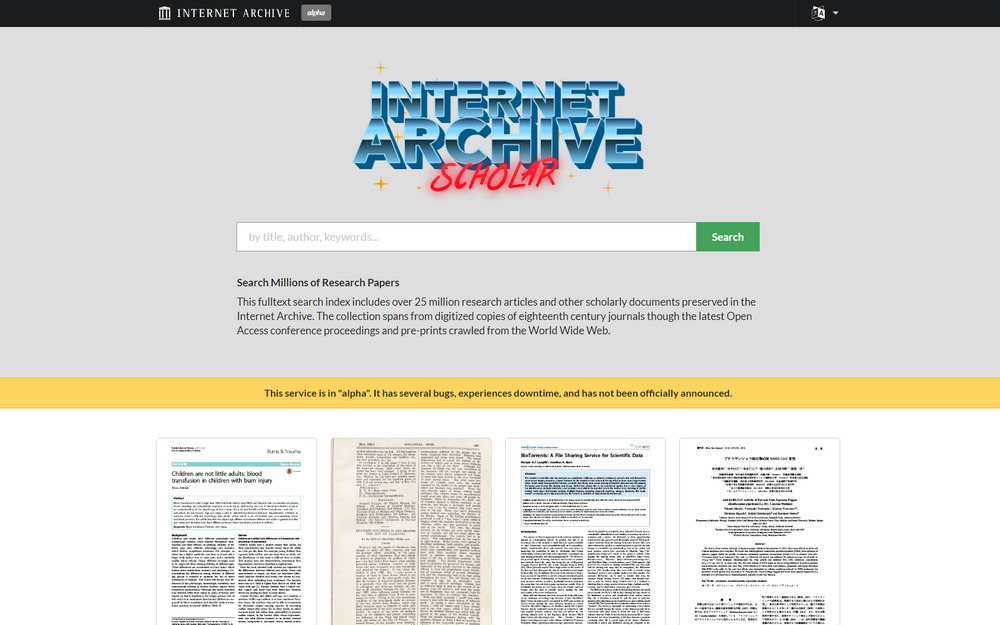
Internet Archive Scholar is live

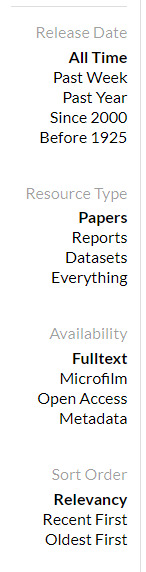
Internet Archive Scholar, formerly the Fat Cat project, now live and purring. Full-marks for having that rarest of sidebar search-filters, “OA”, though “Fulltext” is presumably broader and thus the one most likely to be used most. It’s also great to see there’s now a keyword-based way to search across all those microfilm journal runs that Archive.org has been uploading recently.

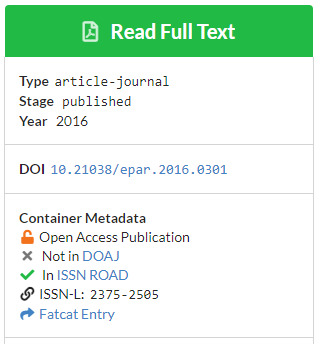
I wouldn’t have used the open ISSN ROAD as a source, nor visually implied that it’s a possible quality-marker. But at least it’s being balanced against the more rigorous DOAJ, and there’s a yes/no flag for both services on the article’s record-page…

It’s good that the “Read full-text” button goes to a PDF copy at the WayBack Machine, and yet there is also a live link on the record-page that serves to keep a record of the source URL.

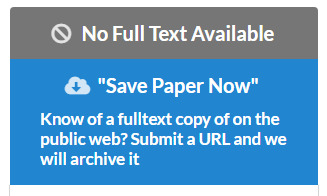
Not all record pages have full-text, though these are very rare. In which case the user is prompted to find and save…

Unfortunately IA Scholar doesn’t appear to respect “quote marks” in search, which is not ideal for a scholarly search engine. For instance a search for “Creationism” defaults to results for “creation”. Nor can it do Google-y stuff like intitle: or anything similar via the sidebar, though I guess such refinements may be yet to come. Update: the command is: title:

A quick test search for Mongolian folk song suggests it’s not wildly astray in terms of relevance. It’s not being led astray by ‘Song’ as a common Chinese author name, for instance, or mongolism as a genetic disease.

How far will Google Search index the fatcat URL? Will they block it from results in due course, for being too verbose and swamping results? Or just tweak the de-duplication algorithm to suppress it a bit? Well, they’re indexing it for now, and as such it’s been experimentally added to JURN. It may well come out again, but I want to test it for a while. If Google Search fully indexes, that should theoretically then give JURN users a way into all the microfilm journal-runs that Archive.org that has recently been uploading.

Report: Equitable access to research in a changing world

Released in June 2020, a new consultancy report titled “Equitable access to research in a changing world: Research4Life Landscape and Situation Analysis”. This surveys the pressures on the Research4Life aid programmes. Established 20 years ago, Research4Life gives developing countries “free or low-cost” online access to journals and books from some 175 publishers. Along with other aid initiatives, this means that African universities often have better free access to journal databases than do some academics in advanced nations. The new report makes no recommendations, but a key point to note is that…

… some of the most relevant and influential research undertaken in low-and-middle income countries happens outside academia: in specialised research institutes, think tanks, or government-backed research agencies. In some countries, research agencies and institutes conduct research in national priority areas and have direct access to and influence on decision-makers” [yet] “these non-governmental organisations have in the past been excluded from open access debates, and may be unable to take advantage of initiatives such as Research4Life.

It could be useful to quantify that “may”, through further research. Do developing nations find roundabout ways to include their research agencies in Research4Life, such as giving off-campus agency researchers special log-ins to access the national university system? Or are such arrangements rather moot, in the age of open-access and Sci-hub? If not, would there be a real benefit if Research4Life were to be extended to bona fide government research agencies and suitable NGOs? How much would such an expansion actually cost, and what could the returns be in such nations?

JURN fixed and repaired

JURN is now as up-to-date as it can be, ready for the “back to university” crowd. I’ve completed a link-check of the full URL base, checking for continued presence of an indexed URL path in Google Search. The full path is checked, not just the top domain (e.g. foobar.foo/foo-foo/journal_of_foo/articles/ and not just foobar.foo). This checking process has been slow, taking about 18 months, on and off.

Of course, a few URLs may still have newly broken in the meanwhile. But the core URL base is kept fresh by a regular check of the key home-page URLs, as organised and listed at the JURN Directory of arts & humanities journals (English-language journals only). This Directory was link-checked and updated in mid September 2020. Also recently link-checked, back in July 2020, was JURN’s openEco Directory of over 800 journal titles variously related to the study of wildlife, ecology etc. Please update any local copies you may be keeping.

Free: My Little Regex Cookbook, for Notepad++

New, My Little Regex Cookbook as a printable eight-page PDF. It has numerous working examples of useful regex for Notepad++ users working with data extraction and text lists. All tested and working in Notepad++.

This is my expanded and now prettified 1.3 PDF version of what first appeared here as the post “Some useful regex commands for Notepad++” in May 2019.

Download: little_regex_cookbook_2020.pdf