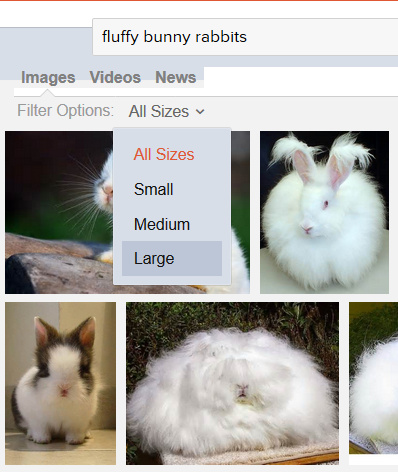
DuckDuckGo’s excellent Image Search has added a size filter…

05 Tuesday Jan 2016
Posted in Spotted in the news
DuckDuckGo’s excellent Image Search has added a size filter…
02 Saturday Jan 2016
Posted in Spotted in the news
It’s Public Domain Day for literature and books in Canada and the UK and Europe. Hyperallergic also picks some choice artists who are now out of copyright outside the USA.
15 Tuesday Dec 2015
Posted in Spotted in the news
“In the race to open Congress’s secretive think tank, a new trove of confidential research goes public”, says The Washington Post today.
Erm, hardly new I’d say. A hefty 7,000 of the Congressional Research Service Reports have been accessible via JURN for years now.
08 Tuesday Dec 2015
Posted in Spotted in the news
“Hidden Online Surveillance: What Librarians Should Know to Protect Their Own Privacy and That of Their Patrons” is open access in the latest issue of the journal Information Technology and Libraries (Library & Information Technology Association / Boston College). Mostly about cookies and commercial tracking, but a useful primer on a small part of the problem.
08 Tuesday Dec 2015
Posted in Spotted in the news
Oh dear, the French legislators are once again proposing a ban on a bit of the Internet. Will French governments ever understand the Internet? Or realise how foolish they look to the rest of the world, when their idiot proposals crash and burn? This time around they want a national ban on the use of the encrypted TOR browser.
The legislators obviously haven’t bothered to read the TOR website for even five minutes, or they would have found the list of the browser’s plugins. It seems obvious that all a French ban would do is to provoke countermeasures, such as the deployment of TOR plugins like SkypeMorph. It cloaks the encrypted TOR browsing stream and makes it look like Skype, to your service provider. It’s already been developed and tested, but has not been deployed. But the SkypeMorph source code is out there. So, even if the original author doesn’t want to release it publicly, then someone else could. Encryption is an arms race that the censors and ban-it-now -ers can never win in a free society, but they never seem to realise that.
Nor does it seem that the legislators have read the French constitution recently, since the French civil liberties organisations say that such a ban would violate the constitution.
Update, 15th Dec: press reports have since appeared saying that the French have backed down for now, while apparently blaming the security services for being over-zealous.
05 Saturday Dec 2015
Posted in Spotted in the news
A peek at the Open Journal System 3.0 beta, including major new accessibility improvements. Very good to hear that they’ve…
“increased the font size considerably.”
05 Saturday Dec 2015
Hypothes.is lets visitors annotate your Web pages, via a pop-out sidebar filled with a Twitter-like stream of visitor comments/links.
It’s the perennial idea of re-inventing the classic footer comments box as a uniform annotation layer, something that has been tried many times over the past 20 years. Google ran such a tool for three years before closing it down. Such services tend to end up as dank wastelands filled with Viagra ads, troll spoor and link-rot.
But this time might be different. There’s a couple of somewhat workable-looking early W3C standards (more are on the way), new options for moderation and closed group working, and an impressive range of publishers and universities are now planning to discuss how social annotation might proceed for scholarship…
Our goal is that within three years, annotation can be deployed across much of scholarship.”
The ‘can’, not ‘will’, is probably because the big publishers like Elsevier et al are noticeably absent from the list of Hypothes.is academic supporters. I can’t see them liking the idea that an open commenting system is being laid over/into their content. The sidebar’s content seems to be outside the control of the page owner, so I could theoretically pitch up at an Elsevier $66 article paywall and say “there’s a free PDF of this article over at Site XYZ…”
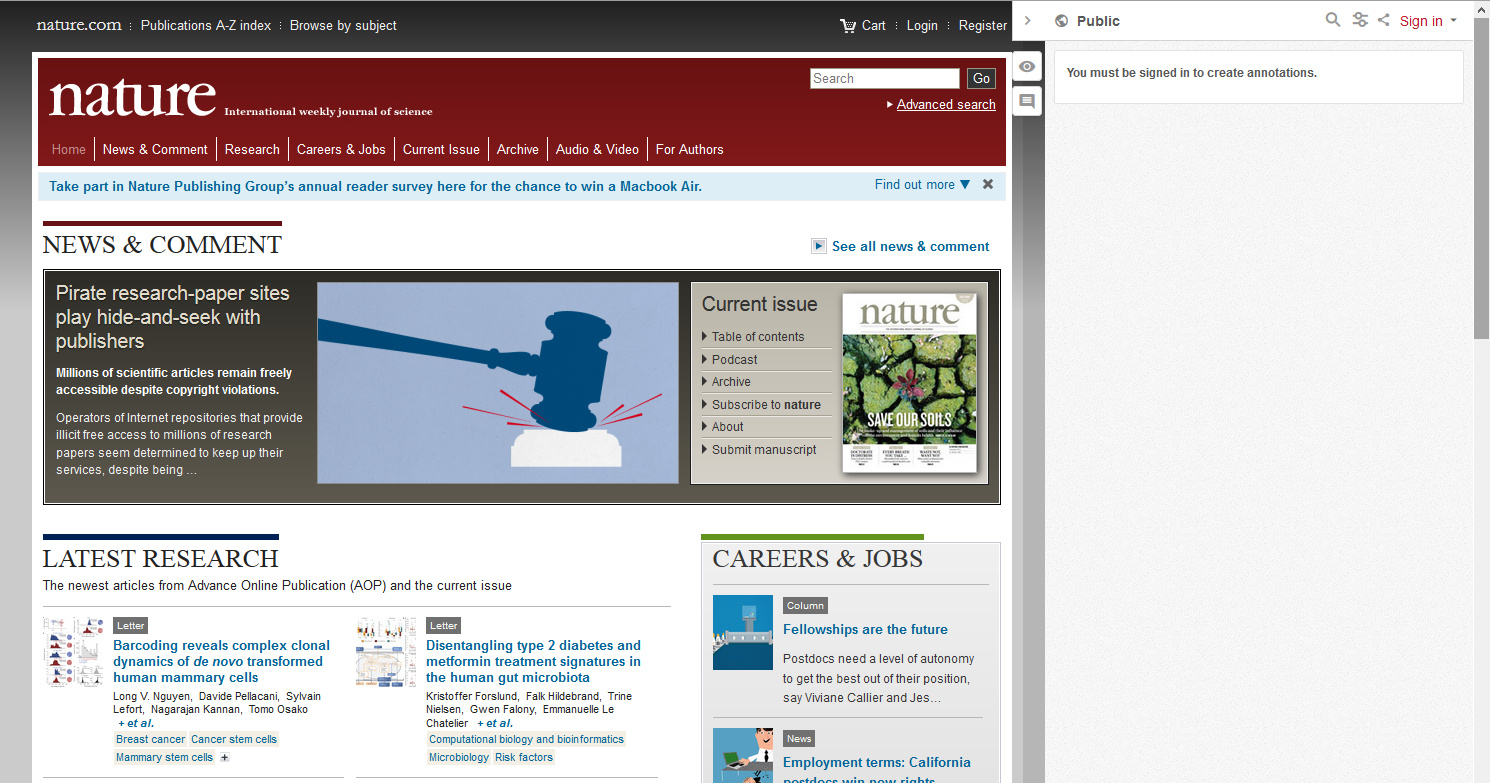
So how does it work, at present? Imagine that someone took a Web page’s comments section from the bottom of the page, and instead put it into a standalone and uniform sidebar. Someone adding a comment also has the option to highlight a bit of text on the page, automatically hyperlinking their comment to it. Other visitors see the comments and the highlighted text. Obviously various Twitter-ish and Wiki-ish features could be added, but that’s the basic functionality.
A pop-out sidebar means that Hypothes.is can work with PDFs, and the Hypothes.is roadmap suggests that annotation of data / images / videos / ePubs could be on the way soon. So it seems Hypothes.is needs fixed browser-displayed content, located on a URL that’s never going to break — a natural fit with things like PDFs in repositories and digital libraries. But even in that relatively limited arena, who will do all the hand annotation, moderation, linkrot checking and repair need to keep such a service usable across a billion or more pages and documents? I somehow doubt that overworked and underpaid repository staff will be skipping through the library stacks with joy, at being told they must also become the herders of social media cats and the tamers of trolls.
03 Thursday Dec 2015
Posted in Academic search, Spotted in the news
The search tool for Italian repositories, PLEIADI, has now returned. It must have been taken down for a big overhaul, when I spotted it had gone 404 earlier this week. It’s now a very usable and neatly re-designed portal, enabling search across the 100 or so Italian open access repositories. In the new PLEIADI a searcher can even filter to show only Open Access content and filter for English language results. Very nice, including over 5,000 open access books…


02 Wednesday Dec 2015
Posted in Spotted in the news
Even Adobe has finally given up on Flash and effectively killed it, it seems…
“Adobe said that it would now encourage developers to “build with new web standards”, primarily HTML5. In an announcement last night, Adobe described Flash as having “helped push the web forward”, but acknowledged the increasing prevalence of newer languages and open standards.”
Adobe’s Flash developer authoring tool will start to move even more toward HTML5 output. Time to swop out or remove any Flash-only front-pages, Flash sidebar menus, Flash flipbooks, anti-copying Flash wrappers or any other interactive Flash widgets you may have around your online publication.
30 Monday Nov 2015
Posted in Spotted in the news
An update on the numbers involved in the ongoing cleaning of the DOAJ, “A Clean House at the Directory of Open Access Journals”…
The process of cleaning up the DOAJ has been going on for some time and is getting close to an important milestone. All the 10,000+ journals listed in DOAJ were required to reapply for inclusion, and the deadline for that is December 30, 2015. After that time, any journals that haven’t reapplied will be removed from the DOAJ.”
…as of November 19 just over 1,700 journals had been accepted under the new criteria, and just over 800 had been removed”
The DOAJ currently has “10,779 Journals” according to their website (5,554 of which are tagged as publishing only in English, and of those 710 also have arts/humanities, linguistics, or ‘general works’ subject classifications). It’ll be interesting to see how many get thrown out on 31st December.