The JURN Directory has been link-checked and updated.
JURN’s Directory updates
19 Sunday Aug 2018

19 Sunday Aug 2018
The JURN Directory has been link-checked and updated.
19 Sunday Aug 2018
Posted in My general observations
Half of JURN’s entire URL base has now been checked, looking for the continuing presence of the URLs in Google Search results. A broken URL path is usually re-found and fixed, but is sometimes deleted where the site is “404” or where the archives have vanished (e.g. the Royal Navy’s Naval Review journal).
19 Sunday Aug 2018
Posted in Ooops!, Spotted in the news
A new post from an elected member of the European Parliament (MEP), Julia Reda in Germany. “Out-of-control censorship machines removed my article warning of out-of-control censorship machines”…
“A few days ago, about a dozen articles and campaign sites criticising EU plans for copyright censorship machines silently vanished from the world’s most popular search engine. Proving their point in the most blatant possible way, the sites were removed by exactly what they were warning of: Copyright censorship machines.”
18 Saturday Aug 2018
Posted in Spotted in the news
“The Open Access Availability of Articles from Highly Ranked Religious Studies Journals: A Study of Ten Journals”, Theological Librarianship, April 2018.
A study of ten highly-ranked religious journals in mid 2015, aiming to find 377 paywalled articles in free self-archived and repository form (by 2016). The choice of top-titles means it was slanted toward health/medical (Journal of Health Care Chaplaincy, Journal of Religion and Health, Psychology of Religion and Spirituality, Intl. Journal for the Psychology of Religion, Journal for the Scientific Study of Religion were five of the ten), and so it probably shouldn’t be taken as a measure of trends in the core humanities. I suspect they would have had less success with leading paywalled journals in church history, art history, theology, music, ethnography etc.
Nevertheless, the results are interesting…
“OA versions were found for 132 (35 percent) of” [the 377 articles, and] “results indicate that using both Google and Google Scholar to search for OA religious studies journal scholarship yields better results than only using Google or Google Scholar.”
Of course one can’t guarantee that what’s online a year after publication will still be online a decade later, if self-archiving. It would be interesting to see a long-term study of the “rot rate” or “404 rate” in OA unofficial self-archiving of paywalled articles over the period of a decade. I’d suspect it would be around 40%.
17 Friday Aug 2018
Posted in New titles added to JURN
Philament (University of Sydney)
BARS Review, The (British Association for Romantic Studies)
Bulletin for Old Testament Studies in Africa
Archive Journal : Archives and Special Collections in Higher Education (indexing Essays only, not the roundtable transcripts).
17 Friday Aug 2018
Posted in Academic search, My general observations
African universities often have better access to journal databases than western counterparts, thanks to big aid deals for the continent, but I wondered if Pakistan has a similar full-range access. I had a quick initial look at the journal-access situation in Pakistan, and soon found the national HEC Digital Library and its list of included databases and publishers…
“HEC National Digital Library (DL) is a[n official national] programme to provide researchers within public and private universities in Pakistan and non-profit research and development organizations with access to international scholarly literature based on electronic (online) delivery, providing access to high quality, peer-reviewed journals, databases, articles and e-Books across a wide range of disciplines.”
The supplied databases look like a wide selection and are available to bona fide institutions in Pakistan, though it looks like there’s a certain subset of databases reserved for larger institutions only.
Access there looks like it is broadly comparable to a medium-sized university in the west, if “The impact of non-accessible library and information science journals on research productivity in Pakistan” in 2016 in anything to go by. It found, from Pakistan…
“18% non-accessible and 37% partially accessible LIS journals on the HEC subscribed databases.”
Thought I note that, since then, Pakistan’s HEC Digital Library has added Gale, Oxford, Proquest, and probably others. Which has likely shortened the gap.
A 2009 grassroots report found that the main problem in access was said to be due to the frequent power-cuts, rather than databases…
“the respondents emphasized that electricity failure is the main hindrance to access to the digital library and to the Internet”
16 Thursday Aug 2018
Posted in Spotted in the news
The DOAJ is back, according to a message yesterday from Clara Armengou, the DOAJ Project and Communications Manager…
Dear community
We are happy to inform that our site is now back to normal and our services have resumed. We are still working on a long-term stability strategy and we will be able to update you on that and also provide a more detailed explanation of our issues soon.
Thank you again for your patience over the last few weeks.
16 Thursday Aug 2018
A new preprint on arxiv.org, “Google Scholar, Web Of Science, and Scopus: A Systematic Comparison of Citations in 252 Subject Categories”.
Google Scholar’s… “citation data is essentially a superset of WoS and Scopus, with substantial extra coverage.” This is partly because “Google Scholar is able to pick up citations… “from non-journal sources … including theses, books, conference papers, and unpublished materials … Many were non-English (19%-38%), and they tended to be much less cited than citing sources that were also in Scopus or WoS.”
However, there are also warnings in the conclusions section, especially that in Google Scholar… “some of the citations [come] from Master’s theses”. Also note that Google Scholar’s citation counts were found to be “lower in the Humanities”.
15 Wednesday Aug 2018
Posted in Spotted in the news
ChatNoir, a friendly way to keyword-search the Common Crawl full-text search index, albeit only the last crawl of 2015.

The big list of university domains in Common Crawl was only added September 2017, so ChatNoir doesn’t currently run across those.
15 Wednesday Aug 2018
Posted in JURN tips and tricks
Wrestling around trying to view and export Creative Commons .SWF files, without an Adobe Flash installation? The wholly freeware Windows Free Flash Decompiler can open even early-version Flash .SWF files and save to .PNG images with scaling. version12.0.1 is the installer Windows users need. (Link updated for new version of Free Flash Decompiler, January 2021. Works fine, post-Flash)
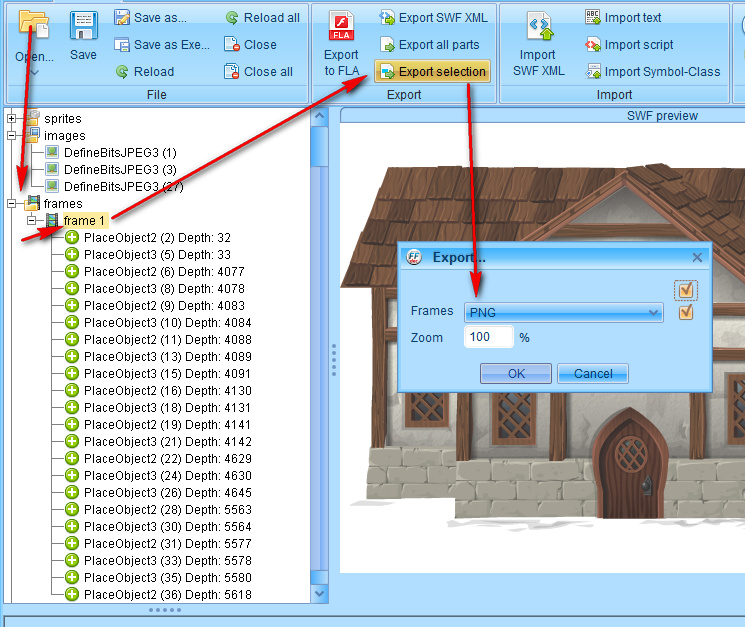
Useful where games have released their art assets under Creative Commons, such as the Odd Job Jack series. Especially if the .SWFs were output in Flash 5, which is very old now, but Free Flash Decompiler had no problem with the older assets.
The free Flash Decompiler was the only genuine freeware found, after hours of searching, which could open such Flash 5 .SWFs (be sure you’re trying to use it to open .SWFs and not .FLAs!). It only lacks a batch processing feature. It doesn’t seem to work with .SWF output from Poser 11, in terms of being able to display or save the render like the Internet Explorer browser can.
Paid options with batch are:
* reaConverter, which can read old SWFs and has batch, but has no option at all to scale up the PNG output, which makes it utterly useless. Update: the latest reaConverter 7.x has % scaling for saving .SWF files to .PNG format.
* SoThink SWF Decompiler, expensive at $80. It has a nice viewer and can read old .SWFs. But it has no .PNG output, only the .SVG vector format. However, this .SVG output can then be further batched with ConversionSVG which is a free 2008 front-end Windows GUI for the free Inkscape. Both ConversionSVG and Inkscape still work fine together. The only slight drawback is that ConversionSVG has no % upscale, so you may need to run it twice, once with 2400px on height and again on 2400px on width. Then manually go through and delete each mis-fire for the very long or very wide graphics. Also, note that not all the Flash gradients will make it to a .SVG file, either mangling or failing. Also, ConversionSVG seems to be a Java application, which is a potential security risk. If you do try it, it requires some juggling at first to switch it from French to English. But it works fine.
* VeryPDF Flash to Image Convertor, which is $20 and has batch, but its PNG output is very fuzzy and unusable at 3000px. It’s fine for making lots of little 400px preview PNGs, but not for anything larger.
Thus, a batch solution for those with 20,000 items to convert is: SoThink SWF Decompiler > batch export to .SVG > install Inkscape > install Java > install ConversionSVG for Inkscape > batch your .SVGs to .PNGs.
Of course, you could get all arcane and command-liney about it, hooking into ImageMagick or similar, but this post is for those who need Windows software with a GUI.
Update: No need for the .SVG intermediary, as I found the $15 Kurst’s SWF Renderer 2.0, which does batch SWF to PNG and has scaling and respects transparency. There’s a demo version, Windows or Mac. Works fine and fast, on Adobe AIR rather than Java. Below are the settings, for outputting a single frame from each .SWF file. Note that you can’t, as with the Free Flash Decompiler freeware above, choose which bit of the .SWF (shapes, frames etc) to output. SWF Renderer 2.0 is a frame renderer, not a shape decompiler.
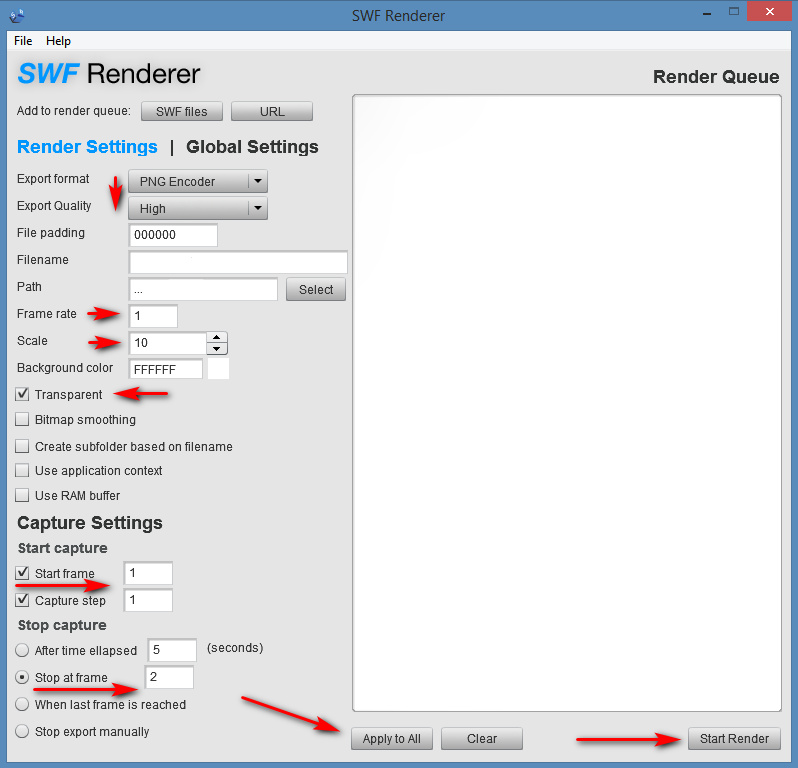
It’s best to chunk the load you give it, to around 100 at a time. You can’t just load in 28,000 SWFs and expect it to cope.
Update: reaConverter 7.x can now scale up and gives nice PNG output, albeit at a cost of $50. Needs to be scaled to 10000% to get anything big (4k+) out of it…

Regrettably it is not reliable at this scale, is very prone to crashes when handling folders with more than a dozen files. Also it often mis-handles transparency and clips renderings. The other viable software, on the other hand, could handle what Rea could not. With the only drawback being lack of batch in Free Flash Decompiler, and the 10x scaling limitation on Kurst’s SWF Renderer 2.0.
Update: After Adobe killed Flash in January 2021, the following results from testing:
* JPEXS Free Flash Decompiler – FINE, with previews, after an update to the latest version. Still no batch.
* Kurst’s SWF Renderer – FINE, no update needed. Still can’t export higher than 10x.
* SoThink SWF Decompiler – OK, no previews at all, but SVG image loads in Inkscape.
* reaConverter – FAIL on the latest 7.6 versions, on preview and render.
Thus, JPEXS and Kirst presumably have internal standalone Flash implementations. Testing reaConverter on a Windows 7 Xeon workstation reveals the cause of its apparently flakiness. When it hits an animated .SFW it feels the need, unlike the other software, to load and then render every frame. Rather than one frame. Naturally, this causes the SWF player module in the Java implementation to use way too much RAM and die. The Xeon Workstation has 24Gb of fast RAM, so it’s not a problem there.