SAGE’s free access period

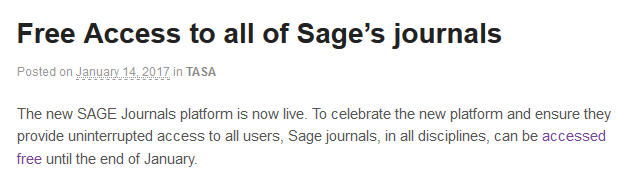
I hope JURN users have been enjoying their free access to all of SAGE’s journal PDFs in January, via JURN’s search results. Thanks to SAGE for making them free, and also for allowing Google Search to index them at the PDF level. We’re now a week into February and their free access continues. I’m checking the free access URL daily, but there may soon come a point where JURN’s SAGE links hit paywalls again — perhaps for as long as 24 hours — before the indexing URL is removed.

sage

UK National Bibliographic Knowledgebase

Newly announced for the UK

“Today Jisc announced that OCLC, the global library cooperative, has been awarded the contract to develop a new national bibliographic knowledgebase (NBK).”

Judging by the initial press-release, the focus seems likely to rest first on cohering UK academia’s metadata management for digital book collections. This will in time…

“enable shared bibliographic metadata to flow into … global search engines”

Hopefully that means Google Search, as well as Google Scholar (which are two separate systems and databases).

From Faceblurgh to Facebook

A quick round-up of some helping hands for a better Facebook experience:

* the vital Facebook Purity plugin has just gone to version 18, restoring blocking of “Sponsored” ad posts in timelines.

* a new Greasemonkey script, Facebook Demetricator tweaks all the fairly pointless “View 33 comments”, “Posted 25 minutes ago” micro-messages and suchlike. Instead you just see a much more relaxed format such as “View comments”, “Posted recently” etc.

* new to me, Unseen for Facebook. Prevents your Web browser from pinging a “Seen” message to Facebook, when you open a message sent via a chat box. Possibly especially useful if your employer starts to use Facebook messaging for business purposes, when you only use Facebook for personal matters.

Added to JURN

Gesnerus : Swiss journal of the history of medicine and sciences (1943-2002, most recent issues partly in English)

SPELL : Swiss papers in English language and literature (1984-2005)

Restored Museum Helveticum to the index (1944-2014, Swiss Journal of Classical Studies. The more recent issues are partly in English, while the most recent two issues are padlocked. Was at retro.seals.ch with the same volume run, but those URLs now redirect to www.e-periodica.ch)

findlectures.com

Lecture Search at findlectures.com is a new search tool, or at least it’s new to me. It appears to have launched in the summer of 2016, which is probably why I missed its launch. In the UK it would have been drowned out by the news of our glorious Brexit.

Lecture Search aims to find ‘intelligent talk’ files such as conference and academic lectures, and it does what it claims. A few early observations:

* Seems to be running from a hand-curated URL list. There’s evidence in the results that the last indexing run may have been in early 2016?

* Includes YouTube and Vimeo as sources but seems to have a filter on them, presumably via indexing only selected channels.

* Searchers should use NOT keyword rather than -keyword to knock out search words from results.

* Nice range of limiting facets, in the sidebar.

* One annoying pop-up nag-box, but it was easily killed with AdBlock Plus’s “select an element to hide…”.

* Relevance ranking is definitely not Google-licious, as it the case for all such Summon-like services. For instance: search for “cave art”, get “The Complete Poetry of Cesar Vallejo” as the first result. That page’s text happens to mention Vallejo once did some research on “cave art”, but then presumably the prestige of the result’s loc.gov URL lifts the result up to No.1.

* Not indexing the BBC’s hundreds of In Our Time .mp3 podcasts, which seems a pity.

Summary execution for students

Precis writing skills among recent American graduates: apparently disappearing faster than UC Berkeley’s federal funding…

“We had close to 500 applicants. Inasmuch as the task was to help us communicate information related to the work we do, we gave each of the candidates one of the reports we published last year and asked them to produce a one-page summary. All were college graduates. Only one could produce a satisfactory summary. … Our own research tells us that a large fraction of community college professors do not assign writing to their students because their students cannot write and the professors do not consider themselves to be writing teachers. It is no wonder that employers like us find it so hard to find candidates with serviceable writing skills.”

Admittedly precis and outline writing is a skill that’s only barely acquired after a good deal of practice, and then not by all in a class. It may help if a student has developed the knack of point-summarising by regularly taking hand-written outline lecture notes. Even then ‘getting it’ might require half a semester, rather than just a couple of hours of lessons. It’s a skill that’s likely to be especially difficult for a student who isn’t an avid advanced reader, ideally a reader of factual argumentative content that requires one to constantly unpick arguments on-the-fly.