Added to JURN

Research in Learning Technology

Le Foucaldien (Michel Foucault)

Grove : Working Papers on English Studies, The

Selim : International Journal of the Spanish Society for Medieval English Language and Literature

The latter two are currently poorly indexed. Selim in terms of access to full-text, which is only via their site and not yet via aggregators.

+

Publications of the Asian Development Bank (new URL)

On ResearchGate

What publishers can take away from the latest early career researcher research ($), a five-page “Industry Update” for the journal Learned Publishing, 28th April 2018…

“ResearchGate is unquestionably the scholarly elephant in the room, which despite being just 10 years old boasts 15 million research members and is still growing at a rate of knots. … publisher offerings can look monastic and parochial by comparison. […] It looks rather like the new scholarly world order.” […] “Much depends on whether ECRs [early-career-researchers] take their millennial beliefs in sharing, openness, and transparency into leadership positions. [and if] publishers [start] feeding ResearchGate rather than competing with it – [making it] a publishing Amazon”.

The Update is by the team doing an industry-supported three-year cohort study of search and similar practices. Their first two reports are Early Career Researchers: the harbingers of change? Year One 2016 and now also the Year Two 2017 report, both free and public at the same website. Apparently the cohort of around 100+ is all science and social studies.

Also fairly new, and related, “ResearchGate and Academia.edu as networked socio-technical systems for scholarly communication: a literature review” (OA), in the Research in Learning Technology journal, 20th February 2018…

“a thorough understanding is still lacking of how these sites operate as networked socio-technical systems reshaping scholarly practices and academic identity. This article analyses 39 empirical studies published in peer-reviewed journals with a specific focus on ResearchGate and Academia.edu.”

Google Search currently suggests circa 72-million full-text PDFs at ResearchGate, although given the above Industry Update statement on ‘the 15m members’ we can probably assume some 10m of those PDFs are just CVs (which are nearly all excluded from JURN, by the way). Remove other fluff and I guess there might be circa 50m proper papers there. It would then be interesting to work out what “the uniques” are, by removing the papers freely available elsewhere in repositories and OA journals and suchlike. I’d very roughly guess that including ResearchGate PDFs in JURN may bring in some 5m to 8m papers not found elsewhere.

Added to JURN

Mashriq & Mahjar : journal of Middle East and North Africa Migration Studies

African Journal for Transformational Scholarship (Tanzania)

Soma : An International Journal of Theological Discourses and Counter-Discourses (Tanzania)

Southern African Humanities

Correspondences : Online Journal for the Academic Study of Western Esotericism


Botswana documents (planning, ecology, and natural resources in Chobe, Botswana, and the wider Zambezi region)

NJAS-Wageningen Journal of Life Sciences (1993-2008)

How to compare two texts side by side

How to compare two texts side by side, with line sync and more:

1. Get the free 32-bit Notepad ++. It must be the 32-bit version. Install, open, then close the software.

2. Get the free ComparePlugin for Notepad ++, which no longer ships with the software by default. Download the Unicode version, currently ‘Compare_1_5_6_UNI_dll.zip’. This is a 32-bit plugin and it cannot run with the 64-bit Notepad ++.

3. Unzip the plugin and extract ComparePlugin.dll, somewhere outside of C:\Program Files. Then copy/paste ComparePlugin.dll to…

C:\Program Files (x86)\Notepad++\plugins

4. Restart Notepad ++. Open two files you wish to compare.

5. From the top menu in Notepad ++, run Compare from the Plugins menu…
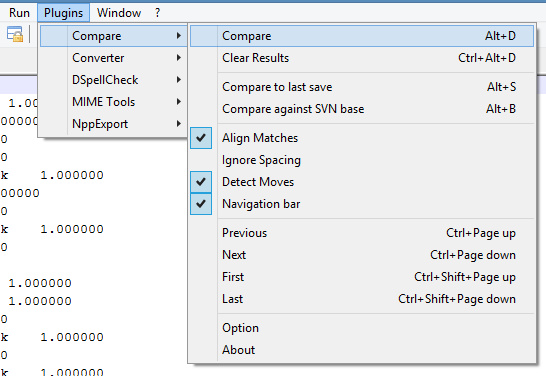
You get sophisticated line-matching, line-synchronisation, and yet also clear identification of non-matching lines in either document.


Added to JURN

Littera Aperta

Mediterranea : International Journal on the Transfer of Knowledge

Museum Review, The

Epoiesen (creative engagement with history and archaeology)

UrbanScope (Urban-Culture Research Center, Osaka City University, Japan)

PMJS : Premodern Japanese Studies

Sunkyunkwan University Journal of East Asian Studies

Japan Studies Review

Japanese Religions


Transletters : International Journal of Translation and Interpreting (forthcoming, added)

Studies in Puritanism (forthcoming, added)

Offa’s Dyke Journal (forthcoming, noted – but has no website yet)

India culls 4,305 dubious journals

Nature India, May 2018: “India culls 4,305 dubious journals from approved list”

“India culls 4,305 dubious journals from approved list. … The University Grants Commission (UGC), which funds and oversees higher-education in India, has removed 4,305 spurious journals from a list of some 30,000 publications used for weighing academic performance.”

The Delhi Declaration on Open Access recently stated “20,000+ journals being published from India” alone.

Up-to-date JURN Directory returns

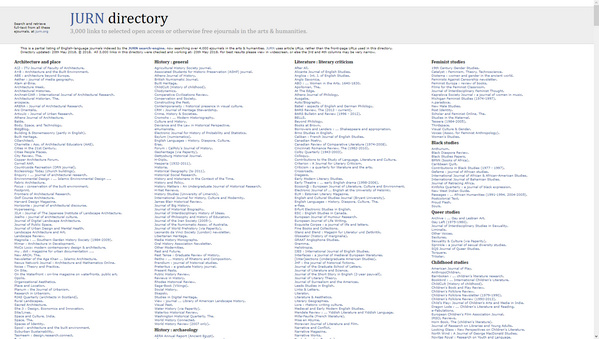
The Directory of 3,000 arts & humanities journals in JURN can now be had on this blog as a saved PDF, in its latest version (currently 20th May 2018). Those who disliked the scripted “bouncy-puppy” effect will be pleased to know the Directory’s sections are now fully expanded.

It’s been saved from the HTML as a PDF for A2 paper in landscape format, to accommodate the HTML wide-screen layout, although I doubt anyone will want to print it out at that size. Future updates will be versioned, with number and date added to the file-name.

Note that Microsoft Reader can’t seem to handle external Web links in PDFs. Adobe Acrobat, SumatraPDF etc work fine and offer clickable Web links. Some side-scrolling may be needed, if you have the likes of SumatraPDF hard-coded for magazine reading with ‘cover page + double-page spreads’.

NOA : Scientific Image Search

NOA : Scientific Image Search. A project currently indexing 2.7 million free-to-use scientific images, extracted from CC-BY sources along with metadata and links. As you’d expect, ncbi.nlm.nih.gov dominates the URL links. I searched for European Lynx and had good results (big kitties), though nothing high-res.

The extracted images and their data are also being copied over to Wikimedia, where Google Images will pick them up after a while — and offer high-res filters.

Incidentally, ncbi.nlm.nih.gov has its own public and official Open-i Biomedical Image Search Engine. A search for European Lynx shows it is indeed strictly biomedical.