Paperpile, a Mendeley competitor

Paperpile has been reviewed by PC World magazine (4th March 2014). Paperpile is a browser-based competitor to Mendeley. It integrates tightly with Google services such as Google Scholar and Google Drive, and can also slurp academic PDFs “directly from Google search results”. I’d be interested to hear if it works with JURN. Once the found PDFs are in your Google Drive cloud storage, it’s reported that…

“Paperpile analyzes your papers and acquires all the necessary metadata by itself.”

Sadly it’s only for the Chrome browser, not Firefox. At present it seems to be just a personal workflow aid, since there’s no collective exposure of the found content to a single public search box (as is offered by Mendeley’s “Search papers” search box).

Most papers will be downloaded at speed, because they “seem they might be worth looking at later”. Yet if Paperpile were able to measure re-open rates, view duration and frequency, and the actual level of citation in a person’s finished project or work, then that would be an interesting basis for a bumping algorithm that could help power the results ranking in a public searchable catalog. Especially if Paperpile could broadly match or align your research interests with those of similar Paperpile users, in combination with a more standard citation analysis, to give you a tailored search experience. Although in practice I guess there would be huge and possibly unwanted feedback amplification loops generated by that approach, as search results could veer heavily toward the latest fashionable topics. Doubtless Google has this nailed down already, and there’s probably a Trendy Search Topic Surge Controller employed somewhere in the Googleplex.

New survey of academic library directors

“What were librarians thinking of?” A question I often ask myself, as I glance at various pointless and fruitless busy-work projects. But now there’s a new survey of the views of “academic library directors in the U.S.”, which gives some insight. Scholarly Kitchen has a handy digest of the report

In 2010, 41% of library directors said that, if given a 10% budget increase, they would like to spend at least some of it on discovery tools. In 2013 only 16% said the same thing.

Taxing times

The South African government is reportedly about to enforce a blanket sales tax on all national/international e-commerce from 1st April 2014. South African ejournal subscribers report that, in combination with a weak currency, this will amount to an immediate cut of “about 40% of their purchasing power” when buying international ejournal subscriptions. It seems that anyone selling ejournals/ebooks, online music and other virtual goods (or even online services) into South Africa after 1st April is required to register for sales tax with the South African government, or face two years in prison.

Sales tax changes are also afoot in the UK and EU, and will affect academic e-content buyers. Most ebooks (and iTunes music, Xbox games, and VOD video) have previously been sold into the UK from the tiny nation of Luxembourg where VAT was set at a low rate. The EU has scrapped that work-around, and is shifting control of taxing e-commerce back to the purchaser’s nation. For UK scholars this seems to mean that by 2015 we’ll see a 15%+ rise in the purchase price of individual ebooks from the likes of Amazon.

As for academic ejournals their sales tax in the UK is already set at a whopping 20%. And as far as I know no paywall publishers rushed over to Luxembourg, just in order to save our libraries a few pounds. UK government states that this 20% tax is not changing any time soon (unless we leave the EU)…

There is no scope with the existing EU VAT [sales tax] legislation to introduce a zero or reduced rate for ebooks or ejournals. (Hansard, the Business, Innovation and Skills Committee, on 4th April 2013).

It seems that there’s little left to tax these days, and a South African style blanket sales tax on all ecommerce sales and services is going to be tempting many grasping governments around 2016.


A Google Pinterest, without the cute kitties and cup-cakes

The Google Cultural Institute website is new to me. It seems Google has a Pinterest, sort of. It appears to work in much the same way as Pinterest, but the pictures are drawn from images in various hi-res/open museum digitisation collections.

googlecult

No ‘kitties in art’ collection yet, although searching for “cat” will get you a big kittie fix if you’re desperate.

Derivative stuff

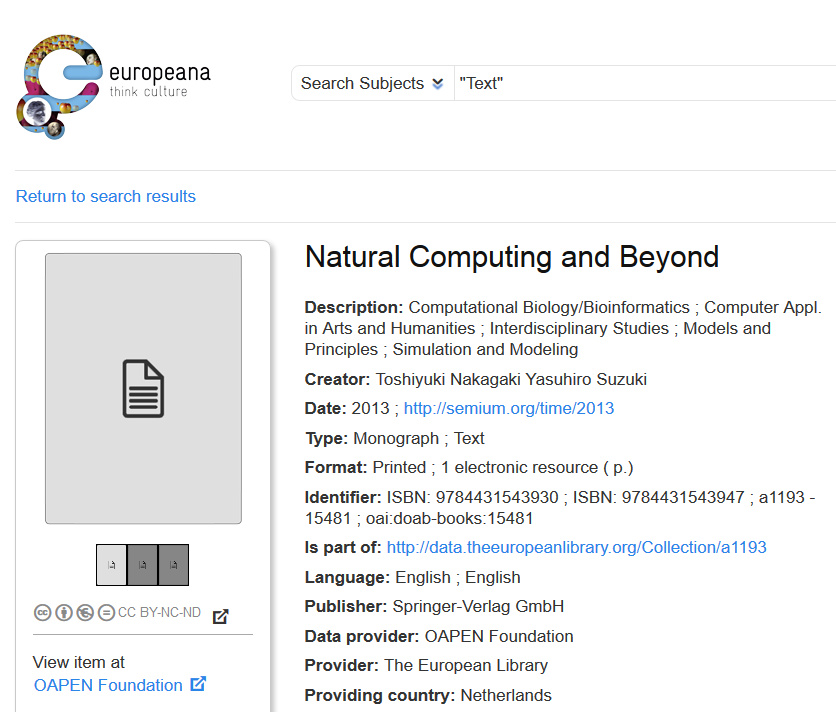
Ross Mounce discusses the problems of blogging snippets from CC BY-NC-ND articles which forbid derivative works. Here’s a live example from Europeana. They couldn’t display a title-page preview, even if they wanted to, due to the no-derivatives licence…

europe

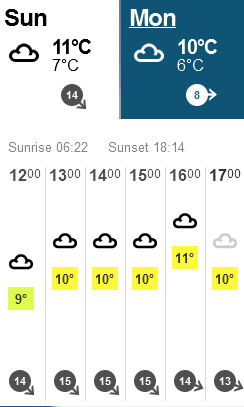
Perhaps we need a little ‘show only a user-defined area’ PDF embedding widget like the excellent Snippage. Snippage lets you display a user-defined frameless fragment of any Web page on your Windows desktop, and have it refresh at regular intervals. Here it is in action on my desktop…

snippage

This is the BBC 5-day UK weather, snipped down to a live two-day tile. A version of Snippage for blog embedding of PDFs would of course embed the whole PDF (a bit clunky, but doesn’t violate the licence…), yet would show only a user-defined area of a specific page. Firefox’s open HTML5 render engine for PDFs might be the underlying tech to make it work.

Or we could just use a screenshot and plead ‘fair use’.

Mendeley adds OA filter on its search

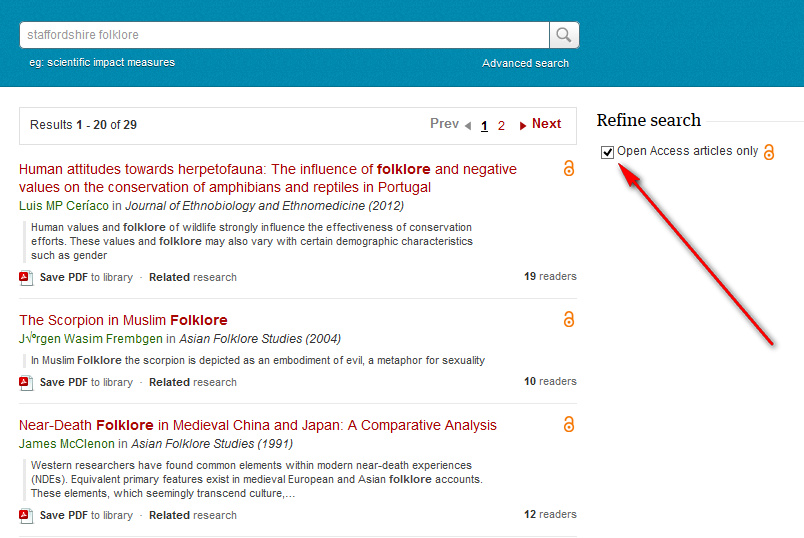
Mendeley now has an open access search filter check-box for its catalogue search. Although unfortunately it currently considers JSTOR articles to be open access. For most of us they’re not, beyond the first page.

medeley-oa

Europeana has the same problem, containing linked records pages for JSTOR content which isn’t open and public (e.g: “History of the churches of India” – Europeana links to it, it’s public domain, but JSTOR has the only copy and wants $10 to access it).