Jisc: Action on discoverability

David Prosser at Jisc blogs on the need for action on discoverability

… 40% of researchers kicked off their project with a trawl through the Internet for material, while only 2% preferred to make a visit to a physical library space. [yet] nearly half of all items within digitised collections are not discoverable via major search engines by their name or title [and, even worse] digitised collections become harder and harder to find over time, for a variety of complex reasons.
The Number of Scholarly Documents on the Public Web

PLOS ONE: “The Number of Scholarly Documents on the Public Web”

“Our estimates show that at least 114 million English-language scholarly documents are accessible on the web, of which Google Scholar has nearly 100 million. Of these, we estimate that at least 27 million (24%) are freely available since they do not require a subscription or payment of any kind.”

I’d say that 27m is probably a large underestimate, given that the two engines used for the study (Google Scholar and Microsoft Academic Search) are proven to be poor at indexing open repositories and open access journals. Given a few hours of work I could probably winkle out from JURN a list of 100 “big” URLs, which together would put JURN at 25m (primarily in English) — before even starting to tally all the other URLs.

Group test: “Alan Moore” Watchmen

Another group test:

JURN group test: “Alan Moore” Watchmen
 
May 2014. Searching for free full-text scholarly articles, theses or book chapters in English, with primary discussion of the famous and seminal graphic novel Watchmen by Alan Moore. Not counting film criticism of the movie version, or book reviews. Clicked through on possible results, and briefly evaluated.
DOAJ 0 Used ‘Article’ search. 0 from four results.
Journal Click 0 0 from zero results. Seems to include a lot of predatory titles and publishers.
JournalTOCS 0 0 from zero results.
Ingenta Connect 0 0 from six paywalled results.
Journal Seek 0 0 from zero results.
Mendeley 0 Searched ‘Articles’ only, then filtered for Open Access articles only — which produced no relevant results. Then removed the OA filter, which gave three relevant results — that were found to be paywalled.
OAlib 0 From 16 results. Had a couple of relevant articles but these were not in English.
Google Search 0 Forced verbatim. Examined first 50 results. As you’d expect, a mess of commercial book listings pages and the occasional pop-cult interview with Moore. The addition of filetype:pdf helped — giving a scattering of student dissertations; the 1st (but not 2nd) edition of the Annotated Watchmen document; and a short undergraduate attempt at a bibliography of scholarly works on Watchmen.
Microsoft Academic 1 One of four results.
CORE 2 Filtered search by English language. CORE offered many incidental or spurious results.
OATD 3 Three from 14 results.
Digital Commons Network 3 Three from 17 results.
NDLtd 3 Three from 12 results.
Google Scholar 8 Examined first 50 results. Google Books links not counted. Five of the good results were from the open journal ImageTexT: interdisciplinary comics studies. Two likely good candidates proved to be “404 Not Found”.
BASE 9 Searched ‘Verbatim’ on ‘Entire Document’. Examined first 50 results.
OPENDoar 12   Examined first 50 results. Two appeared to be basic undergraduate seminar papers.
JURN 25   Checked first 50 results, not counting interviews, book reviews and duplicates. Results remained strong and on-topic right through to result 100.

For JURN, adding an additional search modifier helps to nudge away incidental and duplicate results…

   “Alan Moore” intitle:Watchmen
   [force intitle:]

   “Alan Moore” Watchmen Rorschach
   [add focus by adding the name of a key character]

   “Alan Moore” Watchmen -site:www.academia.edu
   [remove Academia.edu duplicates]

Moore open comics

Open source, open access comics? The great bard of Northampton is on the job, with a little help from NESTA’s Digital R&D Fund…

” Alan Moore said in a statement: … we are assembling teams of the most cutting-edge creators in the industry and then allowing them input into the technical processes in order to create a new capacity for telling comic book stories. It will then be made freely available to all of the exciting emergent talent that is no doubt out there, just waiting to be given access to the technical toolkit that will enable them to create the comics of the future.”

Raphael_Salimena_Alan_Moore.
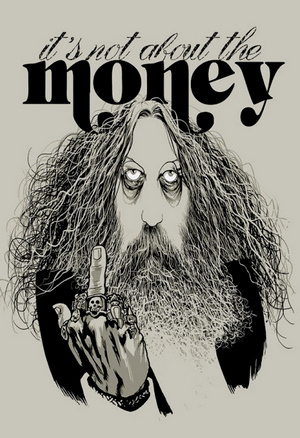
Picture: Alan Moore, drawn by Raphael Salimena.

Do Open Access journals have impact?

A Thomson ISI / Web of Science study is reported in Nature, dated 26th May 2014, as “Do Open Access journals have impact?”. They concluded that…

“Open Access journals [a selection of 190 titles, “core scientific publications”] can have similar impact to other journals, and prospective authors should not fear publishing in these journals merely because of their access model.”