SpaceX, Elon Musk’s private space fleet, has started to place its mission and craft pictures online, under Creative Commons Attribution.



23 Monday Mar 2015
Posted in Spotted in the news
SpaceX, Elon Musk’s private space fleet, has started to place its mission and craft pictures online, under Creative Commons Attribution.
16 Monday Mar 2015
Posted in JURN's Google watch
09 Monday Mar 2015
Posted in Spotted in the news
Google’s StreetView views inside art museums are having some of the public domain paintings painted out, due to copyright claims.

01 Sunday Mar 2015
Posted in JURN's Google watch
What if Google Search could demote websites containing a large number of incorrect facts?
24 Tuesday Feb 2015
A new White Paper from the U.S. National Information Standards Organization (NISO), “The Future of Library Resource Discovery”…
“No open access discovery index has been created.” (p.15)
/cough/
[The white paper’s] “review of the [required] components of an index-based discovery service [purely for open access content] highlights the enormous level of resources required to create and maintain them. The creation of an open access discovery index would require the allocation of capital, personnel, and technical resources at least at the level of what any of the commercial providers has devoted to their projects.” (p.21)
Indeed.
18 Wednesday Feb 2015
Posted in JURN tips and tricks, Spotted in the news
Notey is a new topic-focused blog finding directory. Yeah, I know… but it just reportedly raised $1.6 million in funding.
It has a slick iPad-focussed design, so on a widescreen desktop PC I hit some clunky navigation points a few times. Top of the ‘recent blog posts’ pile on entering was “40+ Insanely Clever Products Your Dog Deserves To Own”, which suggests the marketeers are already in Notey, via marketeering blog-a-zine articles.
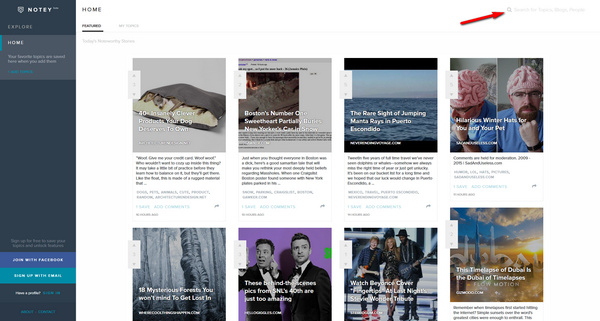
The search box is hidden away, as if they’re ashamed of it. The search experience is not great. I searched for “Lovecraft” (H.P. Lovecraft, famous horror and SF author, on whose life I’m an expert) and the results were incredibly poor. A Google search for…
site:http://www.notey.com/blogs/ lovecraft
… reveals more of the semantic messiness, and the ways that the database is being skewed by the vast cloud of fanboy crapware that now surrounds the man and his fiction.
Sadly Notey doesn’t look like the new Technorati to me, and nor is it of much used to academics seeking a specialist single-topic blog. For discovery of single-topic blogs Google is still your friend, and the following Google Search modifier still works despite Google having abandoned a dedicated blog search box…
inblogtitle:keyword
Update: October 2018. It appears that inblogtitle:keyword is no longer useful, as it now returns only 10 irrelevant results when used with Lovecraft.
16 Monday Feb 2015
Posted in Spotted in the news
Free version of Microsoft Office OneNote. It’s of interest to scholars working with older documents or Google Books pages, who need to quickly and accurately OCR snippets of online scans. It has industry leading OCR for small text in archival scanned documents (Insert | Screen Clipping | Recognize Text), a benefit of Microsoft’s massive investment in typography R&D in the 1990s and 2000s.
09 Monday Feb 2015
“Reference rot in web-based scholarly communication”…
“[In a sample of] 3.5 million scholarly articles published between 1997 and 2012 [there is an] alarming link rot ratio for all three corpora: 13% of arXiv, 22% of Elsevier, and 14% of PMC articles published in 2012 suffer from link rot. These numbers only increase for older articles, for example, for articles published in 2005 the corresponding numbers are 18%, 41%, and 36%.”
08 Sunday Feb 2015
Posted in JURN tips and tricks
03 Tuesday Feb 2015
Posted in My general observations
JURN is now six years old. The alpha version launched with just 951 arts and humanities open access journals, back in early 2009. JURN has been worked on more or less continuously since then, and is now highly optimised and able to offer search results from a much expanded range of titles and disciplines.
Note: I’ve removed all the older “Added to JURN” notification blog posts — too many old/dead links in those posts were making Google rank this blog lower than otherwise.