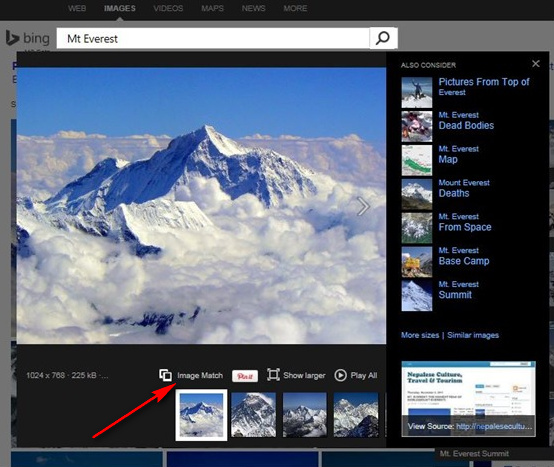
Bing has introduced a new one-click image match search feature…

14 Friday Mar 2014
Posted in Spotted in the news
Bing has introduced a new one-click image match search feature…
03 Monday Mar 2014
Posted in Open Access publishing, Spotted in the news
More new research on Open Access ejournal penetration into commercial journal indexing databases: “Open Access Journals in Communication Studies: Indexing in Five Commercial Databases” (2014). Only…
32 percent of the 147 gold OA journals identified [in the field of Communication Studies] were indexed in five major commercial bibliographical databases commonly subscribed to by academic libraries [including Scopus, EBSCO Complete, Web of Science]
03 Monday Mar 2014
Joseph Esposito has usefully had a peek inside a very expensive commercial market report titled Global Social Science & Humanities Publishing 2013-2014.
Social/Humanities publishing is found to be perhaps 25% of the size of Science/Technology/Medicine, at around $5bn. That actually strikes me as something of an achievement, when you consider that we have far smaller research funding inputs and a smaller technical/training infrastructure to call on. But perhaps the $5bn figure is given a strong boost by teacher training textbooks, social work manuals and the like?
Joseph highlights the report’s finding of a highly fragmented market. This market fragmentation is one of the reasons I’m skeptical about the success of a ‘one metadata to rule them all’ solution to OA indexing and discovery. It seems that DOAJ-listed OA journal titles can’t even find their way in full-text into the largest of commercial databases (such as EBSCO Complete) at higher levels than just over 20%. When last heard of the Web of Science / Scopus seemed to be barely scraping 1,000 OA titles indexed. One art history study found that Google Scholar could index only half the DOAJ’s OA art history titles. A dastardly conspiracy to keep OA titles out of these big indexes seems unlikely. So I suspect it’s largely due to many OA editors in the arts and humanities not giving a fig about providing the means to automatically index their content. Their widespread lack of something as basic as RSS feeds seems to confirm that. Add to that the fact that only 56% of DOAJ journals can supply the DOAJ with article metadata. Persuading non-librarian types to do something as simple tag all their back-issue content with some simple new machine-readable OA tag thus seems rather a long shot. Persuading mainstream publishers to do the same? Well… maybe, but what’s their incentive for that? Even if they do, will they allow mass harvesting of the OA articles? Nor are librarians likely to be of much use, after the fact of publication — since they seem to have mostly failed to apply even their own metadata standards to open content, and open repository metadata quality is reported to be dire.
01 Saturday Mar 2014
Posted in Academic search, Spotted in the news
Cameron Neylon has rustled up a useful map of the public libraries in the UK which are set to offer free access to 8,000 commercial paywalled academic ejournals…

Very nice if you’re in the leafy Home Counties around London, not so useful for those in the industrial Midlands or the North. Although the use terms (“I can only use accessed information for non-commercial research and private study”) make such business access moot for people such as the cybersecurity boffins of Malvern or the ceramics R&D teams of Stoke-on-Trent.
Oh well, there’s always JURN, now with added business and science goodness.
01 Saturday Mar 2014
Posted in Spotted in the news
A 2013 study “Open access journal content found in commercial full-text aggregation databases and journal citation reports”…
“A study was conducted regarding the indexing of [DOAJ listed] open access journals in three large, commercially available full-text aggregation databases [EBSCOhost Academic Search Complete; Gale Onefile; and Proquest 5000 International]”
EBSCOhost Complete was the best of the three, claiming indexing of just over 20% of DOAJ-listed OA journals in full-text. As the author says, the marketing claims/lists on this were taken at face value, and were not verified. Nor was the indexing checked for being up-to-date.
28 Friday Feb 2014
Posted in Spotted in the news
Mapping Scientific Excellence is an interesting new infographic website. The dynamic maps are based on the number of academic papers that were well-cited and/or published in prestigious journals. The papers are from the sciences, plus psychology and social studies.

Above: distribution for papers in Medicine, by author university affiliation.
27 Thursday Feb 2014
Posted in Ooops!, Spotted in the news
Interesting sidelight from the THES, on the new UK trial of public access to 8,000 commercial paywall journals…
the terms of use of the scheme expressly forbid the use of papers accessed through it for “commercial research”.
So perhaps not so useful for business research as had been hoped.
Access is to journals from Elsevier, Wiley, Springer, T&F, through selected public libraries in the more affluent parts of the UK.
26 Wednesday Feb 2014
Posted in Spotted in the news
Forbes muses on what’s known about DARPA’s planned Memex search-engine…
“what’s particularly interesting is that DARPA wants a search engine that can be used by commercial as well as government users”
24 Monday Feb 2014
Posted in Spotted in the news
Knowledge Unlatched has succeeded in signing up 200 libraries to fund its first tranche of open book digitisation and release. List of the books, to be released via OAPEN and Hathi in due course.
20 Thursday Feb 2014
Posted in Economics of Open Access, Spotted in the news
The Amazon Public Data Sets service offers free data storage for useful public domain Big Data sets, on Amazon’s uber-servers. Analysis tools too, it seems.