• Directory
  • FAQ: about JURN
  • Group tests
  • Guide to academic search
  • JURN’s donationware
  • Links
  • openEco: titles indexed

News from JURN

~ search tool for open access content

News from JURN

Category Archives: Spotted in the news

Instant AI audio transcription, in a $300 box

21 Saturday Oct 2023

Posted by futurilla in Spotted in the news

≈ Leave a comment

Instant AI audio transcription / translation, in a small offline box which can can “translate 15 different languages” in real-time. For $300, fully private and offline, no corporate subscription required. Crowdfunding now, with the back end freely available under an open licence at github.com/usefulsensors/useful-transformers.

New book: Athena Unbound

25 Thursday May 2023

Posted by futurilla in Spotted in the news

≈ Leave a comment

A new free book from a UCLA historian, Athena Unbound: Why and How Scholarly Knowledge Should Be Free for All. Partly a history (no mention of JURN, though), and partly another stab at ‘how to make OA work’ in the future. There’s also a podcast interview with the author, albeit revealing some rather interesting assumptions. Such as…

“ChatGPT as I understand it at the moment scrapes and feeds off of the crappy end of the Web … I don’t think it’s able to get past the paywalls and into the scholarly databases and into the journals, as far as I know. So insofar as that’s true, then all we’re getting is a garbage-in, garbage-out product from ChatGPT … good ChatGPT should be based on the stuff that right now the paywalls keep us out of.”

The idea that worthy content is only to be found behind a paywall will raise an eyebrow among many OA publishers and indexers. He also makes the even more questionable assumption that piracy no longer exists in non-academic content (movies, games, TV, software, comics, instructional videos etc). But those assumptions aside, his core points are thought provoking…

i) It certainly would be interesting if an AI could be trained purely on a critical mass of non-science / non-medical academic journal texts. On say… Sci-Hub’s PDFs, Semantic Scholar’s PDFs (which I’m assuming subsumes the DOAJ’s relatively small PDF holdings), and perhaps even all the PDFs that could theoretically be harvested after spidering JURN’s index URLs. So far as I’m aware, in the admittedly blisteringly fast development of AIs, there’s nothing like that just yet. Neither of those three give complete coverage of course. But even in a partial early form such an AI would be interesting to have.

ii) He also raises the question of copyright in the output of such journal-ingesting AIs. If the pure unaltered text product of an AI cannot be copyrighted, he suggest that many will come to prefer the AI’s potted answers over struggling with the actual (paid) articles from which it was hashed. I’d add that what they won’t prefer to do, most likely, is then to laboriously hand-check the AI’s factual claims, logic, references, etc that may trip them up in a follow-on use of the text. Also the errors of taste and historical knowledge that will likely occur with scholarly arts/humanities AIs, such as we already see in dumb taste-matching software on store sites — for instance assuming that Ziggy-era Bowie is the same as Eno-era Bowie and Tin Machine-era Bowie, or that if you like The Hobbit you will also enjoy The Silmarillion.

That said, Elon Musk and others are already reported to be working on fact-checking and check-able ‘citation finding’ AIs. Daisy-chained workflows between very different AIs will likely emerge, and doubtless there will even be AIs which can suggest and optimise such daisy-chains. Part of such chains will likely be AI modules which try to strip out “AI-ness” and also steganographic watermarking and suchlike, and attempt to add “human-ness” to the look and feel of the sale-able end product. Perhaps even filters for glaring “errors of taste” in matters relating to art and literature.

Release: PDF Index Generator 3.3

24 Wednesday May 2023

Posted by futurilla in Spotted in the news

≈ Leave a comment

A new version of PDF Index Generator, the first in a year. It’s the best standalone desktop software for making back-of-the-book indexes from finished PDFs. New in version 3.3 (May 2023), among other changes…

* Can now run-in the sub-headers (rather than doing list-style sub-headings). Video.

* Multi-page indexing (e.g. 265-278) can now be truncated (as 265-78). Video.

* Even/odd pages can now have their own margins set. Video.

* “Added an Include query … to index capitalized words”.

* Database files are now much smaller.

* “Fixed footnotes as it was showing footnote number & normal page number too!”

That last one is especially important for footnoting scholars. The footnotes feature was introduced in 2.9 (February 2020).

The software is still working all the way back to Windows XP, and is still the same price.

EU proposes drastic changes to paper book imports

17 Wednesday May 2023

Posted by futurilla in Spotted in the news

≈ Leave a comment

Currently “small-value goods can be imported free of extra charges” into the EU. Small has meant that parcels valued under 150 Euros (about $160), don’t currently attract customs fees. German newspapers and others are now reporting this is set to be abolished… if an amendment to planned EU customs reforms, tabled by a French MEP, passes into law.

Hopefully this is just a bit of French anti-Amazon gesture-politics, and the amendment will be withdrawn or struck out. Before it can cause damage to the cross-border mail-order trade in books, journals, comics and BDs, small artworks and Etsy-like crafts, and suchlike.

But other moves are equally ominous, and suggest a wider aim among the EU’s MEPs. One reads of plans that would see all mail-order sellers forced to “charge customs duties and VAT [national sales tax] at the time of purchase”, and they would also have to register with a giant new EU Customs Authority and log all transactions and buyers. This seems likely to place a huge and disproportionate burden on small publishers and catalogue-based dealers, such as those selling paper books into the EU. Small-scale creatives are facing enough challenges (digital tax reporting, increased postage, rampant piracy, generative AIs, customers no longer buying due the cost-of-living, etc). They don’t need to be whacked with this is well.

Developing…

Index of Medieval Art

14 Saturday Jan 2023

Posted by futurilla in Spotted in the news

≈ Leave a comment

The Index of Medieval Art Database will become perpetually ‘free to use’ from 1st July 2023 onward, for “researchers at all levels”. The largest database of such research, it is well-established and includes a “photographic archive” which offers iconographic clustering and links to referenced texts (e.g. Arthurian + Sir Lancelot pictures can be clustered together, and apparently there are also links to the story-texts related to each image). It also seems to includes carving, engraved items (spoons etc) and so on, and the definition of “art” appears to be as wide as you might expect or require for answering research questions (e.g. “plain as a pikestaff” — how plain and unadorned were medieval English ‘palmer’ pilgrimage staffs, exactly, compared to the staffs of officials and merchants?).

The Index of Medieval Art is currently public and free for initial searches, though “Subscription is required to view images” even for the thumbnails in the search results.

Flickr Foundation

18 Sunday Dec 2022

Posted by futurilla in Spotted in the news

≈ Leave a comment

A new Flickr Foundation, set to start hiring in early 2023. Among the current aims: “restore and then grow the Flickr Commons”; provide evidence about use and usefulness; and bring in new curators. If only they hadn’t locked me out of my Flickr account years ago (due to the Yahoo crash-and-burn), I’d be among them.

“First, catch your cat…”

18 Sunday Dec 2022

Posted by futurilla in Spotted in the news

≈ Leave a comment

There’s a new Democracy’s Library at Archive.org, a unified hub bringing together… “more than 700 collections from over 50 government organizations, archived by the Internet Archive since 2006.” And they’re collecting more from governments around the world. The collection has a search box, constrained to the collection. As you might expect many documents are a little dated though many are still practical, such as How to Catch a Cat.

URLlister

22 Tuesday Nov 2022

Posted by futurilla in JURN tips and tricks, Spotted in the news

≈ Leave a comment

URLlister 0.4.0 (March 2021) is Windows freeware. Manually click through a long list of URLs, as if with a TV remote-control. Each new click passes the next URL on the list into your Web browser, and loads it in a new tab. No more manual copy-paste needed, for slow and careful ‘eyeball’ manual checking of a list of URLs. More details on GitHub.

It may not be ideal to have lots of tabs opening and accumulating over time, and you may prefer not to have to manually close them. In which case the Tab Wrangler extension for Chrome-based Web browsers can handle that. It “automatically closes idle tabs after a designated time”.

See also the Chrome browser extension Load URLs At Interval, which moves through the URL list at a set timed interval. The URLs are loaded into the same tab, rather than a new tab opening for each.

Browser problem fixed: it was LetsEncrypt’s expired root SSL certificates

03 Sunday Oct 2021

Posted by futurilla in JURN tips and tricks, Spotted in the news

≈ 2 Comments

The browser problem I described yesterday is fixed.

As a test sample, consistently utterly un-reachable sites in Opera were…

www.majorgeeks.com
www.etools.ch/
www.davidrevoy.com/blog

All loaded perfectly fine and instantly in the Pale Moon Firefox-based browser.

One clear possible cause I found was LetsEncrypt changing its root site certificates, which are used by way too many (20%?) of the world’s smaller website servers…

DST Root CA X3 will expire on September 30, 2021. That means those older devices that don’t trust ISRG Root X1 will start getting certificate warnings when visiting sites that use Let’s Encrypt certificates.

The timing was right. The systems affected were right. The reason for the Chrome vs. Firefox strangeness was right…

Browsers (Chrome, Safari, Edge, Opera) generally trust the same root certificates as the operating system they are running on. Firefox is the exception: it has its own root store.

Thanks to ‘GGG’, who got it right. He had exactly the same problem as me, Chrome (Brave) not working, Firefox working fine. He traced the broken sites to their use of LetsEncrypt root SSL certificates. This led me to the server techie Gunter Born in Germany warning of the same problems a little in advance and describing them in detail. Apparently the certificates are free and thus are widely used by smaller sites. It’s the world’s largest certificate authority. Seriously. The world’s largest certificate authority suddenly revokes its 300-million+ key server certificates and effectively breaks 20% of the Web and… the media don’t tell anyone in advance? So far as I can see only a few gadget sites and some Indian sites gave a few hours warning.

Anyway, assuming rogue SSL certificates rather than iffy DNS servers was the actual problem, as now seemed very likely… how to fix it?

The solution: You need to manually add fresher certificates. Do as the Tech Journal explains in the new page for the DST Root CA X3 Certificate Expiration Problems and Fix. There Stephen Wagner has kindly dug up the links to the new fresh certificates.

The guy who saved the world.

You will need a Firefox or Pale Moon browser to get them, as LetsEncrypt’s problem is blocking LetsEncrypt from itself (durh…). Some Windows users will need to choose the .DER rather than the .PEM version of the certificates. Best to get them all and see which version your Windows recognises and adds an icon to.

Once downloaded you need to double-click them and for each one a Windows Certificate import Wizard will launch. Install it to the correct folder….
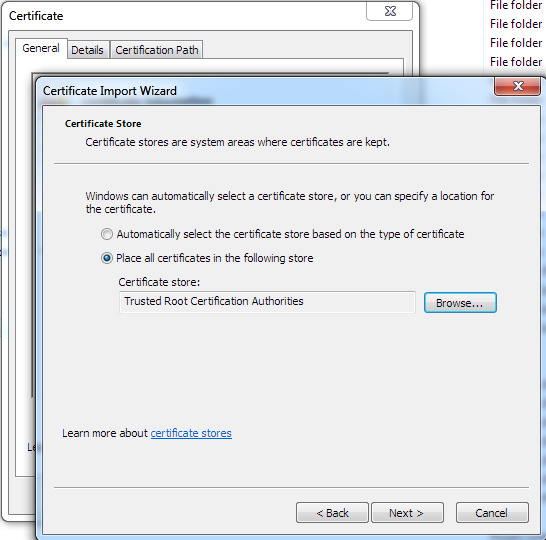
Don’t just accept the Windows defaults (could install anywhere…), but guide each certificate to its correct folder. isrgrootx1.der and isrg-root-x2.der go in the “Trusted Root…” and lets-encrypt-r3.der goes in the “Intermediate…”. Intermediate seems just as important as the others, so don’t skip it. There appears to be no need to delete the old defunct certificates, although browser access seemed to speed up a bit when I hard-deleted the Sept 2021 certs from “Trusted Root…” and “Intermediate…”.

Now when you close and re-launch your Chrome-based browser, and after a pause of perhaps 12-20 seconds for each previously blocked site, the problem should be fixed. It was for me. I assume the one-time pause is for the browser to re-cache the page.

I did not need to re-boot Windows for this fix to ‘take’. The Windows-savvy will be able to type MMC at the Windows Start menu and then load a Snap-in to see new certificates and their dates…
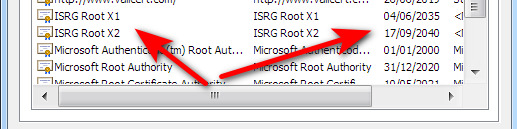
This is also the way you delete the old ones, which cannot be done via Settings | Security | Proxy in Chrome/Opera…


Update: According the Linux Addicts the problem briefly took out Amazon Web Services, Shopify and The Guardian. The Daily Swig adds Google Cloud, Microsoft Azure, and many others.

Chrome-based browsers – “This site can’t be reached”

02 Saturday Oct 2021

Posted by futurilla in JURN tips and tricks, Spotted in the news

≈ 1 Comment

A curious problem has developed persistently in recent days, for users of Chrome and Edge browser… but not for Firefox / Pale Moon. Evidently the problem is now shared by others as well as myself.

While browsing a site/page fails to respond to the Chrome browser, but springs instantly into action for Firefox or Pale Moon (based on Firefox). In the Chrome-based Opera you get…

This site can’t be reached. [URL] took too long to respond.

Doesn’t appear to affect the mega-sites like YouTube or WordPress. Sometimes there is a 20-30 second delay in reaching a mid-ranking site, and often nothing at all from smaller sites or certain known recalcitrant mid-ranking sites (e.g. Stack Overflow, GreasyFork). Slack also seems to be badly affected, though that doesn’t affect me…

The problem appears to be cross OS, as I’m on Windows and this other guy (linked above) is on Linux. I have the same symptoms as he has: Chrome often gives this error while Pale Moon (Firefox) is totally fine. The problem occurs even if you are using a DNS server other than that of your ISP. For instance in Opera, it’s possible to select from a number of DNS servers. They all exhibit the same problem. Other fixes tried include:

* Changing the Windows IVP4 DNS to another (9.9.9.9, 8.8.8.8, 1.1.1.1) makes no difference either.

* Running with all browser extensions and scripts off also makes no difference.

* Visiting the page in ‘Incognito mode’ makes no difference.

* Modem reset makes no difference.

* PC reboot makes no difference.

* I don’t have proxies configured.

My first guess was some iffy under-the-hood Chrome update, perhaps some new and imperfect query being made to the some local and rather sluggish and partial DNS cache. Linux-guy’s claimed solution thinks along these lines and he suggests flushing your local DNS, which on Windows is:

1. Start menu.
2. Run.
3. Run dialog box, type…
4. ipconfig /flushdns
5. Confirm. A DOS-box window should flash up for a microsecond, the DNS cache is flushed, and the Run box exits.

Works as described above, but this didn’t cure the problem for me.

Nor did clearing the internal Chrome DNS cache (who knew?) and restarting the browser…

chrome://net-internals/#dns

Then I downgraded the Opera browser, back to Opera 78.0.4093.147 (mid August 2021) with the help of the full offline installer. Still the same problem, and thus it can’t be due to some recently-updated Chrome component.

So… if its not in Windows and not in Chrome, and not due to extensions or other obvious problems… what on earth could it be? It must be some kind of interaction between any DNS server and a Chrome-based browser, even a slightly older one. A problem which Pale Moon/Firefox is not affected by, and which has only recently started in the last few days. It can vary between DNS servers, some loading one page and not the other and visa versa.

One odd thing is that if you click hard and long and quick enough to load such a jammed page, like 50 times, it will often eventually load. This is repeatable. It’s like there’s a ‘black hole’ somewhere along the route, for smaller and mid-ranking sites that need DNS lookup, and eventually the system will ‘get the message’ and use an alternative route. I wonder in DNS servers have been ‘split’ in three and now have different sub-databases for top, middle and lower-ranking sites? And that the low-ranking databases sometimes power down their disks when not being called? That might explain it. The disks could need time to power up. But surely they would be modern always-on SSD’s and not old mechanical hard-drives?

Why Firefox / Pale Moon is unaffected I have no idea. But it is. I’ve been unable to discover if it uses any special DNS routing. Only that Pale Moon has no support for ‘DNS over HTTPS’.

So the temporary solution is then:

1. Open the Pale Moon browser, which has no such problems, and keep it open.
2. Install Andy Portmen’s “Open in Pale Moon” extension in Opera or Chrome.
3. Pin “Open in Pale Moon” button to your bookmarks bar.
4. Launch any recalcitrant page in Pale Moon (Firefox). This browser is already open so it will load instantly, and the supposedly ‘un-findable’ page will also load instantly.

Sadly the above only works once Opera has actually received the “This site can’t be reached. [URL] took too long to respond.” message. If you pass the URL over to Pale Moon while the browser is still waiting (and waiting and waiting…) for a DNS server, you get nothing in Pale Moon. You can however go back and right-click on the original hyperlink and “Open in Pale Moon” that way.

You can also switch your RSS reader to open pages externally in Pale Moon / Firefox.


Update: This, at first glance, seems to explain the difference between the browsers…

1. “Chrome uses DNS prefetching to speed up website lookups”

2. DNS pre-fetch is off by default in Pale Moon… “DNS prefetching disabled by default to prevent router hangups”.

Checking the value on about:config / network.dns.disablePrefetch assures that it is indeed off in Pale Moon.

In Chrome/Opera this is now called “Preload pages for faster browsing and searching”, and again it is turned off for Opera. The uBlock Origin addon forces it off.

So, despite sounding plausible, the above can’t be the explanation for the problem.


Update: Browser problem fixed: it was LetsEncrypt’s expired root SSL certificates. Install the new ones. Firefox / Pale Moon uses its own SSL certificate store, which was why it was unaffected.

← Older posts
Newer posts →
RSS Feed: Subscribe


Please become my patron at www.patreon.com/davehaden to help JURN survive and thrive.

JURN

  • JURN : directory of ejournals
  • JURN : main search-engine
  • JURN : openEco directory
  • JURN : repository search
  • Categories

    • Academic search
    • Ecology additions
    • Economics of Open Access
    • How to improve academic search
    • JURN blogged
    • JURN metrics
    • JURN tips and tricks
    • JURN's Google watch
    • My general observations
    • New media journal articles
    • New titles added to JURN
    • Official and think-tank reports
    • Ooops!
    • Open Access publishing
    • Spotted in the news
    • Uncategorized

    Archives

    • January 2026
    • October 2025
    • May 2025
    • April 2025
    • September 2024
    • June 2024
    • May 2024
    • April 2024
    • March 2024
    • February 2024
    • January 2024
    • December 2023
    • November 2023
    • October 2023
    • September 2023
    • June 2023
    • May 2023
    • January 2023
    • December 2022
    • November 2022
    • October 2021
    • September 2021
    • August 2021
    • July 2021
    • June 2021
    • May 2021
    • April 2021
    • March 2021
    • February 2021
    • January 2021
    • December 2020
    • November 2020
    • October 2020
    • September 2020
    • August 2020
    • July 2020
    • June 2020
    • May 2020
    • April 2020
    • March 2020
    • February 2020
    • January 2020
    • December 2019
    • November 2019
    • October 2019
    • September 2019
    • August 2019
    • July 2019
    • June 2019
    • May 2019
    • April 2019
    • March 2019
    • February 2019
    • January 2019
    • December 2018
    • November 2018
    • October 2018
    • September 2018
    • August 2018
    • July 2018
    • June 2018
    • May 2018
    • April 2018
    • March 2018
    • February 2018
    • January 2018
    • December 2017
    • November 2017
    • October 2017
    • September 2017
    • August 2017
    • July 2017
    • June 2017
    • May 2017
    • April 2017
    • March 2017
    • February 2017
    • January 2017
    • December 2016
    • November 2016
    • October 2016
    • September 2016
    • August 2016
    • July 2016
    • June 2016
    • May 2016
    • April 2016
    • March 2016
    • February 2016
    • January 2016
    • December 2015
    • November 2015
    • October 2015
    • September 2015
    • August 2015
    • July 2015
    • June 2015
    • May 2015
    • April 2015
    • March 2015
    • February 2015
    • January 2015
    • December 2014
    • November 2014
    • October 2014
    • September 2014
    • August 2014
    • July 2014
    • June 2014
    • May 2014
    • April 2014
    • March 2014
    • February 2014
    • January 2014
    • December 2013
    • November 2013
    • October 2013
    • September 2013
    • August 2013
    • July 2013
    • June 2013
    • May 2013
    • April 2013
    • March 2013
    • February 2013
    • January 2013
    • December 2012
    • November 2012
    • October 2012
    • September 2012
    • August 2012
    • June 2012
    • May 2012
    • April 2012
    • March 2012
    • February 2012
    • January 2012
    • December 2011
    • November 2011
    • October 2011
    • September 2011
    • August 2011
    • July 2011
    • June 2011
    • May 2011
    • April 2011
    • March 2011
    • February 2011
    • January 2011
    • December 2010
    • November 2010
    • October 2010
    • September 2010
    • August 2010
    • July 2010
    • June 2010
    • May 2010
    • April 2010
    • March 2010
    • February 2010
    • January 2010
    • December 2009
    • November 2009
    • October 2009
    • September 2009
    • August 2009
    • July 2009
    • June 2009
    • May 2009
    • April 2009
    • March 2009
    • February 2009

    Proudly powered by WordPress Theme: Chateau by Ignacio Ricci.