Idyll is a new “friendly markup language — and an associated toolchain — that can be used to create dynamic, text-driven web pages.” Interactive diagrams in academic papers, that sort of thing…

13 Wednesday Sep 2017
Posted in New media journal articles, Spotted in the news
Idyll is a new “friendly markup language — and an associated toolchain — that can be used to create dynamic, text-driven web pages.” Interactive diagrams in academic papers, that sort of thing…
09 Saturday Sep 2017
Posted in Spotted in the news
The Jay Kay Klein archive has just released nearly 6,000 vintage photographs of U.S. science fiction fandom. Mostly it appears to be convention room-parties, panels/auctions in progress, and author signings with the head turned down – but there are more than a few gems in there. For instance, here’s Ray Bradbury with young artists from Oakland at BayCon in 1968, holding a lizard-man head made by Philip Tippett. Phil — as he was later known — went on to work on the first Star Wars films and lead the animation team at Industrial Light and Magic.

02 Saturday Sep 2017
Posted in Spotted in the news
Genomic Observatories Meta-database, a new repository for…
“metadata on biological samples, used for biodiversity inventories, population studies, and environmental metagenomics.”
Wider context: “There has never been a better time for a taxonomic renaissance”. And “A Few Bad Scientists Are Threatening to Topple Taxonomy”.
31 Thursday Aug 2017
Posted in Spotted in the news
FurScience… “a multidisciplinary team of scientists studying the furry fandom”.

16 Wednesday Aug 2017
Posted in Spotted in the news
Cambridge University asks: How to “provide training solutions for scholarly communication” in the UK? Not usually, it would seem from reading this article, by inviting along the member of the library school staff who teaches such things…
“It is fairly universally acknowledged that it is a challenge to engage with library schools [in universities] on the issue of scholarly communication, despite repositories being a staple part of research library infrastructure for well over a decade. There are a few exceptions but generally open access or other aspects of scholarly communication are completely absent from the curricula.” (my emphasis)
Amazing: one would have thought that Open Access — along with all the other ‘public and free-to-access’ online sources from Google Books to data sources — would have been covered in a compulsory double-module for an entire semester of the second year of a degree in librarianship. But apparently not, though no doubt there are a few unremarked exceptions quietly doing good work.
Note that this new article has an associated Google Docs list of the (currently very minimal) UK provision for Scholarly Communication training provision, including a useful linked list of online caches of free training materials.
The introduction to this Google Doc further suggests that such training is not always present even at the Masters degree level, or is not there of sufficient duration and quality…
“… the traditional educational route for library workers through a Masters degree does not always equip them with an adequate level of knowledge [on open access, copyright and research data]”
The implication of the Cambridge University article is that other professional groups may have to be asked to provide such training to researchers, since librarians as-a-class seem to be so unwilling to engage with these pressing topics. It seems yet another indicator that librarians as-a-class are at risk of being labelled: ‘Underutilized, consider discarding’.
11 Friday Aug 2017
Posted in Spotted in the news
PastPin by Geopast, challenging the public to geo-locate and time-tag photos of unknown location/time, uploaded by 115 selected institutional contributors to the Flickr Commons.

A nice cleanly designed service for public domain pictures, but page-loading assumes that you have superfast broadband, and that your broadband isn’t already being saturated with other downloads and music streaming. It also seems to be calling images from the often-slow Flickr, which slows it down even further. Lovely idea, but too grindingly slow for the majority of Internet users.
29 Saturday Jul 2017
Posted in Spotted in the news
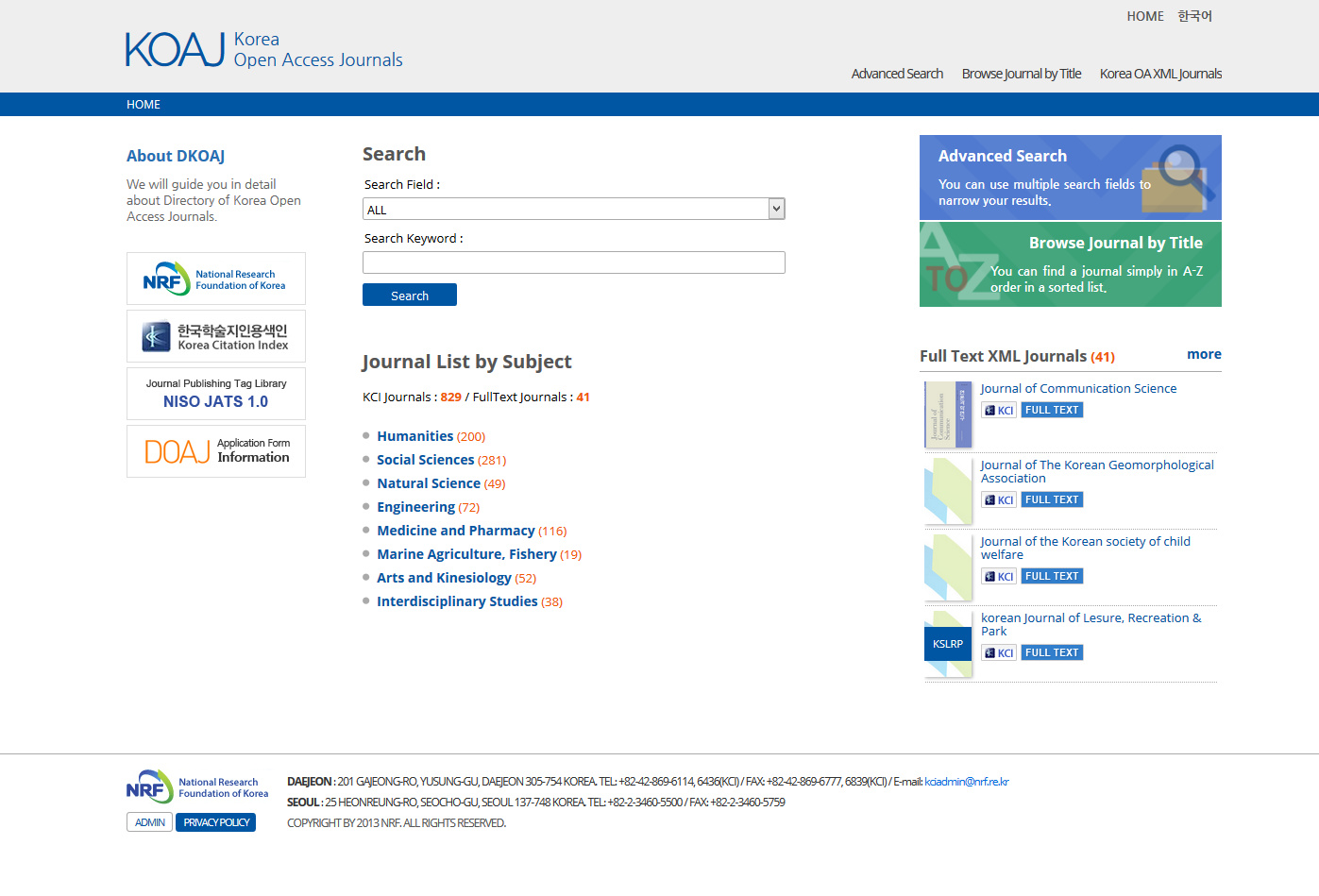
New to me, the Directory of Korea Open Access Journals from the National Research Foundation of Korea. The NRF’s website is currently down and their Wikipedia page is confusing, but at 2017 they appear to be a bona-fide if somewhat semi-detached arm of the Korean culture ministry.
29 Saturday Jul 2017
Posted in Spotted in the news
High quality long-form journalism on “The future of learning and the independent scholar”, from Karl Schmude in The Spectator Australia…
“In this essay I will focus on three things – firstly, to sketch the contribution of the independent scholar to the world of learning in the past, and more broadly to the world of culture; secondly, to reflect on changes in university and academic life that have affected the capacity, and even the existence, of the independent scholar; and thirdly, to highlight the potential for independent scholarship in present-day culture, given that the university has now come to dominate the world of learning, and even of vocational training.”
The British edition of The Spectator sporadically nips behind a paywall, but this is from the Australian edition and is free for me.
Schmude is writing from a Catholic perspective, so the essay entertains a few hobby-horses which canter around aimlessly for a few lines, but when he’s sticking to the topic it’s a stimulating read. Worth it for the phase “immune to the insinuations of conformism” alone…
… he was largely immune to the insinuations of conformism.
27 Thursday Jul 2017
Posted in Spotted in the news
Algeria now has an official Algerian Scientific Journal Platform (ASJP) aggregator for online journals (inc. humanities), all of which appear to be open. It’s from CERIST (Centre de Recherche sur l’Information Scientifique et Technique), which a little digging shows is a bona fide arm of the Algerian Ministry of Higher Education and Scientific Research.

22 Saturday Jul 2017
“An Evidence-Based Review of Academic Web Search Engines, 2014-2016”… “This article seeks to summarize research concerning Google Scholar, Google Books, and Microsoft Academic from the past three years”.
Useful. Interesting snippets from this excellent new summary survey:
* Weiss noted, “no critical studies seem to exist on the effect that Google Books might have on the contemporary reference experience” (Weiss 2016, 293). […] Research is badly needed about the coverage and utility of both Google Books and Microsoft Academic.”
Seriously? None, not one single study from 2005-2015? For one of the most important innovations in books since Gutenberg? Wow. That’s one hell of a grudge you’re holding there, librarians.
* “In September 2016, Hug et al. […] noted Microsoft Academic has “grown massively from 83 million publication records in 2015 to 140 million in 2016″ […] As of February 2017 its index contains 120 million citations.”
Great news, which means I’ll have to take another look at that. I’m overdue for doing another big ‘group test’ of OA coverage in public search-engines, so this news may spur that. Of course, “citations” are not full-text, but 120m is impressive.
* “Bonato [2016] noted Google Scholar retrieved different results with Advanced and Basic searches”
So that’s another thing to take into account if I do another group-test this summer.
* A “glaring lack of research related to the [search] coverage of arts and humanities scholarship” [and specifically] “Little is known about coverage of arts and humanities by Google Scholar.” [and it is evident that arts and humanities scholars’] preferences and behavior […] cannot be inferred from the vast literature focused on the sciences.”
* “research concerning the use of academic web search engines by undergraduates, community college students, high school students, and other groups would be welcome.”
* “Scholar results have been said to contain “clutter””.
This is the closest the paper comes to mentioning all the predatory journals and similar dubious items, which get dragged into Scholar by automated collection bots.
* “During interviews of 20 historians by Martin and Quan-Haase (2016) concerning serendipity, five mentioned Google Books and Google Scholar as important for recreating serendipity of the physical library online.”
Yes, serendipity is vital. It’s more of a loosely chain-linked set of serendipity loops during search-based research, really, interspersed with deep-dives to get tiny confirming nuggets of fact (e.g.: was Borges correct when he suggested that The Time Machine‘s famous central motif of ‘the future-flower’ was almost certainly not influenced by a striking passage in Coleridge’s notebooks? Yes he was, presumably by a private letter of enquiry to some learned bibliophile in London. But he was characteristically recondite on this point in the essay, and thus can only be proved correct if you do the 30 minute deep-dive to the primary sources needed to get the exact month-of-publication dates in 1895).
* “arts and humanities scholars […] commonly expressed the belief that having a complete list of research activities online improves public awareness [with] the enormous potential for this tool’s use.”
Might be more useful to have a rolling listing of what’s not being done, but which needs to be done. Sort of like a speculative Kickstarter, only you’d gather people rather than cash.
* “Gardner (2016) showed […] people working in the humanities and religion and theology prefer to use Google”. “Humanities scholar use of Google over Google Scholar was also found by Kemman et al. (2013); Google, Google Images, Google Scholar, and YouTube were used more than JSTOR or other library databases”
* “Namei and Young’s [2015] comparison of Summon, Google Scholar, and Google using 299 known-item queries. They found Google Scholar and Summon returned relevant results 74% of the time; Google returned relevant results 91% of the time.”
* “In Yang’s (2016) study of Texas Tech’s DSpace IR [the university repository], Google was the only search engine that indexed, discovered, or linked to PDF files supplemented with metadata; Google Scholar did not discover or provide links to the IR’s PDF files, and was less successful at discovering metadata.”
I’m guessing this possibly illustrates the value of separating a university’s big dumpy Digital Collections from the nimble research repository, by putting them on different domains? Texas Tech’s DSpace has them both cheek-by-jowl, and adds a Law repository for good measure.
* “IR platform and metadata schema dramatically affect discovery, with some IRs nearly invisible (Weideman 2015; Chen 2014; Orduña-Malea and López-Cózar 2015; Yang 2016) and others somewhat findable by Google Scholar (Lee et al. 2015; Obrien et al. 2016).”
* “Another area needing investigation is the visibility of links to free full text in Google Scholar.” [and more generally] “retrieval of full text, which is another area ripe for more research studies, especially in light of the impressive quantity of full text that can be retrieved without user authentication.” […] “When will academic users find a good-enough selection of full-text articles that they no longer need the expanded full text paid for by their institutions?”
Indeed.
There are also good formulations of four future-research questions specific to the arts and humanities (pages 27-28).