• Directory
  • FAQ: about JURN
  • Group tests
  • Guide to academic search
  • JURN’s donationware
  • Links
  • openEco: titles indexed

News from JURN

~ search tool for open access content

News from JURN

Category Archives: Open Access publishing

Researcher to Reader conference

08 Friday Mar 2024

Posted by futurilla in Academic search, How to improve academic search, Open Access publishing, Spotted in the news

≈ Leave a comment

I’m pleased to learn about London’s annual Researcher to Reader Conference, which focusses on getting research to interested readers. Information Today has a detailed report of the February 2024 event…

even today, in 2024, we don’t have consistent metadata to identify the article type in many cases with certainty (is it a research article? A review article? An editorial?) nor even the corresponding author of an article, let alone knowing how much a university is paying publishers for APCs to publish articles. Would any other industry tolerate such vagueness?

The COAR of the issue

29 Friday Jan 2021

Posted by futurilla in Academic search, Economics of Open Access, Open Access publishing, Spotted in the news

≈ Leave a comment

A useful new analysis today from COAR, “Don’t believe the hype: repositories are critical for ensuring equity, inclusion and sustainability in the transition to open access”. Recent…

publishers’ comments portray gold open access as the only ‘legitimate’ route for open access, and attempt to diminish the repository (or green) route.

According to the author, some publishers are even implying that repositories have no aggregators, or are not present in Google Search or in specialist search-engines such as Scholar and GRAFT. Laughably, they apparently suggest that poor over-worked researchers will instead…

need to search through individual repositories to find the articles.

The publishers are also said to be trying to stop all but a sub-set of elite repositories from being used for data deposit, via…

proposing to define the repository selection criteria for where their authors’ should deposit research data. These criteria, which are very narrowly conceived, threaten to exclude thousands of national and institutional repositories as options for deposit.

Again, this sounds like it is designed to make researchers feel it’s more convenient to publish their article + data via a big publisher.

Altmetric Advantages

27 Sunday Sep 2020

Posted by futurilla in Open Access publishing, Spotted in the news

≈ Leave a comment

New from the University of Wolverhampton in the UK, “Open Access Books in the Humanities and Social Sciences: an Open Access Altmetric Advantage”…

“examines the altmetrics of a set of 32,222 books (of which 5% are OA) and a set of 220,527 chapters (of which 7% are OA) indexed by the scholarly database Dimensions” in Humanities and Social Sciences.

Mind the Gap

09 Friday Aug 2019

Posted by futurilla in Official and think-tank reports, Open Access publishing, Spotted in the news

≈ Leave a comment

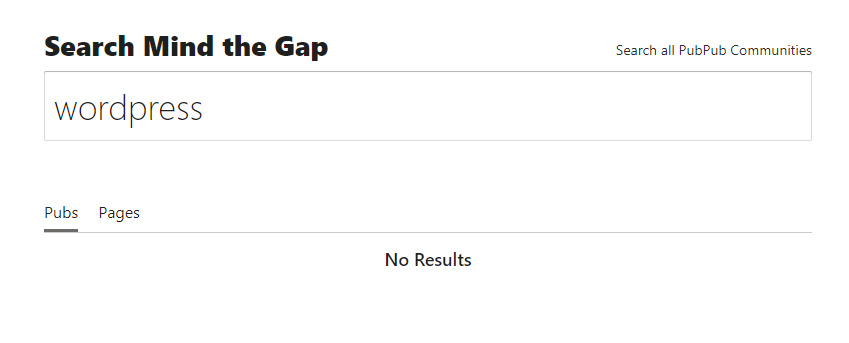
MIT’s Mind the Gap is a new comprehensive survey report on open source publishing systems that can be used for scholarly purposes. The only one I can see that’s missing is WordPress. Which is open source, free, easy to use and rent a server for, and can be quickly tooled-up with plugins for such purposes. In fact, it’s not even mentioned once, even to explain why it and its plugins were omitted.

Open Access Week: Events

27 Thursday Sep 2018

Posted by futurilla in Open Access publishing, Spotted in the news

≈ Leave a comment

Open Access Week: Events listing for 22nd – 28th October 2018.

Szczepanski’s List

21 Saturday Jul 2018

Posted by futurilla in Open Access publishing, Spotted in the news

≈ Leave a comment

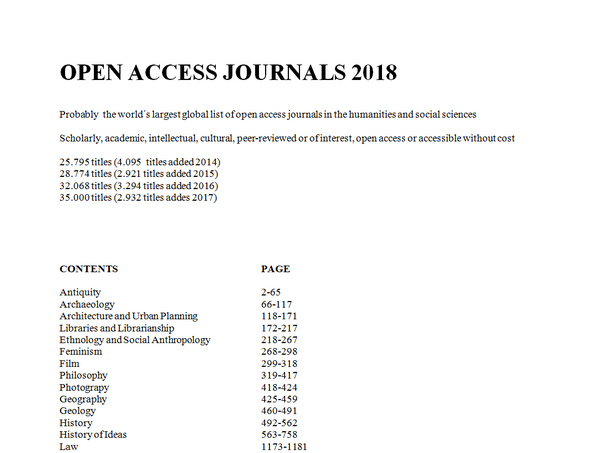
My thanks to Jan Szczepanski for alerting me that his list has a new home. Szczepanski’s List of Open Access Journals is now available via the EBSCO.com website, as a freely downloadable .DOCX Word file. The page describes this 35,000-title / 9Mb / 672-page subject-ordered list as… “probably the world’s largest list of open access journals in the humanities and social sciences” plus Law, Statistics and Geology. No “probably” about it, this fine work is surely the largest OA-only list which is also freely available to the public. The EZB is at a similar scale, and does have 37,600 OA titles since 2010, but the EZB covers all disciplines including the sciences.

I had assumed the list had long since stopped updating circa 2015 and was now a legacy item, but the new header now notes “2,932 titles added 2017”. The file’s internal datestamp says the last update in Word was made March 2018. Unfortunately there’s no “First included in (date)…” component to the list entries, by which one might extract just the new 2016-18 finds. Nor does EBSCO appear to offer a rolling “What’s New”.
Having found the list again I’ve now added a link to it on the JURN Guide / Directory / FAQ pages. Despite its inevitable 15% linkrot (see below for details on that) Jan’s list has a big advantage over the JURN Directory. In that it can serve as a discovery tool for OA titles published in languages other than English, and which are unlikely to be on the DOAJ for various legitimate reasons. In contrast, the JURN Directory only lists titles which publish in English or are genuinely multi-language with English.

The home-page URLs given in Jan’s list appear to be hyperlinked with blue-underlining, but my copy of Word won’t allow me to launch these. That’s probably just a security thing on my PC. A simple “Save as…” to a .PDF does give me launchable URLs.

One can also save the list from Word to a filtered .HTML page, which gives a 23Mb Web page with launchable URLs. Despite being so large, my Linkbot software didn’t have problems with my saved Web page version of the list. 60 minutes later the Linkbot results reported that the list has the disadvantage of link-rot:

* Contains 45,536 individual home-page URLs across approx. 35,000 titles (some records have more than one URL). Of broken…

* After discounting the useful redirects (e.g.: http:/ to https:/ or the ubiquitous OJS redirects from the home-page to the current issue page), an Excel tally told me there were 6,808 ‘fatal’ URLs such as outright 404s, ‘Unauthorized’ or ‘Host not found’. That’s a 15% rot rate.

Perhaps someone could now look at helping Jan with a crowd-funder, to pay some Web-elves (on Fivver.com or similar) or unemployed recent graduates to fix the broken 15% of URLs? At $20 per batch of 25 URLs, I figure it should cost around $6,000.

itty.bitty

07 Saturday Jul 2018

Posted by futurilla in Open Access publishing, Spotted in the news

≈ Leave a comment

itty.bitty, new from the design leader at Dropbox. Itty.bitty uses the URL to contain the text of a Web page. The page can have 2,000 bytes, or about 170-200 words, if you’re going to support legacy Web browsers such as Internet Explorer.

No hosting server is required, and as the data sits after the # symbol. What comes after the # is meant to be page-position related, and as such it never gets sent to the server.

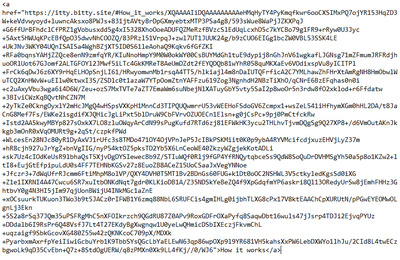
The base64 link code is not pretty…

But the same link/page displays as…

How it works

This link is the page.

Scripting and hyper-linking is enabled in such pages, so long as it all fits in the URL length. The code can’t do images, but you can do old-school ASCII-art.

The main drawback seems to be that you’re going to have to be 1000% sure that your text is exactly as you want it before you make the link… because there’s no after-post editing for errors or updating of dead hyperlinks in the page.

In which case you’d ideally consistently version and date-stamp the

">How it works

bit, as…

">How it works (v.0.1 | 14/07/2018)

…so that people and search-tools can discover later updated versions of the same content. Otherwise the itty.bitty system risks becoming an intertwingled mess of half-baked and old/broken stuff that you (and probably Google) won’t want in search results.

I’m guessing that advanced Web browsers such as Brave will soon ‘add a feature’ in relation to this, by enabling much longer data-carrier code to be read from URLs. Perhaps also some simple automatic “…and can we find a later version of this itty.bitty.site?” query, done inside the browser. There would, however, also have to be some sort of dynamic ownership hash embedded in the page, to protect against impersonation of the page-author. Perhaps the system of authoring an ownership-hash and datestamp could be combined into a simple ‘one-click operation’ in a desktop authoring tool.

Anyway, it’s one example of the coming uncensorable Decentralized Web.

Massive Bronze figure unearthed

14 Wednesday Feb 2018

Posted by futurilla in Academic search, Open Access publishing, Spotted in the news

≈ Leave a comment

“The state of OA: a large-scale analysis of the prevalence and impact of Open Access articles” (Feb 2018, PeerJ)…

“the most common mechanism for OA is not Gold, Green, or Hybrid OA, but rather an under-discussed category we dub Bronze: articles made free-to-read on the publisher website, without an explicit Open license.”

Of Bronze, “few studies have highlighted its role” [in OA]. “We manually inspected a small sample of Bronze articles in order to understand this subcategory more; we found that while many Bronze articles were Delayed OA from toll-access publishers, nearly half were hosted on journals that published 100% of content as free-to-read but were not listed on the DOAJ and did not formally license content (using CC-BY or any other license).”

Bronze was found to be at a whopping 47% of OA, from a one-week sample of Unpaywall-DOIs in 2017.

Open Access Journals in Commercial Databases

01 Wednesday Nov 2017

Posted by futurilla in Academic search, Open Access publishing, Spotted in the news

≈ 1 Comment

“Open for Business: Open Access Journals in Commercial Databases”, a new article (dated 27th October 2017) in The Serials Librarian journal.

‘Table 3. Presence of OAs titles in databases’. Percent of DOAJ titles found in database:

Scopus – 29.18%
Academic Search Complete – 18.00%
Web of Science – 10.91%

… between 70.82% and 89.09% of DOAJ journals are not found in the databases analyzed here, which is potentially problematic given that most researchers depend on databases to locate scholarly information

Knowable Magazine

27 Friday Oct 2017

Posted by futurilla in New media journal articles, Open Access publishing, Spotted in the news

≈ 1 Comment

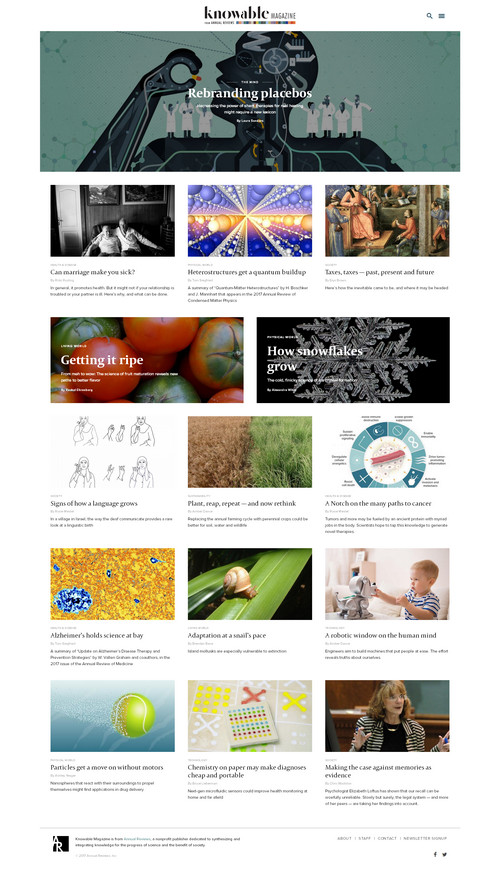
Launched today for Open Access Week, the free Knowable Magazine under CC BY-ND. Access the issue here.

There doesn’t seem to be a portable PDF version, just a tablet-tastic Web site with no RSS feed. I don’t mind the lack of a PDF, but if they want to be in the newsfeeds of influencers then surely someone needs to plug in the RSS module.

← Older posts
RSS Feed: Subscribe


Please become my patron at www.patreon.com/davehaden to help JURN survive and thrive.

JURN

  • JURN : directory of ejournals
  • JURN : main search-engine
  • JURN : openEco directory
  • JURN : repository search
  • Categories

    • Academic search
    • Ecology additions
    • Economics of Open Access
    • How to improve academic search
    • JURN blogged
    • JURN metrics
    • JURN tips and tricks
    • JURN's Google watch
    • My general observations
    • New media journal articles
    • New titles added to JURN
    • Official and think-tank reports
    • Ooops!
    • Open Access publishing
    • Spotted in the news
    • Uncategorized

    Archives

    • January 2026
    • October 2025
    • May 2025
    • April 2025
    • September 2024
    • June 2024
    • May 2024
    • April 2024
    • March 2024
    • February 2024
    • January 2024
    • December 2023
    • November 2023
    • October 2023
    • September 2023
    • June 2023
    • May 2023
    • January 2023
    • December 2022
    • November 2022
    • October 2021
    • September 2021
    • August 2021
    • July 2021
    • June 2021
    • May 2021
    • April 2021
    • March 2021
    • February 2021
    • January 2021
    • December 2020
    • November 2020
    • October 2020
    • September 2020
    • August 2020
    • July 2020
    • June 2020
    • May 2020
    • April 2020
    • March 2020
    • February 2020
    • January 2020
    • December 2019
    • November 2019
    • October 2019
    • September 2019
    • August 2019
    • July 2019
    • June 2019
    • May 2019
    • April 2019
    • March 2019
    • February 2019
    • January 2019
    • December 2018
    • November 2018
    • October 2018
    • September 2018
    • August 2018
    • July 2018
    • June 2018
    • May 2018
    • April 2018
    • March 2018
    • February 2018
    • January 2018
    • December 2017
    • November 2017
    • October 2017
    • September 2017
    • August 2017
    • July 2017
    • June 2017
    • May 2017
    • April 2017
    • March 2017
    • February 2017
    • January 2017
    • December 2016
    • November 2016
    • October 2016
    • September 2016
    • August 2016
    • July 2016
    • June 2016
    • May 2016
    • April 2016
    • March 2016
    • February 2016
    • January 2016
    • December 2015
    • November 2015
    • October 2015
    • September 2015
    • August 2015
    • July 2015
    • June 2015
    • May 2015
    • April 2015
    • March 2015
    • February 2015
    • January 2015
    • December 2014
    • November 2014
    • October 2014
    • September 2014
    • August 2014
    • July 2014
    • June 2014
    • May 2014
    • April 2014
    • March 2014
    • February 2014
    • January 2014
    • December 2013
    • November 2013
    • October 2013
    • September 2013
    • August 2013
    • July 2013
    • June 2013
    • May 2013
    • April 2013
    • March 2013
    • February 2013
    • January 2013
    • December 2012
    • November 2012
    • October 2012
    • September 2012
    • August 2012
    • June 2012
    • May 2012
    • April 2012
    • March 2012
    • February 2012
    • January 2012
    • December 2011
    • November 2011
    • October 2011
    • September 2011
    • August 2011
    • July 2011
    • June 2011
    • May 2011
    • April 2011
    • March 2011
    • February 2011
    • January 2011
    • December 2010
    • November 2010
    • October 2010
    • September 2010
    • August 2010
    • July 2010
    • June 2010
    • May 2010
    • April 2010
    • March 2010
    • February 2010
    • January 2010
    • December 2009
    • November 2009
    • October 2009
    • September 2009
    • August 2009
    • July 2009
    • June 2009
    • May 2009
    • April 2009
    • March 2009
    • February 2009

    Proudly powered by WordPress Theme: Chateau by Ignacio Ricci.