• Directory
  • FAQ: about JURN
  • Group tests
  • Guide to academic search
  • JURN’s donationware
  • Links
  • openEco: titles indexed

News from JURN

~ search tool for open access content

News from JURN

Category Archives: Official and think-tank reports

Access to scholarly content: gaps and barriers

07 Wednesday Mar 2012

Posted by futurilla in Economics of Open Access, Official and think-tank reports

≈ Leave a comment

An interesting new report from RIN, Access to scholarly content: gaps and barriers (Dec 2011).

* 79.1% in “industry and commerce” said their access to research papers was “easy to access”.

* When the same group was later asked more specifically about academic papers…

“In a later question, put only to those researchers for whom journal articles are important, respondents in all sectors rated their access as somewhere between ‘variable’ and ‘good’. Conference papers, on the other hand, were rated somewhere between ‘variable’ and ‘poor’.”

* “the motor industry, utilities companies, metals and fabrication, construction, and rubber and plastics.” reported the poorest access.

* “34.4 per cent of researchers and knowledge workers describe their current level of access to conference papers (in print or online) as `poor’ or `very poor’.”

* “Based on an analysis of the Labour Force Survey, CIBER estimates that there are around 1.8 million professional knowledge workers in the UK, many working in R&D intensive occupations (such as software development, civil engineering and consultancy) and in small firms, who may not currently have access to journal content via subscriptions.”

JISC report on UK academic library use

18 Saturday Feb 2012

Posted by futurilla in Official and think-tank reports

≈ Leave a comment

Published 1st Feb 2012: “UK Scholarly Reading and the Value of Library Resources: Summary Results of the Study Conducted Spring 2011“, a JISC Collections report. 1000 academics were surveyed, at six British universities.

Open access: impact for researchers, universities and society

13 Friday Jan 2012

Posted by futurilla in Official and think-tank reports

≈ Leave a comment

A handy new four-page advocacy briefing sheet from Research Libraries UK Open access: impact for researchers, universities and society. Although note that it doesn’t mention the poor level of indexing and search findability.

University libraries, student research culture, and Google use

01 Sunday Jan 2012

Posted by futurilla in Academic search, Official and think-tank reports, Spotted in the news

≈ Leave a comment

Published at the end of September 2011, the book College Libraries and Student Culture: What We Now Know (ALA Editions). This from the Inside Higher Ed coverage of the research in the run-up to publication…

“… the Illinois researchers found something they did not expect: students were not very good at using Google. They were basically clueless about the logic underlying how the search engine organizes and displays its results. Consequently, the students did not know how to build a search that would return good sources. (For instance, limiting a search to news articles, or querying specific databases such as Google Book Search or Google Scholar.) Duke and Asher said they were surprised by “the extent to which students appeared to lack even some of the most basic information literacy skills that we assumed they would have mastered in high school.” Even students who were high achievers in high school suffered from these deficiencies, Asher told Inside Higher Ed in an interview.”

Seriously, they were surprised? Surely anyone who teaches undergraduates could have told them this?

New report on UK digital literacy

28 Monday Nov 2011

Posted by futurilla in Official and think-tank reports, Spotted in the news

≈ Leave a comment

UK students are in danger of becoming “illiterate” when it comes to technology, says a new Department for Education report which is due to be published today…

“Ian Livingstone, president of gaming publisher Eidos and author of a recent report into teaching tech in schools, has called for improvements to computing education ahead of a response to his report due out from the Department for Education today.”

National humanities publishing

13 Sunday Nov 2011

Posted by futurilla in Official and think-tank reports

≈ 2 Comments

As university presses stagger in the economic storm, the Australian Book Industry Strategy Group final report (PDF link) suggests a national publically-funded ‘publisher of last resort’…

“Australia needs a National University Press Network to print book and chapter-length research in the humanities and social sciences — research that, being too long for journals and not commercial enough for the struggling publishing industry, might otherwise never see the light of day.”

Personally I would be inclined to get such research out there for free, via blogs and personal websites, Amazon Kindle store, open repositories such as Archive.org, and print-on-demand services such as Lulu or CreateSpace. There seems to me absolutely no excuse for any research “never seeing the light of day” in the digital age, especially if you envisage selling only 50 copies or so. Impact assessment will apparently take little or no notice of where or by whom something was published, in future. So what does a publisher really give you? Proof-reading services, and a little bit of publicity, both things you can buy off-the-shelf from eLance and the like. If you really have to have a proof reader from within the discipline, they can also be found provided you’re willing to pay, among the thousands of humanities lecturers now languishing in unemployment. Even if the ‘buried’ text is somehow still in a yellowing typescript from before the Word processing era, how difficult can it be to pay an undergraduate £50 to scan and OCR it for you?

Reinventing Research? – report

14 Friday Oct 2011

Posted by futurilla in My general observations, Official and think-tank reports, Spotted in the news

≈ 2 Comments

Reinventing Research? : information practices in the humanities (PDF link), a 2011 report from the UK’s RIN consortium. The report looked at all digital research resources, not just social media. The English Department at the University of Birmingham was one of the case-studies, which presents an interesting three-page snapshot of digital usage (or not — only two staff were bloggers) in a single department.

From the summary of the report…

“We found only limited use — except among philosophers — of blogs and other social media.” […] there is little evidence as yet of their taking full advantage of the possibilities of more advanced tools for text-mining, grid or cloud computing, or the semantic web; and only limited uptake of even simple, freely-available tools for data management and sharing.”

There may also be some overestimation of usage of new media for the dissemination of research findings. This is something that may be increasingly important in the UK in future, as funding becomes partly dependent on the public ‘impact’ of public-funded research. This apparent overestimation doesn’t seem to be mentioned in the RIN report, but it was summed up in a comment from Dr. Michael Jubb, Director of the Research Information Network (RIN)…

“While they [researchers] say they’re using [these] tools for dissemination, in fact they’re not. When you look at the research results they’re not using these kind of tools to aid dissemination, they’re going back to conference papers and journal articles in the traditional way…”

He made the comment in the questions after a recent talk in Harrogate by Bill Russell (presenting huge-sample research which found that Skype and Google Docs were the most used of the new digital resources).

Such lackadaisical behaviour may be dangerous. Change is coming fast. It doesn’t seem that our academics may have a great deal of time and leisure in which to make the change…

“There is a new global race in scientific research and it’s so fast it may well be of world historical importance, a signal of a new, expanding Enlightenment, unconstrained by national boundaries, powered by multilateral institutions and open access publishing through the web, and, above all, by the belief, first put forward by one of the founders of the Royal Society, the Irish scientist Robert Boyle, that knowledge teems with profitable invention. Reading through the 144-page report [ Knowledge, networks and nations (Royal Society, March 2011) ], one can almost sense the authors — some of Britain’s most distinguished scientists — marveling at the findings.”

The Location of Academic Knowledge

18 Sunday Sep 2011

Posted by futurilla in My general observations, Official and think-tank reports

≈ 1 Comment

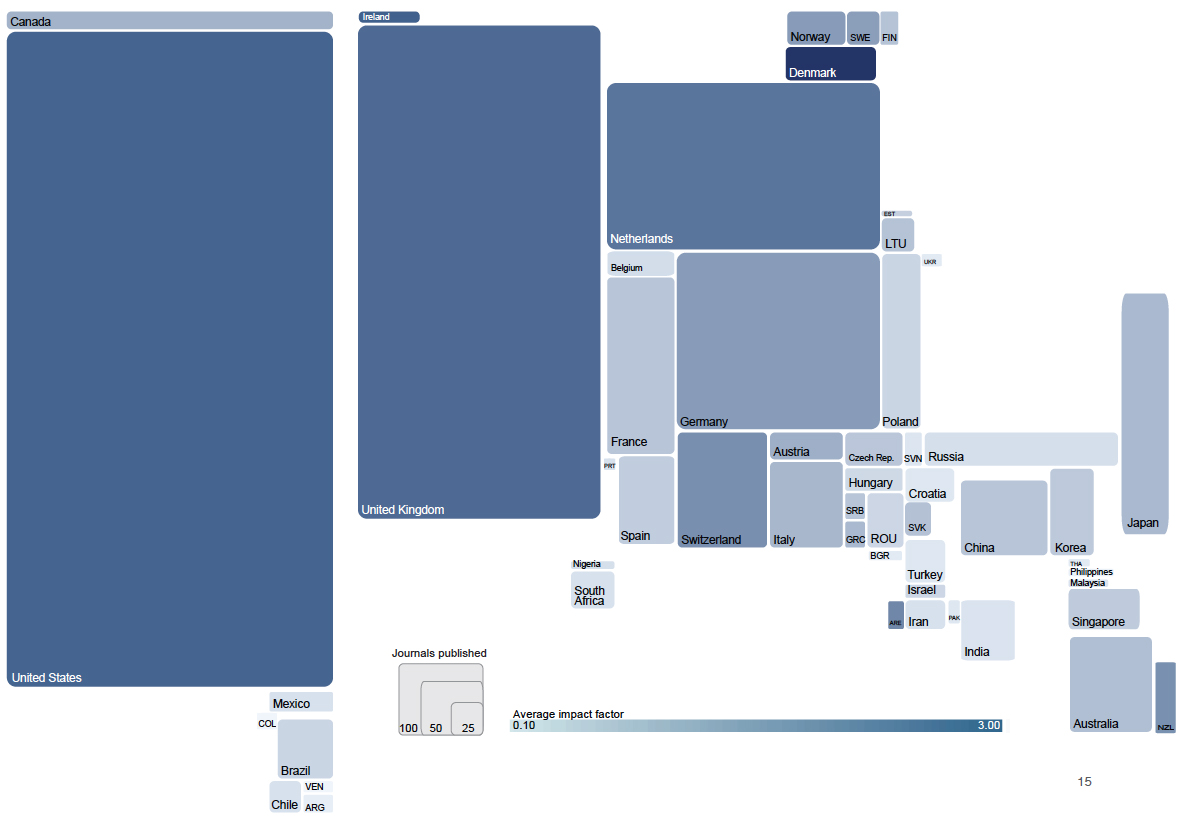
The Location of Academic Knowledge (journals by country) included in Web of Knowledge *. Click for larger version.

From: Graham, M., Hale, S. A., and Stephens, M. (2011) “Geographies of the World’s Knowledge”. Oxford Internet Institute & Convoco.

  * Web of Knowledge subsumes Web of Science, and includes Journal Citation Reports, Science Citation Index (1945+), Social Science Citation Index (1956+) and the Arts and Humanities Citation Index (1994+). ‘High impact’ journals, inc. around 1,300 major arts and humanities titles in Arts and Humanities Citation Index. One might keep in mind, however, the 2009 Gale Reference Review comment that… “I looked at the widely touted figures [for journal numbers] in the promotional materials [ of Web of Science and Scopus and found ] they should not be taken for granted. Many of these are incorrect and exaggerated. Their compilation has been fast and loose, sometimes making them fiction rather than fact.”

Final RIN report on ejournals

19 Wednesday Jan 2011

Posted by futurilla in Official and think-tank reports, Spotted in the news

≈ Leave a comment

The Phase II report of the UK’s RIN study, just published: E-Journals: Their Use, Value and Impact, Final Report…

“Based on an analysis of log files from journal websites and data from libraries in ten [UK] universities and research institutions [in 2009]”

From the report…

“It is difficult, often impossible, to distinguish from log records alone between researcher and student use of e-journals. Moreover, there are no figures in the public domain regarding the levels of use of e-journals by students and researchers respectively, and it seems unlikely that any librarians or publishers know this with any confidence.”

However, the research also used other methods…

“No other study has subjected a UK research community to such intense scrutiny: logs, questionnaires, interviews, observation and statistical datasets were used to enrich and triangulate the findings presented in this report.”

Some interesting snippets relating to the humanities…

“Only a small minority (14%, mostly in the humanities) visit the library building to browse or to read hard copy journals.”

“Researchers now expect immediate access to the full text, and they are frustrated when they find that their university does not have the necessary subscription, or that they are asked for a password they do not have, or that they are asked to pay for a download. Over a third of our survey respondents reported such problems […] Historians […] seem to face the most problems with access,”

And relating to student use of ejournals…

“Student use of e-journals is clearly substantial, and this represents a powerful argument for sustained long-term spending on them. E-journals play a major role in supporting learning and teaching, as well as research.”

The anti-search attitude

01 Monday Nov 2010

Posted by futurilla in My general observations, Official and think-tank reports, Spotted in the news

≈ Leave a comment

On Saturday I picked up a special one-off Google “how to” £9.99 magazine in W.H. Smiths (the biggest UK magazine chain store). It claimed to be a comprehensive guide to Google, yet devoted just a half of one of its hundreds of pages to some basic search modifiers such as “quote marks for phrase”. And most of that half-page was screenshots. This inexplicable dismissal of search as a teachable skill is something that’s been worrying me for some time. Despite the absolute necessity of learning to search, to find and re-find — it’s not a skill that’s taught at primary, secondary or further education, except in the most perfunctory manner. Students enter my new technologies undergraduate class and the British education system has simply not equipped 95% of them with the most basic knowledge of how to skilfully search using Google.

Stephen E. Arnold of Beyond Search has a long post today in which he sees this same inexplicable mood appearing in businesses, where bad search skills have a direct financial impact. He calls the new mood “anti-search”…

“People at this meeting don’t want search. These attributes are anti search, and I think that is the big trend for 2011. Everyday users of online systems don’t know how to formulate a query, figure out most business intelligence reports, and have little time to invest in piecing together an “answer.” The goal is the intellectual equivalent of buying a do-nut when hungry. Quick, easy, and probably not good in the long run but okay for the now moment.

What is anti search?

I think it is a culmination of many experiences. People who did lousy research in college don’t become great researchers when they get a job, gain 30 pounds, and have to juggle life’s rubber balls.

Anti search, therefore, is the need for systems that are easy to use, require little intellectual effort to learn, and deliver “good enough” information. Maybe information “on training wheels” is a better way to think about anti search.

Anti search 2011 is taking root in an environment with several characteristics…”

This is a ridiculous attitude, since properly training staff in search would pay for itself. For instance, in a recent Network World (2010) article on findability, it was said that research has found that professionals…

“spend 20% of their time looking for information and they find what they are looking for less than half of the time. That’s equivalent to spending 10 weeks a year searching for information and remaining ignorant half of that time.”

And a summary of the Summer 2010 ROI Research survey of 500 search-engine users found that…

“19% abandon the online search, taking it offline if they can’t find the information”

The UK business situation was reported in research from official UK government researchers YouGov, The Costs of Traditional Filing. Small and medium businesses in the UK…

“[staff in an average firm] spend approx. 3 months a year looking for [paper] documents […] 87% of respondents spend up to 2 hours every day looking for documents”

The national waste of time was estimated to cost £42 million each day. And that’s just paper documents. Add to that the time that untrained staff waste looking for things online (“spend 20% of their time looking for information and they find what they are looking for less than half of the time”), and it seems there’s some serious wastage going on in businesses. And I’d suspect that matters are the same in much of the UK’s public sector.

← Older posts
Newer posts →
RSS Feed: Subscribe


Please become my patron at www.patreon.com/davehaden to help JURN survive and thrive.

JURN

  • JURN : directory of ejournals
  • JURN : main search-engine
  • JURN : openEco directory
  • JURN : repository search
  • Categories

    • Academic search
    • Ecology additions
    • Economics of Open Access
    • How to improve academic search
    • JURN blogged
    • JURN metrics
    • JURN tips and tricks
    • JURN's Google watch
    • My general observations
    • New media journal articles
    • New titles added to JURN
    • Official and think-tank reports
    • Ooops!
    • Open Access publishing
    • Spotted in the news
    • Uncategorized

    Archives

    • February 2026
    • January 2026
    • October 2025
    • May 2025
    • April 2025
    • September 2024
    • June 2024
    • May 2024
    • April 2024
    • March 2024
    • February 2024
    • January 2024
    • December 2023
    • November 2023
    • October 2023
    • September 2023
    • June 2023
    • May 2023
    • January 2023
    • December 2022
    • November 2022
    • October 2021
    • September 2021
    • August 2021
    • July 2021
    • June 2021
    • May 2021
    • April 2021
    • March 2021
    • February 2021
    • January 2021
    • December 2020
    • November 2020
    • October 2020
    • September 2020
    • August 2020
    • July 2020
    • June 2020
    • May 2020
    • April 2020
    • March 2020
    • February 2020
    • January 2020
    • December 2019
    • November 2019
    • October 2019
    • September 2019
    • August 2019
    • July 2019
    • June 2019
    • May 2019
    • April 2019
    • March 2019
    • February 2019
    • January 2019
    • December 2018
    • November 2018
    • October 2018
    • September 2018
    • August 2018
    • July 2018
    • June 2018
    • May 2018
    • April 2018
    • March 2018
    • February 2018
    • January 2018
    • December 2017
    • November 2017
    • October 2017
    • September 2017
    • August 2017
    • July 2017
    • June 2017
    • May 2017
    • April 2017
    • March 2017
    • February 2017
    • January 2017
    • December 2016
    • November 2016
    • October 2016
    • September 2016
    • August 2016
    • July 2016
    • June 2016
    • May 2016
    • April 2016
    • March 2016
    • February 2016
    • January 2016
    • December 2015
    • November 2015
    • October 2015
    • September 2015
    • August 2015
    • July 2015
    • June 2015
    • May 2015
    • April 2015
    • March 2015
    • February 2015
    • January 2015
    • December 2014
    • November 2014
    • October 2014
    • September 2014
    • August 2014
    • July 2014
    • June 2014
    • May 2014
    • April 2014
    • March 2014
    • February 2014
    • January 2014
    • December 2013
    • November 2013
    • October 2013
    • September 2013
    • August 2013
    • July 2013
    • June 2013
    • May 2013
    • April 2013
    • March 2013
    • February 2013
    • January 2013
    • December 2012
    • November 2012
    • October 2012
    • September 2012
    • August 2012
    • June 2012
    • May 2012
    • April 2012
    • March 2012
    • February 2012
    • January 2012
    • December 2011
    • November 2011
    • October 2011
    • September 2011
    • August 2011
    • July 2011
    • June 2011
    • May 2011
    • April 2011
    • March 2011
    • February 2011
    • January 2011
    • December 2010
    • November 2010
    • October 2010
    • September 2010
    • August 2010
    • July 2010
    • June 2010
    • May 2010
    • April 2010
    • March 2010
    • February 2010
    • January 2010
    • December 2009
    • November 2009
    • October 2009
    • September 2009
    • August 2009
    • July 2009
    • June 2009
    • May 2009
    • April 2009
    • March 2009
    • February 2009

    Proudly powered by WordPress Theme: Chateau by Ignacio Ricci.