Report: Custom essay writing services
19 Friday Aug 2016

19 Friday Aug 2016
24 Thursday Mar 2016
A major new consultancy report, “How Readers Discover Content in Scholarly Publications” (March 2016)….
* “… people working in the Government, Corporate and Charity sectors think Google is the most important discovery resource for books.”
This sentiment would have been rather more pronounced, if the Google respondees had been bundled with those who favoured Google Books.
* “… people working in Humanities and Religion & Theology prefer to use Google [rather than Google Scholar, to find articles]”
* “… people in Humanities are much less likely to use ToC alerts [to find their ‘last article accessed’] and have “other sources” they may use.”
Wide-spectrum serendipitous ‘topic search’, of the sort enabled by JURN, is also strongly favoured in the Humanities….
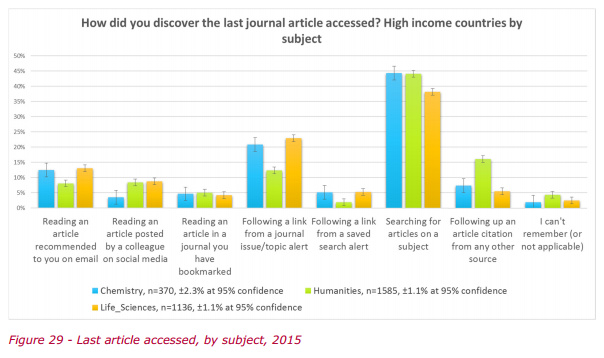
And the researchers found that…
* “Librarians behave quite differently to everyone else in search, preferring professional search databases and library-acquired resources.”
14 Sunday Feb 2016
I’m very pleased to see that the U.N. has launched the new comprehensive U.N. iLibrary, to act as a repository for all its major open-access items…
The United Nations iLibrary is the first comprehensive global search, discovery, and viewing source for digital content created by the United Nations. … Every year around 500 new titles are planned to be added to United Nations iLibrary.”
This new public site has over 700 books and annual reports accessible via /books/all.
02 Tuesday Feb 2016
A new white paper from publisher SAGE, “Expecting the Unexpected: Serendipity, Discovery, and the Scholarly Research Process”.
Serendipity is considered mainly in the context of discovery via automated content-recommendation systems, since the research (a survey and a literature review) was done in the context of the making of the new SAGE Recommends system.
So the report’s not really about serendipity in the wild frontier of academic keyword search on the open Web. There are some interesting observations, however…
“Serendipitous discovery should be of particular interest to information providers precisely because there is so little precedent; there is still tremendous scope for individual organizations to bring their own priorities and values to bear on how they recommend or otherwise help researchers discover their content.”
“If discovery is too exacting or too precise, it can end up reinforcing habits rather than exposing students and researchers to new information, sharply limiting the researcher’s view of the world of information. … We might even suggest that there is room for errors and luck in recommendation systems; a serendipitous system that does not include some element of chance is hardly serendipitous at all.”
“… based on our research, it appears that approaches to encourage serendipity that do not place the content front and centre might encounter problems.” [i.e.: academic searchers want recommendations based on the actual content, rather than on the behaviour or tastes of other system users]
“The less exciting, but equally as important, corollary to discovery is delivery, or access: providing the patron with the material once they have found it. Given that “the researcher’s discovery-to-access workflow is [already] much more difficult than it should be” (Schonfeld, 2015 $ paywall), improving discovery before solving the challenges of infrastructure and access is perhaps kicking the can down the road. This is not to say that there is no value to tools and solutions that promote discovery within an isolated silo, but their potential is limited until publishers, libraries, and discovery vendors make interoperability a priority.”
28 Thursday Jan 2016
OAPEN-UK’s final report on open access monographs, OAPEN-UK final report: A five-year study into open access monograph publishing in the humanities and social sciences.

“Many libraries will […] be providing links to the open access copies of monographs through their discovery systems, but librarians are not always aware of this. A minority are also reluctant to include open access content within their catalogues.”
“30% of respondents currently identify open access monographs for inclusion within their library collections – 49% do not, while 21% were unsure.” — Librarian survey for the report.
Unsure about including OA at all, or unsure if anyone on staff was identifying OA items?
“There are also large numbers of researchers – especially early career and retired academics – who do extremely valuable research which deserves publication but who work outside academic institutions. Changing publishing culture in a way that affected these researchers negatively would damage the overall discipline.”
06 Tuesday Oct 2015
JISC has commissioned a new September 2015 Spotlight Literature Review on scholarly discovery, which is available now in PDF. Short, but to-the-point…
in most cases staff over-estimate the extent to which users use different library services, in some cases very greatly. […] overall they think, it seems mistakenly, that the library discovery layer attracts very similar usage to Google Scholar”
one recent ethnographic study of student research behaviour (Dalal et al, 2015) highlights the low levels of information literacy skills displayed by many undergraduates even after library training in research skills [… they still had] very basic search techniques and poor search strategies [and a] Failure to locate the full text of articles.”
I’m interested in serendipity’s role in online search, and so I was pleased that the report pointed me to the December 2014 Library Journal article “Serendipitous Discovery: Is it Getting Harder?”. I was also rather tickled to discover that the word ‘serendipity’ was invented by Horace Walpole.
24 Tuesday Feb 2015
A new White Paper from the U.S. National Information Standards Organization (NISO), “The Future of Library Resource Discovery”…
“No open access discovery index has been created.” (p.15)
/cough/
[The white paper’s] “review of the [required] components of an index-based discovery service [purely for open access content] highlights the enormous level of resources required to create and maintain them. The creation of an open access discovery index would require the allocation of capital, personnel, and technical resources at least at the level of what any of the commercial providers has devoted to their projects.” (p.21)
Indeed.
22 Thursday Jan 2015
HEFCE report on Monographs and open access is out now…
The perception that academic books are not being read, or even read in depth, does not appear to be sustained by the evidence.”
A quick search and read-through of the main report shows no use of the words “index” or “indexing”, in the context of discovery. There are only fleeting and cursory mentions of “discovery”. Discovery for download-and-reading barely merits a full paragraph…
There appears to be disagreement about whether providing open access to a book without active measures to disseminate it is sufficient. … the rise of aggregation and distribution services for open-access books, as well as increasing sophistication in search engine technology and an ever-greater reliance among academics and others on the Web as a discovery tool, might help smaller operations to challenge the larger publishers … For policymakers this is a critical area of concern: a key benefit of open access is surely increased dissemination; if particular models are likely to fail in this regard, then the benefit could be lost.”
It would have been interesting to know if the current standard monograph practice requires that the author must submit a publicity and marketing plan along with their open monograph. That practice isn’t mentioned, so I wonder how often it happens in the UK. It seems a pity to overlook active paid-for marketing, of the sort that proper publishers take for granted. Especially when there might be an opportunity now to embed this widely for even the most diffident or overworked authors, potentially enhancing everything from the scholar’s career and the university’s standing through to the UK’s wider projection of ‘soft power’. So the report might have suggested (at least) a new flowchart / guide for planning some basic academic book marketing, and a requirement that it be completed and submitted along with the monograph. Something that would take just six hours to enact, by someone other than the author (one has to factor in how utterly sick of a book an author can be by the time it’s completed, and how they just want to see the back of it). Asking for specifics such as a list of Facebook groups and listservs etc; contacts for likely book reviewers; magazine and newsletter contacts for tailored press releases; ‘local author writes book’ local newspaper contacts (since their stories, naff though they may be in tone, show up in Google News); niche radio and podcast interview possibilities, and so on. Such a one-day publication-day campaign might then most usefully be handed off to a freelance marketeer on oDesk for $350 or so, rather than be dumped on someone who either lacks the skills or doesn’t have the time.
Note that there’s also an “Annex 3: Patterns of scholarly communication in the humanities and social sciences” for the report…
Humanities and social science researchers also seem to make significant use of relatively old content, compared to other disciplines. Tenopir et al (2012) find that around half of the ‘last articles read’ in the critical incident component of their survey were more than 6.5 years old; a quarter were more than 15 years old.”
27 Saturday Dec 2014
The new book-length Humanities World Report 2015 is now available for download in Kindle or PDF…
“The first of its kind, this ‘Report’ gives an overview of the humanities worldwide. Published as an Open Access title and based on an extensive literature review and enlightening interviews conducted with 90 humanities scholars across 40 countries, the book offers a first step in attempting to assess the state of the humanities globally.”

Some nicely pithy comments from interviewees throughout, drawn from interviews undertaken since 2011. But, rather oddly, a quick search of the body of the book for the phrase “open access” reveals not a single mention.
I had some fun boiling the report’s recommendations down to:
* Truth | [attempt to] reinstate confidence in the humanities as truth finding disciplines [and convey that] we do generate answers, as well as questions.
* Experience | position the humanities as the guardian of human diversity, [a] unique repository of knowledge and insight into the rich diversity of the human experience, past and present.
* Impact | [encourage] support systems for effective[ly and meaningfully conveying one’s work to wider audiences than just peers and students. Add] incentives to encourage more academics to engage in [this].
* Digital bridges | digital humanities experts [should] start the process of bridge-building [with those who either fear or don’t see the potential of digital humanities]. [We should also gently push supervisors for better] training [of] the next generation of humanists [enabling them to] exploit the potential of digital technologies and methods.
* Interdisciplinary (when it works) | not all research requires [a strong] quest for interdisciplinarity [and so it] should not be treated as an end in itself [by funders]. [We should be more aware of the contexts where] interdisciplinary [research] does have considerable [demonstrable] value [and learn how to break down] significant institutional barriers [to unlock that value]. [University] promotion criteria should be reformed so as to give due weight to interdisciplinary research [thus making it less] risky in terms of publication and career advancement.
* Integrity | increased scrutiny of [large funding programmes] to see how well they maintain academic freedom alongside [their role in government] decision-making [and validation of completed government schemes].
* Exploration | humanists should not typically be expected to answer the [“what use is this apparently useless research?”] question.
* Nomadics | there is a crying need for experiment over and above the traditional university and its disciplinary divides.
* Expeditions | [we need major new long-term] integrative platforms as spaces for networking, capacity building and preparation of research on questions [which aid the] understanding [of] the human condition. [These would go far beyond the existing traditional advanced] centres and institutes, visiting fellowships and stakeholder interaction [initiatives]. They might identify [what we don’t know] and what we might know [if the funding and will and focus were enough to] lower the barriers between the human, the social and the natural sciences, [and if researchers were allowed to pay no] regard to national priorities.
On that last point, the 10,000-year perspective and vigourous autonomy of The Long Now Foundation springs immediately to mind. They are, effectively, an expedition to the future.
On both the Impact and “what use is this apparently useless research?” points, I would have suggested a role for a new type of naturally inquisitive ‘curator and explicator’. Someone able to naturally pick up and draw out such tenuous or obscured connections, and from across a wide range of disparate research. Such a unique matchmaking/publicist role would rise far above the low orbit of a university’s PR department, or the middle manager who routinely bundles researchers into funding-worthy projects. Such a role would need a rare combination of curious journalist, art curator, brilliant academic, political operator and publicist.
03 Tuesday Jun 2014
David Prosser at Jisc blogs on the need for action on discoverability…
… 40% of researchers kicked off their project with a trawl through the Internet for material, while only 2% preferred to make a visit to a physical library space. [yet] nearly half of all items within digitised collections are not discoverable via major search engines by their name or title [and, even worse] digitised collections become harder and harder to find over time, for a variety of complex reasons.
