• Directory
  • FAQ: about JURN
  • Group tests
  • Guide to academic search
  • JURN’s donationware
  • Links
  • openEco: titles indexed

News from JURN

~ search tool for open access content

News from JURN

Category Archives: Academic search

Group test: “Alan Moore” Watchmen

30 Friday May 2014

Posted by futurilla in Academic search, JURN metrics

≈ Leave a comment

Another group test:

JURN group test: “Alan Moore” Watchmen
 
May 2014. Searching for free full-text scholarly articles, theses or book chapters in English, with primary discussion of the famous and seminal graphic novel Watchmen by Alan Moore. Not counting film criticism of the movie version, or book reviews. Clicked through on possible results, and briefly evaluated.
DOAJ 0 Used ‘Article’ search. 0 from four results.
Journal Click 0 0 from zero results. Seems to include a lot of predatory titles and publishers.
JournalTOCS 0 0 from zero results.
Ingenta Connect 0 0 from six paywalled results.
Journal Seek 0 0 from zero results.
Mendeley 0 Searched ‘Articles’ only, then filtered for Open Access articles only — which produced no relevant results. Then removed the OA filter, which gave three relevant results — that were found to be paywalled.
OAlib 0 From 16 results. Had a couple of relevant articles but these were not in English.
Google Search 0 Forced verbatim. Examined first 50 results. As you’d expect, a mess of commercial book listings pages and the occasional pop-cult interview with Moore. The addition of filetype:pdf helped — giving a scattering of student dissertations; the 1st (but not 2nd) edition of the Annotated Watchmen document; and a short undergraduate attempt at a bibliography of scholarly works on Watchmen.
Microsoft Academic 1 One of four results.
CORE 2 Filtered search by English language. CORE offered many incidental or spurious results.
OATD 3 Three from 14 results.
Digital Commons Network 3 Three from 17 results.
NDLtd 3 Three from 12 results.
Google Scholar 8 Examined first 50 results. Google Books links not counted. Five of the good results were from the open journal ImageTexT: interdisciplinary comics studies. Two likely good candidates proved to be “404 Not Found”.
BASE 9 Searched ‘Verbatim’ on ‘Entire Document’. Examined first 50 results.
OPENDoar 12   Examined first 50 results. Two appeared to be basic undergraduate seminar papers.
JURN 25   Checked first 50 results, not counting interviews, book reviews and duplicates. Results remained strong and on-topic right through to result 100.

For JURN, adding an additional search modifier helps to nudge away incidental and duplicate results…

   “Alan Moore” intitle:Watchmen
   [force intitle:]

   “Alan Moore” Watchmen Rorschach
   [add focus by adding the name of a key character]

   “Alan Moore” Watchmen -site:www.academia.edu
   [remove Academia.edu duplicates]

Microsoft Academic Search 2

21 Wednesday May 2014

Posted by futurilla in Academic search, Spotted in the news

≈ Leave a comment

Says Microsoft: it’s crap, but… ‘hey, there’s a new version coming soon’. No, they’re not talking about the Windows 8.1 KB2919355 debacle and Windows 10, but rather about MS Academic Search…

Asked about the collapse [in the current version], a spokesperson for Microsoft Research declined to address the problem directly, writing in an e-mail:

“Microsoft Academic Search [has] a next-generation version of MAS, which focuses on enhancing the user experience and evolving it from a research project to an integrated offering within Microsoft’s services portfolio. During this transition, Microsoft has maintained the features, functionality, and the ability for third parties to enter new and updated content into the existing search engine, but the majority of our focus has now shifted to this new initiative.”

Oaddo

18 Sunday May 2014

Posted by futurilla in Academic search, How to improve academic search, Spotted in the news

≈ Leave a comment

Oaddo is an early alpha of a cool new search tool. Imagine that Wikipedia and Pinterest combined to give autocomplete a usability makeover, with Trello acting as the makeup girl. The aim is to help you do deep ‘research search’ when you don’t really know what you’re searching for.

It has an interesting way of allowing your search terms to interact with clustered semantic tags, for drilling down to the best search result. Sort of like a Google autocomplete / autosuggest that’s slowed way down and is largely under your control, and is curated by humans — and as a consequence is not dumb.

Oaddo has a nice clean interface too, which is neatly poised between power and simplicity. The developer Tim Borny has obviously been looking at Trello and Pinterest for inspiration. Although at the moment the discarding of search modifier tags takes two clicks, instead of a fun one-click “fling it to the discard tray” movement.

The other innovation is that it aims to have a democratic user-driven model. That aspect might take Oaddo a long way, provided there’s a critical mass of people — and provided a mechanism can be found to reign in the inevitable SEO spivs, ideological censors, and WikiPolice types.

* Users will ‘vote’ on content, curate content and the database of related terms.

* The community will drive the addition of new features.

So, very interesting. Amid the sea of recent search launches, this is actually one to watch. Here’s Tim Borny’s full explanation…

[youtube https://www.youtube.com/watch?v=vCGeIV9NctA?rel=0&w=420&h=315]

Odysci

15 Thursday May 2014

Posted by futurilla in Academic search, Spotted in the news

≈ Leave a comment

Odysci Academic Search is aimed at allowing…

“technical professionals and companies to find and use the relevant technical information” in “computer science, electrical engineering and math-related areas”

Their blog entries tail off and stop in 2011, so it’s been around for a while, but the developers have a new paper which describes the technical infrastructure and gives the algorithms. I was interested to learn that…

“This framework is able to import, de-duplicate and persist 200K papers in the database (and all their entities) in 16 hours on an i7-based workstation with 32GB of RAM.”

My broad test search for…

   “energy conservation” organizations

… gave me 44 results which included three fulltext links. That suggests that when Odysci imports records, there might be PDF links on less than 10% of those records?

On that basis I would guesstimate an ability to ingest, strip and process perhaps 20,000 fulltext PDF papers every 16 hours, give or take? So in terms of making a standalone JURN, give me six such PCs and the bulk of the humanities journal indexing might be done in… six months? Keep in mind that processing power is increasing (the Core i7 CPU line was introduced in 2008). If Odysci’s i7 is a circa-2008 CPU then more modern processors will do the job faster, and superfast broadband would speed up the actual PDF downloading.

The same search in JURN tended to foreground papers on the role of human behaviours/attitudes and public policy in organizational energy conservation — rather than the technical aspects of electrical implementation. That suggests that — despite the recent science additions — JURN will tend to veer toward ‘the human element’ of topics. I also ran the test in Google Scholar, which proved to have the same veer, though with a heavier emphasis on articles from Psychology.

Slidee

09 Friday May 2014

Posted by futurilla in Academic search, Spotted in the news

≈ Leave a comment

Slidee, a new search engine for Powerpoint presentations. Very underpopulated at present, but it may improve. It’s better than Google in one respect: Google Search currently refuses to show any results when using a doubled-up filetype search, so as to cover both types of Microsoft Office file, such as this one…

metadata “open access” filetype:pptx filetype:ppt

Bing doesn’t balk at double filetype: modifiers, but then it just seems to discard/ignore any .pptx results (Google sees 10 million of those). Odd, considering Bing is from Microsoft.

PicaPica

05 Monday May 2014

Posted by futurilla in Academic search, Spotted in the news

≈ Leave a comment

Debora Weber-Wulff tests a plagiarism search/detection system called PicaPica.

Microsoft Academic Search abandoned?

01 Thursday May 2014

Posted by futurilla in Academic search, Spotted in the news

≈ Leave a comment

Did Microsoft effectively abandon Microsoft Academic Search to autopilot, sometime last year?

“an unexpected and unnoticed discovery: Microsoft Academic Search is outdated since 2013 … the second part of the working paper aims at advancing some data demonstrating this lack of update. … The data shows an abrupt drop in the number of documents indexed [per year?] from 2,346,228 in 2010 to 8,147 in 2013 and 802 in 2014.”

JURN group test: what is history carr

05 Saturday Apr 2014

Posted by futurilla in Academic search, JURN metrics, My general observations

≈ Leave a comment

Spurred by my recent musings on Future Studies, software bots, and ‘predictive intelligence‘, I’ve done a quick survey test by running JURN against other search tools. For the test I picked this search for E. H. Carr’s famous What is History?…

what is history carr

… intending to evaluate the ability to deliver semantic-deductive quasi-predictive search results based only on a very fuzzy ‘possible print title’ + ‘a hint at a possible surname’. A hat-tip to Musings About Librarianship (Aaron Tay) for this search idea.

JURN group test: what is history carr
 
April 2014, using unmodified Internet Explorer 11, not signed in to Google.
Searching for free full-text scholarly articles, theses or book chapters related to historian E. H. Carr. Clicked through on results, and evaluated.
Google Scholar 0 Examined first 50 results. Google Books links were not counted.
DOAJ 0 Used ‘Article’ search. The single result was a false positive for “Carr, L. G.”
JournalTOCS 0 Only 13 results
Ingenta Connect 0 Only 13 results
NDLtd 0 Only 7 results. Appears more generally to have a great many “404 Not Found” links.
Journal Seek 0 “No results” message was surrounded by Google ads.
Mendeley 0 Search ‘Articles’ only, then filtered for Open Access articles only. Mendeley ignored ‘Carr’ totally, and appeared to search only on ‘What’ + ‘History’. Examined first 20 results, 19 of which were science.
OATD 0 Looked at first 30 results. The No.1 result Politics at Its Demise: E. H. Carr, 1931-1939 looked promising, but this thesis proved to have been deleted or moved. All other results were way off mark.
Microsoft Academic 0 Examined first 50 results. Lots of paywall articles, on or from just about every Carr except A. H. Carr!
Digital Commons Network 0 Searched Arts and Humanities portal, then filtered results by ‘History’ facet. Appears to use the same system as OALib, giving many false positives for caricature, carrying and career etc.
CORE 1 Search not filtered. Examined first 50 results. Only the first topmost result was good.
OAlib 1 Examined first twenty results. Many false positives for caricature, carrying and carry. Switching to ‘Author’ search failed to surface A. H. Carr in first 10 results.
BASE 1 Searched ‘Verbatim’ on ‘Entire Document’. Examined first 50 results. Several promising early results proved to be repository records with no link to full-text. From the second page onward there were false positives for history + what and perhaps for carried.
OPENDoar 8 Examined first 50 results. Several valid results arose from approaches to understanding Carr in relation to Trotsky, in old leftist journals.
Google Search 9 Forced verbatim. Examined first 50 results. Didn’t count erudite blog posts (of which there were about a dozen, inc. a couple with footnote references) or Google Books links. Five of the nine counted results were sorry-looking unofficial scans of the famous work itself.
JURN 11   Checked first 50 results. First page of results has seven relevant results. Later false positives were nearly all for other academics named Carr.

CONCLUSION: So JURN is certainly not a magic wand for this tricky search, but it is performing much better than other search tools and vastly better than Google Scholar or the DOAJ. The results do especially well in terms of the accuracy of the first seven results, but thereafter they struggle (yet do at least focus mostly on people named Carr). Across all the search tools it was surprising to see so little cross-talk in the results from academic articles and chapters on Star Carr, a very famous archeological site in the UK. I noticed no cross-talk at all from the history of cars (vehicles) despite my lack of capitalisation on carr.

DATA: The relevant results list from JURN is…

1. Alun Munslow, Book review of E.H. Carr: A Critical Appraisal, History in Focus, Autumn 2001 (Institute of Historical Research at the University of London)

2. Alun Munslow, Review of What is History?, Reviews in History, November 1997.

3. Unofficial scan from What is History?.

4. Richard J. Evans, The Two Faces of E.H. Carr, History in Focus, Autumn 2001 (Institute of Historical Research at the University of London) (Based on his introduction to a new Palgrave edition of What is History?)

5. Table of Contents for the special What is History? edition of History in Focus, Autumn 2001 (Institute of Historical Research at the University of London)

6. Micheal Cox, Will the real E. H. Carr please stand up?, International Affairs, 75, 3 (1999). (Review of The Vices of Integrity, E. H. Carr, 1892-1982).

7. David Freeland Duke, Edward Hallett Carr: Historical Realism and the Liberal Tradition, Past Imperfect, Vol.2, 1993.

~

14. De Lamar Jensen, What is History? Edward Hallett Carr, Brigham Young University Studies, Vol.5, No.2 (1964).

~

26. Philosophy of History article in Internet Encyclopedia of Philisophy. (Mentions Carr in passing)

27. Ann Talbot, Chance and necessity in history : E.H. Carr and Leon Trotsky compared, Historical Social Research, 34 (2009).

28. Political Realism in International Relations article in Stanford Encyclopedia of Philosophy. (Carr has his own section in this, “E. H. Carr’s Challenge of Utopian Idealism”)


Why no Open J-Gate in this group test? It died years ago. Scirus also died more recently, at the start of 2014. Google News was tested, but for this search it proved to be useless at this moment in time — although it can sometimes be surprisingly useful.

Good Judgment

04 Friday Apr 2014

Posted by futurilla in Academic search, Spotted in the news

≈ 2 Comments

The Good Judgment Project is a four year study organized as part of a government-sponsored forecasting tournament. It is currently moving its 3,000 signed-up citizen ‘future forecasters’ toward the close of its season three, in which…

Thousands of people around the world predict global events. Their collective forecasts are surprisingly accurate.

They have to do a whole load of research of course, it’s not fortune-telling. Hope they know about JURN. They tend to work in teams of about twelve, but the delightfully named Dart-Throwing Chimp is one of those leading the pack. He…

would have qualified for ‘superforecaster’ status in Season 3 had he not joined our research team [to help craft better questions]

The background to this is the broad failure of intelligence-led prediction based on closed information, a topic that can be explored in an accessible manner by listening to the 90-minute Long Now Foundation talk “Why Foxes Are Better Forecasters Than Hedgehogs”.

The Good Judgment Project seems to suggest the best results may come from finding ways to reliably blend the aggregated ‘wisdom of the crowd’ + human-curated Big Data computer models + autonomous bots + time-served human experts. I predict that the area of practical ‘predictive intelligence’ is one that the average researcher is going to be hearing a lot more about over the coming years.

And it might be a field for the Arts and Humanities to pitch a tent in, re: the abilities of creative industries in cultural trend spotting and meme tracking, our advanced ethical tools, the skill-sets of digital humanists, the abundant lessons to be distilled from history, the insights of ethnography and suchlike.

Mendeley adds OA filter on its search

15 Saturday Mar 2014

Posted by futurilla in Academic search

≈ Leave a comment

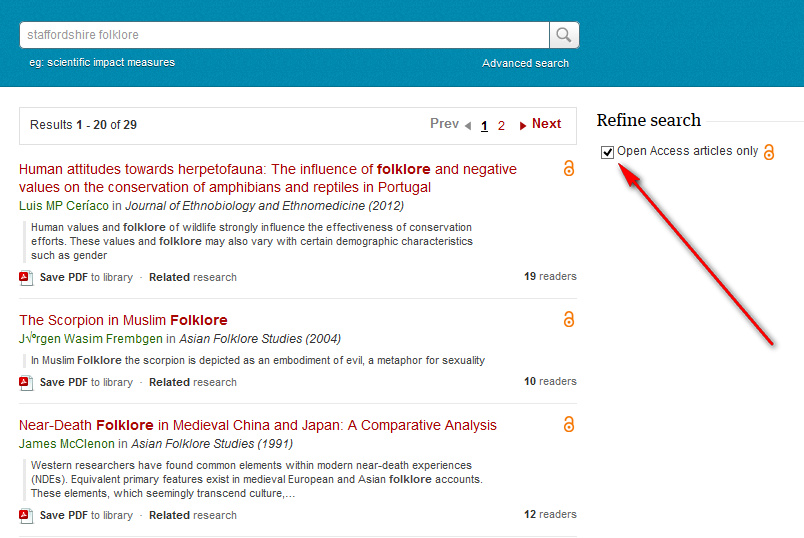
Mendeley now has an open access search filter check-box for its catalogue search. Although unfortunately it currently considers JSTOR articles to be open access. For most of us they’re not, beyond the first page.

medeley-oa

Europeana has the same problem, containing linked records pages for JSTOR content which isn’t open and public (e.g: “History of the churches of India” – Europeana links to it, it’s public domain, but JSTOR has the only copy and wants $10 to access it).

← Older posts
Newer posts →
RSS Feed: Subscribe


Please become my patron at www.patreon.com/davehaden to help JURN survive and thrive.

JURN

  • JURN : directory of ejournals
  • JURN : main search-engine
  • JURN : openEco directory
  • JURN : repository search
  • Categories

    • Academic search
    • Ecology additions
    • Economics of Open Access
    • How to improve academic search
    • JURN blogged
    • JURN metrics
    • JURN tips and tricks
    • JURN's Google watch
    • My general observations
    • New media journal articles
    • New titles added to JURN
    • Official and think-tank reports
    • Ooops!
    • Open Access publishing
    • Spotted in the news
    • Uncategorized

    Archives

    • February 2026
    • January 2026
    • October 2025
    • May 2025
    • April 2025
    • September 2024
    • June 2024
    • May 2024
    • April 2024
    • March 2024
    • February 2024
    • January 2024
    • December 2023
    • November 2023
    • October 2023
    • September 2023
    • June 2023
    • May 2023
    • January 2023
    • December 2022
    • November 2022
    • October 2021
    • September 2021
    • August 2021
    • July 2021
    • June 2021
    • May 2021
    • April 2021
    • March 2021
    • February 2021
    • January 2021
    • December 2020
    • November 2020
    • October 2020
    • September 2020
    • August 2020
    • July 2020
    • June 2020
    • May 2020
    • April 2020
    • March 2020
    • February 2020
    • January 2020
    • December 2019
    • November 2019
    • October 2019
    • September 2019
    • August 2019
    • July 2019
    • June 2019
    • May 2019
    • April 2019
    • March 2019
    • February 2019
    • January 2019
    • December 2018
    • November 2018
    • October 2018
    • September 2018
    • August 2018
    • July 2018
    • June 2018
    • May 2018
    • April 2018
    • March 2018
    • February 2018
    • January 2018
    • December 2017
    • November 2017
    • October 2017
    • September 2017
    • August 2017
    • July 2017
    • June 2017
    • May 2017
    • April 2017
    • March 2017
    • February 2017
    • January 2017
    • December 2016
    • November 2016
    • October 2016
    • September 2016
    • August 2016
    • July 2016
    • June 2016
    • May 2016
    • April 2016
    • March 2016
    • February 2016
    • January 2016
    • December 2015
    • November 2015
    • October 2015
    • September 2015
    • August 2015
    • July 2015
    • June 2015
    • May 2015
    • April 2015
    • March 2015
    • February 2015
    • January 2015
    • December 2014
    • November 2014
    • October 2014
    • September 2014
    • August 2014
    • July 2014
    • June 2014
    • May 2014
    • April 2014
    • March 2014
    • February 2014
    • January 2014
    • December 2013
    • November 2013
    • October 2013
    • September 2013
    • August 2013
    • July 2013
    • June 2013
    • May 2013
    • April 2013
    • March 2013
    • February 2013
    • January 2013
    • December 2012
    • November 2012
    • October 2012
    • September 2012
    • August 2012
    • June 2012
    • May 2012
    • April 2012
    • March 2012
    • February 2012
    • January 2012
    • December 2011
    • November 2011
    • October 2011
    • September 2011
    • August 2011
    • July 2011
    • June 2011
    • May 2011
    • April 2011
    • March 2011
    • February 2011
    • January 2011
    • December 2010
    • November 2010
    • October 2010
    • September 2010
    • August 2010
    • July 2010
    • June 2010
    • May 2010
    • April 2010
    • March 2010
    • February 2010
    • January 2010
    • December 2009
    • November 2009
    • October 2009
    • September 2009
    • August 2009
    • July 2009
    • June 2009
    • May 2009
    • April 2009
    • March 2009
    • February 2009

    Proudly powered by WordPress Theme: Chateau by Ignacio Ricci.