• Directory
  • FAQ: about JURN
  • Group tests
  • Guide to academic search
  • JURN’s donationware
  • Links
  • openEco: titles indexed

News from JURN

~ search tool for open access content

News from JURN

Category Archives: Academic search

Another Sci-Hub study

02 Thursday Nov 2017

Posted by futurilla in Academic search, Spotted in the news

≈ Leave a comment

Another recent study of the pirate academic site Sci-Hub, “Sci-Hub and LibGen: what if… why not?”. On a thoroughly randomised sample of articles, found via 55 different commercial databases recommended to students at McGill University, Canada…

the overall retrieval rates for the 2,750 samples, as of July 2017, is pretty good. The full-text retrieval rates for both Sci-Hub and LibGen are respectively 70% and 69% […] At the discipline level, the results are showing the lowest retrieval rates in Sci-Hub for Law (20%), Music (28%) and Business/Management (32%). [while] five databases (9%) are showing a 100% retrieval rate (British Humanities [Humanities Index, nowadays tracking around 400 titles from the UK and Commonwealth], Elsevier ScienceDirect, Sage, Springer and Wiley) coming from the following disciplines – Humanities and Multidisciplinary.

“100% retrieval rate” for the Humanities Index seems odd. Although looking at the titles list of current actively indexed titles, it seems possible for the 318 “Core coverage titles”. Though I’m not sure you’d be picking up many articles at Sci-Hub from newspapers such as the Times Literary Supplement or trade journals such as Town and Country Planning.

Open Access Journals in Commercial Databases

01 Wednesday Nov 2017

Posted by futurilla in Academic search, Open Access publishing, Spotted in the news

≈ 1 Comment

“Open for Business: Open Access Journals in Commercial Databases”, a new article (dated 27th October 2017) in The Serials Librarian journal.

‘Table 3. Presence of OAs titles in databases’. Percent of DOAJ titles found in database:

Scopus – 29.18%
Academic Search Complete – 18.00%
Web of Science – 10.91%

… between 70.82% and 89.09% of DOAJ journals are not found in the databases analyzed here, which is potentially problematic given that most researchers depend on databases to locate scholarly information

Open-i

30 Monday Oct 2017

Posted by futurilla in Academic search, Spotted in the news

≈ Leave a comment

Rather suitable for Halloween, the Open-i Biomedical Image Search Engine from nlm.nih.gov. Sample non-gruesome search: banana.

New paper: Academic Web Search Engines, 2014-2016

22 Saturday Jul 2017

Posted by futurilla in Academic search, How to improve academic search, Spotted in the news

≈ Leave a comment

“An Evidence-Based Review of Academic Web Search Engines, 2014-2016”… “This article seeks to summarize research concerning Google Scholar, Google Books, and Microsoft Academic from the past three years”.

Useful. Interesting snippets from this excellent new summary survey:

* Weiss noted, “no critical studies seem to exist on the effect that Google Books might have on the contemporary reference experience” (Weiss 2016, 293). […] Research is badly needed about the coverage and utility of both Google Books and Microsoft Academic.”

   Seriously? None, not one single study from 2005-2015? For one of the most important innovations in books since Gutenberg? Wow. That’s one hell of a grudge you’re holding there, librarians.

* “In September 2016, Hug et al. […] noted Microsoft Academic has “grown massively from 83 million publication records in 2015 to 140 million in 2016″ […] As of February 2017 its index contains 120 million citations.”

   Great news, which means I’ll have to take another look at that. I’m overdue for doing another big ‘group test’ of OA coverage in public search-engines, so this news may spur that. Of course, “citations” are not full-text, but 120m is impressive.

* “Bonato [2016] noted Google Scholar retrieved different results with Advanced and Basic searches”

   So that’s another thing to take into account if I do another group-test this summer.

* A “glaring lack of research related to the [search] coverage of arts and humanities scholarship” [and specifically] “Little is known about coverage of arts and humanities by Google Scholar.” [and it is evident that arts and humanities scholars’] preferences and behavior […] cannot be inferred from the vast literature focused on the sciences.”

* “research concerning the use of academic web search engines by undergraduates, community college students, high school students, and other groups would be welcome.”

* “Scholar results have been said to contain “clutter””.

   This is the closest the paper comes to mentioning all the predatory journals and similar dubious items, which get dragged into Scholar by automated collection bots.

* “During interviews of 20 historians by Martin and Quan-Haase (2016) concerning serendipity, five mentioned Google Books and Google Scholar as important for recreating serendipity of the physical library online.”

   Yes, serendipity is vital. It’s more of a loosely chain-linked set of serendipity loops during search-based research, really, interspersed with deep-dives to get tiny confirming nuggets of fact (e.g.: was Borges correct when he suggested that The Time Machine‘s famous central motif of ‘the future-flower’ was almost certainly not influenced by a striking passage in Coleridge’s notebooks? Yes he was, presumably by a private letter of enquiry to some learned bibliophile in London. But he was characteristically recondite on this point in the essay, and thus can only be proved correct if you do the 30 minute deep-dive to the primary sources needed to get the exact month-of-publication dates in 1895).

* “arts and humanities scholars […] commonly expressed the belief that having a complete list of research activities online improves public awareness [with] the enormous potential for this tool’s use.”

   Might be more useful to have a rolling listing of what’s not being done, but which needs to be done. Sort of like a speculative Kickstarter, only you’d gather people rather than cash.

* “Gardner (2016) showed […] people working in the humanities and religion and theology prefer to use Google”. “Humanities scholar use of Google over Google Scholar was also found by Kemman et al. (2013); Google, Google Images, Google Scholar, and YouTube were used more than JSTOR or other library databases”

* “Namei and Young’s [2015] comparison of Summon, Google Scholar, and Google using 299 known-item queries. They found Google Scholar and Summon returned relevant results 74% of the time; Google returned relevant results 91% of the time.”

* “In Yang’s (2016) study of Texas Tech’s DSpace IR [the university repository], Google was the only search engine that indexed, discovered, or linked to PDF files supplemented with metadata; Google Scholar did not discover or provide links to the IR’s PDF files, and was less successful at discovering metadata.”

   I’m guessing this possibly illustrates the value of separating a university’s big dumpy Digital Collections from the nimble research repository, by putting them on different domains? Texas Tech’s DSpace has them both cheek-by-jowl, and adds a Law repository for good measure.

* “IR platform and metadata schema dramatically affect discovery, with some IRs nearly invisible (Weideman 2015; Chen 2014; Orduña-Malea and López-Cózar 2015; Yang 2016) and others somewhat findable by Google Scholar (Lee et al. 2015; Obrien et al. 2016).”

* “Another area needing investigation is the visibility of links to free full text in Google Scholar.” [and more generally] “retrieval of full text, which is another area ripe for more research studies, especially in light of the impressive quantity of full text that can be retrieved without user authentication.” […] “When will academic users find a good-enough selection of full-text articles that they no longer need the expanded full text paid for by their institutions?”

   Indeed.

There are also good formulations of four future-research questions specific to the arts and humanities (pages 27-28).

The scanners run hot, in Iceland…

27 Thursday Apr 2017

Posted by futurilla in Academic search, New media journal articles, Spotted in the news

≈ Leave a comment

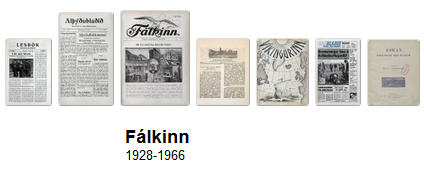
Iceland has digitised the historical collections for all of the nation’s newspapers, newsletters and small magazines and popped a unified search box on them. My search for a random set of likely keywords suggests they’re all in the local language.

Iceland’s historical digitised books collection is similarly comprehensive, and also contains a small number of English-language books recounting visits and stays on the Iceland.

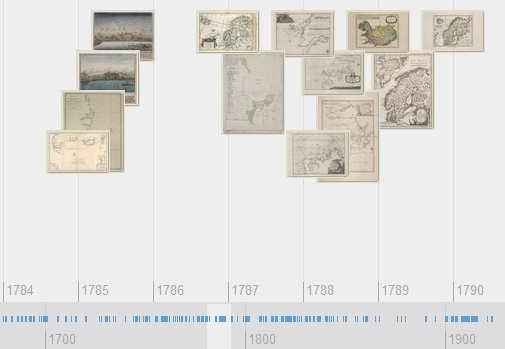
There’s also a similar historic manuscripts online library, and a historical maps collection with an embedded timeline of click-able thumbnails.

The timeline is built on the open source Web-widget SIMILE Timeline from MIT. I note that there’s now a 2015 WordPress Plugin which integrates the SIMILE Timeline into a self-hosted WordPress installation, and this rather usefully appears to allow the user to avoid a lot of hacking-and-slashing through the javascript and HTML. SIMILE can use multiple side-scrolling bands, allowing you to display and navigate long or highly detailed timelines.

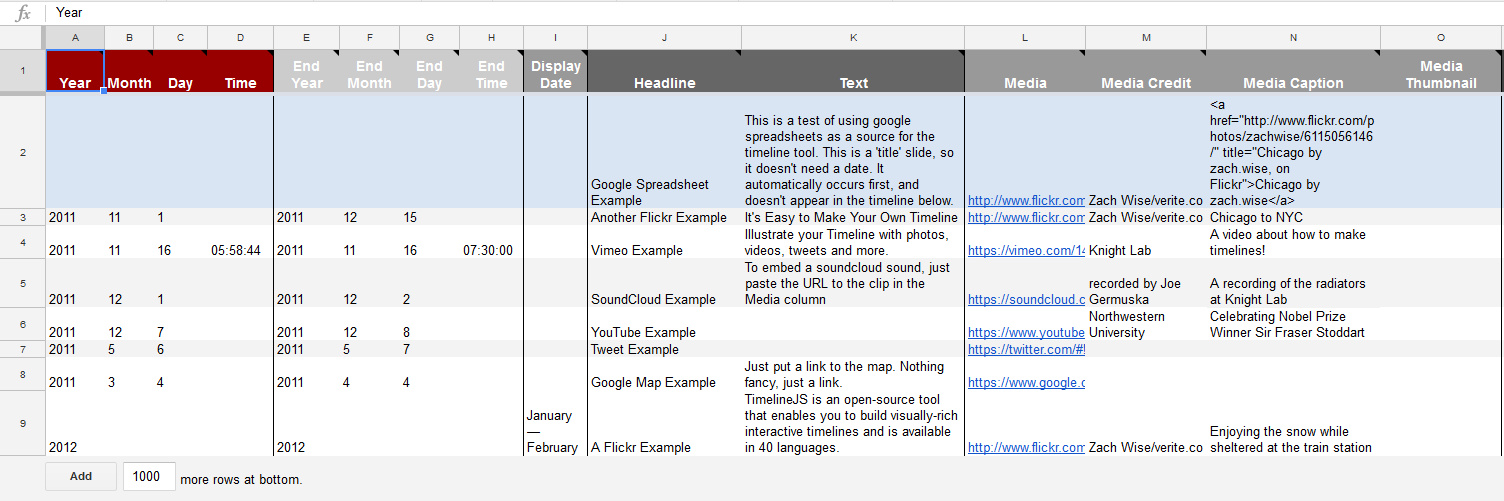
A simpler slideshow-like alternative would be TimelineJS, fairly easily workable via a Google Spreadsheet template rather than WordPress. The free service imports the completed Google Spreadsheet and automatically outputs an elegant simple side-scrolling timeline. Note however that the developers say that… “We recommend not having more than 20 slides [timeline points] for a reader to click through”, and that the Web page embedding code for “TimelineJS does not work with WordPress.com sites”.

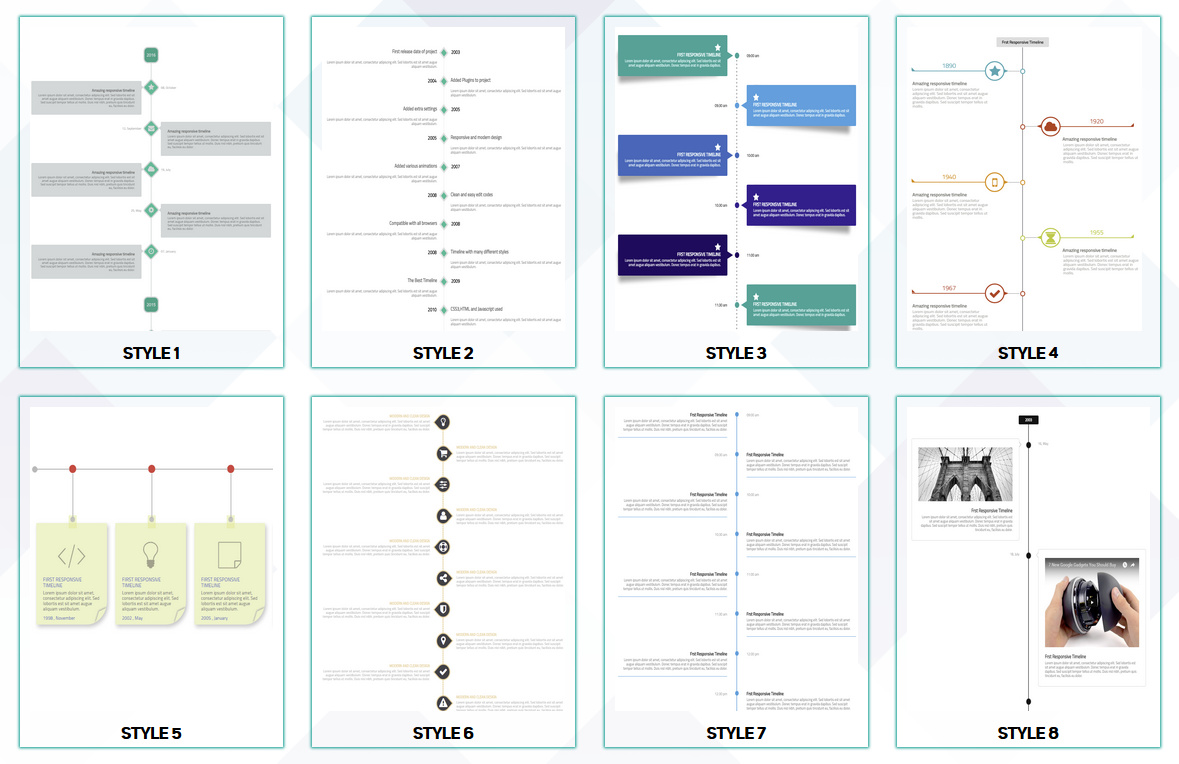
For small tablet-tastical timelines + templates, see the $12 Responsive Timeline by Toghrool on CodeCanyon, and his Responsive Timeline WordPress version. Made in 2017, and it looks good for making a short timeline which will have to be seen by tablet-centric clients from beyond the world of education.

Omeka also has the Neatline plugin, which might be worth a look if you’re working with maps and images and time.

If you can pay a monthly fee, I see there’s also now a nice-looking commercial timeline service called Tiki Toki.

findlectures.com

03 Friday Feb 2017

Posted by futurilla in Academic search, Spotted in the news

≈ 1 Comment

Lecture Search at findlectures.com is a new search tool, or at least it’s new to me. It appears to have launched in the summer of 2016, which is probably why I missed its launch. In the UK it would have been drowned out by the news of our glorious Brexit.

Lecture Search aims to find ‘intelligent talk’ files such as conference and academic lectures, and it does what it claims. A few early observations:

* Seems to be running from a hand-curated URL list. There’s evidence in the results that the last indexing run may have been in early 2016?

* Includes YouTube and Vimeo as sources but seems to have a filter on them, presumably via indexing only selected channels.

* Searchers should use NOT keyword rather than -keyword to knock out search words from results.

* Nice range of limiting facets, in the sidebar.

* One annoying pop-up nag-box, but it was easily killed with AdBlock Plus’s “select an element to hide…”.

* Relevance ranking is definitely not Google-licious, as it the case for all such Summon-like services. For instance: search for “cave art”, get “The Complete Poetry of Cesar Vallejo” as the first result. That page’s text happens to mention Vallejo once did some research on “cave art”, but then presumably the prestige of the result’s loc.gov URL lifts the result up to No.1.

* Not indexing the BBC’s hundreds of In Our Time .mp3 podcasts, which seems a pity.

Meta.com purchased, to be made free

31 Tuesday Jan 2017

Posted by futurilla in Academic search, Spotted in the news

≈ Leave a comment

In the news this week, Priscilla Chan and Mark Zuckerberg (Facebook) have purchased an academic search engine Meta, and are set to… “offer Meta’s tools free to all researchers” at some point in the future. Very nice of them.

Currently meta.com’s search is shuttered to the public, but the site is inviting sign-ups. Meta.com is not a name that’s been on the tip of my tongue, or covered here. I don’t recall if public access to it was ever available, but possibly not. Apparently the pre-Zuckerberg Meta was one a clutch of startups trying to apply AI to a limited set of the academic literature — often in the relatively tame-but-lucrative biomedical field. I had a glancing post here on the apparently-similar Iris AI 2.0 back in November. At its search tool level Iris AI seems to propose much the same search capabilities as Meta — but via a demo of 30m+ records harvested from repositories by CORE. In contrast the pre-Zuckerberg Meta.com covered PubMed, according to a November 2015 press-release, combining that with metadata input from “dozens of publishers”. Another November 2015 press release rather ambitiously claimed that Meta.com enabled a user to…

“navigate the entirety of scientific information (25 million papers with 4,000 new ones published daily)”.

“Ambitiously” because there’s no way that the “entirety of scientific information” in journal article form = 25m papers.

After the Zuckerberg-boosted relaunch the stated aim is to expand the functionality via third-party access…

“we will enable developers to build on it or integrate it into third party platforms and services … will embrace the ideas and efforts of researchers in the diverse fields that Meta intersects with – including machine learning, network science, ontologies, science metrics, and data visualization”.

Hopefully that opening up will also include open public access to the most juicy commercial bits of Meta.com, like the ‘early awareness’ Horizon Scanning module. This claimed to be able to descry a predictive map of future research agendas and trends…

“will enable academics and industries to maintain early awareness of emergent scientific and technical advances at a speed, scale and comprehensiveness far beyond human capacity, and years in advance”

Assuming that works as intended (I haven’t encountered any gushing reviews) I’m still not sure I’d want to absolutely rely on a predictive tool that only saw a fraction of the picture. Since a mere “25 million papers” seems a little lightweight, re: a claim to index “the entirety of scientific information”. On the other hand, if it covers all of the output in one’s tight little niche, and has semantic links out into a spread of related and similarly delimited fields, then it could be quite useful for some people.

Microsoft Academic tested

14 Tuesday Jun 2016

Posted by futurilla in Academic search, Spotted in the news

≈ Leave a comment

A June 2016 study of the current incarnation of Microsoft Academic…

“It outperforms the Web of Science for nearly all articles and is an equal to Scopus.”

Regrettably I’m unable to give it a quick test, as http://academic.microsoft.com/ is totally down for me at present — despite my trying it in multiple Web browsers.

VizioMetrix

01 Wednesday Jun 2016

Posted by futurilla in Academic search, Spotted in the news

≈ Leave a comment

VizioMetrix: Search Engine of Scientific Visual Information, from the eScience Institute at the University of Washington.

diag

“How Readers Discover Content in Scholarly Publications”

24 Thursday Mar 2016

Posted by futurilla in Academic search, Official and think-tank reports, Spotted in the news

≈ Leave a comment

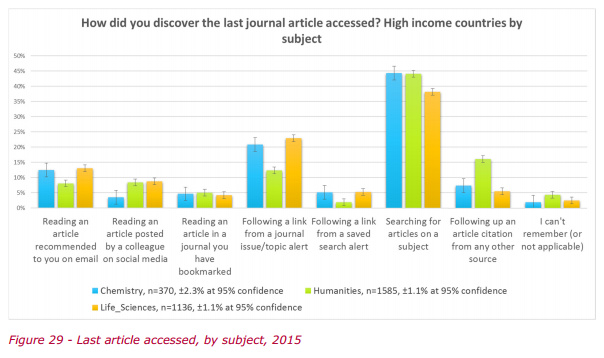
A major new consultancy report, “How Readers Discover Content in Scholarly Publications” (March 2016)….

* “… people working in the Government, Corporate and Charity sectors think Google is the most important discovery resource for books.”

This sentiment would have been rather more pronounced, if the Google respondees had been bundled with those who favoured Google Books.

* “… people working in Humanities and Religion & Theology prefer to use Google [rather than Google Scholar, to find articles]”

* “… people in Humanities are much less likely to use ToC alerts [to find their ‘last article accessed’] and have “other sources” they may use.”

Wide-spectrum serendipitous ‘topic search’, of the sort enabled by JURN, is also strongly favoured in the Humanities….

lastart

And the researchers found that…

* “Librarians behave quite differently to everyone else in search, preferring professional search databases and library-acquired resources.”

← Older posts
Newer posts →
RSS Feed: Subscribe


Please become my patron at www.patreon.com/davehaden to help JURN survive and thrive.

JURN

  • JURN : directory of ejournals
  • JURN : main search-engine
  • JURN : openEco directory
  • JURN : repository search
  • Categories

    • Academic search
    • Ecology additions
    • Economics of Open Access
    • How to improve academic search
    • JURN blogged
    • JURN metrics
    • JURN tips and tricks
    • JURN's Google watch
    • My general observations
    • New media journal articles
    • New titles added to JURN
    • Official and think-tank reports
    • Ooops!
    • Open Access publishing
    • Spotted in the news
    • Uncategorized

    Archives

    • February 2026
    • January 2026
    • October 2025
    • May 2025
    • April 2025
    • September 2024
    • June 2024
    • May 2024
    • April 2024
    • March 2024
    • February 2024
    • January 2024
    • December 2023
    • November 2023
    • October 2023
    • September 2023
    • June 2023
    • May 2023
    • January 2023
    • December 2022
    • November 2022
    • October 2021
    • September 2021
    • August 2021
    • July 2021
    • June 2021
    • May 2021
    • April 2021
    • March 2021
    • February 2021
    • January 2021
    • December 2020
    • November 2020
    • October 2020
    • September 2020
    • August 2020
    • July 2020
    • June 2020
    • May 2020
    • April 2020
    • March 2020
    • February 2020
    • January 2020
    • December 2019
    • November 2019
    • October 2019
    • September 2019
    • August 2019
    • July 2019
    • June 2019
    • May 2019
    • April 2019
    • March 2019
    • February 2019
    • January 2019
    • December 2018
    • November 2018
    • October 2018
    • September 2018
    • August 2018
    • July 2018
    • June 2018
    • May 2018
    • April 2018
    • March 2018
    • February 2018
    • January 2018
    • December 2017
    • November 2017
    • October 2017
    • September 2017
    • August 2017
    • July 2017
    • June 2017
    • May 2017
    • April 2017
    • March 2017
    • February 2017
    • January 2017
    • December 2016
    • November 2016
    • October 2016
    • September 2016
    • August 2016
    • July 2016
    • June 2016
    • May 2016
    • April 2016
    • March 2016
    • February 2016
    • January 2016
    • December 2015
    • November 2015
    • October 2015
    • September 2015
    • August 2015
    • July 2015
    • June 2015
    • May 2015
    • April 2015
    • March 2015
    • February 2015
    • January 2015
    • December 2014
    • November 2014
    • October 2014
    • September 2014
    • August 2014
    • July 2014
    • June 2014
    • May 2014
    • April 2014
    • March 2014
    • February 2014
    • January 2014
    • December 2013
    • November 2013
    • October 2013
    • September 2013
    • August 2013
    • July 2013
    • June 2013
    • May 2013
    • April 2013
    • March 2013
    • February 2013
    • January 2013
    • December 2012
    • November 2012
    • October 2012
    • September 2012
    • August 2012
    • June 2012
    • May 2012
    • April 2012
    • March 2012
    • February 2012
    • January 2012
    • December 2011
    • November 2011
    • October 2011
    • September 2011
    • August 2011
    • July 2011
    • June 2011
    • May 2011
    • April 2011
    • March 2011
    • February 2011
    • January 2011
    • December 2010
    • November 2010
    • October 2010
    • September 2010
    • August 2010
    • July 2010
    • June 2010
    • May 2010
    • April 2010
    • March 2010
    • February 2010
    • January 2010
    • December 2009
    • November 2009
    • October 2009
    • September 2009
    • August 2009
    • July 2009
    • June 2009
    • May 2009
    • April 2009
    • March 2009
    • February 2009

    Proudly powered by WordPress Theme: Chateau by Ignacio Ricci.