• Directory
  • FAQ: about JURN
  • Group tests
  • Guide to academic search
  • JURN’s donationware
  • Links
  • openEco: titles indexed

News from JURN

~ search tool for open access content

News from JURN

Category Archives: Academic search

Google’s Talk to Books

19 Saturday May 2018

Posted by futurilla in Academic search

≈ Leave a comment

Talk to Books is a new Google service that tries to show book snippets directly relevant to your well-formulated query question.

I rather unfairly tried it with a fiendish question: When did J.R.R. Tolkien discover the word earendel? (without quote marks). None of the results were accurate, in contrast to Google Books where the top three results were accurate / useful / authoritative, as was the seventh result. Not only that, but the snippets were also more or less spot on.

It’s a tricky question, not only because lower-case earendel is Anglo-Saxon. There’s that use, and then there’s also the capitalised name Eärendil. Which is the name of the character Tolkien developed, after being inspired by the Anglo-Saxon word and its very complex clusters of meanings and associations. The other problem is that no-one knows exactly when in the first half of 1913 he found the word, and exactly where he found it — in a dictionary, a commentary or a footnote, or was he told about it by a tutor at Exeter College (he was having personal tuition with some of the great names in word-lore), or was his first encounter with the word while actually reading Crist in Old English? The word is the key root-hole for his work, from which the seed of his great legendarium later arose.

So, kudos to Google Books for getting it right in a useful way. Google’s Talk to Books on the other hand seems to have semantically smushed the words and ignored earendel. The name-authority was accurate, but it seemed to assume I just wanted something about Tolkien and his use of words in general, and tried a scattergun approach…

1. His fictional use of dwarf-names in the Icelandic Dvergatal (‘Dwarf table’), found in the Voluspa.
2. His early work on writing entries for the Oxford English Dictionary.
2. His mid-career attitude to the Celtic languages.
4. His entry for “Walrus” in the Oxford English Dictionary.
5. His early and reluctant abandonment of the worn-out word ‘fairy’ in his early poetry and invented-languages, in favour of ‘elf’.

There was no connection made between earendel and Eärendil, which suggests that perhaps Talk to Books might usefully add a semantic sub-system devoted to character-names, and their variants and mis-spellings?

‘Discoverability of award-winning undergraduate research in history’

03 Thursday May 2018

Posted by futurilla in Academic search, Spotted in the news

≈ Leave a comment

New paper: “The discoverability of award-winning undergraduate research in history: Implications for academic libraries”, College & Undergraduate Libraries, April 2018…

“eight of the fifteen papers could be found in full text. If full text was available somewhere, Google always found it. Google Scholar only found four of the eight full-text papers […] Microsoft Academic found two of the full-text papers”

Lens.org

01 Tuesday May 2018

Posted by futurilla in Academic search, Spotted in the news

≈ Leave a comment

Lens Scholarly Search, a new tool to search across patents and citations at the cutting-edge of innovative science and engineering. Looks great, with nice clean design and fast response. It’s one of the new wave of citation search tools.

It’s public, and can be used without an account sign-in, unlike Sparrho (which claims 60m across both citations and patents).

I can’t see any way to filter the search results for “… and has link to free public full-text”. But I guess if you need a focussed tool like this, then your innovative project has the funding to access everything that you need to read.

Searches can be embedded in URLs, as can the ‘search by date’ setting. Which means that saving a set of bookmarks would give you a usefully quick way of regularly horizon-scanning across the developed applications and commercialisation of a specific research topic. I don’t see that Lens.org has the capability to offer a RSS alerts-type feed, based on keywords, though it looks like it may do if you sign up for an account. Of course, on highly sensitive projects, such an account has dangers — in that you don’t know if competitor nations might be sniffing at or profiling your search-trail in some way.

New book: Harnessing the Power of Google

01 Thursday Mar 2018

Posted by futurilla in Academic search, Spotted in the news

≈ Leave a comment

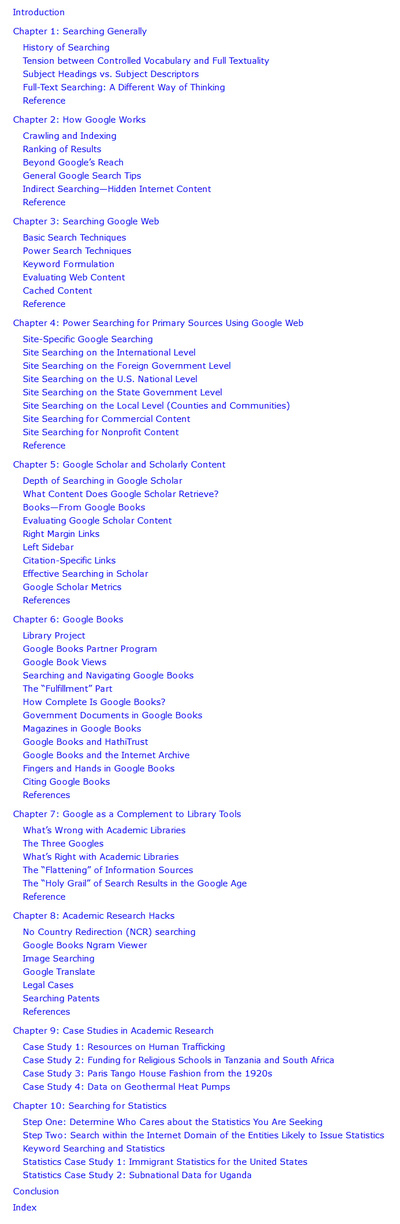
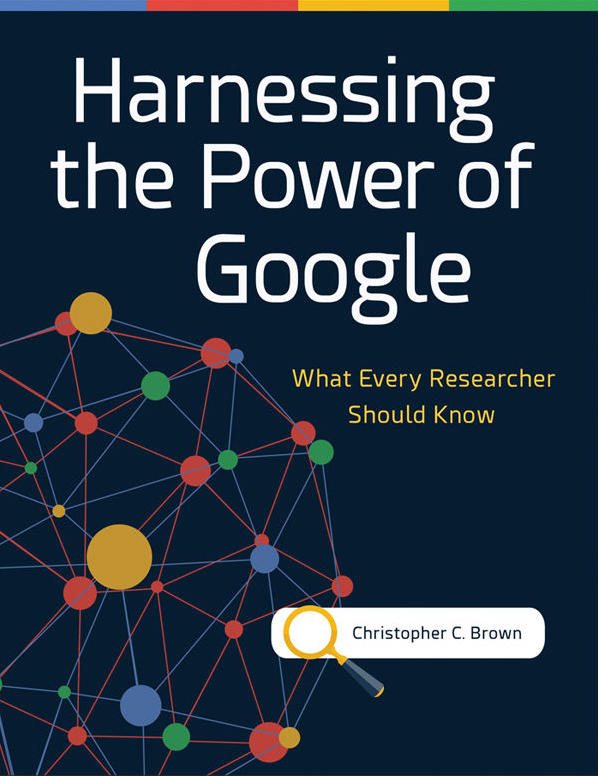
I see that I missed the publication of a new book about Google Search. Harnessing the Power of Google: What Every Researcher Should Know was released in summer 2017, when I wasn’t paying much attention to news. It’s a short primer of 150 pages and the contents list looks very encouraging. These contents seem to chime with a blog review and an Amazon review, which both suggest the book is aimed at… “librarians who will be working with researchers”. Implying researchers of the type who will expect to be working with expert Google users rather than Google-phobics.

It’s possible to peer inside the book via Google Books. Sadly this shows that the book doesn’t mention the rich possibilities of Google Custom Search, as a keyword search of the text shows no results for either “custom search” or “CSE”.

It appears that the book has yet to receive any open/public reviews from librarians. But the business researcher blog Infonista has a polished and informative review.

“Access to Freely Available Journal Articles” (2017)

27 Tuesday Feb 2018

Posted by futurilla in Academic search

≈ Leave a comment

Access to Freely Available Journal Articles: Gold, Green, and Rogue Open Access across the Disciplines (2016 conference presentation script/summary, published 2017)…

“We randomly selected 300 articles that were indexed in Scopus and published in 2015. A hundred of them are from the arts and humanities, and a hundred of them are from the social sciences, and a hundred are from the life sciences, and all of them, again, randomly selected.”

These 300 appear to have been a random mix of paywall and OA and were then searched for on Google, Google Scholar, Researchgate, and Sci-Hub. The researchers were simply looking for free public copies of the articles, wherever they could be found.

The methodology used is slightly fuzzily explained…

“We just did a title search. We didn’t do anything further than the title search”.

Fuzzy, because a Google “full-title” known-title search “as a phrase” is not the safest way to go about such a test. Due to the way Google Search works, ideally one would want to search on the first 50 characters of the title instead of on the entirety of a long academic article-title.

Also, Scopus is poor at indexing Open Access, only managing 29.18% coverage of the DOAJ Open Access titles even in 2017. And the Scopus spreadsheet, now sortable by OA status, indicates Scopus has very poor coverage of OA arts and humanities titles. So 100 arts and humanities articles from Scopus is not a great starting point, even if suitably randomised. The sample will likely skew heavily toward paywall articles.

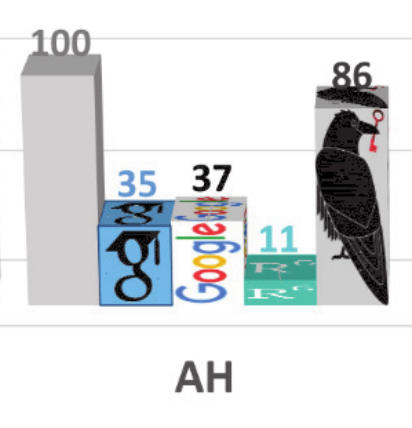
Anyway, even with these limitations the results for public full-text free-access were somewhat interesting. From left to right, just for the 100 Arts & Humanities articles: Google Scholar, Google Search, Researchgate, and Sci-Hub (prior to its recent problems)…

Sci-Hub was known to have severe problems accessing things like recent Project MUSE articles, so perhaps glitches like that prevented an even higher result than 86%.

More GRAFT

20 Tuesday Feb 2018

Posted by futurilla in Academic search, New titles added to JURN

≈ Leave a comment

GRAFT has updated with new additions to the URLs indexed. Now searching across full-text and records alike, in 4,569 repositories.

Massive Bronze figure unearthed

14 Wednesday Feb 2018

Posted by futurilla in Academic search, Open Access publishing, Spotted in the news

≈ Leave a comment

“The state of OA: a large-scale analysis of the prevalence and impact of Open Access articles” (Feb 2018, PeerJ)…

“the most common mechanism for OA is not Gold, Green, or Hybrid OA, but rather an under-discussed category we dub Bronze: articles made free-to-read on the publisher website, without an explicit Open license.”

Of Bronze, “few studies have highlighted its role” [in OA]. “We manually inspected a small sample of Bronze articles in order to understand this subcategory more; we found that while many Bronze articles were Delayed OA from toll-access publishers, nearly half were hosted on journals that published 100% of content as free-to-read but were not listed on the DOAJ and did not formally license content (using CC-BY or any other license).”

Bronze was found to be at a whopping 47% of OA, from a one-week sample of Unpaywall-DOIs in 2017.

Completeness and overlap in open access systems

22 Friday Dec 2017

Posted by futurilla in Academic search, Spotted in the news

≈ Leave a comment

A new paper, “Completeness and overlap in open access systems: Search engines, aggregate institutional repositories and physics-related open sources”. It tests the coverage of papers published from 2001-2013 by Nobel Prize winners in Physics. ‘Not all that many papers, then…’ you might think, but apparently 6,094 items were searched for.

96.8%  Google Scholar
96.5%  Astrophysics Data System
91.6%  Microsoft Academic (current version)
48%  OpenDOAR
45.3%  OAIster

Mixnode

29 Wednesday Nov 2017

Posted by futurilla in Academic search, Spotted in the news

≈ Leave a comment

Common Crawl has updated and is now at “3.2 billion Web pages and 260 TiB of uncompressed content”. In September they added a list of university domains to the crawl. This time, for the first time, they’ve actively been trying to blacklist spam-network pages.

The Crawl is also now including 300m+ new URLs from a paid service called Mixnode, which looks like a very interesting on-demand custom-crawling and indexing service…

“Mixnode can breeze through thousands of URLs per second and download gigabytes of data per minute without a hitch.”

Presumably some of this comes via abstracting sections of the Common Crawl, then ‘filling in’ the rest?

Now all Mixnode needs is a half-decent ‘public search’ front-end for a Mixnode crawl, and it’s ‘Build Your Own Search Engine’ time — without the limitations of a Google CSE.

oaFindr now called 1Findr

17 Friday Nov 2017

Posted by futurilla in Academic search, Spotted in the news

≈ Leave a comment

Nothing about this on Google News, but apparently the universities-only oaFindr has dropped the OA bit of the name and is now called 1Findr…

“1science has decided to change the name of the product line. Market analysis shows that its greatest value is the analysis and the integral access to the content, and to reflect this change, they have changed the prefix “oa” to “1”. So, oaFindr becomes 1Findr; oaFigr becomes 1Figr; and oaFoldr + becomes 1Foldr Data.”

Por un lado, 1science ha decidido cambiar el nombre de línea de productos. Puesto que su mayor valor es el análisis y el acceso integral al contenido, para reflejar este cambio, han cambiado el prefijo “oa” por “1”. Así pues, oaFindr se convierte en 1findr; oaFigr se convierte en 1figr; y oaFoldr + se convierte en 1foldr Data. … proporciona hipervínculos a 30 millones de artículos disponibles en acceso abierto.

Source, SEDEC Bulletin, Nov 2017.

The same source also quotes some current statistics. According to the CEO 1Findr currently … “provides hyperlinks to 30 million articles available in Open Access.” as part of a wider mixed database of records for 85 million. That’s both paywalled and OA academic articles. Apparently dating from the 17th century onwards, interestingly. In comparison, Microsoft Academic’s last known total (late 2016) was 140 million.

← Older posts
Newer posts →
RSS Feed: Subscribe


Please become my patron at www.patreon.com/davehaden to help JURN survive and thrive.

JURN

  • JURN : directory of ejournals
  • JURN : main search-engine
  • JURN : openEco directory
  • JURN : repository search
  • Categories

    • Academic search
    • Ecology additions
    • Economics of Open Access
    • How to improve academic search
    • JURN blogged
    • JURN metrics
    • JURN tips and tricks
    • JURN's Google watch
    • My general observations
    • New media journal articles
    • New titles added to JURN
    • Official and think-tank reports
    • Ooops!
    • Open Access publishing
    • Spotted in the news
    • Uncategorized

    Archives

    • February 2026
    • January 2026
    • October 2025
    • May 2025
    • April 2025
    • September 2024
    • June 2024
    • May 2024
    • April 2024
    • March 2024
    • February 2024
    • January 2024
    • December 2023
    • November 2023
    • October 2023
    • September 2023
    • June 2023
    • May 2023
    • January 2023
    • December 2022
    • November 2022
    • October 2021
    • September 2021
    • August 2021
    • July 2021
    • June 2021
    • May 2021
    • April 2021
    • March 2021
    • February 2021
    • January 2021
    • December 2020
    • November 2020
    • October 2020
    • September 2020
    • August 2020
    • July 2020
    • June 2020
    • May 2020
    • April 2020
    • March 2020
    • February 2020
    • January 2020
    • December 2019
    • November 2019
    • October 2019
    • September 2019
    • August 2019
    • July 2019
    • June 2019
    • May 2019
    • April 2019
    • March 2019
    • February 2019
    • January 2019
    • December 2018
    • November 2018
    • October 2018
    • September 2018
    • August 2018
    • July 2018
    • June 2018
    • May 2018
    • April 2018
    • March 2018
    • February 2018
    • January 2018
    • December 2017
    • November 2017
    • October 2017
    • September 2017
    • August 2017
    • July 2017
    • June 2017
    • May 2017
    • April 2017
    • March 2017
    • February 2017
    • January 2017
    • December 2016
    • November 2016
    • October 2016
    • September 2016
    • August 2016
    • July 2016
    • June 2016
    • May 2016
    • April 2016
    • March 2016
    • February 2016
    • January 2016
    • December 2015
    • November 2015
    • October 2015
    • September 2015
    • August 2015
    • July 2015
    • June 2015
    • May 2015
    • April 2015
    • March 2015
    • February 2015
    • January 2015
    • December 2014
    • November 2014
    • October 2014
    • September 2014
    • August 2014
    • July 2014
    • June 2014
    • May 2014
    • April 2014
    • March 2014
    • February 2014
    • January 2014
    • December 2013
    • November 2013
    • October 2013
    • September 2013
    • August 2013
    • July 2013
    • June 2013
    • May 2013
    • April 2013
    • March 2013
    • February 2013
    • January 2013
    • December 2012
    • November 2012
    • October 2012
    • September 2012
    • August 2012
    • June 2012
    • May 2012
    • April 2012
    • March 2012
    • February 2012
    • January 2012
    • December 2011
    • November 2011
    • October 2011
    • September 2011
    • August 2011
    • July 2011
    • June 2011
    • May 2011
    • April 2011
    • March 2011
    • February 2011
    • January 2011
    • December 2010
    • November 2010
    • October 2010
    • September 2010
    • August 2010
    • July 2010
    • June 2010
    • May 2010
    • April 2010
    • March 2010
    • February 2010
    • January 2010
    • December 2009
    • November 2009
    • October 2009
    • September 2009
    • August 2009
    • July 2009
    • June 2009
    • May 2009
    • April 2009
    • March 2009
    • February 2009

    Proudly powered by WordPress Theme: Chateau by Ignacio Ricci.