• Directory
  • FAQ: about JURN
  • Group tests
  • Guide to academic search
  • JURN’s donationware
  • Links
  • openEco: titles indexed

News from JURN

~ search tool for open access content

News from JURN

Category Archives: Academic search

Towards a meta-pedia browser add-on

11 Thursday Jun 2020

Posted by futurilla in Academic search, How to improve academic search

≈ Leave a comment

An interesting idea: a meta-pedia browser add-on, to consult all public encyclopedias at the same time. Presenting the results as an elegant full-screen dashboard with a strip of side-links to Google Books, Archive.org, Scholar, JURN etc. Ideally with configurable sources…

* Wikipedia
* Current Britannica
* 1911 Britannica
* Specialist public encyclopedias is they exist for the topic, e.g. Philosophy, Catholic, Science-fiction etc.

I’m assuming this would need to be a browser add-on, as a cloud service that did this would face lawsuits and frame-busting scripts. The closest I can find is 2019’s free ResearchKit which shows Wikipedia and the current Britannica side-by-side, above bot-driven auto-summaries of their text. It’s not exactly elegant to look at it, but it works.
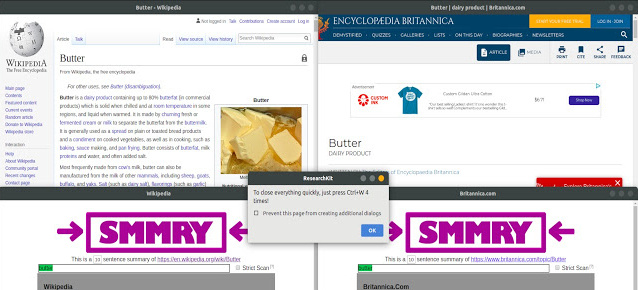
Obviously some fuzzy-lookup might be needed to align search topics, though the individual encyclopedias strive to do that on their pages via navigation strips and links.

But rather than jumping straight to a presumed page, perhaps each encyclopedia panel might first show sub-panels with a half-dozen ‘possible’ hits, colour-shaded by order of likely relevance to the search. If such a browser addon was in widespread use, the data gathered from such mass human-driven topic-selection/alignment might be rather useful, over time being judiciously used to augment existing ‘knowledge navigation trees’ that are able to cope at a meta-level with shifting topic titles (e.g. Aetheopia > Abyssinia > Horn of Africa > Eastern Africa > Ethiopia).

Another way to do it might be for the addon to ‘read’ such existing navigation on the encyclopedia pages, make its own deft distillation of such, and then use that to ‘prime’ with keywords the sidebar links to Google Books, Archive.org, Scholar, JURN etc.

New from Google Research

05 Tuesday May 2020

Posted by futurilla in Academic search, Spotted in the news

≈ Leave a comment

Google Research has launched COVID-19 Research Explorer. This has “a semantic search interface” that enables better search and discovery across “more than 50,000 journal articles and preprints”.

A new group test of search

17 Friday Jan 2020

Posted by futurilla in Academic search, Spotted in the news

≈ Leave a comment

Which Academic Search Systems are Suitable for Systematic Reviews or Meta-Analyses? Evaluating Retrieval Qualities of Google Scholar, PubMed and 26 other Resources, October 2019.

“Our tests revealed that the help files of numerous search systems promise a Boolean search functionality that our tests could not verify. These findings were especially alarming because users of such systems rely on functionalities that they assume work properly, but that may not be the case.” … “our results contradict systematic review guidance that assumes that “all the search engines in some way [would] permit the use of Boolean syntax operators to expand or restrict the search””.

Regarding… “full Boolean search strategies” the authors also noted that “Google Scholar [does] not offer such functionality”. The word “full” here is the critical word, and indicates that NOT is still a missing operator for Google Scholar.

For open access, this new test concludes that those outside of biomedical research… “are limited to the multidisciplinary system BASE” for discovering open access material, but that unspecified… “other open, or partially open search systems that fail to meet the criteria for query-based search might still be useful for supplementary search methods.”

Review of Cabell’s Predatory Journal Blacklist

02 Thursday May 2019

Posted by futurilla in Academic search, Spotted in the news

≈ Leave a comment

A new review of a paywalled up-to-date blacklist of predatory journals, “Cabell’s Predatory Journal Blacklist: An Updated Review”, at the Scholarly Kitchen.

SciRide Finder

12 Friday Apr 2019

Posted by futurilla in Academic search, Spotted in the news

≈ Leave a comment

SciRide Finder is a newly launched search tool that searches Medline/PubMed, but it limits the search to just those “statements, numbers and protocols” which cite other publications. A fine idea, but the core concept may initially be a little difficult for humanities scholars to fathom. You can see what they’re talking about, in this visual example…

SciRide Finder appears to have crashed under the initial surge of traffic, but is “under maintenance” and should be up again soon.

Mamont

06 Saturday Apr 2019

Posted by futurilla in Academic search, Spotted in the news

≈ Leave a comment

I’m pleased to find another good FTP search engine for filename searches, Mamont. The best of the bunch on Biskbard’s survey.

Caught in the Web

31 Sunday Mar 2019

Posted by futurilla in Academic search, Spotted in the news

≈ Leave a comment

“Building a mission critical research ecosystem for Russia” (Feb 2019). The glossy report appears to be at attempt to sell Web of Science to Russia, and states…

The Web of Science platform is the first and only comprehensive, publisher-neutral discovery resource for trusted, peer-reviewed Open Access content.

More on OA in Web of Science and Scopus

21 Thursday Feb 2019

Posted by futurilla in Academic search, Ooops!

≈ Leave a comment

A new February 2019 paper, from the German Centre for Higher Education Research and Science Studies, testing existing methods for auto-detection of OA papers in Web of Science (WOS) and Scopus. The conclusions are about what you might expect — that it’s easier said than done, even with such well-behaved services, and even then it’s partial.

But as part of the study a research assistant valiantly undertook further manual checking by hand. They found that OA full-text links there were broken at a rate of 17%…

“a further manual check found about 17% of OA publications are not accessible … 17.57% in WOS and 16.74% in Scopus.”

OOIR

12 Tuesday Feb 2019

Posted by futurilla in Academic search, How to improve academic search, Spotted in the news

≈ Leave a comment

The new OOIR List. Currently with 849 journals in its List, these being from Web of Science’s SSCI journals in social studies. 119 of the titles on the OOIR List are flagged as Open Access, though a good number of these are greyed-out and not tracked (because they don’t bother to also submit to CrossRef).

Evidently Web of Science only covers 119 such OA titles, which means its OA coverage in this area has hardly budged since 2015 when Web of Science was only showing 116 titles in OA in social studies.

Within that very limited range, what OOIR is trying to do with its titles seems interesting, by providing an aggregated ‘latest’ / ‘trending’ / ‘active journals’ dashboard. It’s neatly presented, and there are also per-journal metrics over on the Statistics tab.

Apparently the service is focussed on recent papers, and “OOIR does not link to papers published before Nov 2018”. A previous RSS-feed based version, for politics and diplomacy, was titled Observatory of International Relations (OIR). But this has now been shut in favour of OOIR.

I guess the question now is, would it be possible to build something bigger and similar and slightly shinier, that could provide a public tracking-dashboard for all such material of use to those interested in timely new research on politics, diplomacy and related matters? Zak Kallenborn has some ideas on that in his recent article “Academic Paywalls Harm National Security”.

Humanists’ digital workflows

05 Wednesday Dec 2018

Posted by futurilla in Academic search, JURN tips and tricks, Spotted in the news

≈ Leave a comment

New in DHQ: Digital Humanities Quarterly, “Researcher as Bricoleur: Contextualizing humanists’ digital workflows”. A small-scale observational study from 2016, building on a larger ‘Digital Scholarly Workflow’ study. The body is made up of case studies and commentary. Here’s the tale of a search by a historian for “1916” “November” “War Council”:

Audrey, a professor of history, searched for literature on an event that took place in 1916, and for which she had only partial information. Audrey’s search starts with her personal collection of notes written in Word and stored on the internal hard drive. She uses a Word search function that queries the folder for a supposed event name, but this search yields no result. Audrey then switches to her browser and the online search. She logs on to the Penn State library and enters a search phrase composed of three descriptors into the discovery search interface, LionSearch. This attempt does not yield any results either.

“Okay, no problem, I’m going to go to some of my favorite databases,” Audrey says optimistically, and, using the same search phrase, she continues her search in the Historical Abstracts database. “All right, I need another field. It happened in Rome,” she comments still optimistically, and expands her search with one more field, which reads “Rome.” Still nothing. “Seriously?!,” Audrey exclaims with annoyance. “All right, let me just do ‘war council,’ something more specific,” she says with reasserted optimism, and changes her search phrase accordingly. Failure again. “Really?!,” Audrey laments in shock. “I would have thought it was more important.” Audrey then reaches to her bookshelf and grabs a book. She reads through a few pages, trying to find any additional information that could help her search. Nothing. But Audrey is not ready to give up yet.

She returns to her library search and adds “November” as one more search field, trying to make her query as precise as possible. No results. Still, Audrey does not give up, and, instead of adding one more search term, she decides to change her search phrase. She creates a new search phrase, again composed of three descriptors as the possible event name. “Nope. All right, strange,” Audrey says quietly, confident that any further search would be pointless. “You would think someone must have written an article about this. It was the time that the different allies got together and hammered out a strategy…,” she continues murmuring, but discontinues her library search.

Instead, Audrey decides to try her luck with Google Search. She enters the search phrase and the Wikipedia entry pops up right away. “See, that’s the thing,” Audrey comments. “One would love to use more scholarly resources, but I just typed [the search phrase] and it’s up there [on Wikipedia]! Sadly, Historical Abstracts was not of too much use; the most useful one was still Wikipedia,” this historian concludes.

The problem here appears to be that the Supreme War Council of the three allies was created in November of 1917, not 1916. Only by switching the search terms from 1916 to 1917 does the Wikipedia page mentioned appear, so one has to suspect that there was some finessing of the search before hitting Google Search.

← Older posts
Newer posts →
RSS Feed: Subscribe


Please become my patron at www.patreon.com/davehaden to help JURN survive and thrive.

JURN

  • JURN : directory of ejournals
  • JURN : main search-engine
  • JURN : openEco directory
  • JURN : repository search
  • Categories

    • Academic search
    • Ecology additions
    • Economics of Open Access
    • How to improve academic search
    • JURN blogged
    • JURN metrics
    • JURN tips and tricks
    • JURN's Google watch
    • My general observations
    • New media journal articles
    • New titles added to JURN
    • Official and think-tank reports
    • Ooops!
    • Open Access publishing
    • Spotted in the news
    • Uncategorized

    Archives

    • January 2026
    • October 2025
    • May 2025
    • April 2025
    • September 2024
    • June 2024
    • May 2024
    • April 2024
    • March 2024
    • February 2024
    • January 2024
    • December 2023
    • November 2023
    • October 2023
    • September 2023
    • June 2023
    • May 2023
    • January 2023
    • December 2022
    • November 2022
    • October 2021
    • September 2021
    • August 2021
    • July 2021
    • June 2021
    • May 2021
    • April 2021
    • March 2021
    • February 2021
    • January 2021
    • December 2020
    • November 2020
    • October 2020
    • September 2020
    • August 2020
    • July 2020
    • June 2020
    • May 2020
    • April 2020
    • March 2020
    • February 2020
    • January 2020
    • December 2019
    • November 2019
    • October 2019
    • September 2019
    • August 2019
    • July 2019
    • June 2019
    • May 2019
    • April 2019
    • March 2019
    • February 2019
    • January 2019
    • December 2018
    • November 2018
    • October 2018
    • September 2018
    • August 2018
    • July 2018
    • June 2018
    • May 2018
    • April 2018
    • March 2018
    • February 2018
    • January 2018
    • December 2017
    • November 2017
    • October 2017
    • September 2017
    • August 2017
    • July 2017
    • June 2017
    • May 2017
    • April 2017
    • March 2017
    • February 2017
    • January 2017
    • December 2016
    • November 2016
    • October 2016
    • September 2016
    • August 2016
    • July 2016
    • June 2016
    • May 2016
    • April 2016
    • March 2016
    • February 2016
    • January 2016
    • December 2015
    • November 2015
    • October 2015
    • September 2015
    • August 2015
    • July 2015
    • June 2015
    • May 2015
    • April 2015
    • March 2015
    • February 2015
    • January 2015
    • December 2014
    • November 2014
    • October 2014
    • September 2014
    • August 2014
    • July 2014
    • June 2014
    • May 2014
    • April 2014
    • March 2014
    • February 2014
    • January 2014
    • December 2013
    • November 2013
    • October 2013
    • September 2013
    • August 2013
    • July 2013
    • June 2013
    • May 2013
    • April 2013
    • March 2013
    • February 2013
    • January 2013
    • December 2012
    • November 2012
    • October 2012
    • September 2012
    • August 2012
    • June 2012
    • May 2012
    • April 2012
    • March 2012
    • February 2012
    • January 2012
    • December 2011
    • November 2011
    • October 2011
    • September 2011
    • August 2011
    • July 2011
    • June 2011
    • May 2011
    • April 2011
    • March 2011
    • February 2011
    • January 2011
    • December 2010
    • November 2010
    • October 2010
    • September 2010
    • August 2010
    • July 2010
    • June 2010
    • May 2010
    • April 2010
    • March 2010
    • February 2010
    • January 2010
    • December 2009
    • November 2009
    • October 2009
    • September 2009
    • August 2009
    • July 2009
    • June 2009
    • May 2009
    • April 2009
    • March 2009
    • February 2009

    Proudly powered by WordPress Theme: Chateau by Ignacio Ricci.