From today, D&AD is offering free membership, which allows people access to an online archive of every ad to win a D&AD award [and] free copies of the D&AD annual


26 Wednesday Mar 2014
Posted in Spotted in the news
From today, D&AD is offering free membership, which allows people access to an online archive of every ad to win a D&AD award [and] free copies of the D&AD annual
25 Tuesday Mar 2014
Posted in Spotted in the news
All the six-inch to the mile Ordnance Survey maps of Great Britain, 1842-1952. Now free, zoomable, and synced as geo-located historical series onto Google Maps.

It would be nice if they could get a system to extract all the keywords from the map lettering, rectify the (inevitably corrupted) keywords by fuzzy matching each of them against a standard historical gazetteer / place-name list for the area, then inject the hyper-linked names into each map’s page as keywords. That way the maps would be more easily searchable by keyword in Google Search. I’m not sure that’s even possible when old-style text is overlapping with graphical elements, as seen below, but it might be interesting to try…
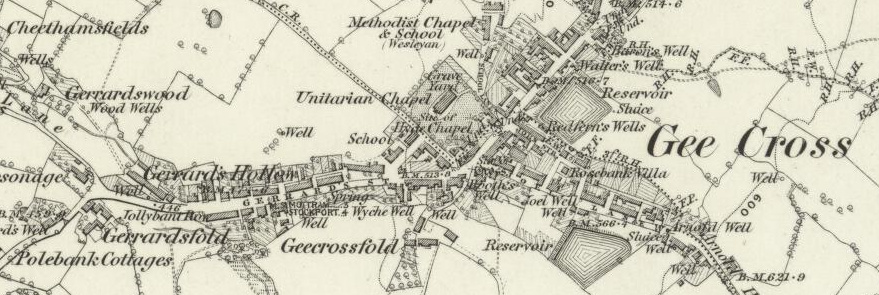
The modern names of places can, of course, already be looked up. But “Gerrardsfold” for instance, seen above in Cheshire, can only take one to a “Gerrards Fold Barn” in Lancashire when using the service’s modern lookup gazetteer.
25 Tuesday Mar 2014
The academic world recently learned that bots can write automated gibberish and — with a little help from their fleshy minions — can have it published in mainstream peer-reviewed scientific publications. But are we prepared for what follows from the moment when bots can reliably produce writing that makes real sense and which is useful and timely enough for use in major newspapers? It’s happening already. The finances of newspapers are such that a wave of robo-journalism seems inevitable, once we have a few more advances in semantics and automated basic fact-checking. Given the current dismal state of newspaper science reporting such new-fangled robo-news may even be slightly better than what we have now.
It follows that journal editors and publishers may soon need to add a new clause to their author guidelines, such as: “articles must be fully written by humans”. Not for fear of gibberish faux-papers, but rather because bots will be able to add sensible summaries and otherwise usefully aid in the writing of a research paper. Or we may need to develop an agreed form of simple presentation to flag up: [bot]this section of the text was written by bots[/bot] and to embed links to the bot’s sources.
Incidentally, I’ve also often thought that the humourous LOLcat language would form a pleasing basis for identifying messages-sent-to-humans by objects embedded in The Internet of Things, clearly marking their simpler forms of communications to us as being: ‘not kreated by th humanz’. We already have the LOLcat translation systems available.
25 Tuesday Mar 2014
Posted in Ecology additions, Spotted in the news
The Europeana Creative Challenge…
aim[s] to identify, incubate and spin off into the commercial sector viable online applications based on the re-use of digital cultural heritage content [from Europeana, and] The best five applications will be invited to a final challenge event to pitch their ideas to representatives from the cultural and creative industries as well as to investors.
The current challenge has a Natural History theme. Deadline: 31st March 2014.
Springing to mind: a simple workflow for automated extraction and smoothing of 3D shapes from high-res 2D photos of organic shapes (shells, fossils, wings, insects carapaces, etc), to create a royalty-free bank of organic starting-point shapes for rapidly iterative and generative product design prototyping.
 Chlamyphorus truncatus, via Europeana. The prototype for your new girls’ hairbrush has arrived… 😉
24 Monday Mar 2014
Posted in Spotted in the news
The major new Chinese Google-alike Chinaso, just launched, has a Chinaso Theory for those eager to march down “The socialist road with Chinese characteristics”, joyously waving their copies of the Theory of Party Building journal…

24 Monday Mar 2014
Posted in Ecology additions, New titles added to JURN
Completed the addition of URLs from the open ejournals in ornithology list. JURN now has excellent coverage of free and open ornithology journals.
23 Sunday Mar 2014
Posted in Spotted in the news
“The Music Composed By An Algorithm Analysing The World’s Best Novels”. Researchers at the National Research Council Canada have used software to automatically measure…
“the way the emotional temperature changes throughout a novel, and then [have] automatically generated music that reflects these moods and how they evolve throughout the book.”
Although perhaps it’s worth remembering that Eno says he doesn’t bother to sync his ambient music and images these days — since he finds that people experience them as being synced together, even when they’re not.
23 Sunday Mar 2014
Posted in New titles added to JURN
New “Future studies” section added to the JURN Directory…

22 Saturday Mar 2014
Posted in JURN metrics, My general observations
I’ve overhauled the code that’s driving search and display for JURN, plugging in newer v2 CSE code and and wrangling in some new CSS. JURN should now be a little faster than before, while giving Google a little less server overhead.

Changes, as seen above:
1. A spiffy new graphical “Search” button to click. Next to it is an X to click, which clears the search and starts over again.
2. Removed the confusing and misleading “Found 565,000 hits in 0.4 seconds…” notifications. Google was never providing JURN’s users that many hits anyway. It was just that valuable computational time was not being spent finessing down the main index numbers for the benefit of curated Custom Search users.
3. The search results page links — found at the very foot of the search results as 1 2 3 4 5 6 7 8 9 10 — are now aligned left.
4. The faint dotted underline on links is now carried over onto the actual results links. Last week Google started taking underlines off search results altogether, though it was mostly tech-heads who spotted it being tested. For now, links are still underlined on the JURN results. But if underlines do get taken off Google links in the near future then I’d hope my faint dotted underline will remain to soften the blow for traditionalists.
5. A millisecond delay as the search-box loads, on first visiting the page.
21 Friday Mar 2014
I found a 2013 article from geoscientists who had tested Google Scholar: “Literature searches with Google Scholar: Knowing what you are and are not getting”. Although the body of the paper states that their test phrase was “wildfire-related debris flows”, the data shows they actually tested Scholar with the keywords wildfire-related debris flows. They reportedly found that…
“free articles were available in PDF format for 88% of citations returned by Google Scholar. They were available from open-access journals or via links to organizational sites where authors had posted their publications.”
However if you actually look at their linked search-results data file, then the above statement needs additional clarification. Since it’s clear that paywall articles from Elsevier, Springer and the like, appearing in their Scholar results, were being counted toward those “free articles”. It turns out that many of these were “free” only via a DigiTop proxy overlay for Scholar that is, in the words of DigiTop, “available to USDA employees only”. Nice if you work under the U.S. Department of Agriculture umbrella, but it seems that those outside have to pay.
Does Google Scholar perhaps need to add some kind of “paywall box detector” to its scraper bots? Then perhaps something like [PDF] [-||-] could be added on the right-hand column of the Scholar results, to indicate a PDF that’s “available maybe” — but which will prove to have a paywall that needs to be either backed out from or negotiated? And perhaps [PDF] [-~-] could indicate a genuine direct link to a bona fide PDF file?
Anyway… this is what geoscientists are talking about when they refer to wildfire-related debris flows. Seems like it might be a geological process that intelligent farmers, hiker-campers, and treeline homesteaders around the world would like to learn some precise details about…


Giant mudslides, basically.
Incidentally, the same wildfire-related debris flows search in JURN needs to be tightened up just a little for strong results. Using wildfire-related “debris flows” works better, though the first six pages of good results do stray just a little (to pick up what seem to be three articles about prehistoric ‘dinosaur-era’ debris flow events). Yet even on this test JURN appears to be doing about twice as well as Google Scholar in terms of getting open articles, once Scholar’s ‘false-positive’ paywall PDFs from Elsevier & co. are subtracted from Scholar’s results.