A Pirate Bay for news, it seems: Daily Paywall. An admirably spartan design, at least. Admirable motives, not so much.


24 Wednesday Dec 2014
Posted in Spotted in the news
A Pirate Bay for news, it seems: Daily Paywall. An admirably spartan design, at least. Admirable motives, not so much.
24 Wednesday Dec 2014
Aeon magazine has a very nice new Save to Instapaper drop-down on its articles, which might usefully be copied by ejournals offering articles in HTML.
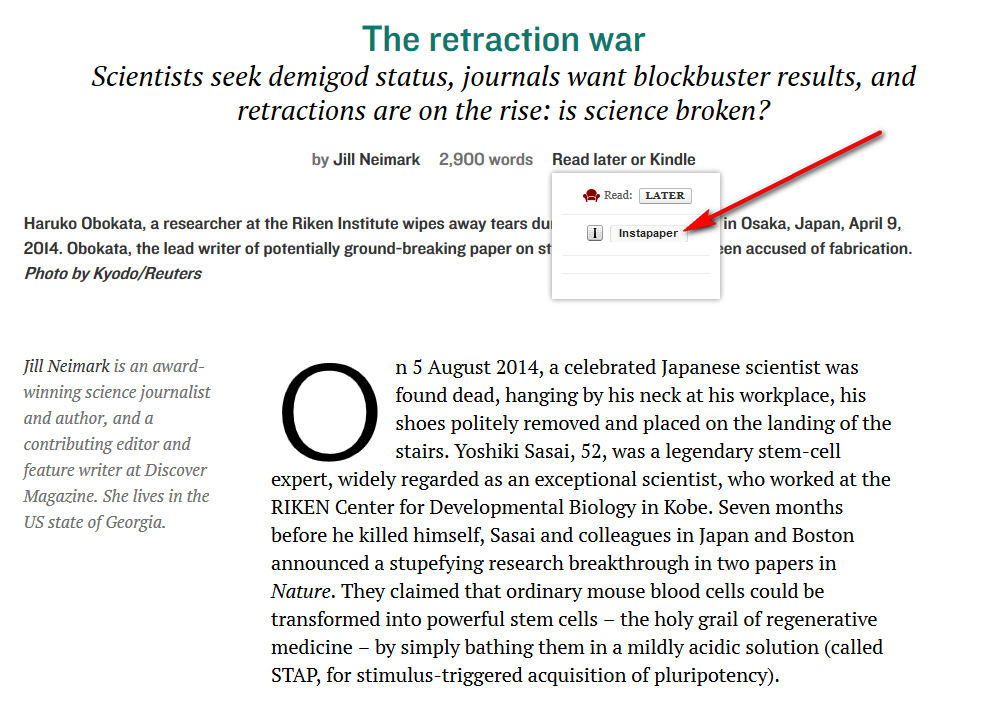
Compare the blissful ease of doing this with the impossibility of saving Digital Arts magazine’s new 2015 creative trends survey article to Instapaper. Impossible because of the database-driven URL structure, which loathsomely uses ? in the URL to spawn a new page hanging off of a static URL. I ended up having to copy-paste to a .txt file and then used Amazon’s Send to Kindle desktop software. I guess Digital Arts are assuming their younger clear-eyed readers are going straight to the page on an iPad, rather than needing the ‘old-eyes friendly’ font-scaling on a Kindle.
No mention of this Aeon button on the Instapaper official blog in 2014, so I’m guessing it’s custom to the editors, probably wrapped up in a WordPress widget or similar. But their little button looks like it can be fairly easily implemented in a DIV in your HTML code…

17 Wednesday Dec 2014
Posted in JURN tips and tricks
The EZB has evidently had a slight re-design. They’ve removed the ability to set a date-limit on the “List of new EZB journals”. However, the date is still being set in plaintext in the URL itself. Users can dial back the date range by typing a new date at the end of the URL, and then reloading. The dialogue to set a date-range on the page itself has been removed, as has the ability to filter by partly OA titles (now the options are just ‘freely available’ or ‘not accessible’).
17 Wednesday Dec 2014
Posted in JURN's Google watch, Spotted in the news
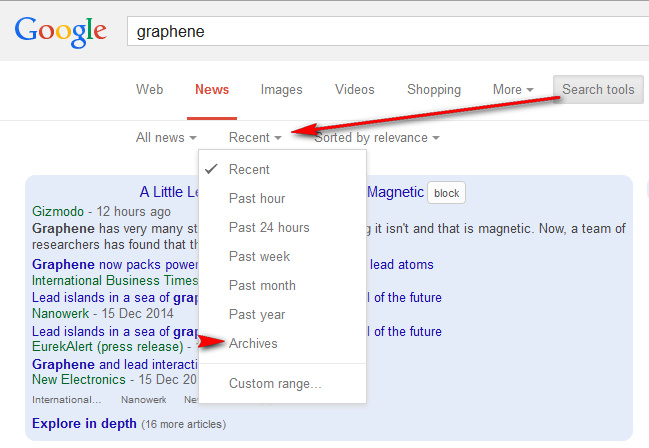
The Google News team has re-enabled the lost archives feature, for searching newspaper archives as far back as 2003…
Great news — we’ve re-enabled archives search! Our team listened to all your feedback you left here in the forum, and was hard at work to bring you an even better archive experience. From all the posts we received, we heard loud and clear how important these archives are to our users. You can now go digging back in time to 2003. Search on :)”
13 Saturday Dec 2014
A new embedded search tool for non-fiction writers, Bing Insights for MS Office. It only seems to work in MS Office Live, rather than as a plugin for older desktop installations of Office. Sadly I just couldn’t find the Insights feature at all in Office Live, when I went to test it. So perhaps it’s not yet been rolled out the UK.
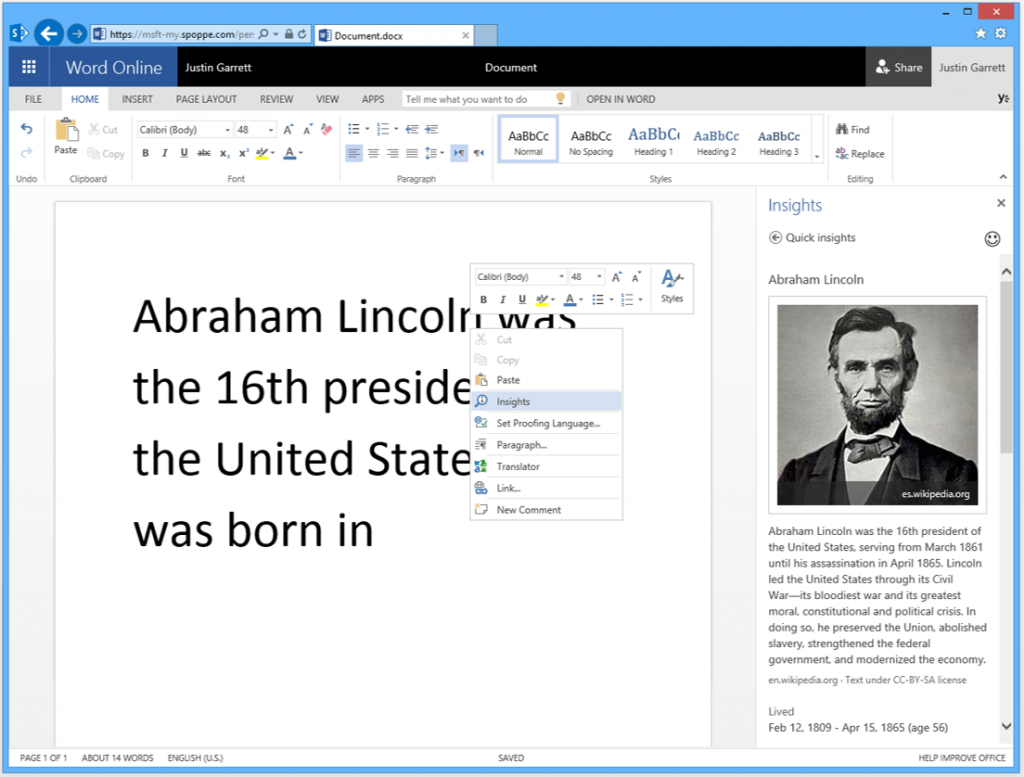
But it seems a neat idea, meaning that checking a basic fact no longer entails bouncing out of Word and into a Web browser. The search process also apparently inherits semantic nudges, drawn from the other words and phrases detected in the document. One wonders if the semantic data that Microsoft gain from this will, in time, improve the Bing Search service itself.
I’d expect the Open Source Office software suites to add this sort of fact-checking feature to their Word Processor soon, if they haven’t already (I couldn’t immediately find something similar for Open Office, LibreOffice, etc). Although their natural choice of partner, Wikipedia, might not be the most trustworthy source of facts.
13 Saturday Dec 2014
Posted in Spotted in the news
12 Friday Dec 2014
Posted in My general observations
It’s not often that one gets to see exactly who is using JURN in Africa. One such is young geography graduate Saliou Abdou in Cotonou, Benin, West Africa. Among other achievements, he’s helped put his city on OpenStreetMap, taken part in the International Space Apps Challenge 2014 (a two-day NASA hackathon of its Big Data), and attended Barcamp Benin 2014. He’s recently discovered MOOCs and JURN.

12 Friday Dec 2014
A key element of online search literacy appears to be going backward, rather than forward. Results from 1,200 U.S. librarians surveyed in May 2014 appear to show a …
… 29.3 percent increase, over the past two years, in the perception that students have a rudimentary understanding of web evaluation. “[…] librarians feel students are now using the open web for research less than they did in 2012,” the report says, “[and] when students are on the open web, their evaluation skills are more lackluster.” […] 36.1 percent of the students surveyed felt that they had an advanced understanding of website evaluation, whereas only two percent of librarians considered their students to have a high degree of skill in the same area.”
The respondents were librarians from across the core educational spectrum, from elementary through to four-year academic institutions. 31 percent were based in high schools.
29 Saturday Nov 2014
Posted in Economics of Open Access, Spotted in the news
The new book Open Access and the Humanities: Contexts, Controversies and the Future is now available from Cambridge University Press, including a free online version as PDF chapters. It seems a usefully comprehensive and dense primer on the subject. But fairly short, at 150 pages for the chapters. Chapters open in a PDF viewer in the browser, but if you use Internet Explorer it should ignore the javascript obfuscation and offer to let you download as a PDF file.
However it doesn’t seem to be a book to go to for an in-depth discussion of public discoverability and search. There is some slight discussion of discoverability on page 53, briefly suggesting that if the academy wishes to make a believable claim to act as an agent of social change, then it must pass its public-funded knowledge to all rather than allow it to be hoarded by a tiny elite. Page 101 discusses the adoption (or not) of text mining, briefly mentioning the discoverability experiments that text mining might enable.
Page 118 suggests that a curated monograph range at a publisher inherently contains a discoverability aspect (so long as the publisher’s publicist is doing their job assiduously, I’d add). If such a publisher also offers a ‘digital-first’ work-flow for monographs then an easy conversion to a mainstream .ePub or .mobi ebook is enabled, again adding discoverability potential (when the book pops on the Amazon Kindle store and suchlike, and/or in Open Access aggregators). In the Kindle Store discoverability shades over into readability, via the convenience of reading on dedicated ereaders rather than struggling with reading a PDF on a small tablet.
19 Wednesday Nov 2014
Posted in Spotted in the news
Twitter Search now indexes “every tweet ever sent”.
