• Directory
  • FAQ: about JURN
  • Group tests
  • Guide to academic search
  • JURN’s donationware
  • Links
  • openEco: titles indexed

News from JURN

~ search tool for open access content

News from JURN

Author Archives: futurilla

Use MS Excel 2007 to split a long column / list into smaller chunks

24 Tuesday Nov 2015

Posted by futurilla in JURN tips and tricks

≈ Leave a comment

How to use MS Excel 2007 to split a long column or list into smaller chunks, for later batch processing:

Real world scenarios: You have a simple but huge list that you want to parcel/email out in equal portions to various project participants. Or you are working with an old form-based system that can only process X amount of items at a time.

1. Get the excellent free ASAP Utilities plugin, install it in Excel. Note that you may need to enable it before its tab will appear (Top-left orb | Excel Options | Add-ins | Disabled Applications | ASAP + Go | Enable ASAP | OK)

2. Open a new sheet and paste your long list down into a single column.

3. In your new ASAP Utilities tab, click the Select button.

4. ASAP’s Columns and Rows | Select gives you a list of choices before it runs. Choose option 2 (“Conditional Row and Column Select…”) and then use the dialog box that appears. Here I’ve opted to have ASAP tell Excel to select every 25th cell…

25

No ‘Select’ button? Go: Options | Find and Run a Utility | Type ‘Select’ | Scroll down to “Conditional Row and Column Select…”.

5. Run Select, then exit the dialog box. The cells won’t immediately look like they’ve been selected. But if you Ctrl + C to copy them, then the familiar “marching ants” will reassuringly appear around the selected cells.

6. Now right-click your mouse anywhere inside your new group of selected of cells, and choose ASAP Utilities | option 18 “Insert before and/or after each cell in your selection…” In this new dialog choose “Insert after” and type {lf} to add a new blank line inside each of your selected cells.

7. Run the Insert process. It may take a minute to run, on a long list. Each selected cell will be given a double height by adding a line-break, thus…

paddedcell

If you just need to print out an Excel spreadsheet with each list-chunk separated by a space, perhaps so that your manager can easily read through the list in printed form, then you can leave the process there.

8. Some may now want to go further. When the whole column is selected and copied out to Notepad, you will see that the 25th, 50th, 75th etc cell will appear in quote marks “”, thus…

item 24
“item 25”
item 26

That’s kind of useful, but not really — since the primitive Notepad can’t handle multi-line search/replace.

However, simply paste the same list into the free open-source Notepad++ and the list copies as…

item 24
“item 25
”
item 26

9. That’s perfect. So now we just use Notepad++ to search all the “ occurrences and replace them with blanks. Then we have our list in chunks of 25 — each nicely separated by a blank line.

10. The neatly chunked list can now be pasted back into Excel, adding real blank cells between each chunked section. You might then add a comma to each blank cell, thus giving a basic comma-delimited .csv file for use with automated mailing-list software and similar.

Or the list can simply be saved out of Notepad++ as a plain .txt list, to work with manually — in clearly defined batches of 25 at a time.
Antiquity through autobiography

24 Tuesday Nov 2015

Posted by futurilla in Spotted in the news

≈ Leave a comment

A fab new blog from Charles Jones of AWOL, The History of the Study of Antiquity through the Lens of Autobiography. Complete with a “Working Bibliography”.

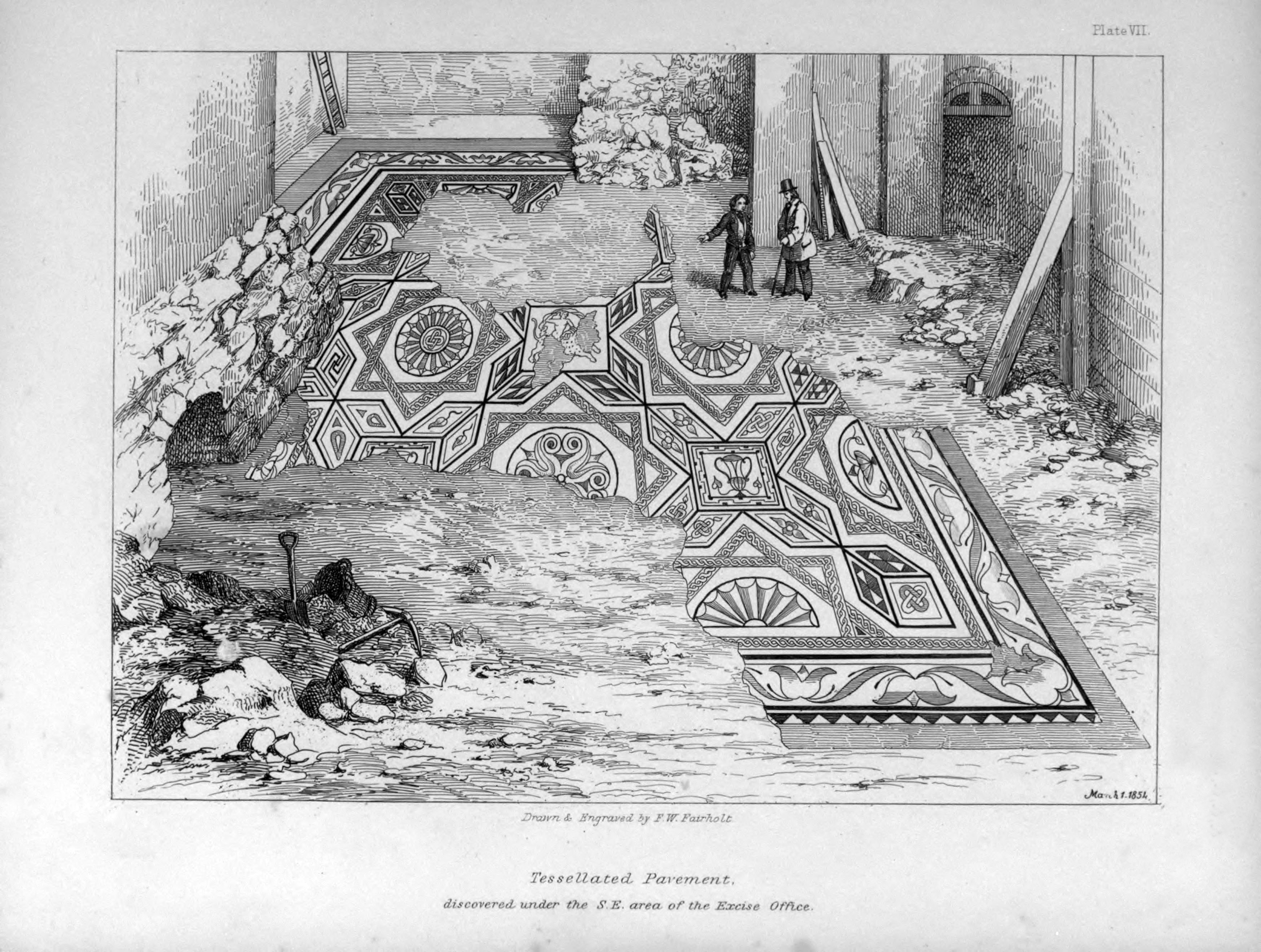
Illustrations_of_Roman_London_page213 Discovery of a Tessellated Pavement, Illustrations of Roman London, page 213. Public domain.

The Academia.edu advantage

23 Monday Nov 2015

Posted by futurilla in Academic search, Open Access publishing, Spotted in the news

≈ Leave a comment

Post your articles to Academia.edu as soon as they’re published, get more citations….

Based on a sample size of 34,940 papers, we find that a paper in a median impact factor journal uploaded to Academia.edu receives 41% more citations after one year than a similar article not available online, 50% more citations after three years, and 73% after five years. We also found that articles also posted to Academia.edu had 64% more citations than articles only posted to other online venues, such as personal and departmental homepages, after five years.” [the conclusion expands this “other” element, it includes: “journal site, or any other online hosting venue”]

The studied papers were uploaded at “the same time they’re published”. Excluded from the study were… “articles uploaded to Academia.edu after they were published”.

Amazingly, the authors also note that…

To our knowledge there has been no research on what features of open access repositories or databases make articles easier to discover”

All that public money spent on repositories around the world, and not one librarian has felt the need to test for such public discoverability vectors? Seriously?

oaFindr

22 Sunday Nov 2015

Posted by futurilla in Academic search, Open Access publishing, Spotted in the news

≈ 1 Comment

A new Canadian commercial start-up is offering its new oaFindr service, with free / low-cost trials for university libraries. oaFindr is said to be able to explore a library’s existing journal subscriptions, and to identify just the open access articles within the hybrid journals. According to the press release oaFindr…

… enable[s] academic institutions to analyze their journal subscriptions and provide[s] them with a reliable, precise search and discovery tool to retrieve all open access articles. This solution will also help them comply with governmental open access mandates, and support them in rapidly increasing the diffusion of their institutions’ scholarly production in a manner that is much less labour-intensive”

The idea appears to be that the discovered OA articles are then harvested and passed to the company’s related oaFoldr service, with oaFoldr providing a conduit into their hosted repository for the OA articles. Nice if it works and gets adopted and, if public, it would provide a welcome new mega-repository for Google and JURN to index. Alternatively, I suppose that the oaFoldr may just be a private folder for cataloguers, in which the articles reside before being placed into the university’s own repository. More likely to be the latter, since otherwise one commercial company could potentially get to corral the world’s OA article output in its own repository, and would then be in a position to sell it back to universities via an enhanced search and mining/metrics service.

Regrettably, as Bernard Rentier observes, mass extraction and archiving of 1000s of OA articles per month from commercial databases may not be welcomed by the big publishers…

Elsevier has designed a way to prevent researchers from mass-downloading articles from its website where they are so-called open access…”

So how would universities harvest efficiently? Bear in mind that commercial licenses may also prevent a university from taking the proprietary hybrid journal metadata from the likes of Elsevier, Springer, Oxford etc, along with their OA fulltext PDFs. So I guess it’s much more likely that each institution will play safe and harvest only PDF articles by their own researchers, thus giving a much lower harvesting volume that might not trigger download blocking. And that they’ll find ways not to take any metadata generated around the OA article by publisher databases.

I wonder if some large institutions may have to harvest articles via spoofing multiple ‘student’ accounts? Or is oaFindr itself pre-harvesting OA PDFs from hybrid journals and then vending them to institutions along with metadata? Probably not, or the big publishers would likely be throwing lawsuits at the company. oaFindr seems more likely to be a sort of super-Paperity, but covering all hybrid titles from the big publishers plus all the DOAJ titles at the article level. I’m guessing a lot here, or course, but if such a service works then it would be rather cool. Though probably lacking in things like Google-strength semantics and relevance ranking.

So let’s assume that the university libraries are the ones that do the work of harvesting OA PDFs for their repositories. OA mandates and the consequent exponential growth of OA articles may still lead to the hitting of a ‘mass downloading’ roadblock in the near future, even at a university which restricts itself to its own outputs and/or harvests fulltext via multiple accounts. Big publishers might even change their database small-print, so as to forbid ‘type targetted’ mass harvesting leading to local storage of articles.

I guess one solution would then be to rely only on having repository records + Web links to the fulltext (fulltext hosted back on the journal’s website). Though that assumes that links don’t break. Which they do, and at a horrendous rate.

In the end I suspect it may just be easier for a university to go after its research staff with pitch-forks, and literally force them to upload their OA papers to the university repository. If your new paper isn’t in the repository after 28 days, then your next month’s salary gets docked 20% and your department can’t apply for any new funding or external partnerships in the next six months. That sort of thing.


Update, Nov 2017: OAFindr is now called 1Findr.

Help fill in a spreadsheet of open conference proceedings

20 Friday Nov 2015

Posted by futurilla in Spotted in the news

≈ Leave a comment

Deborah Fitchett is finding all the research conference proceedings that are online and open access, and at which New Zealand researchers are known to have presented. She could do with a little help on filling in the final 1,500 or so entries on the online spreadsheet.

MOSF Journal of Science Fiction : call for papers

20 Friday Nov 2015

Posted by futurilla in Spotted in the news

≈ Leave a comment

The MOSF Journal of Science Fiction, launching soon as open access, and calling for papers now.

For Web links to more such open access online SF research journals in English (Fafnir, Brumal, Eaton Journal of Archival Research in Science Fiction, SFRA Review) see the JURN directory.

McLuhan on libraries

17 Tuesday Nov 2015

Posted by futurilla in Spotted in the news

≈ Leave a comment

Issue 140 of Australia’s Island magazine has a 6,000 word extract from the unfinished/unpublished mid-1970s Marshall McLuhan book on the future of libraries…

ISLAND140_front-cover_1024x1024

The_City_As_Classroom3

[ Hat-tip: Mita Williams ]

facebookGroupArchive

16 Monday Nov 2015

Posted by futurilla in JURN tips and tricks

≈ Leave a comment

facebookGroupArchive…

A [2015] tool to allow someone to archive a Facebook group and then provide a searchable API for the archive.”

Note that Facebook’s own option of: Settings | “Download a copy of your Facebook data” doesn’t include an archive of Groups you admin/moderate.

Dissemin

15 Sunday Nov 2015

Posted by futurilla in How to improve academic search, Spotted in the news

≈ Leave a comment

Have you spotted an academic who is supposed to have made their work OA, but who hasn’t done so? Dissemin checks their OA status, and provides a way to upload their papers to the Zenodo repository (CERN’s data repository).

zenodo

Walk the British Museum in Google StreetView

15 Sunday Nov 2015

Posted by futurilla in Spotted in the news

≈ Leave a comment

Oh, how wonderful. Now you can walk the floors of the British Museum, via Google Streetview, and get close-ups of 4,500 artefacts. No more trudging for miles through hordes of tourists, with nowhere to sit down except in the cafes…

Built over 15 months with the help of a Google employee with a camera on wheels [and] completed by the Google Cultural Institute after hours, with special light-bulbs being installed to ensure the lighting remained the same through the galleries. The results can now be used by members of the public, academics who wish to study objects in detail from home, or teachers, who are being encouraged to “bring their lessons to life” through the resources.”

Also very useful for visitors who are only ever going to get one pass at an in-person visit, and who want to learn the layout of the place first in order to maximise their time at the Museum.

britmus-start

britmus

britmus2

← Older posts
Newer posts →
RSS Feed: Subscribe


Please become my patron at www.patreon.com/davehaden to help JURN survive and thrive.

JURN

  • JURN : directory of ejournals
  • JURN : main search-engine
  • JURN : openEco directory
  • JURN : repository search
  • Categories

    • Academic search
    • Ecology additions
    • Economics of Open Access
    • How to improve academic search
    • JURN blogged
    • JURN metrics
    • JURN tips and tricks
    • JURN's Google watch
    • My general observations
    • New media journal articles
    • New titles added to JURN
    • Official and think-tank reports
    • Ooops!
    • Open Access publishing
    • Spotted in the news
    • Uncategorized

    Archives

    • February 2026
    • January 2026
    • October 2025
    • May 2025
    • April 2025
    • September 2024
    • June 2024
    • May 2024
    • April 2024
    • March 2024
    • February 2024
    • January 2024
    • December 2023
    • November 2023
    • October 2023
    • September 2023
    • June 2023
    • May 2023
    • January 2023
    • December 2022
    • November 2022
    • October 2021
    • September 2021
    • August 2021
    • July 2021
    • June 2021
    • May 2021
    • April 2021
    • March 2021
    • February 2021
    • January 2021
    • December 2020
    • November 2020
    • October 2020
    • September 2020
    • August 2020
    • July 2020
    • June 2020
    • May 2020
    • April 2020
    • March 2020
    • February 2020
    • January 2020
    • December 2019
    • November 2019
    • October 2019
    • September 2019
    • August 2019
    • July 2019
    • June 2019
    • May 2019
    • April 2019
    • March 2019
    • February 2019
    • January 2019
    • December 2018
    • November 2018
    • October 2018
    • September 2018
    • August 2018
    • July 2018
    • June 2018
    • May 2018
    • April 2018
    • March 2018
    • February 2018
    • January 2018
    • December 2017
    • November 2017
    • October 2017
    • September 2017
    • August 2017
    • July 2017
    • June 2017
    • May 2017
    • April 2017
    • March 2017
    • February 2017
    • January 2017
    • December 2016
    • November 2016
    • October 2016
    • September 2016
    • August 2016
    • July 2016
    • June 2016
    • May 2016
    • April 2016
    • March 2016
    • February 2016
    • January 2016
    • December 2015
    • November 2015
    • October 2015
    • September 2015
    • August 2015
    • July 2015
    • June 2015
    • May 2015
    • April 2015
    • March 2015
    • February 2015
    • January 2015
    • December 2014
    • November 2014
    • October 2014
    • September 2014
    • August 2014
    • July 2014
    • June 2014
    • May 2014
    • April 2014
    • March 2014
    • February 2014
    • January 2014
    • December 2013
    • November 2013
    • October 2013
    • September 2013
    • August 2013
    • July 2013
    • June 2013
    • May 2013
    • April 2013
    • March 2013
    • February 2013
    • January 2013
    • December 2012
    • November 2012
    • October 2012
    • September 2012
    • August 2012
    • June 2012
    • May 2012
    • April 2012
    • March 2012
    • February 2012
    • January 2012
    • December 2011
    • November 2011
    • October 2011
    • September 2011
    • August 2011
    • July 2011
    • June 2011
    • May 2011
    • April 2011
    • March 2011
    • February 2011
    • January 2011
    • December 2010
    • November 2010
    • October 2010
    • September 2010
    • August 2010
    • July 2010
    • June 2010
    • May 2010
    • April 2010
    • March 2010
    • February 2010
    • January 2010
    • December 2009
    • November 2009
    • October 2009
    • September 2009
    • August 2009
    • July 2009
    • June 2009
    • May 2009
    • April 2009
    • March 2009
    • February 2009

    Proudly powered by WordPress Theme: Chateau by Ignacio Ricci.