• Directory
  • FAQ: about JURN
  • Group tests
  • Guide to academic search
  • JURN’s donationware
  • Links
  • openEco: titles indexed

News from JURN

~ search tool for open access content

News from JURN

Monthly Archives: January 2013

The social article

15 Tuesday Jan 2013

Posted by futurilla in My general observations, Open Access publishing

≈ 2 Comments

The December 2012 Literary & Linguistic Computing has a new paper on enhancing the traditional scholarly article, “Toward Modeling the Social Edition: An Approach to Understanding the Electronic Scholarly Edition in the Context of New and Emerging Social Media” (its annotated bibliographies are free)…

“This article explores building blocks in extant and emerging social media toward the possibilities they offer to the scholarly edition in electronic form, positing that we are witnessing the nascent stages of a new ‘social’ edition existing at the intersection of social media and digital editing.”

The five practical possibilities noted in the paper are:

   * Collaborative Annotation (via third-party browser toolbar addons).

   * User-derived Content (user-made linked ‘overlay’ collections).

   * Folksonomy Tagging (freeform keyword tagging, open to all).

   * Community Bibliography (using Zotero et al).

   * Community Text-Analysis (via tools yet to be created).

That seems a sensible ‘overlay’ approach. Bolting the current social media fad-of-the-year right into the heart of a text would be asking for problems. No-one opening a document in the year 2040 will want to find that all of the document’s embedded Twitter hooks are broken, and thus they face a sea of broken pop-ups and sidebars (because in 2040 a short comment is perhaps sent simply by thinking it via a digi-telepathic implant, whereupon it gets sent to someone’s augmented-reality contact-lens complete with a beautiful little overlay cloud of colour-shaded emotional nuances…).

Adding a light digital patina of polite academic chatter and margin notes assumes that the author keeps basic control of the core text. But what if we do not remain safely within the polite scholarly culture of abstracting short quotes for ‘fair use’? What if we enter into a world of open remixing, perhaps via state mandated CC-BY licences? On certain platforms we’re already in a situation where the core digital text only appears to have a pure and elegant print-like form, while a “view source” operation shows the author’s text is held in a cat’s-cradle of structured data and code. What if future advances in such structuring/tagging mean that the text can be swiftly abstracted / summarised / remixed (probably with the aid of a cloud of automated software bots) or even rewritten? The core text would thus not simply be overlaid with a friendly social chatter. It would be opened to being policed in depth. For instance, we might imagine an efficient commercial fact-checking service (also bot-enhanced), operating in much the same way as the plagiarism bots that already patrol student essays in some universities. Hopefully such policing might be benign and useful, but it some cases it might not be. One might imagine a “Great Firewall of China” which rather than blocking a text actively rewrites it on-the-fly (in much the same way as Google Chrome currently auto-translates Chinese to English).

In such circumstances scholars might find some comfort in thinking that their work is wrapped up in the tough rhino-like hide of the reliably printable PDF. But I suspect that even our PDF silos will in time be understood as just transitory arrangements. I suspect our legacy PDF silos will eventually be gobbled up by some complex OCR-based conversion and semantic coding autobot, which will elegantly and faithfully convert them into an advanced structured form — from which we can then easily abstract and remix and rewrite them in increasingly complex ways.

Digital Humanities Map

13 Sunday Jan 2013

Posted by futurilla in My general observations, Spotted in the news

≈ 2 Comments

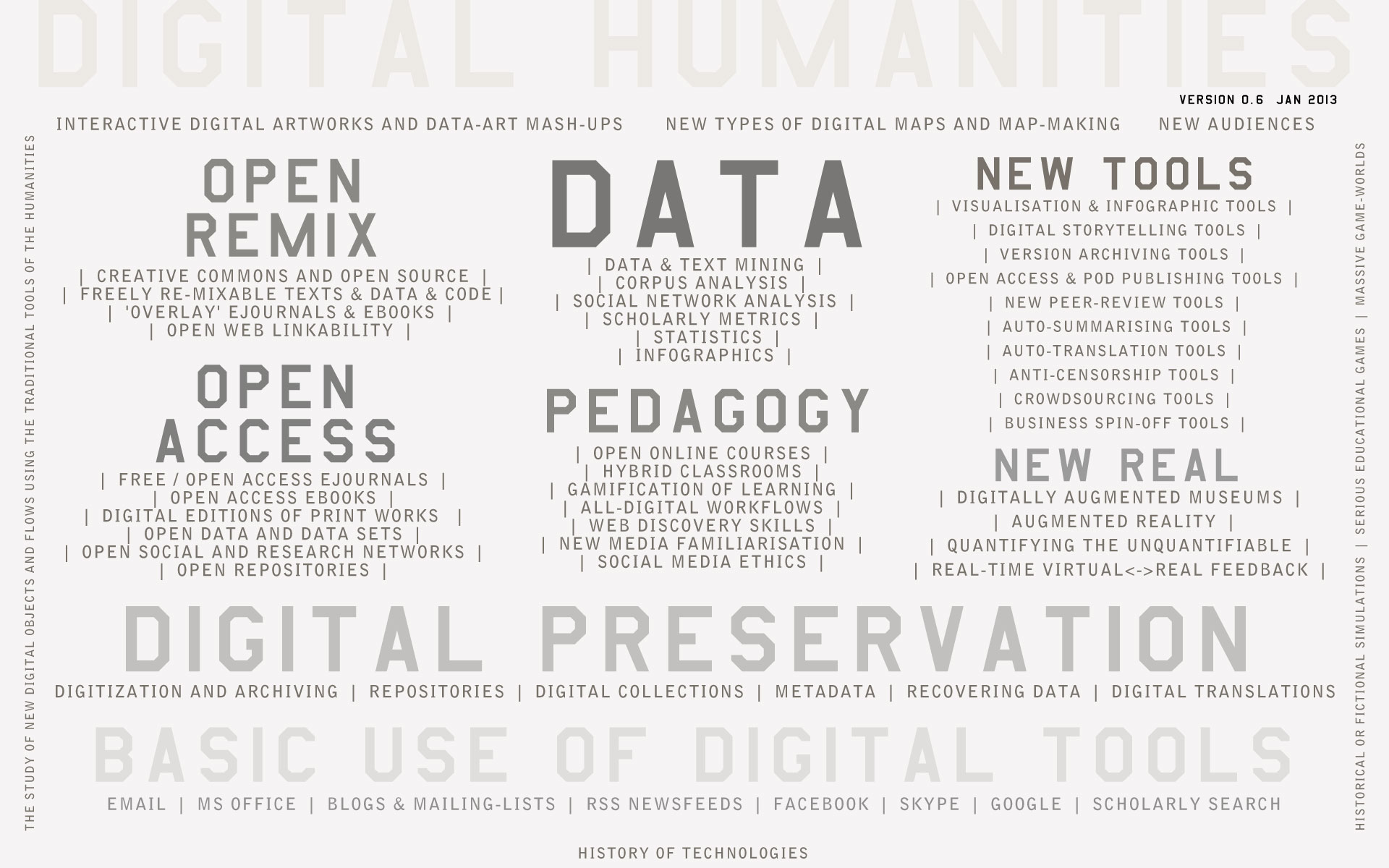
Since the Huffington reports that… “The backlash against so-called ‘Digital Humanities’ (DH) has begun in earnest,” I thought I’d spend a merry hour with Photoshop and put together a quick at-a-glance map of the way I see the digital humanities at January 2013. It might be useful, at the start of such a flame-war debate, to have at least one neat visual of what the digital humanities seem to encompass.

Digital humanists may already be popping their pods at the upstart presumption of my doing this, yet I can’t find any online evidence that they’ve published anything similar. Concise corrections and suggestions are welcome…

digital_humanities_map


By “new media familiarisation” in pedagogy I mean structured programmes of hands-on experience: “profs play videogames, etc” but also “students venture outside their own little tech-bubble”.

By “real-time virtual-real feedback” I mean our ability to place cheap sensors in the real world that feed data into online services in real-time, and thus affect people’s behavior in the real world. Behaviors which the sensors then feed back into the virtual environments, in a never-ending loop.

“Quantifying the unquantifiable” might have read, for clarity: “Quantifying those aspects of the real world which were formerly unquantifiable”, but that was a tad too long to fit. And yes, I do realise that the idea of “the real” as something separate from human culture is contested. A bridge is an objectively real structure yet it arises from human culture, for instance — but we only wish to cross a bridge if it rests on immutable and objectively real laws of physics and geometry. Thus, “the real”.

Those outside of the arts and humanities may wonder why I included the most basic layer. It’s because the research shows that many of our academics are still very much dragging their feet in the use of even basic digital tools, and it seems to me to be part of the digital humanities project to hope to bring them into the 21st century.

Scholr.ly

11 Friday Jan 2013

Posted by futurilla in Academic search, Spotted in the news

≈ Leave a comment

New academic search-engine, Scholr.ly. Launched late summer 2012, and currently only… “indexing computer and information science”.

schola

JSTOR free Register & Read expands to 1,200 titles

10 Thursday Jan 2013

Posted by futurilla in Academic search, Spotted in the news

≈ Leave a comment

JSTOR’s Register & Read beta service has been letting anyone sign up to read up to three JSTOR articles per fortnight, for free. Just to read, mind you — not to download or copy-and-paste. Until now R&R access has been to a mere 77 journals.

But a new Jan 2013 press release proclaims a much meatier “1,200 journals” for the R&R offer…

“more than 1,200 journals [titles .xls] are now available for limited reading by the public. This is part of a major expansion of JSTOR’s experimental program Register & Read…”

R&R access can be had by registering for a MyJSTOR account.

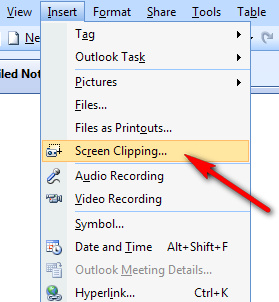
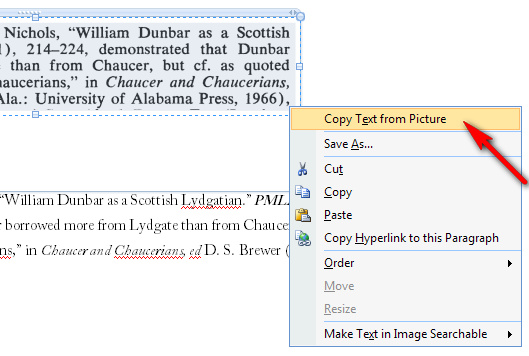
If you need to quote from an R&R article, don’t struggle with retyping the quote into your essay. The Microsoft Office 2007 OneNote ‘screen clipping’ OCR function is your friend, in such cases. OneNote works extremely well at “reading” screengrab images and turning them into editable text, even when the text is very small and a bit rough…

clipping

copytext

New “Recently available via JURN Search…” rss-powered page

09 Wednesday Jan 2013

Posted by futurilla in Academic search, My general observations

≈ 2 Comments

Announcing a new JURN tool: the “Recently available via JURN Search…” page. 180 viable/active RSS feeds, discovered via delving into the 3,000 links on the JURN Directory, and then tied into some whizz-bang Web code. The page only shows the most recent article per journal, then it re-sorts the whole list by date. Without a wider use of RSS among open access ejournals, this page is as near as JURN can get to a “new issue alerts” service, let alone a full TOCs service. It’ll be tweaked and improved over the coming months. Enjoy…

recentjurn

Yes, statistics hounds: only 180 decent RSS feeds after weeding, from 3,000 links. It puts the number of free/open arts and humanities ejournals using RSS autodiscovery at about 6%. In the coming weeks I’ll be doing some Google searching for filetype:rss etc, to see if I can manually discover more. Update: added another 42 feeds.

RSS and British universities

08 Tuesday Jan 2013

Posted by futurilla in My general observations

≈ Leave a comment

I found Tony Hirst’s UK University Autodiscoverable RSS feeds service on ScraperWiki, while looking for a means to pull RSS feeds from the 3,000 links in the JURN Directory. Tony’s hosted script on ScraperWiki (it’s like a supercharged British version of Yahoo Tubes) pulls in the URLs of 137 British universities, then autodetects all the RSS feeds on those URLs, and also searches the html for links to .rss, .rdf, and similar feed-indicating links.

You can download the resulting table as a .csv file for Excel, and in the “furl” column you find all the feed links. Cart away all the dead from the list, and you have around 85 autodiscoverable news feeds which validate and show as active in Feeddemon. And which are not about “clearing” course places for students, or library minutiae aimed at students and staff.

It’s a useful starting point. But I then had to manually add in nearly all the Midlands universities — Birmingham; Keele; BCU and BIAD; Coventry; Staffordshire; Nottingham; MMU at Crewe — since the autodetect hadn’t worked for any of them. Yet they all have feeds. Sadly no RSS news is offered by Wolverhampton or Worcester.

So I think this shows the limitations of RSS autodiscovery, even when it’s running from a good data source and using an accomplished bit of scripting. And possibly it also shows the limitations of scraping and bots in general. Rather than spend the time learning to script / setting up the script, in this case it’d probably be easier and cheaper to pay someone in India £50 to run through all the 137 UK universities home-page URLs and manually discover each RSS feed for news / jobs / events and more.

If you’re interested, here’s my final checked and Midlands-augmented OPML file for plugging into your feedreader. Just knock “.txt” off the end of the filename uk_unis_rss_feeds_jan_2013.opml.txt to get the .opml file for import. If you augment it with missing university feeds from your own region of the UK, please post a link to your OPML in the comments on this post.

ctrlQ

08 Tuesday Jan 2013

Posted by futurilla in Academic search, How to improve academic search

≈ Leave a comment

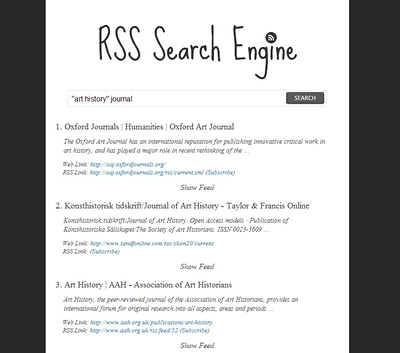
The nice little niche search-engine ctrlQ: RSS Search Engine displays “full URL” RSS feed links, as part of the search results. Another, Search4RSS is similar. Not sure if they just do basic RSS autodiscover, or if they’re also delving deeper looking for .rdf, .rss links etc. It would be great if this functionality was also in the main Google Search results, perhaps via a Greasemonkey script?

rss

“Do Cry for Me, Argentina”

07 Monday Jan 2013

Posted by futurilla in Spotted in the news

≈ Leave a comment

Daniel Nehring’s blog post from the end of December, “And Then There Were No Books”, brings me news that…

“it seems that Argentina has banned, or almost banned, the import of foreign books” [and, in addition] “Amazon steadfastly refused to sell me certain electronic books due to my location in Argentina”.

Seems very curious. Stories in the Wall Street Journal and elsewhere appear to confirm the bizarre news. You’d think they might have better things to ban. This is a nation that still has routine mass torture endemic in its institutions.

Daniel also writes that he worries about citing page numbers in ebooks, in a Kindle-tastic world of reflowable text. But many Kindle books now have “real” page numbers…

“[Amazon are] adding real page numbers that correspond directly to a book’s print edition. We’ve already added real page numbers to tens of thousands of Kindle books, […] Page Numbers are only displayed when you press the Menu button.”

Even if your Kindle ereader book is obscure and doesn’t have “real” page numbers by default, simply go to Google Books and type a unique fragment of your quotation enclosed “in quote marks”. For most recent academic books you can now get a full-text image-preview of the relevant page, but even for older works Google Books should tell you the required page number and edition.

UK Gateway to Research beta

06 Sunday Jan 2013

Posted by futurilla in Academic search

≈ Leave a comment

Beta Gateway to Research, a unified search tool for all projects funded by the various UK research councils since 2006. Daily Mail hacks are no doubt having a field day with this one…

researcuk

List of open ejournals in Scopus, and WoS

06 Sunday Jan 2013

Posted by futurilla in Academic search

≈ 2 Comments

A handy new combo list of the open ejournal titles included in PubMed, Scopus and the ISI Master Journal List…

  Languages and Literatures: 280
  History and Archaeology: 198
  Philosophy and Religion: 162
  Communication and Information: 145
  Arts and Architecture: 137
  General and Multidisciplinary: 43

  Total of the above, at Dec 2012: 965.


As for the omitted Web of Science, the last I heard was that at the end of May 2011 the Transforming Scholarly Communication blog had posted a list (my .xls version) of all open access titles in WoS, showing that…

“The Web of Science database (including Arts & Humanities Citation Index, Science Citation Index, and Social Sciences Citation Index) now indexes close to 1,000 peer-reviewed open access titles”.

But I just found a paper published in 2012, “Challenges for open access journals”, which gave a figure of… “864 open access journals” in arts and humanities in Web of Science.

← Older posts
Newer posts →
RSS Feed: Subscribe


Please become my patron at www.patreon.com/davehaden to help JURN survive and thrive.

JURN

  • JURN : directory of ejournals
  • JURN : main search-engine
  • JURN : openEco directory
  • JURN : repository search
  • Categories

    • Academic search
    • Ecology additions
    • Economics of Open Access
    • How to improve academic search
    • JURN blogged
    • JURN metrics
    • JURN tips and tricks
    • JURN's Google watch
    • My general observations
    • New media journal articles
    • New titles added to JURN
    • Official and think-tank reports
    • Ooops!
    • Open Access publishing
    • Spotted in the news
    • Uncategorized

    Archives

    • January 2026
    • October 2025
    • May 2025
    • April 2025
    • September 2024
    • June 2024
    • May 2024
    • April 2024
    • March 2024
    • February 2024
    • January 2024
    • December 2023
    • November 2023
    • October 2023
    • September 2023
    • June 2023
    • May 2023
    • January 2023
    • December 2022
    • November 2022
    • October 2021
    • September 2021
    • August 2021
    • July 2021
    • June 2021
    • May 2021
    • April 2021
    • March 2021
    • February 2021
    • January 2021
    • December 2020
    • November 2020
    • October 2020
    • September 2020
    • August 2020
    • July 2020
    • June 2020
    • May 2020
    • April 2020
    • March 2020
    • February 2020
    • January 2020
    • December 2019
    • November 2019
    • October 2019
    • September 2019
    • August 2019
    • July 2019
    • June 2019
    • May 2019
    • April 2019
    • March 2019
    • February 2019
    • January 2019
    • December 2018
    • November 2018
    • October 2018
    • September 2018
    • August 2018
    • July 2018
    • June 2018
    • May 2018
    • April 2018
    • March 2018
    • February 2018
    • January 2018
    • December 2017
    • November 2017
    • October 2017
    • September 2017
    • August 2017
    • July 2017
    • June 2017
    • May 2017
    • April 2017
    • March 2017
    • February 2017
    • January 2017
    • December 2016
    • November 2016
    • October 2016
    • September 2016
    • August 2016
    • July 2016
    • June 2016
    • May 2016
    • April 2016
    • March 2016
    • February 2016
    • January 2016
    • December 2015
    • November 2015
    • October 2015
    • September 2015
    • August 2015
    • July 2015
    • June 2015
    • May 2015
    • April 2015
    • March 2015
    • February 2015
    • January 2015
    • December 2014
    • November 2014
    • October 2014
    • September 2014
    • August 2014
    • July 2014
    • June 2014
    • May 2014
    • April 2014
    • March 2014
    • February 2014
    • January 2014
    • December 2013
    • November 2013
    • October 2013
    • September 2013
    • August 2013
    • July 2013
    • June 2013
    • May 2013
    • April 2013
    • March 2013
    • February 2013
    • January 2013
    • December 2012
    • November 2012
    • October 2012
    • September 2012
    • August 2012
    • June 2012
    • May 2012
    • April 2012
    • March 2012
    • February 2012
    • January 2012
    • December 2011
    • November 2011
    • October 2011
    • September 2011
    • August 2011
    • July 2011
    • June 2011
    • May 2011
    • April 2011
    • March 2011
    • February 2011
    • January 2011
    • December 2010
    • November 2010
    • October 2010
    • September 2010
    • August 2010
    • July 2010
    • June 2010
    • May 2010
    • April 2010
    • March 2010
    • February 2010
    • January 2010
    • December 2009
    • November 2009
    • October 2009
    • September 2009
    • August 2009
    • July 2009
    • June 2009
    • May 2009
    • April 2009
    • March 2009
    • February 2009

    Proudly powered by WordPress Theme: Chateau by Ignacio Ricci.