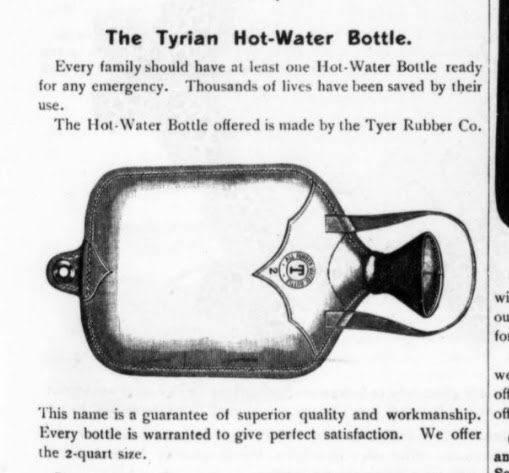
In 1903 Slavoljub Eduard Penkala of Croatia, Eastern Europe, patented a rubber hot-water bottle. This is commonly cited. But did he invent it? A quick search found that the modern rubber hot-water bottle had actually been sold to the masses in the USA, as the ‘Tyrian’ made by the Tyer Rubber company (personal rubber goods specialist) since 1893. Here is one of their adverts from the U.S. mass-circulation magazine Youth’s Companion for 1895, evidently sold from circa 1893…
Here in the UK one can find evidence from further back, with Thornton and Co.’s 1867 ‘India Rubber’ hot water bottle advertised to the chilly Scots in The Glasgow Herald newspaper. Thornton was an Edinburgh company (est. 1848), an “India rubber manufacturer” that specialised in waterproof and rubber goods.
Evidently they were in use in hospitals in the north of England by 1875, as evidenced by an article in The British Medical Journal (10th July 1875, p. 57). This mentions in passing that an “India-rubber hot-water bottle” was being applied to a lady’s feet.
Are there any in museums? Not that I can find via online search. There are metal ‘bedpan-like’ ones but I assume the early ones all perished as the rubber decayed. The older ones were apparently made of purer rubber than today’s, but they still would have perished over the decades.
So, who did invent the modern rubber hot-water bottle?
Well, let’s look at the history of the material needed — vulcanised rubber — and see if this gives any clues. In the USA this useful multi-purpose material was patented by Charles Goodyear on 15th June 1844. He had purchased the basic idea from another man, and then he apparently hit upon the exact combination due to an accident with a hot stove while in prison.
However… here in Britain one Thomas Hancock had also hit on vulcanised rubber and the same process, and he had a British patent for it on 21st November 1843. Before Goodyear. Who got there first? We may never know. Perhaps it was an invention that was ‘in the air’, and both men got there independently.
But we do know that Hancock grew the vulcanised rubber business with his nephew James Lyne Hancock from 1842, who went into business making many vulcanised rubber products for Britain and the British Empire by the mid 1840s. Their firm showed a range of products at the Great Exhibition of 1851. For those interested, there’s now a book, The Hancocks of Marlborough: Rubber, Art and the Industrial Revolution — A Family of Inventive Genius (2009), and see also Thomas Hancock’s own Personal Narrative of The Origin and Progress of the Caoutchouc or India-Rubber Manufacture in England (1857, reprinted 1920, now on Archive.org).
So this would seem to narrow down the dates. We may be talking about somewhere between about 1847 and 1867.
Thomas Hancock’s Personal Narrative shows some of his earliest designs. They are obviously not the modern hot-water bottle at the neck, but have the basic shape. He called them “water cushions and pillows” and they could evidently hold hot water.
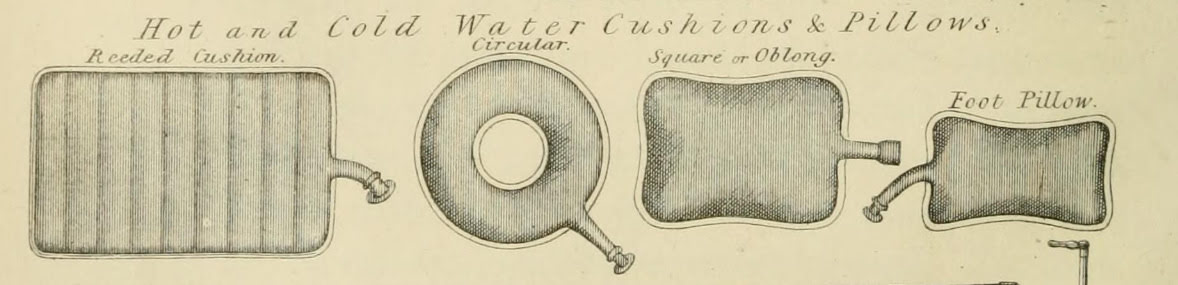
He adds however that…
“At first the aperture for admitting the air [to a ‘cushion’] was simply a stop-cock; but, after a variety of methods had been tried to supersede it, the screwvalve at present in use was adopted, and is universally preferred.” (page 51)
We have to assume that the same was true for the water-holding bags. This means the screwvalve was likely in use in British hot water-bottles by the mid 1850s if not earlier. Hancock could also make very hard ‘carveable’ rubber, as he explains in his book, so perhaps that was what the screwvalves were made of?
However, there is an even earlier instance. Hancock’s book also recalls that he made “hot-water bags” with his early partner Macintosh (of waterproof capes, rubberised raincoats fame, etc) back in 1830 in Manchester (pages 72 and 75). This was before vulcanised rubber, and at that time the U.S. vulcaniser Charles Goodyear was in a debtor’s prison in America and was still a hardware man. Hancock recalled that…
“Sheet rubber was also brought into requisition for lining hot-water bags, which required an extra thickness of rubber. These bags were made of all sizes, and at the breaking out of the cholera and during its prevalence were in great esteem, and have ever since been more or less in use, and sometimes large enough for beds; they were, and are, used also for cold water by the doctors in particular cases.”
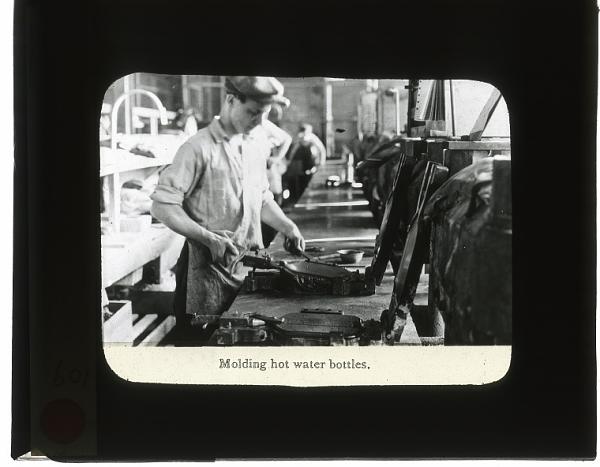
So, vulcanisation was not strictly required. Early British “hot-water bags” could be made of “sheet rubber”, and he recalls these came into wide everyday use in the 1831-1832 cholera epidemic. They appear to have been made in Manchester. Though these likely had the older stop-cock method of sealing, which the modern screwvalve replaced sometime before the mid 1850s. Presumably the seams of these bags were sealed by being painted with rubber cement (i.e. rubber in naptha). The Smithsonian has a picture of worker who looks as though he’s preparing one half of a water-bottle in this way…
Hancock also notes that British buyers of these early bags had taken to adding an… “external covering of silk, or kid and morocco leather, some of which latter were used by [King] George IV. in his last illness”. George IV died in 1830, which dates the reference.
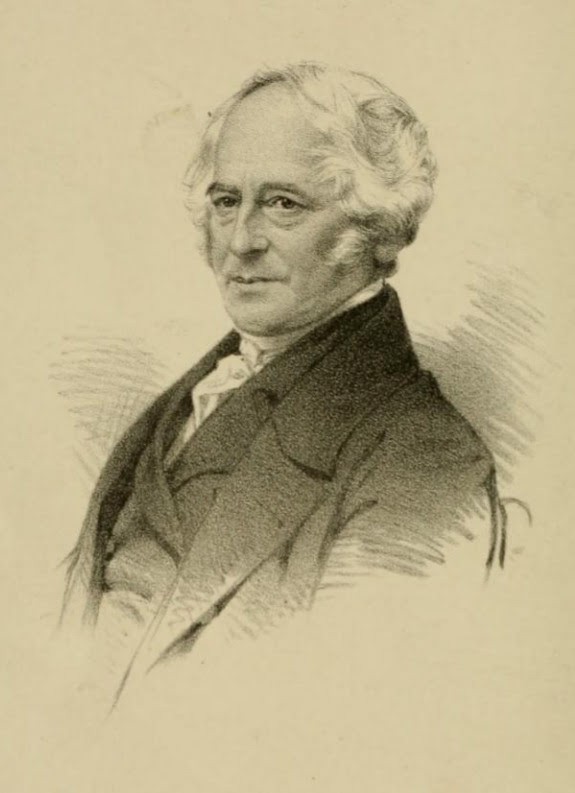
So it looks to me as if the modern rubber hot-water bottle evolved in England, rather than being invented ‘in one go’ in Croatia in 1903. In England it was initially under the direction of Thomas Hancock who, to evolve the 1830 design, was possibly (my guess) working with designers from the Macintosh company circa 1830-1840 and with his nephew James Lyne Hancock from 1842-1857.
Timeline:
* 1830: Sheet rubber hot-water bags, with a stop-cock closure. Owners make custom covers for them, of various fabrics and leathers.
* 1830-32: Sheet rubber hot-water bags become popular in Britain. The first cholera epidemic greatly boosts demand.
* 1850s: Vulcanised rubber hot-water bags/bottles, presumably lighter and more durable than the old sheet-rubber ones, and now also with a better screw-thread closure.
* 1875: “India rubber” hot-water bottles known to be used in hospitals in northern England. A name-change from “bags” to “bottles” seems to have occurred, at least in the British medical profession. Nursing manuals in the U.S. continued to use “bags” into the 1910s.
* 1890s: U.S. magazine adverts shows ‘Tyrian’ brand hot-water bottles with the distinctive angled ‘flappy mouth’ at the top of the bottle.
* 1893: Fashion magazine Harper’s Bazzar notes… “articles of woman’s work are quilted covers for hot-water bags. They are made in sizes to fit the different sizes of the bags, and have a flap at the top to button over in envelope fashion. By their aid the heat is retained in the water for many hours, and they so successfully disguise the appearance of the rubber receptacles that no one need mind taking one in the carriage on a winter’s day. Some of the covers are made of canvas, with a pattern in Berlin-work running around the edge, and a geometrical figure or initials within an oval line in the centre. A strap of ribbon or of cord from one corner to the other serves to lift the article conveniently when it is full. The lining should be of tacked or quilted cotton, whatever the outside may be.”
* 1895: Promoted as a regular family home item in the U.S., vital to have.
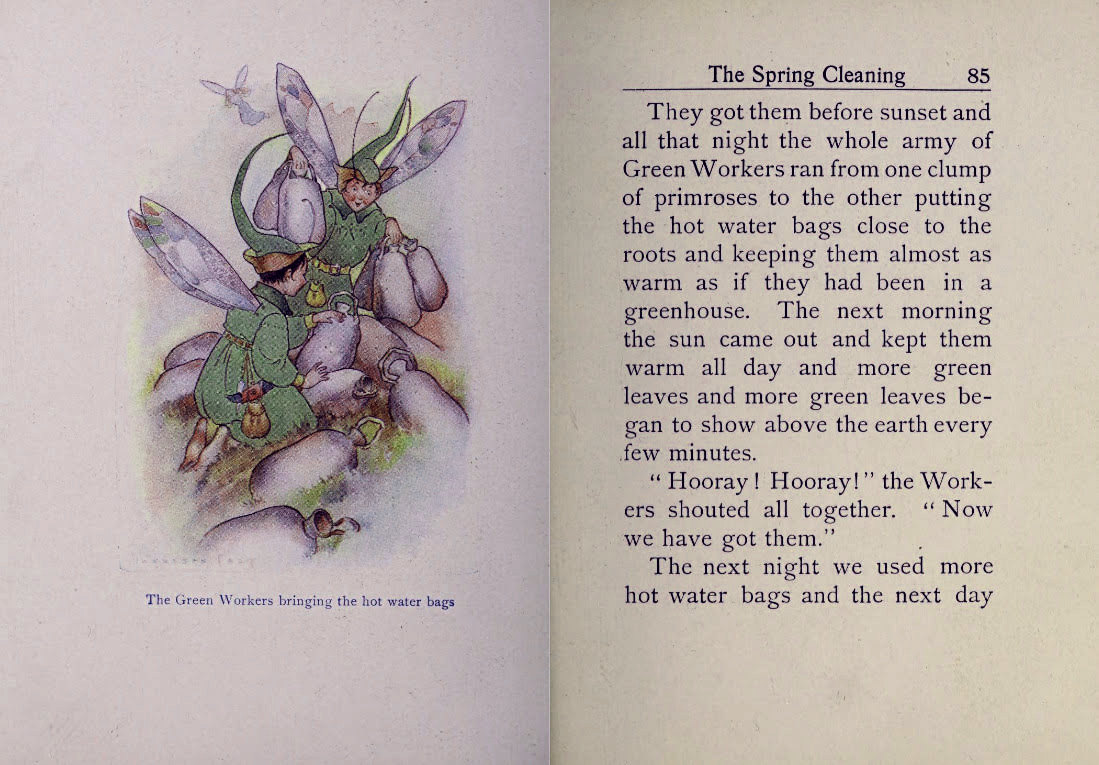
* 1908: Obviously well known to young children, as evidenced by Frances Hodgson Burnett’s 1908 fairy story book The Spring Cleaning.
* 1942: Rubber hot water-bottle manufacturing ceases in Britain due to the Second World War. British people are expected to use the pre-rubber stone bottle type, and the remaining stocks of rubber ones are only dispensed to those over age 80 or with a medical certificate.
Those who have access to large quickly-searchable archives of newspapers/magazines and their adverts may well be able to expand on the above.