Tolkien Gleanings #416

Tolkien Gleanings #416

* John Garth welcomes the new book J.R.R. Tolkien and G.B. Smith: With Wind in our Ears (2026)…

I’m still reading and absorbing the papers, but so far it’s a feast. Clearly, contributors have put in much valuable work beyond what they were able to prepare for the excellent 2023 conference [on Smith].

* A new YouTube video on What Tolkien’s Oxford students were reading in the 1930s

“Thanks to university records and the enormous amount of Tolkienalia published, we have a pretty good idea of what being one of the professor’s Old English students at Oxford must have been like. Today’s video covers his primary ‘reading list’: the fifteen poems and works that he lectured on and read most frequently with his students, while teaching Old English at Pembroke College.”

I imagine the various exam papers for his courses should be available somewhere, as well?

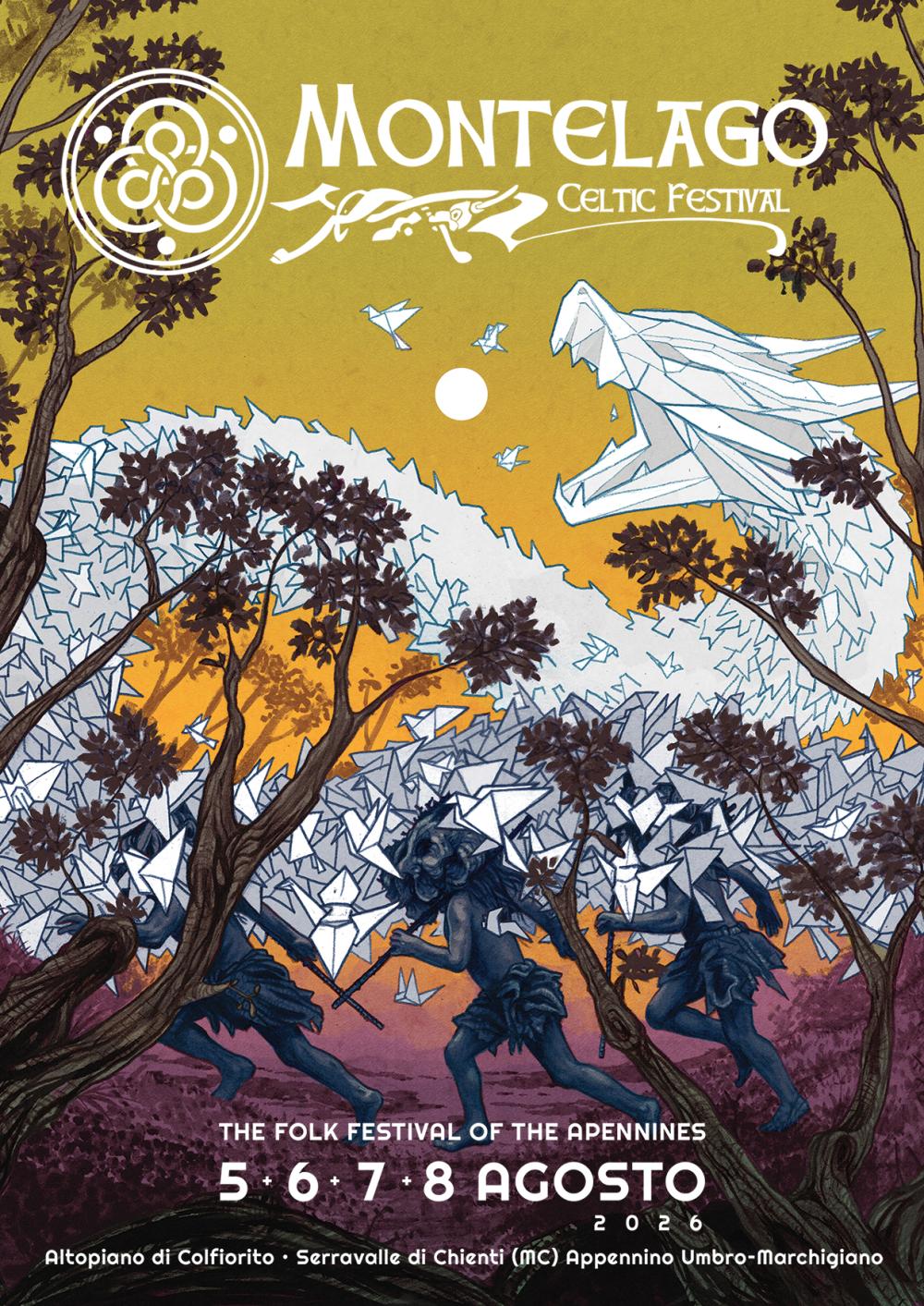
* Italy’s August 2026 Montelago Celtic Festival appears to foreground Tolkien, with events including…

Stefano Giorgianni talking on Tolkien and environmentalist thought; Cesare Cata’s lecture-show, conceived as a journey between Tolkien’s narration and symbols of medieval mythology; and a talk on Tolkien and RPGs. The event concludes with Wu Ming 4’s keynote on the constructed nature of The Lord of the Rings and the imagery of Middle-earth.

* The French national library (Bibliotheque Nationale de France) now has the catalogue available for its current Paris exhibition Cartes imaginaires – Inventer des mondes (‘Imaginary Maps: Inventing Worlds’). March 2026, 256 pages, in French but lavishly illustrated.

* Alas Not Me muses on the similarity of the approach used by the German historian Leopold von Ranke and Tolkien, in his new blog post “What really happened,” or, “Was hat Ranke mit Tolkien zu tun?”. Ranke very sensibly used sources that were as close to the historical period as possible, while overlooking or discounting nothing from the period as irrelevant.

* Miriam Ellis has a short new post on “Tolkien and the Old Wives”, along with a new painting.

On this topic, it occurred to me recently that there’s an unwritten subtext to the return of the women of Gondor, returning on what Beregond states was… “the road to the vales of Tumladen and Lossarnach, and the mountain-villages, and then on to Lebennin”. They return on this same road, perhaps a journey of two or three days for women with children and belongings. Their return is described as… “And the City was filled again with women and fair children that returned to their homes laden with flowers”. The attentive reader also knows by this point that Lossarnach is where Ioreth and her sisters gather healing herbs, and that these are conveyed to the market in the city (“it is days out of count since ever a carrier [of healing plants] came in from Lossarnach”. Thus the “flowers” being brought back in the wains, collected at the perfect plucking-time when “spring and summer joined and made revel together”, are likely not only a scattering of decorative and childish fancies. Indeed the wains are “laden” with flowers, in other words they are ‘weighed down’. Thus these “flowers” could also be the results of some five weeks of a great effort by the older women to find, gather, dry and bundle up healing plants. Intended, when they returned, as the means to restore the greatly depleted stocks of the healers of the city and its outlands.

* The Last Homely House podcast celebrates its 200th edition with a discussion of Notable Numbers in Middle-earth.

* And finally, nicely timed to coincide with the release of the wonderful Stable Audio 3, a new interview on ‘fantasy synth’ music

“The style of music known as fantasy synth is too new to feature on [a key map] of music genres […] [For this interview we welcome] one of fantasy synth’s most avid listeners — the British artist and designer Luke Edward Hall.”

Don’t overlook the Web link at the very bottom of the page, to Bandcamp’s “Exploring the Mystical Realms of Fantasy Synth” guide. This has descriptions, cover artwork and embedded album tracks.

Tolkien Gleanings #415

Tolkien Gleanings #415

* The latest rolling issue of The Journal of Tolkien Studies has added Kristine Larsen’s paper from the recent Kalamazoo Medieval Congress, “Voyaging into the Void in Tolkien’s Early Cosmologies”. Freely available online.

* Tomorrow sees a French online conference about heraldry in Middle-earth, Tolkien heraldiste. Place et histoire des armoiries dans les oeuvres de J.R.R. Tolkien (‘Tolkien, heraldist: the place and history of coats-of-arms in the works of J.R.R. Tolkien’).

* Kalimac unearths a vivid 1974 observation by science-fiction author James Tiptree on Tolkien and H.G. Wells, re: their experiences of trauma during their young manhood. The unstated historical context for the Tiptree quote is that the very ill Wells nearly died, while living in Stoke-on-Trent in 1888. See the short memoir by Wells “How I Died”, and also my book H.G. Wells in the Potteries: North Staffordshire and the Genesis of The Time Machine (2017).

* Fellowship & Fairydust has a long interview with the Tolkien/Inklings scholar David Bratman. Freely available online.

* Modern Reformation on “A Veil Before the Eyes of the Enemy: On Tolkien, Foolishness, and the Ordinary Means of Grace”. Freely available online.

* Saint Tolkien on “Tolkien and the Virtue of Pity”. Freely available online.

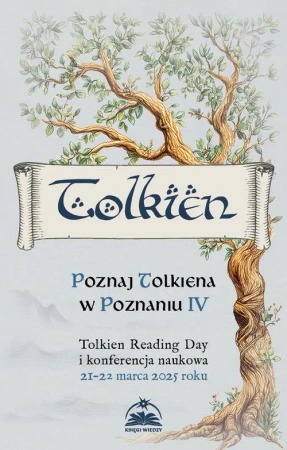
* A new Polish ebook available now, Poznaj Tolkiena w Poznaniu IV. Containing the proceedings of the nation’s annual conference / Reading Day event.

No contents listing, but the papers at the conference included (titles here translated to English)…

   “Sources and symbolism of the appearance of groups.” (clothing, weapons, etc)
   “I have over a hundred editions of The Hobbit”.
   “A zoologist in Middle-earth”.
   “Tolkienalia in Fantastyka and Nowa Fantastyka magazine”.
   “Tolkien’s work: more pagan than Christian?”
   “(Not only) the King’s hands have the power to heal” (healing motifs in LoTR).

   “Goths, Huns and Anglo-Saxons: Tolkien’s historical inspirations for Rohan”. (panel)
   “History of Polish translations of Tolkien’s works, vol. 4”. (panel)

* The Mortimer History Society has two x £1,000 Research Bursaries for PhD and M.A. students… “whose research includes any aspect of the medieval Welsh Marches or the Mortimers”. Deadline: 30th June 2026.

* Transcripts of the 1981 radio adaptation of The Lord of the Rings, newly available on Archive.org

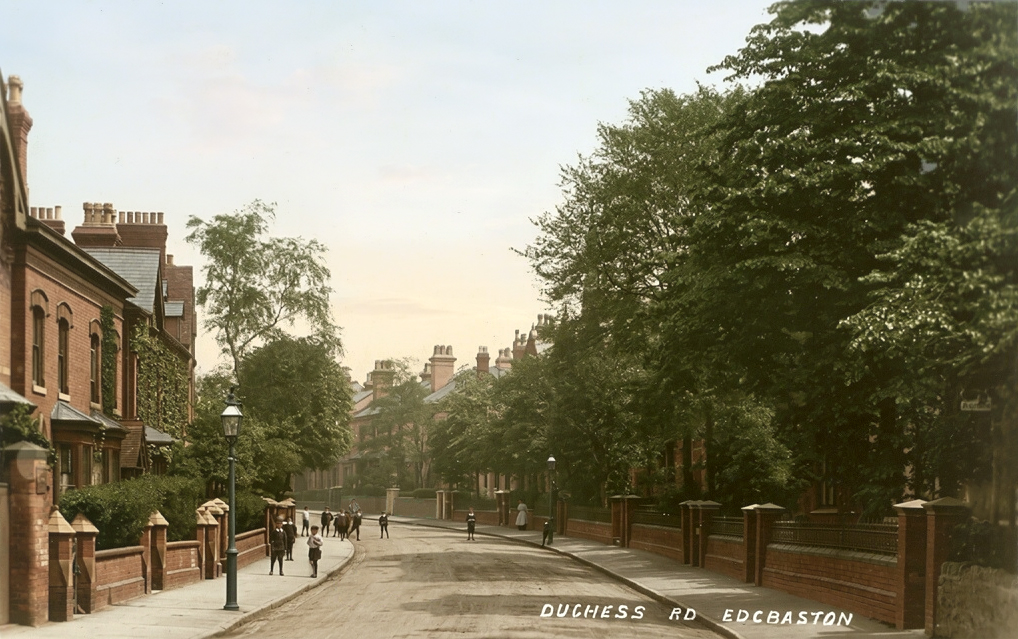
* And finally, Duchess Road, Edgbaston. A formative place for Tolkien and his brother. An eBay scan and here newly colorised. At a guess, circa 1905-1910?

Tolkien Gleanings #414

Tolkien Gleanings #414

* The Pints with Aquinas podcast settles in for a long two-hour chat with Malcolm Guite. Includes his thoughts on “Who is is Tom Bombadil?” among much else.

* The Tolkien Pop podcast interviews the Rev. Dr. Tom Emanuel, discussing…

“his recently completed PhD work on the religiosity of Tolkien fandom in a post-religious world. We also discuss his Tolkien experience, progressive theology and religious studies in Tolkien Studies”.

* In Italy, a talk on Tolkien and AI on 22nd May 2026, in advance of a new book…

“Philosopher Rick DuFer’s new essay, published in March by Bompiani, offers an original reflection on the thought of J.R.R. Tolkien and the surprising relevance of his works. [Via Tolkien] the philosopher addresses contemporary issues such as artificial intelligence, war, the fear of death, and the very meaning of existence. [His public talk relates to his forthcoming book] Il pensiero speronte. Tolkien in difesa del presente (‘An Encouraging Thought: Tolkien in defence of the present’). [He is] now one of the most popular philosophers in Italy […] co-founder of the Cogito Academy, an organization dedicated to practical philosophy and cultural dissemination.”

* Tom Shippey’s Uppsala Books imprint has announced another book for later in 2026. Hoarded Gold: A Book of Old English Wisdom. New translations of the ‘wisdom poems’, offering…

“everything from wry sayings about money and mead-drinking to guidance on psychological and emotional growth, as well as profound meditations on how human beings can acquire and use wisdom.”

* The Birmingham Mail local daily newspaper covers The Tolkien Society’s Sarehole Mill festival in the south of the city on 31st May 2026, including details of ticket prices and travel.

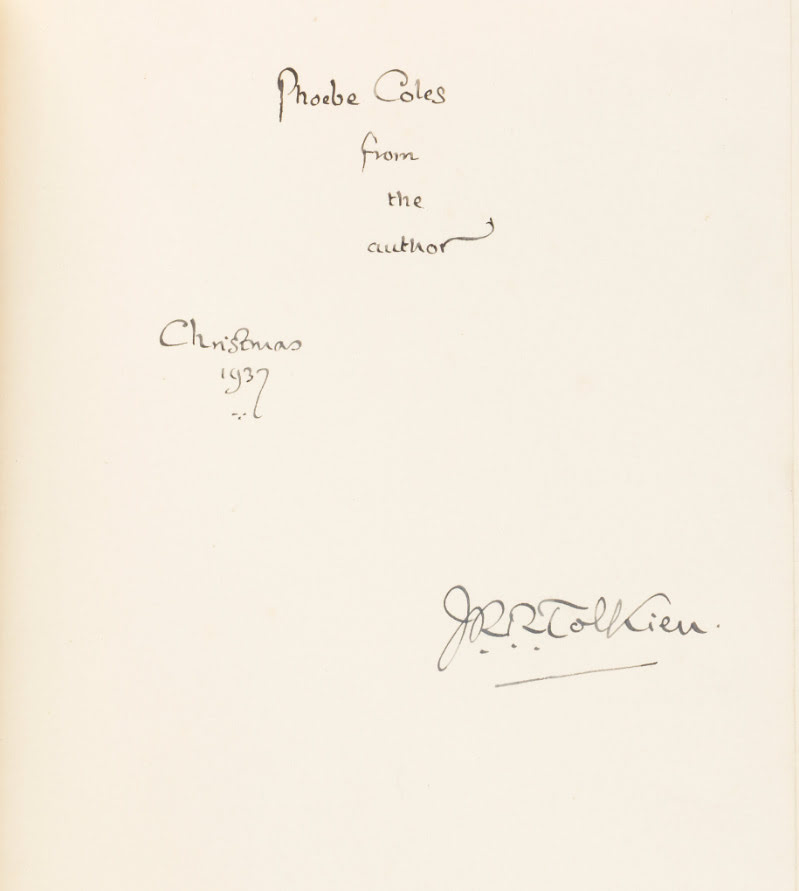
* A signed copy of The Hobbit has just dinged an auctioneer’s cash-register for $450,000. The book was a Christmas gift to his housekeeper Phoebe Coles at Christmas 1937.

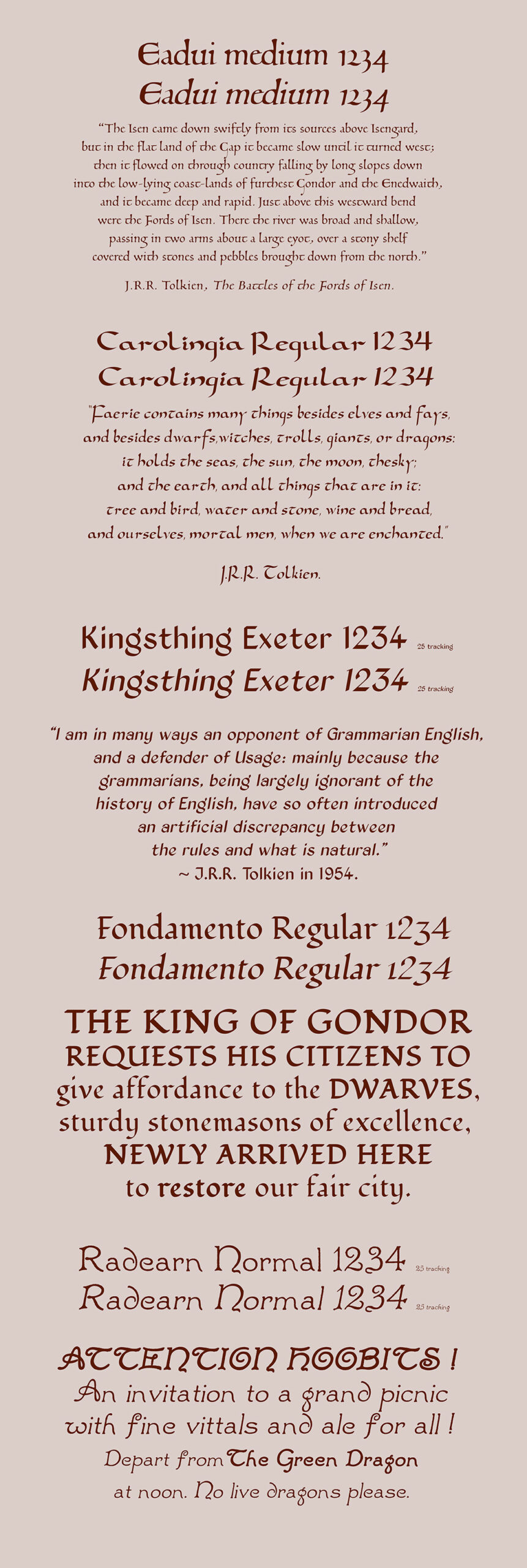
* And finally, some choice free commercial-use fonts. Which some may find of use…

  — Peter Baker’s Eadui, based on the hand of an 11th century scribe.

  — William Boyd’s Carolingia, based on Carolingian Minuscule.

  — Kevin King’s Kingthings Exeter.

  — Brian J. Bonislawsky’s Fondamento.

  — Paul Lloyd’s Radaern.

Italic and bold versions had via clicking Photoshop’s ‘Fake Italics’ / ‘Fake Bold’ buttons. The examples here are all on dead-straight baselines, but know that there’s a Photoshop script to jitter the baseline and more. Alternatively set up a ‘lined-paper page’ with lines from the pen tool, then wave the lines slightly, then run text along them.

Tolkien Gleanings #413

Tolkien Gleanings #413

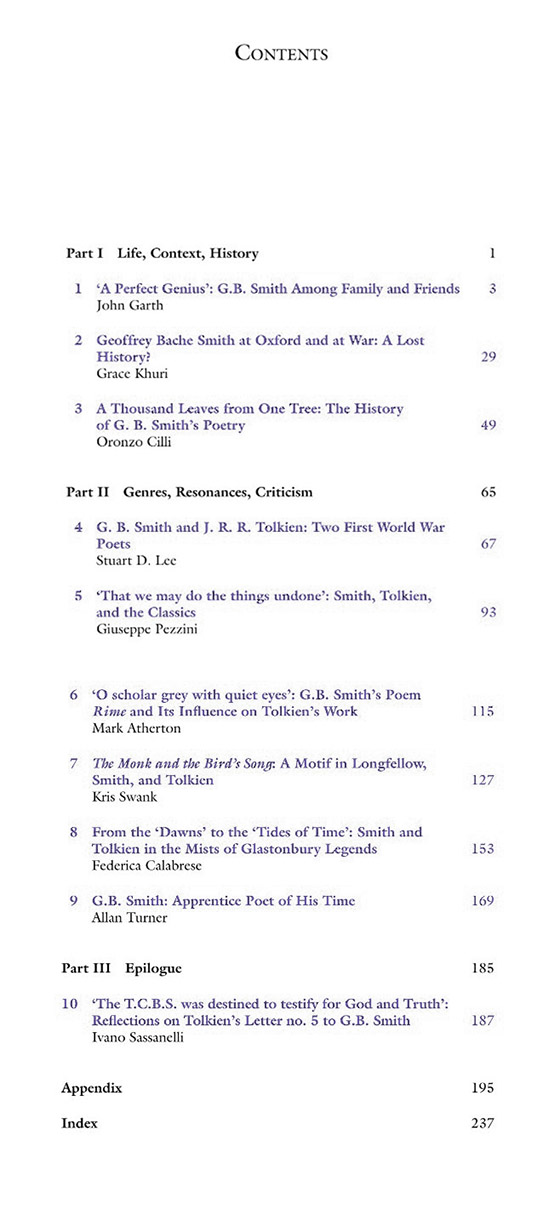
* The £95 book J.R.R. Tolkien and G.B. Smith: With Wind in our Ears (2026) has been published. The introduction/overview can be had for free from the Springer website.

* An undergraduate final dissertation, “Morphological Analysis of Oilima Markirya: Deciphering J.R.R Tolkien’s Early Elvish Poetry” (2026). Freely available online.

“This paper examines J.R.R. Tolkien’s Quenya poem Oilima Markirya (“The Last Ark”) through a morphological analysis of its linguistic structure. By constructing a detailed morphological chart, this study analyzes noun cases, verb conjugations, and derivational patterns in the poem, demonstrating how grammatical meaning is systematically encoded in Quenya. This paper also compares multiple versions of the poem preserved in Parma Eldalamberon 16, tracing how Tolkien revised morphological forms over time.”

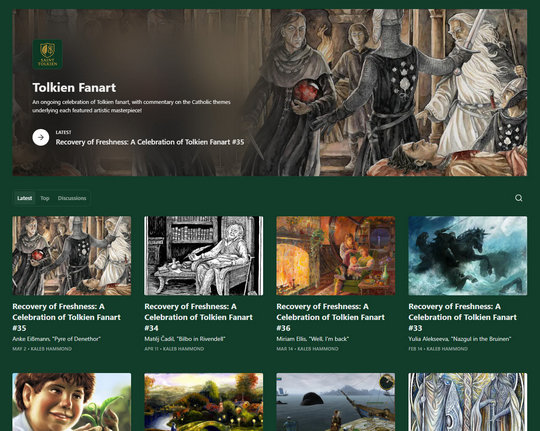
* A Tolkien Fanart section at Saint Tolkien. So far, 35 posts, each appreciating a choice bit of Tolkien fanart.

* In Spain, the Barcelona Comics Festival has just closed. It had an exhibition of Tolkien related artwork. The exhibition was one of about ten themed shows at this huge annual comic-arts event. It surveyed Middle-earth as it has appeared in various…

“concept art for audiovisual productions, scale models, art, comics, role-playing games and board games, as well as showcasing the rich parody tradition of it [Middle-earth] in Spanish comics and cartooning.”

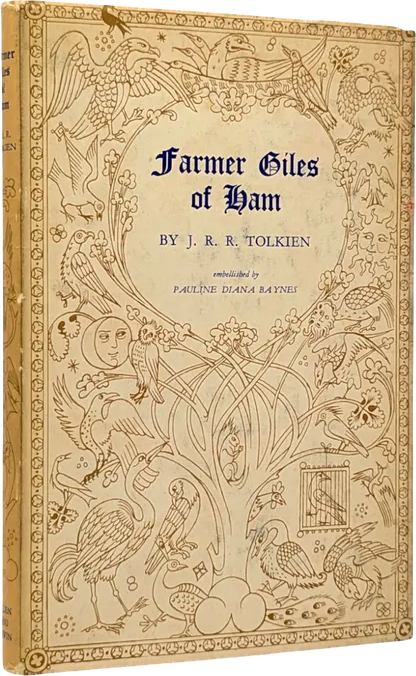
* Up for auction, a Farmer Giles of Ham first edition. I’d never seen the Pauline Baynes dustjacket before…

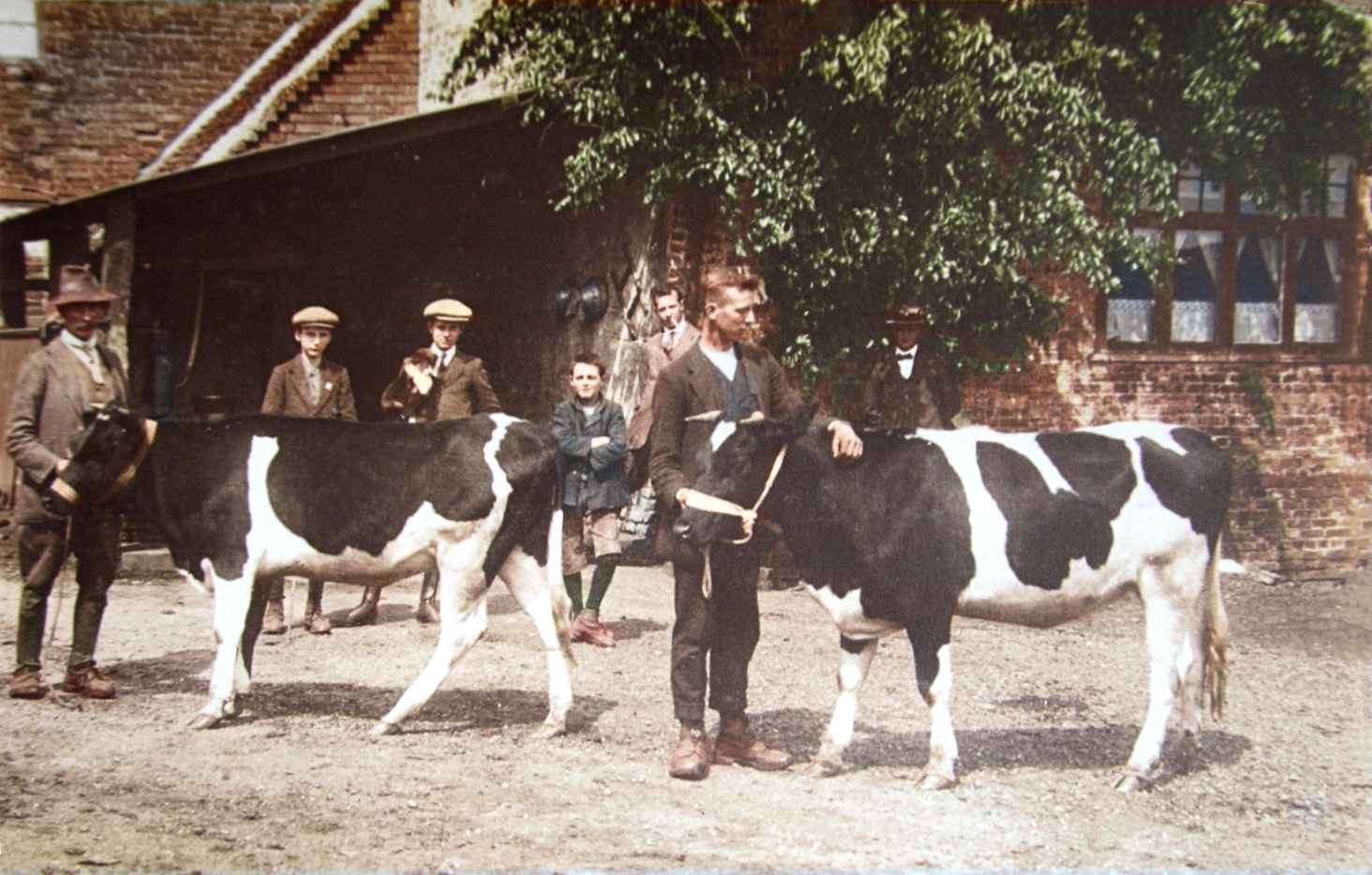
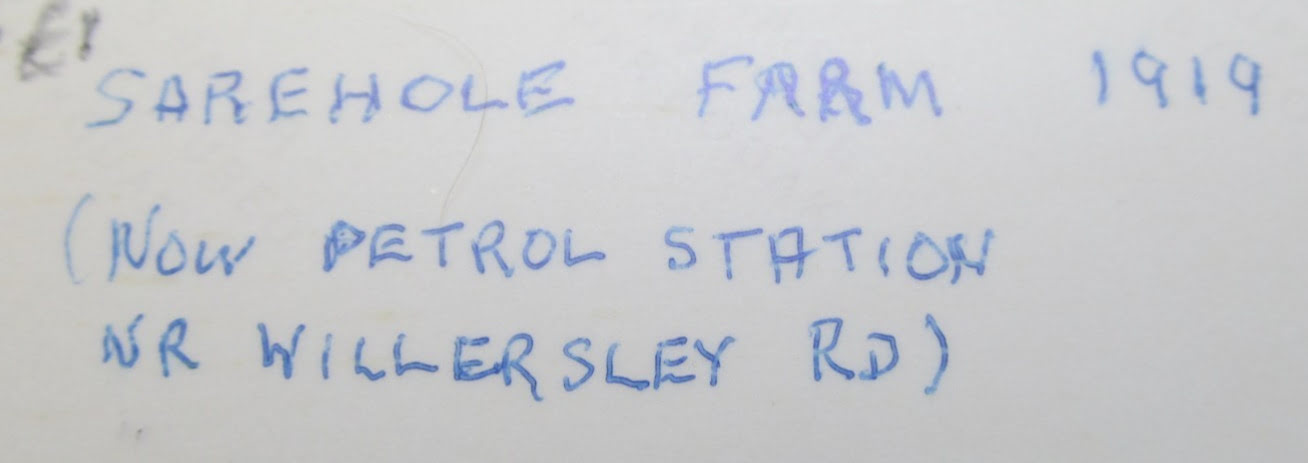
* And finally, talking of farmers, this week eBay has a picture of life at Sarehole Farm in 1919. Here newly colorised. Do we perhaps glimpse the “White Ogre” from the childhood of the Tolkien brothers, on the left?

Tolkien Gleanings #412

Tolkien Gleanings #412

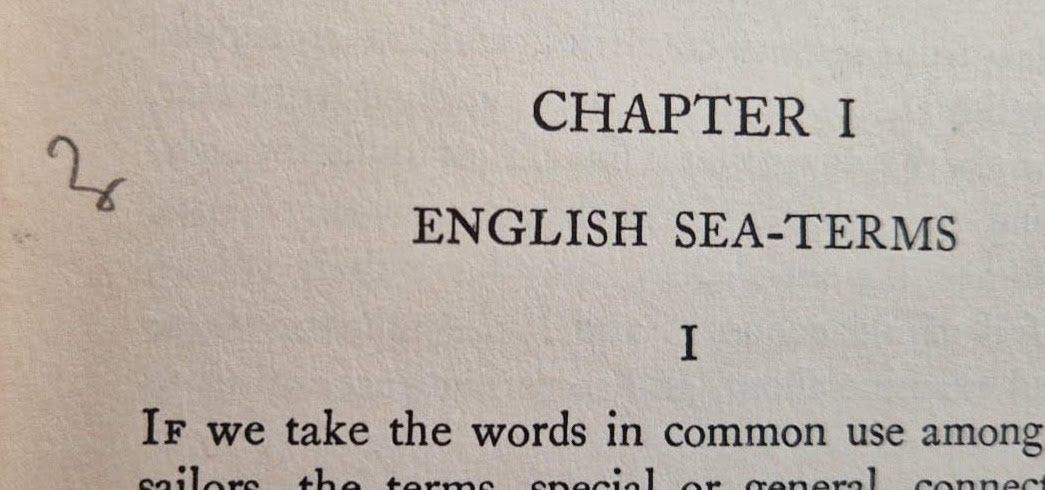
* A peep at Tolkien’s copy of Words and Idioms (1925), a book which opens with the chapter “English Sea-terms”. Tolkien’s pencil annotations and underlinings, presumably from the mid or late 1920s, are shown along with attempts at deciphering his handwriting. (Substack, but freely available online).

A 1928 reprint of the 1925 edition of Words and Idioms is freely available on Archive.org.

* The Imaginative Christian perceptively considers Malcolm Guite on Coleridge’s Mariner, and J.R.R. Tolkien. Freely available online.

* A new PhD thesis on Joy Beyond the World, Poignant as Grief: Fantasy as a Literature of Continuance (2026). Embargoed by the repository until June 2028. The second chapter is on Tolkien and The Lord of the Rings, discussing the…

“continued appeal of this strange, disjointed, oddly formal novel, and how understanding its endurance as a text can help illuminate the possibilities of fantasy as a genre that works to synthesize environmental grief and desire”

* Tolkien: Medieval and Modern has three new essays on… “the role of light, gems, and the passing down of objects designed to keep evil away”. The essays arise from class discussions: “Gems, Eternity, and Evil”; “Jewels, Light, and the Weight of Beauty in Tolkien”; and “Given, Not Kept”. All freely available online.

* New in the latest rolling issue of the Journal of Tolkien Research, “The library of Michael H.R. Tolkien (1920-1984): dispersal, reconstruction and partial bibliography”. Freely available online. The article is on the books owned by Tolkien’s son, with no mention of any runs of journals.

* John Garth is offering two paid summer-school courses in Oxford in 2026, Tolkien: The Great War and the Beginnings of Middle-earth and Building Middle-earth: Tolkien’s Geography and the Power of Place. There are only a few places left on either, at time of writing.

* Italian TV company Rai and Lucca Comics plan a joint exhibition on Tolkien later in 2026. This will focus on Tolkien in relation to the comic-book arts, illustration and screen animation…

“an exhibition dedicated to J.R.R. Tolkien, featuring works by Angelo Montanini. Leading names from the world of drawing and animation will attend the festival, including illustrators Domenico Cava and Katerina Ladon, comic artist and writer Barbara Baraldi, and writer and screenwriter Pierdomenico Baccalario.”

Set to be staged at ‘The Aurum’, a former liqueur distillery now refurbished and re-used, located in the large sea-front town of Pescara on the Adriatic. I’d imagine it’s the type of exhibition which might travel in due course.

* In Italian, a recording of a March 2026 talk on Tolkien on war as a necessity, and his criticisms of war. The talk was… “at the invitation of the newly formed Tolkien association Valmar”. Freely available online.

* A new short article from the University of Notre Dame, “Connecting with the Public Through Medieval Animals”. Likely to be of special practical use for teachers of young children, but also relevant to adult outreach. Also note the links for further reading, such as the open-access scholarly article “Foxes and Badgers in Anglo-Saxon Life and Landscape” (2015). Both items freely available online.

* And finally, a long abstract for an undergraduate final dissertation on a Russian rock-opera, “The Lay of Leithian: A Singable Translation of the Russian Musical” (2026)… “The bulk of this project is the [singable] translation itself [into English].”

Tolkien Gleanings #411

Tolkien Gleanings #411

* In the latest Words Do Things ‘Elvish English’ series podcast, Statler & Waldorf Talk Tolkien

“Tom Hillman & Joe Hoffman take Sorina Higgins through how myth and language are co-causational, what Tolkien believed about the Logos and creation (and subcreation), and what makes languages beautiful.”

* Ramblings On My Bookshelves surveys J.R.R. Tolkien and C.S. Lewis in Puffin. Puffin being the main children’s paperback imprint in the Britain of the 1960s and 70s.

* In Spanish, a new PhD thesis in Education Studies, Mas alla de los hobbits: dialogo fe-cultura a traves de la literatura de fantasoia. Estudio de caso: Cartas de Papa Noel (2026). On using Tolkien’s Father Christmas letters in Catholic classrooms (ages 11-14). Freely available online.

* Spanish readers will soon have Cartas de J.R.R. Tolkien, this being the latest expanded Letters in Spanish translation. Set for a 10th June 2026 release.

* In Italy, a three-day Sentieri Tolkieniani 2026 festival. At Castle Macello, roughly 100 miles south-west of Milan, from 12th-14th June 2026. Linkups with the Oxford Tolkien Network and the UK’s Tolkien Society suggest some scholarly talks, as well as festival performances by folk/metal bands, craft stalls, costumed displays and children’s activities.

* The Journal of the Fantastic in the Arts will close submissions soon…

“2026 general article submission window will be open until the beginning of June 2026. Book review queries and submissions remain open throughout the year.”

* The latest Amon Hen is available to members of the Tolkien Society, and this issue of the magazine has an interview with the artist Miriam Ellis.

* This week John Garth muses on the afterlife of his book Tolkien and the Great War (2003).

* Here in the UK, The Free Speech Union can now accept PayPal for the annual membership fee, at long last. Just in time for me not to be able to afford subscriptions any more. Oh well, the Web link may benefit others. The Union has funded, and won, many free-speech legal and tribunal cases on behalf of its members.

* And finally, The Nerd Daily has a free extract from the forthcoming novel The Inklings Detective Agency.

Tolkien Gleanings #410

Tolkien Gleanings #410

* Magdalen College, Oxford has a nice new job offer. Work for three years as a postdoctoral researcher on “C.S. Lewis and J.R.R. Tolkien: A Scholarly Reappraisal”. The successful candidate is to be paid £42.7k(!) per year. Not a AHRC project. Deadline 7th June 2026, to start 1st October 2026.

* New in the forthcoming £245 Routledge Companion to Early Modern Music and Literature, the chapter “Tolkien, the Gawain-Poet, and Music”. The book is due in June 2026, with a free chapter-abstract available now.

* The Entmoot Podcast this week interviews the author of the book Tolkien, Enchantment, and Loss (2021).

* Kmita’s Library has the new article “Legendary Heroes and Baptismal Symbolism in Tolkien’s Stories”. Substack, but freely available.

* Humanum Review has the new article “Table Matters: On St. Thomas, Tolkien and Babette’s Feast”. Freely available online.

* Tolkien: Medieval and Modern has a new article on “The Fallen World and the Fear of Monsters”. Freely available online…

“In [Edmund] Wilson’s critique, and [that of] many others, the idea of monsters is taken as a childish one, conjurations of the imagination that serve as nothing more than a means to scare children into behaving. They’re not real, and as such don’t deserve any real study or focus. [… But for Tolkien, monsters can be made] to illuminate the truth of sin Tolkien believes to exist in our world […] monsters are sin, and that sin, to Tolkien, is very real, and should be feared.”

* From the University of Silesia, Poland, the PhD thesis Myths, Gods and Saga Structure: On Heroism and Tradition in the Old-Norse Sagas (2024), now freely available online. In English, a close comparison of the Volsungasaga and The Nibelungenlied, with a touch of Tolkien at the end…

“The last chapter provides a view on modern ideas of heroism and its depiction. Arthurian myth and the works of J.R.R. Tolkien are examined in terms of comparison with what is represented in the source texts, showing a significant overlap of motifs in all texts.”

* A new debut novel, just published, The Inklings Detective Agency (May 2026). Set in 1936, a fictional Tolkien and C.S. Lewis team up with Agatha Christie and Dorothy L. Sayers to solve a series of mysterious Oxford murders.

There’s a slight spoiler in the official blurb, which I’ll skip. The blurb then goes on to gush…

“Packed with historical details, intrigue, and a thrilling whodunit, this novel is a masterful blend of high-stakes drama. Dive into a world where the creators of fantasy and mystery confront a real-life menace in a race against the clock.”

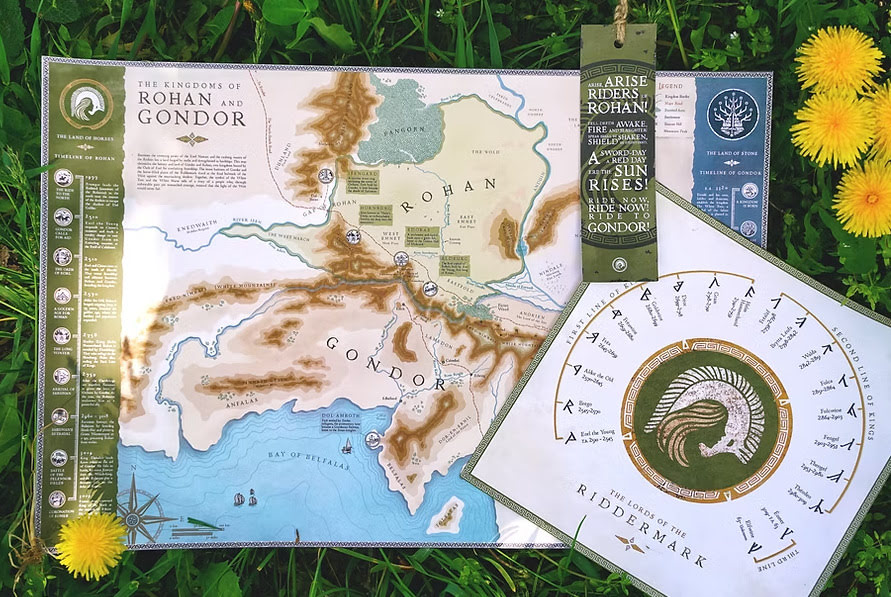
* A new Middle-earth map-pack, for sale from Into Far Lands, Kingdoms of Rohan and Gondor.

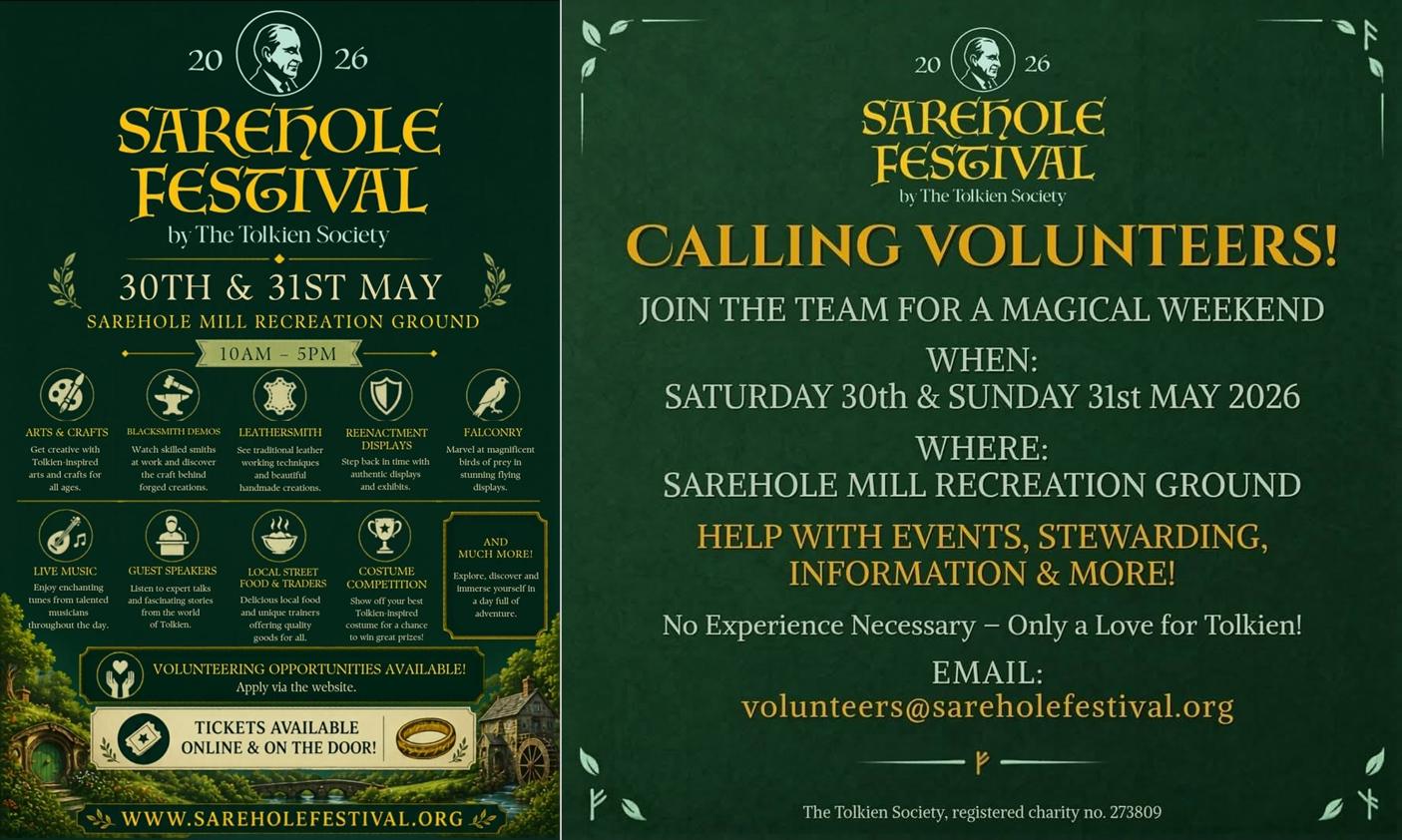
* The Tolkien Society’s revived Sarehole Festival in Birmingham now has an official poster / flyer…

* Should you bag the above lucrative £47k per-year Magdalen College job, and thus be jetting down to sun-drenched Corfu to celebrate… note that the painter Spyros Gelekas has started a Tolkien Museum on the idyllic Greek island. This official Tolkien Calendar artist (2024/2027) has newly…

“founded in Corfu a permanent exhibition space dedicated to Tolkien’s world, the ‘Art of Middle-earth Gallery’, one of the few internationally dedicated to approaching the subject through contemporary visual art.”

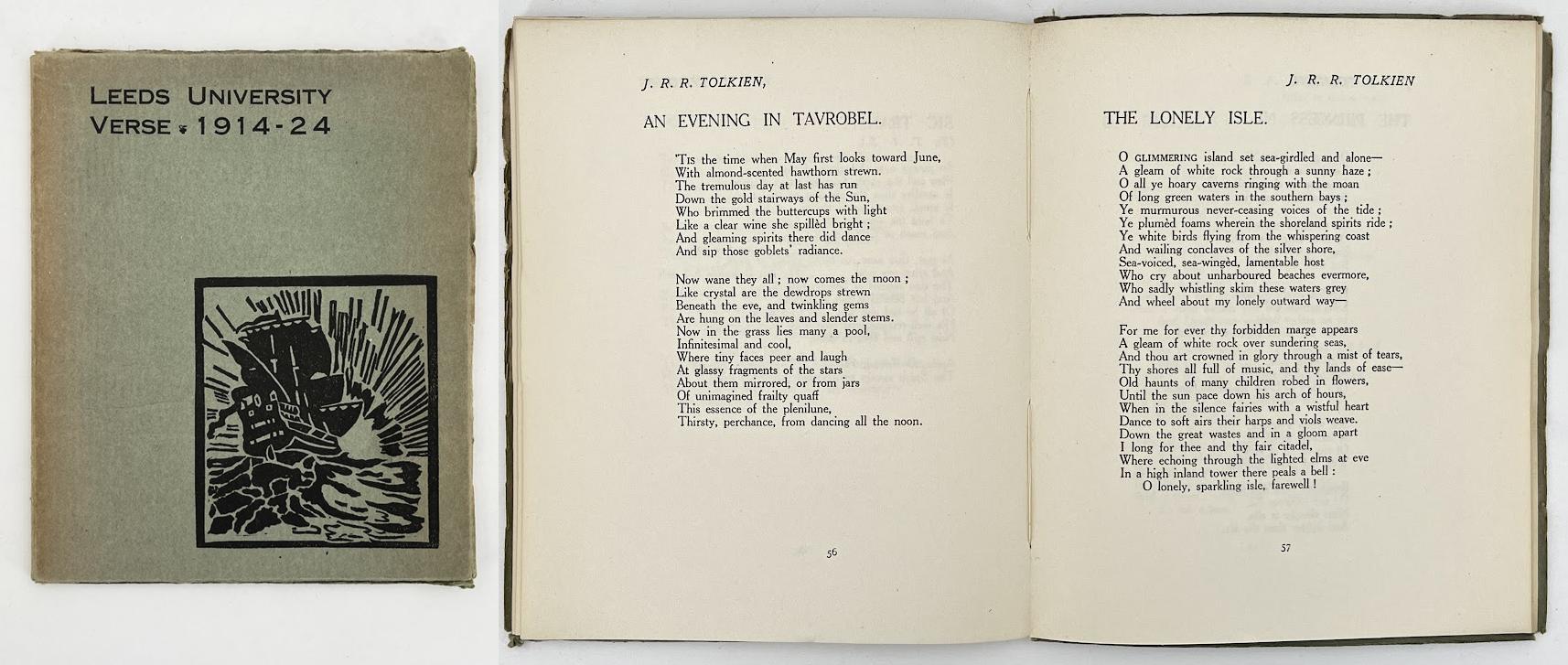
* Seemingly newly up for sale from a seller of rare books, a 1924 example of Tolkien’s published poetry.

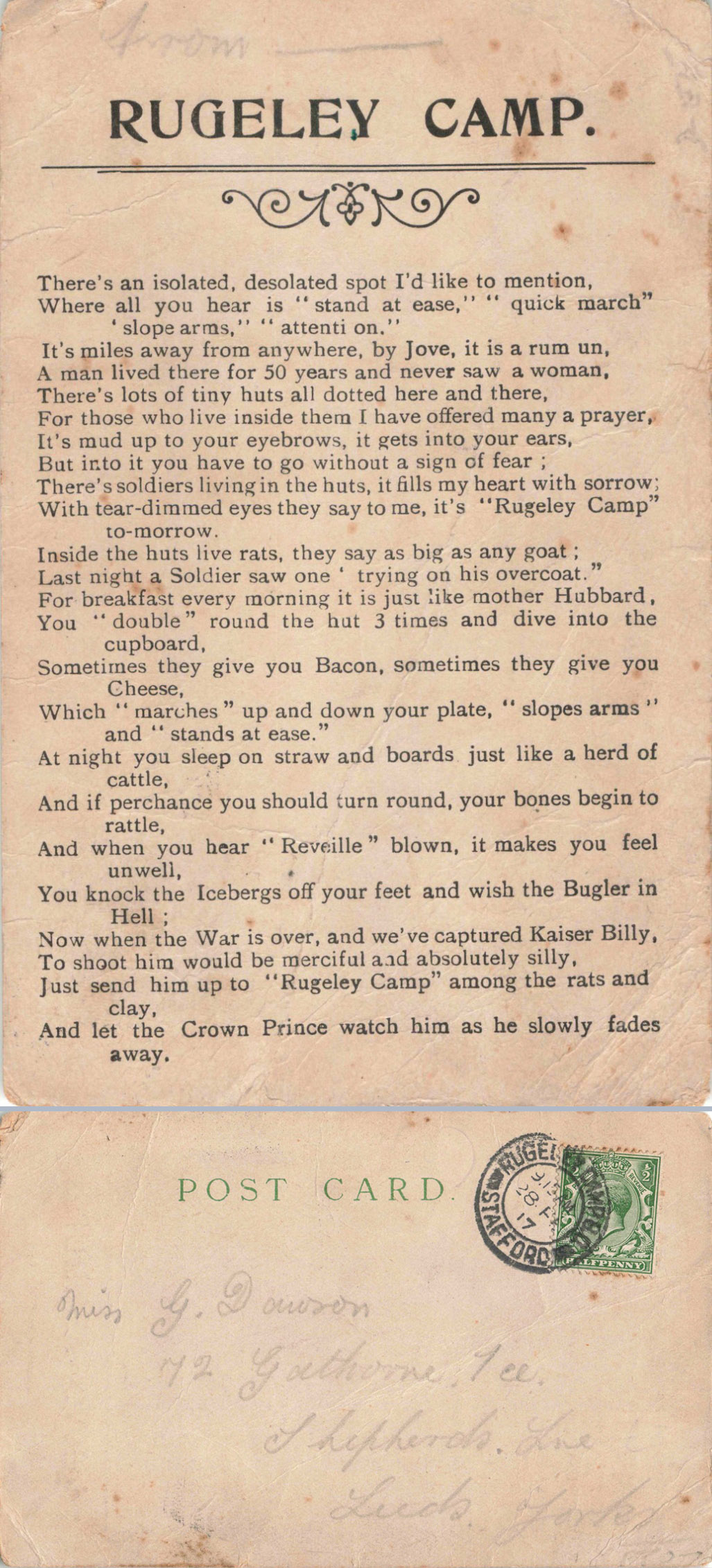
* And finally, this week an unusual item popped up on eBay. A frank and amusing ordinary soldier’s poem from “Rugeley Camp” (one of the popular names for Tolkien’s Penkridge Bank Camp). The 1917 card is new to me, and I’m fairly experienced in plucking mid and north Staffordshire cards from eBay. Perhaps it’s scarce due to predations by the war-time censor, due to its focus on the camp’s rats?

Evidently the camp’s men had rough straw matresses, and there were rats which invaded the huts, at least by 1917. If Tolkien encountered either in his stays in 1915 or 1918 we can’t now know. The anonymous poet’s… “You “double” round the hut three times and dive into the cupboard.” also suggest the men had to run three times around their hut ‘at the double’, before being allowed to scramble for the hut’s tea-cupboard? Tolkien suggests something of the same scramble…

“The usual kind of morning standing about freezing and then trotting to get warmer so as to freeze again. We ended up by an hour’s bomb-throwing with dummies. Lunch and a freezing afternoon… we stand in icy groups in the open being talked at! Tea and another scramble – I fought for a place at the stove and made a piece of toast on the end of a knife: what days!” (letter to Edith Bratt, 26th November 1915).

Penkridge Bank Camp was located at Brindley Heath on Cannock Chase, between Rugeley and Hednesford. Also known to some at the time as ‘The Camp, Hesnedford’ but more often referred to simply as ‘Penkridge Camp’. One of several Staffordshire camps which Tolkien experienced during The First World War.

Tolkien Gleanings #409

Tolkien Gleanings #409

* In Lombardy, northern Italy, an evening talk and academic conference “Tolkien: Fantasist or Prophet?”. With Malcolm Guite as guest speaker…

“Scheduled for Thursday 14th May 2026 [under the auspices of the Philosophicum Ghislieri Association,] Guite will argue that Tolkien had anticipated many of the definitive crises of the twenty-first century […] and that his narrative does not offer an escape from these problems, but a coherent imaginative response to them.”

* The Spanish Tolkien Society has a YouTube link, and a Spanish text-summary, for a recent conference talk on the history of its journal Nolme (six issues from 2002-2024, ongoing). There are also details of future plans for this bilingual Spanish/English journal…

“Issue 7 is already underway, and looking ahead to issue 8 the team will launch an open call for papers. If you would like to collaborate with the magazine in translation, proofreading or layout work, please contact the team; the magazine is waiting for you…”

* The programme book is now available for the vast 61st International Congress on Medieval Studies (14th-16th May 2026). Papers include, among others…

    — Beyond the Stars: Voyaging into the Void in Tolkien’s Early Cosmologies. [Larsen]
    — Ulmo and Manannan mac Lir as Lords of the Waters and Divine Intermediaries.
    — How Mad Ye Be: Water as Essential Boundary in Akallabeth and Pearl.
    — “We that endured the Grinding Ice”: The Helcaraxe in the Noldor Imaginary.
    — Ethereal: J.R.R. Tolkien and the Dreamer’s Near-Death Experience in the Middle English Pearl.
    — A Survey of Parents and Parenting in Tolkien’s Middle-earth.
    — Samwise the Gardener: Parenting as Salvation and Recovery.
    — Where Now the Horse and Rider? The Shifting Medieval Voice in Tolkien’s Afterlives.
    — Script and Story: Tolkien’s Philological Imagination in “On Aelfwine’s Spelling”.
    — Scribal Practice and the Footnotes of The Lord of the Rings.
    — The Tell-Tale Tengwar, or, What the Script Reveals About the Scribe.
    — Tolkien, Exodus, and the Dirty, Stinking, Lying, Pusillanimous Scribes.
    — Exodus from Edoras: Tracing the Old English Exodus in The Lord of the Rings.
    — The Translator as Sub-Creator: Tolkien’s Beowulf, Exodus, and the Mythopoeic Imagination.
    — Tolkien and the Old English Exodus: the Influence of the Poem on the Legendarium.

    — The Dragon’s Big Pile: New Tolkien Manuscripts Discovered. [Judging by its placement, possibly a humorous squit to end the conference with?]

    — Adaptations of Tolkien: Medieval Traces in Movies, Games and Other Transmedial Text. [roundtable]
    — One Hundred Years of Tolkien and Lewis: Fruits of a Medieval Collaboration. [roundtable]

    — The Forge of Friendship: J.R.R. Tolkien and C.S. Lewis. [film screening]

    — The Medieval March of Wales and Its Gentry Libraries. [Sir Gawain relevance]
    — Fragments and Frameworks: Rebuilding the Libraries of Early Medieval England.

    — Two Paths Diverged in an Old English Wood: The Conceptual Metaphor of Wayfaring in Old English Poetry.

* Dimitri Fimi considers “Bilbo’s decluttering” of Bag End, in The Hobbit.

* Tolkien: Medieval and Modern has a new essay on “Worship, Language, and the Liturgy”.

“The practice of saying names and the presence of songs is an essential component of not only Tolkien’s storytelling method, but also the manner in which the plot unfolds. The beauty of Sam’s song stands tall in the tower of art, and also communicates what Tolkien’s vision of worship might actually be.”

* And finally, The Gregorio project is an open-source typesetter for engraving “beautiful Gregorian chant scores”. I’m guessing it might be useful for creating fine sheet-music for Elvish singing? “Elvish singing is not a thing to miss…”, as Bilbo once remarked. Tricky to install locally, by the looks of it, but note the links to free installations that one can use online.

Tolkien Gleanings #408

Tolkien Gleanings #408

* Words Do Things podcast has a new ‘Elvish English’ series, and a new interview with Verlyn Flieger on Tolkien

“In the second episode in the ‘Elvish English’ series, Sorina Higgins has the distinct honor of talking with Verlyn Flieger, one of the greats of Tolkien studies.”

The .MP3 download link is hidden under the “… More” button.

* Malcolm Guite has the chapter “Allegory Among the Inklings”, in the new £150 book The Oxford Handbook of Allegory (May 2026). Readers of this may find David Bratman’s free online A Handlist of Books by the Inklings a useful accompaniment.

* Elfenomeno has an Interview with Michael Martinez, author of Parma Endorion: Essays on Middle-earth (2001).

* From the University of East Anglia, an abstract for “Teaching, Learning, and Biblical Symbolism: The environmentalisms of J.R.R. Tolkien and C.S. Lewis” (2026). This is a Masters dissertation, currently under university repository embargo until 2028.

* A new Reading Soundscape for The Adventures of Tom Bombadil ($ Substack, with a paywall for the audio)…

“Soundscapes are original music and sound design that are meant to accompany your reading and they really are such a lovely way to experience Tolkien’s works. Jordan’s soundscape for Smith of Wootton Major by J.R.R. Tolkien was such a delightful addition to our slow reading for our Faerie segment and I’m really excited that we now have a soundscape to accompany our reading of Tolkien’s poems!”

* The International Association of Music Libraries has the new long article “The Piano Makers: An exploration of the musical history of the Tolkien family”, well illustrated with period images. It also serves as an update on project progress…

“We have found a functional Tolkien piano located at Winterbourne House in Birmingham that we will visit and photograph. […] we will be recording some of the smaller scale works [discovered as a sheet music], possibly even all of them if we can bridge the gap of financing small projects without affecting our other projects and aims. The operas and cantatas by Frederick Tolkien (of which there are some incredible reviews of performances in the late 1890s to early 1900s) may be beyond our means currently, but we have been retrieving the scores and supporting documents for them. A book may be a possibility with new editions of the printed music and family history connecting it.”

* “St. John Ambulance and British Army officers wait for the arrival of wounded soldiers from the Western Front at Snow Hill, 1916” (restored, and for once Nano Banana 2 got the details right — even the slowing train, which looks vaguely modern, is the same in the original).

It appears from the photograph that Tolkien’s First World War “ambulance train”, then the common name of the train which carried battle-front soldiers home from the hospital-ships, arrived at Birmingham Snow Hill and not (as might be expected) at New Street station. A little research discovers that the women of the Birmingham Nursing Corp., assisted by men of St. John Ambulance brigade, led… “the rest station at Snow Hill [which] has been organised and developed until it is now acknowledged to be not only the largest, but in all respects the best rest station in the country” (Birmingham Post newspaper, 6th November 1917). They organised the initial reception of the ambulance train at the station. Tolkien’s hospital ship docked at Southampton, and the pre-closure/pre-1950s Snow Hill station appears to have had the required direct ‘Southampton docks to Birmingham Snow Hill’ connection, via Worcester. I see Snow Hill (later re-opened and now a working station again) still sells tickets for the three-hour journey from Birmingham to Southampton.

* And finally, in Greece, “The ‘Guardians of the White Tower’ stage epic Tolkien battle in Thessaloniki city-centre”. Sadly not in costume and on the streets. Rather, it’s an innovative approach to tabletop war-gaming that combines gaming with storytelling…

“more than 1,000 hand-painted miniatures will be deployed across nine themed boards, all custom-built to capture Gondolin’s aesthetic […] The programme will run for approximately five and a half hours and […] follow Tolkien’s narrative arc. This approach aims to offer a complete visual and strategic experience, combining storytelling with tactical gameplay [to re-enact The Fall of Goldonin]”.

40 years since the Stoke-on-Trent National Garden Festival 1986

This week marks the 40th anniversary of the opening of the Stoke-on-Trent National Garden Festival 1986. The event was opened by the Queen and was open to the public for six months on a transformed site that is now Festival Park, Stoke-on-Trent. Its associated improvement works also stretched south along the Trent & Mersey canal through Etruria, and north through Grange Park and Rogerson’s Meadow and to within a stone’s throw of the gates of Burslem churchyard. Despite that summer’s atrocious weather, which saw near-constant rain and high winds, the festival was a visitor success and also a huge environmental success. It showed the world that even one of Europe’s most scarred and polluted heavy-industrial sites could be scoured, cleansed and restored. Rapidly, imaginatively, and at relatively little cost. The Festival’s wet weather may well have helped the long-term ‘bed in’ of the new tentative new environment, which had (in some cases, as in an imported peat-bog that was otherwise destined for destruction) been quite literally ‘laid over’ the old industrial landscape. The site, in May of 2026, now amply rewards the efforts of those who worked on restoring it all those decades ago. Both in terms of the richly maturing garden landscape and the wealth of jobs.

BBC Radio Stoke has the new short radio documentary “The Story of Stoke-on-Trent 1986”, apparently “available now” but I see no download button. Possibly it’s only available via the BBC’s player.

Several books give the story of the site’s reclamation and the Festival itself, including Etruria: Jaspers, Joists and Jillivers: The History of the 1986 Garden Festival Site Stoke-on-Trent (2002), and in brief in the official Festival handbook (1986). There’s also the Sculpture at Stoke – 1986 Garden Festival booklet and catalogue which is online as a rough scan at the Internet Archive, as well as Up The Garden Path which was a Dungeons & Dragons RPG adventure set at the site.

The Staffordshire Film Archive also has a DVD documentary, which appears to be still available.

Tolkien Gleanings #407

Tolkien Gleanings #407

* The Oxford C.S.Lewis Society has posted its list of April-June 2026 events. Talks include…

    — J.R.R. Tolkien and the Patriotism of G.K. Chesterton: Little England, The Shire, and Notting Hill.
    — Biography of C.S. Lewis’s Library: The Kilns’ Years.

* Tolkien: Medieval and Modern muses on “Tolkien’s Metaphysics”.

* The Tolkien Pop! podcast has a new long interview with Dr. Luke Shelton, editor of Mallorn and author of a recent thesis on the reception of The Lord of the Rings among young readers.

* Tolkien Oddments tracks down the “Books Dedicated to J.R.R. Tolkien During His Lifetime”. (Substack, but freely available).

* Miriam Ellis reviews Malcolm Guite’s new book Galahad and the Grail (2026).

* The Church Times reviews Fairies: A history (2026).

* The Gondolin Student Project has built Tolkien’s Gondolin in 3D and rendered a view of it using the open-source Blender software.

* And finally, via a crisp eBay scan, a restored and colorised ‘magic-lantern’ slide of Warwick Castle from the river.

“June-July 1914: Tolkien spends the early part of his vacation visiting Edith in Warwick. Probably on this visit he draws a view of Warwick Castle seen from under a bridge, apparently made from a punt or boat on the river. He will later date it ‘1913-14?'” — Hammond & Scull, Chronology.

O fading town upon a little hill,
Old memory is waning in thine ancient gates,
The robe gone grey, thine old heart almost still;
The castle only, frowning, ever waits

— Tolkien, from the first version of “Kortirion among the Trees” (1915).

Tolkien Gleanings #406

Tolkien Gleanings #406

* New listings for the May and June 2026 Tolkien Research Seminars at the University of Oxford…

   – Lexical Palimpsests: Old English and Old Norse loan words in Tolkien’s Gnomish Lexicon (1917).
   – Tolkien the Parodist: Revisiting Songs for the Philologists.
   – Tolkien and Sawles Warde.
   – Genealogy of Smaug: Draconic influences on Tolkien.
   – Charting Faerie: Cartography as the threshold of enchantment.
   – The Verbal System of Quenya: Structures, functions, and linguistic models in Tolkien’s linguistic invention.

* Luna Press have picked up the book Las Vacaciones de un Hobbite (2022) for an English translation. In their English edition it will be titled A Hobbit’s Holiday: J.R.R. Tolkien’s Journeys in the Belle Epoque. The book apparently considers the young Tolkien’s various real journeys as formative encounters, made in unfamiliar landscapes such as Switzerland, Scotland, Paris, Brittany, Cornwall etc.

* The Inklings blog notices the 100th Anniversary of the meeting of Tolkien and C.S. Lewis. (Substack, but freely available online).

* The Imaginative Conservative has a new article on “Tolkien, Chesterton, & the Sloth of England”. Freely available online.

* Matej Cadil starts blogging his artistic journey through Tolkien. (Substack, but freely available online).

“So here we set out together: chapter by chapter through The Hobbit. In each post I’ll reflect on Tolkien’s text — its story, themes, connections, and what caught my attention — and then turn to my illustration for that chapter to discuss my choices, influences, and small discoveries that shaped it.”

* And finally, in France the La Cuivrerie de Cerdon seems to be a newly restored and reopened large ex-industrial site, now specialising in crafts metalwork training. It’s located about 40 miles east of the city of Lyon in central France. This summer and autumn they have a Tolkien and metalwork exhibition

“a unique exhibition where copperwork meets the imagination of J.R.R. Tolkien. Through the theme of forging, discover the fascinating links between Middle-earth and our industrial heritage. La Cuivrerie de Cerdon opens the doors to a universe where metal comes to life and speaks of legends.”