Tolkien Gleanings #444
* Elfenomeno interviews Janet Brennan Croft, editor of Mythlore…
“the field is mature enough that we now need specialized bibliographies and histories of certain themes in the [Tolkien] scholarship.”
* The latest issue of the French journal Fantasy Art and Studies is issue 20, themed as Chronicles of Another Time: Fantasy Confronts Historical Writing. Includes…
– “”I have a historical mind”: the First Age and Tolkien’s relationship to historicity through the evolution of the loremaster Pengolod in the 1950s” (in French)
– “Beautiful Creatures in Motion: The Unsolvable Conundrum of Historicizing Moral Fables in Plato and Tolkien” (in English)
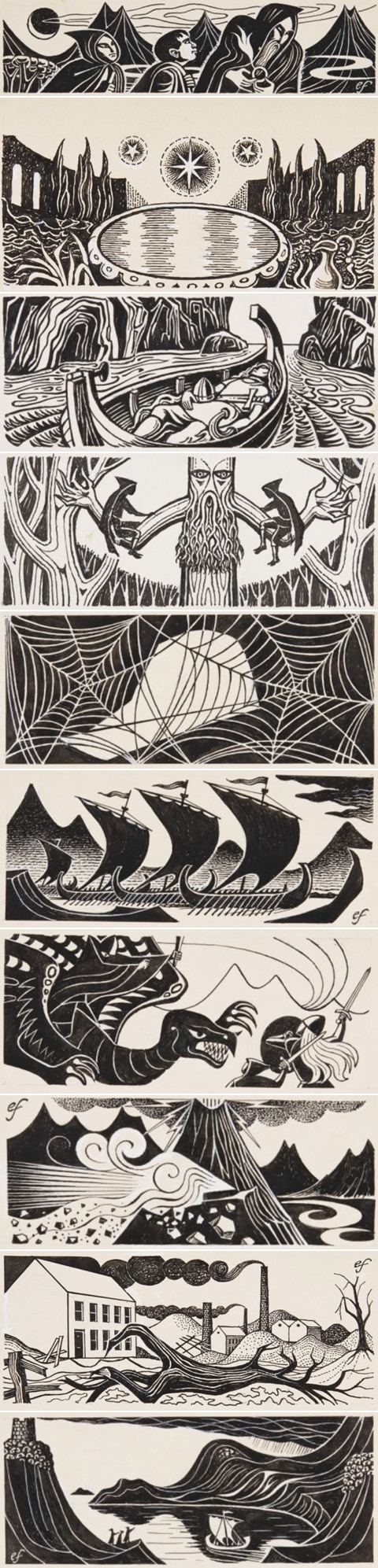
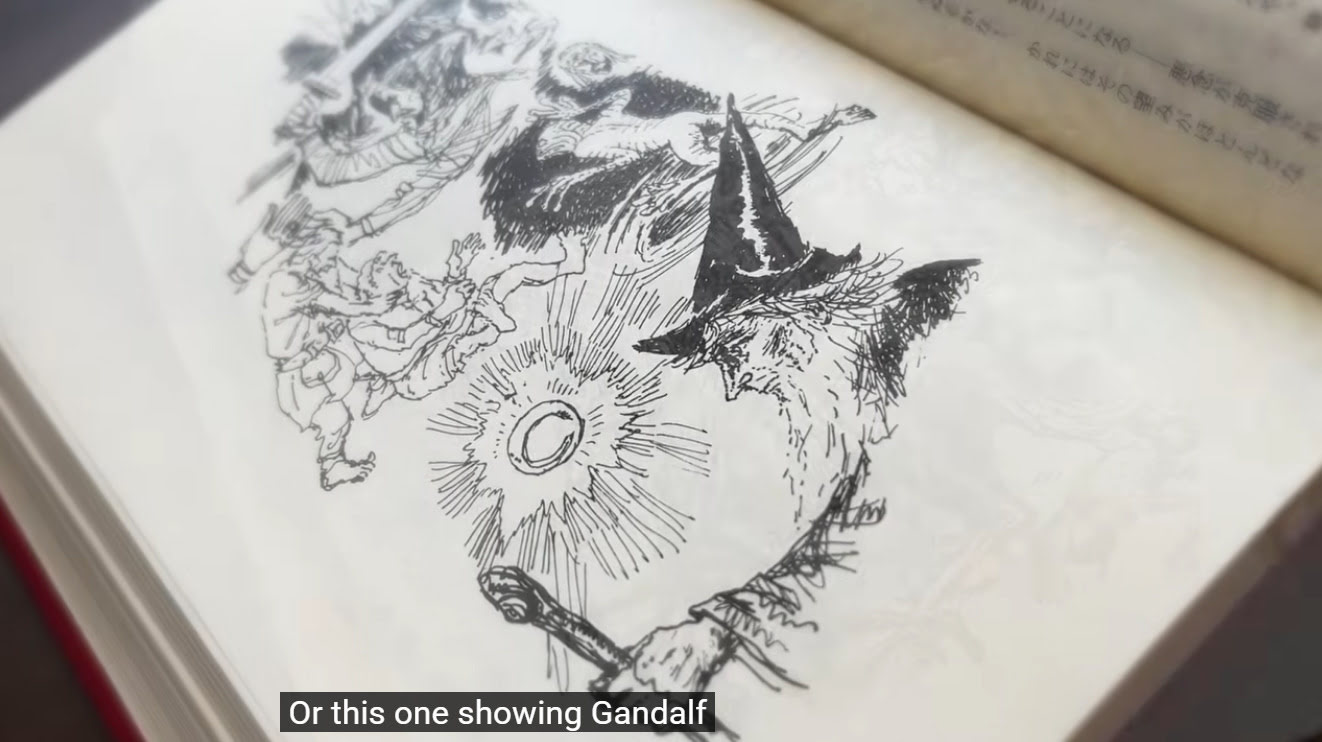
* Tolkien & Illustration summarises in English the new PhD thesis Illustrer Tolkien: la Terre du Milieu du texte a l’image (‘Illustrating Tolkien: Middle-earth from text to image’) (June 2026). There’s also a download link to the full thesis in French.
* New in the rolling open-access Journal of Tolkien Research, “He Had Named Himself the Stranger” which…
“examines the narrative functions of strangeness and hospitality in J.R.R. Tolkien’s The Book of Lost Tales [and suggests that Tolkien] “transforms the guest from a [traditional Northern] hero whose deeds secure fame into a cultural mediator whose listening and inscription preserve a threatened mythic tradition.”
* Also new in the Journal of Tolkien Research, the conference paper “Getting Tolkien Right: Middle-earth in the National Review”. Surveys the discussion of The Lord of the Rings and The Silmarillion by four writers in William F. Buckley’s U.S. conservative magazine National Review, from 1965-1981.
* The forthcoming new book Human* Being: On Otherkin Identity and Digital Community (August 2026) has a chapter which peers back to the brief U.S. Tolkien craze of the 1960s, and notes where some of those people went in the 1970s after the counterculture burned out. The chapter is seeking early cos-players who liked to pretend they really were other-than-human (dragons, elves, hobbits etc)…
“beginning with elven love letters; through zines, role-playing games, and early Web fora; and into contemporary social media ubiquity. And we will start back with those young Tolkien fans. Moving into the 1970s, many of them took up Neopaganism and began to more fully embrace the reenchantment of the world. Some of those did so in a way that hearkened back to Tolkien and began to identify with elves almost as a Rousseau-ian ideal. And a few began to identify as elves.”
* In the new issue of Postmedieval, the interview “Caroline Bynum is a child of the Sixties: A conversation”…
“When I was growing up in the 1940s and 1950s, my mother had a friend from her graduate school days who used to send us English books to thank my mother, who had sent food packages to her in England during the war. One year the first volume of Lord of the Rings arrived. My mother was too busy to read it. But I read it, fell in love with it, and saved up my money to buy volume two (which had to be ordered from England). Then, of course, volume three was not yet published. My mother told her friend about my enthusiasm, and she promised to send the book (copies were not yet available in the US in 1954–1955). I can remember long summer days of sitting on the front steps of my house in Atlanta waiting for the post to come. When volume three finally came, my mother’s friend had gotten a copy of volume three autographed for me by Tolkien. My daughter, who also loved the books, has that autographed first edition still.”
* The forthcoming book Proof-of-Concept: Visions of Peace and Nonviolence in Pop Culture (Amazon UK “knows nuurthing” about it, as yet, so no ETA) has a chapter which surveys “Nonviolent activism in The Lord of the Rings”…
“One major through-line of the book is the careful depiction of what war is actually like: how much time, energy, and effort it actually takes, and how the devastation it causes ranges from the immediate to the long-term, from direct to indirect impacts. Furthermore, LoTR does not present the logics of militarized political violence as inevitable – it shows readers again and again both the choice-laden nature of these activities and that alternatives are always available. This brings a criticality to Tolkien’s depiction of war that is important to recognize. That being said, LoTR is not a straightforwardly antiwar text – the free peoples of the world going to war against Sauron’s and Saruman’s armies is portrayed as a justified response [yet] it is also portrayed as deeply tragic, because the business of war is not only all-consuming, but also highly destructive in both immediate and more subtle ways. That much is lost in war, and that much of what is lost is not even clearly recognized as such, is a strong theme throughout LoTR.”
* A forthcoming academic book on Shakespeare’s Enemies, now underway though at an early stage…
“Shakespeare’s Enemies is a project that takes on, for the first time really as a book-length project, the history of Shakespearean animus — by which I mean those individuals, artists, creators, educators, students, popular public figures who just really don’t like Shakespeare. There’s actually been surprisingly little attention paid to this. But as it turns out, many of our most accomplished and famous writers really didn’t like Shakespeare — from Ben Jonson to Voltaire to Wittgenstein to Tolstoy, even to J.R.R. Tolkien, who, kind of surprisingly, wasn’t really a big fan of Shakespeare. […] Tolkien, as a fantasist, really took umbrage at Shakespeare’s treatment of fairies and elves.”
* The latest Weekend University podcast is “Owen Barfield, Imagination, & The Evolution of Consciousness”… “a conversation between Dr. Mark Vernon and Professor Peter Hawkins”. Free on Youtube.
* Undefined Boundary: The Journal of Psychick Albion (Volume 4, Issue 1) has Mark Valentine surveying “The Other Country: Numinous Landscape in English Supernatural Fiction”. ($ print only).
* Good to see that the town of Crickhowell has nearly raised enough to pay for Tolkien’s important and newly-discovered ‘Crickhollow letter’, which they recently won at auction. the GoFundMe fundraiser now stands as just over £18k of the £20k needed.
* And finally, the 26-part The Lord Of The Rings BBC Radio dramatisation (1981) is to be issued on vinyl (£250) and CD sets for Christmas 2026. I imagine we’ll also get the related Radio Times magazine spot-art and cover-art as a small artbook, in the bundle? Though the dreadful cover-artwork for the new set doesn’t reassure.