Tolkien Gleanings #450
* New in the Dutch legal trade-journal Ars Aequi, “De val van Gollum als juridische casus” (‘The downfall of Gollum as a legal case’) ($ paywall). The article presents…
“A criminal law analysis of evidence, alternative scenarios and reasons for a judicial conviction … this article illustrates how modern insights into rational proof — such as working with alternative scenarios — can contribute to careful judgment in criminal cases. At the same time, the case of Gollum offers students an accessible introduction to criminal evidence law.”
* A new Spanish newspaper profile of a local academic and Tolkien scholar, “La buena literatura es mas util para entender el sufrimiento que los manuales psicologicos”. In Spanish, but easily translated to English…
“The tension between Gollum and Smeagol [is] not an issue that has been studied in depth on a psychological level. Until now. Dr. Emilio Lopez-Navarro, professor at the Department of Psychology at the University of the Balearic Islands, has focused on this question, having just published a study in the Journal of Tolkien Research in which he analyzes Gollum’s voice based on the theory of relational frames.”
* New in the latest Journal of Cultural Geography, “Subterranean geographies: fantasy underworlds as spatial hinges of power”. One of the three case-studies is The Hobbit, and the article concludes that… “For The Hobbit, the underworld layers on anxieties about British imperialism and othering”. Free in open-access.
* A new academic book, Popularising the Middle Ages in Modern Fantasy: Neomedievalism, Video Games, and Vikings (2026). Includes the survey chapter “Four Decades of Medievalism in Video Games with Historical Settings”, apparently starting in 1972.
* On YouTube, a video reflection on attending A summer school at the University of Oxford, studying Lewis and Tolkien at Christ Church.
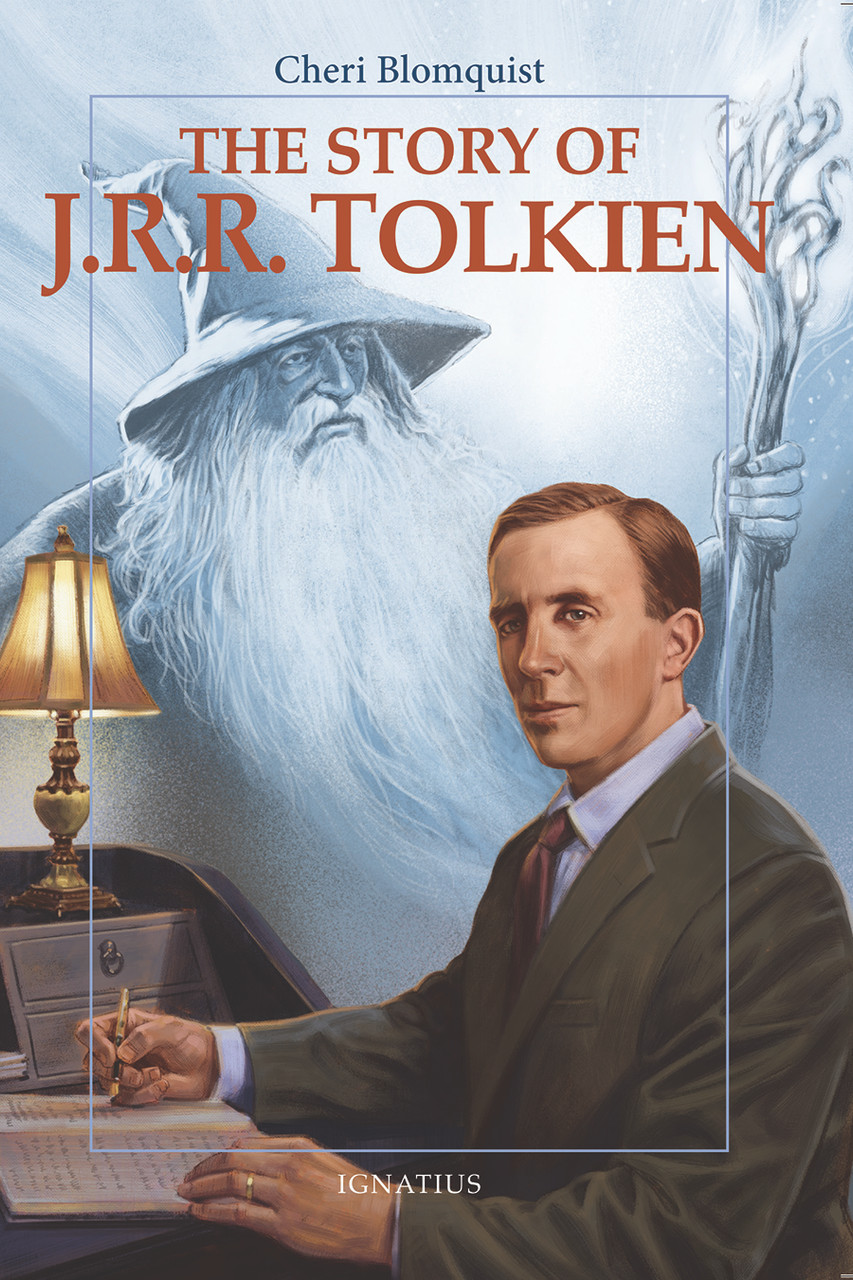
* A new short Tolkien biography, from Catholic publisher Ignatius Press, The Story of J.R.R. Tolkien (July 2026). Appears to be the latest in a line of uniform format books, each offering a relatively short and accessible biography of a well-known Catholic.
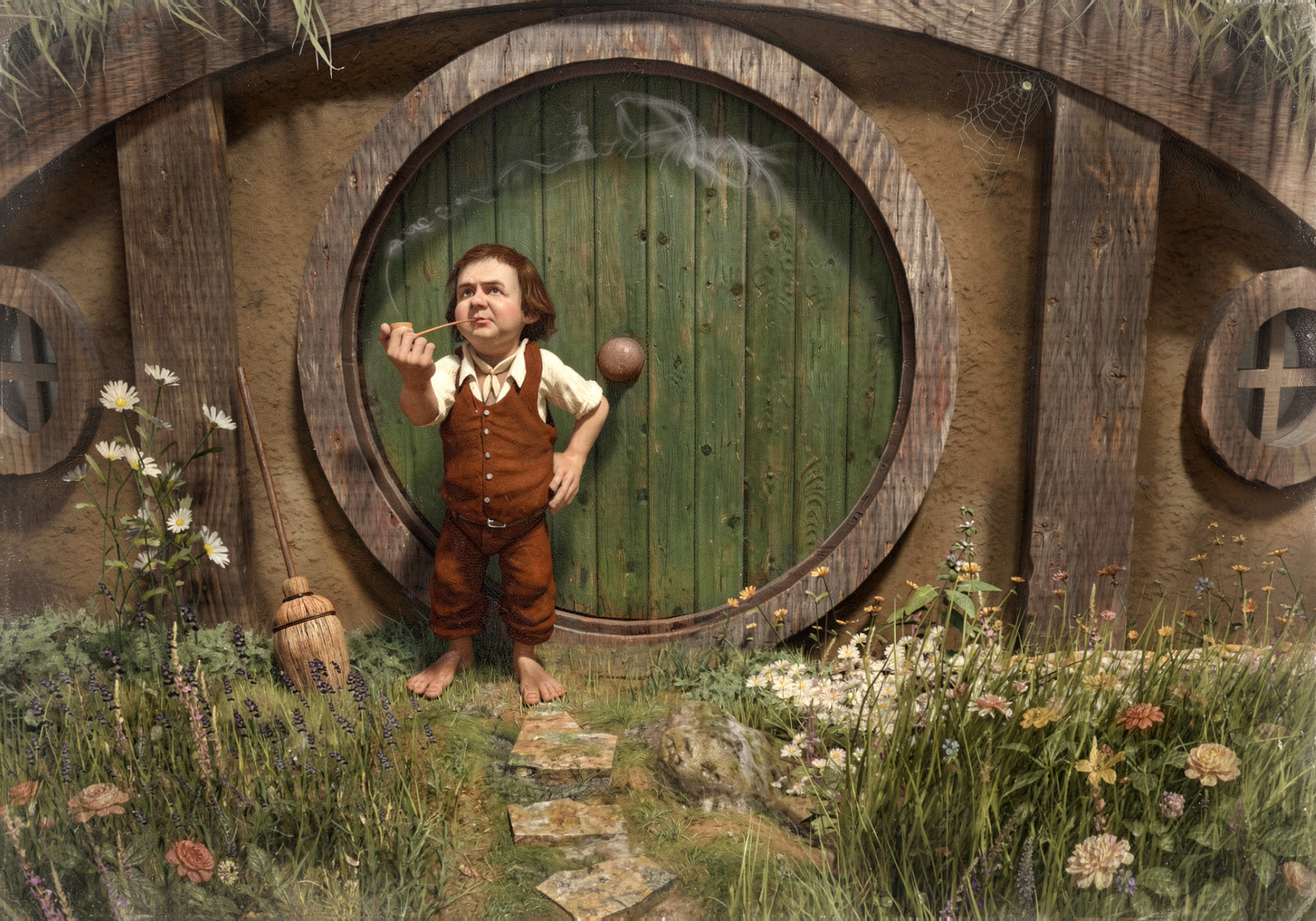
* “Samwise dreams of adventure”, new on DeviantArt.
* And finally, “Medieval Castles, Trapped Sheep & Total Exhaustion” is the second and final part of a gripping YouTube video which documents one man’s attempt to cross the Middle-earth like English county of Shropshire ‘mediaeval style’. By using only public footpaths, avoiding all roads, and seeking churchyard water-taps along the way. As with the first part (Gleanings #443), you may wish to convert to a slideshow video, if watching wobbly camerawork makes you feel sea-sick.
Bonus mini-essay for Gleanings #450, for readers who read this far:
Q. Why do Eomer and Gandalf not know Boromir?
Using Shire dating.
Boromir was born in 1378 (*), his brother Faramir in 1383. The wizard Gandalf goes to study in the library-archives of Gondor in 1417, and he overwinters there until early 1418. During this time Gandalf is aided by Faramir and he teaches enough for Faramir’s father to later chide his son for being a “wizard’s pupil”. In 1417 Faramir is aged 34. Boromir is aged 39. In the primary medieval world, the brothers would be deemed middle-aged. But in Middle-earth both are deemed relatively young, when measured by the longevity of the line of the Stewards of Gondor.
It is not possible that Boromir was away in Rohan, even though 1417 is the same year when Eomer takes over as a Marshal of the Mark from his father. Since Eomer says of Boromir… “He came seldom to the Mark, for he was ever in the wars on the East-borders; but I have seen him.” Only seen him from afar, not met him. Here then is the most likely answer: Boromir was away at the “wars on the East-borders”, during the winter of 1417/18.
There is a possible catch here. It’s true that Faramir tells Frodo, when they first meet… “I first saw him [Gandalf] when I was a child, and he has been [to Gondor] twice or thrice since then.” So perhaps Gandalf had seen Boromir… but only as a child. We know that Gandalf visited Gondor in 1417 when the brothers were grown, but Boromir was likely at the wars, as I’ve suggested above. Faramir states there could have been one, or perhaps two, more visits in addition. I can only assume then that this other visit (or two visits) took place when Boromir was grown up (as implied by Faramir’s “since then”, i.e.: after childhood), and that the older brother was again away ‘at the front’ and not seen by Gandalf.
Where were these ‘East-borders’ exactly? When the men of Rohan ride to Gondor’s aid they go…
“… through the Fenmarch, where to their right great oakwoods climbed on the skirts of the hills under the shades of dark Halifirien by the borders of Gondor; but away to their left the mists lay on the marshes fed by the mouths of Entwash. And as they rode rumour came of war in the North. Lone men, riding wild, brought word of foes assailing their east-borders, of orc-hosts marching in the Wold of Rohan.”
So when Eomer says “wars on the East-borders” he may be using the name used by and of Rohan, and these borders were deemed a fast and long ride north of the Entwash marshes. They are the same as the East Wall of Rohan then, more or less, since the orcs have evidently broken in at the north end. We also know from Eomer that… “The East-mark is my charge, the ward of the Third Marshal”. We further know from Eomer that Rohan is not “yet at open war with him” [i.e. with Sauron], when he first meets Aragorn.
Such are the facts in The Lord of the Rings. Eomer states that Boromir was in the “wars on the East-borders” and these are likely to be the wars of Gondor, fought on but not inside the eastern borders of Rohan. Rohan is not at war with Sauron. In that case we must assume it was diplomatic for Boromir to make almost no visits to Rohan (“He came seldom to the Mark”), and if he ever went to Edoras he would not be seen to associate with Eomer the Marshal of the East-mark — for fear of dragging the allies into an open war with Sauron.
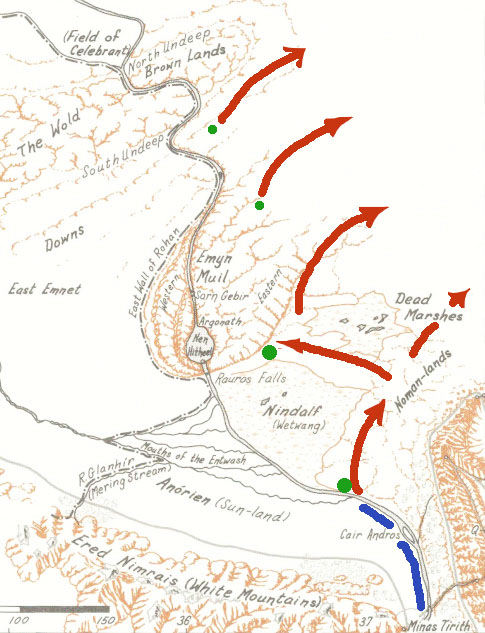
Map: Likely river-access and onward defensive postures. Gondor can easily access and supply the area by heading north of Cair Andros by ship and onward tracks, without involving Rohan. Green dots indicate likely field camps.
Boromir was thus likely away from Gondor — in the South Undeep / Emyn Muil and perhaps making patrols and raids out into Dagorlad (the ‘battle plain’) north of the Morannon — when Gandalf visited the library-archives of Gondor. Boromir was protecting the east-borders of his allies in Rohan. His presence there would be especially likely in the year that young Eomer took over the East-mark from his father, 1417. Gondor would have to anticipate that Sauron likely knew of the new Marshal, and that Sauron would wish to test him by sending renewed waves of orc-raids into Rohan — a further good reason for additional vigilance along the east-borders. Gondor would thus want their firmest leader in the “wars on the East-borders” at this time, so as to give the untried Eomer time and space to get a grip on his new command.
I should note that Gondor was not just protecting their allies from horse-stealing. Their worry was that orcs would start to overrun the East-mark, gain footholds defensible against mounted attack, and then march south. This possibility gives the men of Gondor every reason to vigorously minimise orc activities along that border. They are ultimately defending Gondor itself from a simultaneous attack from west and east. And so they send their best man to lead their forces — Boromir.
All this then helps explain why both Eomer and Gandalf only knew of Boromir, but had not actually met him.
* Incidentally… 1378 (Shire dating) is a very interesting birthdate for Boromir, Tolkien’s most Gawain-like character. My book gives a wealth of new evidence, and from this suggests Sir Gawain and the Green Knight was likely to have been written for Christmas 1377 / New Year 1378. Could the Professor have been dropping a subtle hint about his thoughts on Gawain’s dating?