Tolkien Gleanings #437

Tolkien Gleanings #437

* The latest Entmoot Podcast is a long interview with the editors of the recent ‘Asexuality’ special issue of the open-access Journal of Tolkien Research.

* A Tolkien-focused report from the Oxford English Graduate Conference 2026. Substack, but free.

* Personal Canon Formation on “Tolkien and the Myth of Decline”. Substack, but free.

* The Middle Ages in the Modern World conference calls for papers, for 22nd-24th June 2027 in Oxford. Note especially the suggestion for “Oxford and medievalism” as a possible theme. Deadline: 30th September 2026.

* Law & Liberty magazine considers “The Seeing Stones of Modern Warfare” in relation to Tolkien. Freely available online.

* The cover is now available for the forthcoming Tolkien comic biography I mentioned previously on Gleanings. The format is a ‘BD’ — a eurocomics format that usually takes the form of a relatively short high-quality graphic novel, printed oversized on good paper and in hardback, and usually with a self-contained story. The book is due in mid August 2026, in French from Futuropolis. There are also now a few more details about the approach taken…

“Alternating intimate biographical moments from his life and scenes from his novels, the authors show us how these personal events are at the source of the mythology that Tolkien created.”

* An Interactive Timeline of Middle-earth, newly online and free at Elfenomeno.

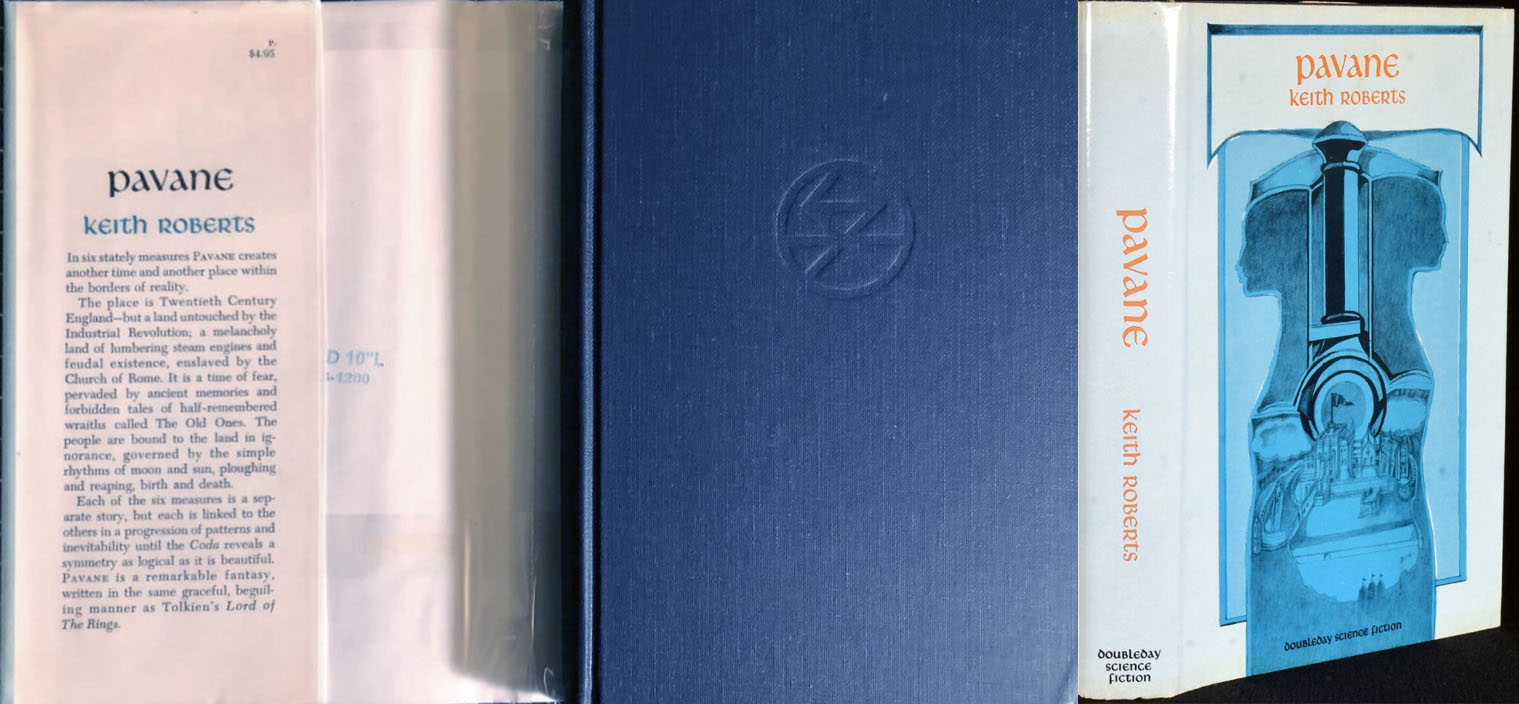
* I’m pleased to learn of Pavane: a Critical Companion (2024), via an excellent long review on the BSFA website. Freely available online.

“Pavane is a particularly British work, a book made up of a cycle of stories, and one imbued by religion, sense of place, and the mythical past of the English countryside. [In an alternative history where Catholic Spain triumphed over England, there is still] faery magic, a component of a specific form of British myth and fiction dating back to before Shakespeare, [which] features in [the sections] “The Signaller” and “Lady Margaret”. Roberts mines the English countryside, and often specifically Dorset, to explore a hidden faery world, creating an emotional resonance for the reader with the landscape itself.”

This classic fix-up novel of 1968 has had some terrible covers over the years, but the U.S. Doubleday first-edition hardback was quite pleasing. The edition’s blurb cannily managed to intrigue readers of both Lovecraft and Tolkien, while the art gave a very subtle nod towards the Sphinx and the Machine of The Time Machine

* And finally, this week the Throwback Review reviews the book Middle-earth Role Playing (1984), and notes the large hinterland of expansion books it spawned in the 1980s. There was a second edition of the main gamebook, and…

“[the publisher ICE also] produced a huge body of regional sourcebooks, adventures, and campaign material, and that may be what many people remember most fondly. Even players who did not love every corner of the [main book of] rules often loved the books. MERP invited you to roam far beyond the most familiar corners of Tolkien’s fiction, turning Middle-earth into a place you could explore in layers. That sense of scope was one of the game’s great accomplishments. It helped teach a lot of players that a roleplaying setting could feel like a scholarly hobby in itself, something to read, collect, and immerse yourself in even when you were not actively playing.”

On Archive.org, one can find the Iron Crown Enterprises Consumer Catalog Spring ’87. This notes a Lords of Middle-earth Vol 1., the first in three part series, with the first profiling all “the great ones” of Middle-earth and beyond. The second book in this series focused on the Men and Mannish races, and the Third on Dwarves, Orcs, Trolls, Elves and Hobbits.
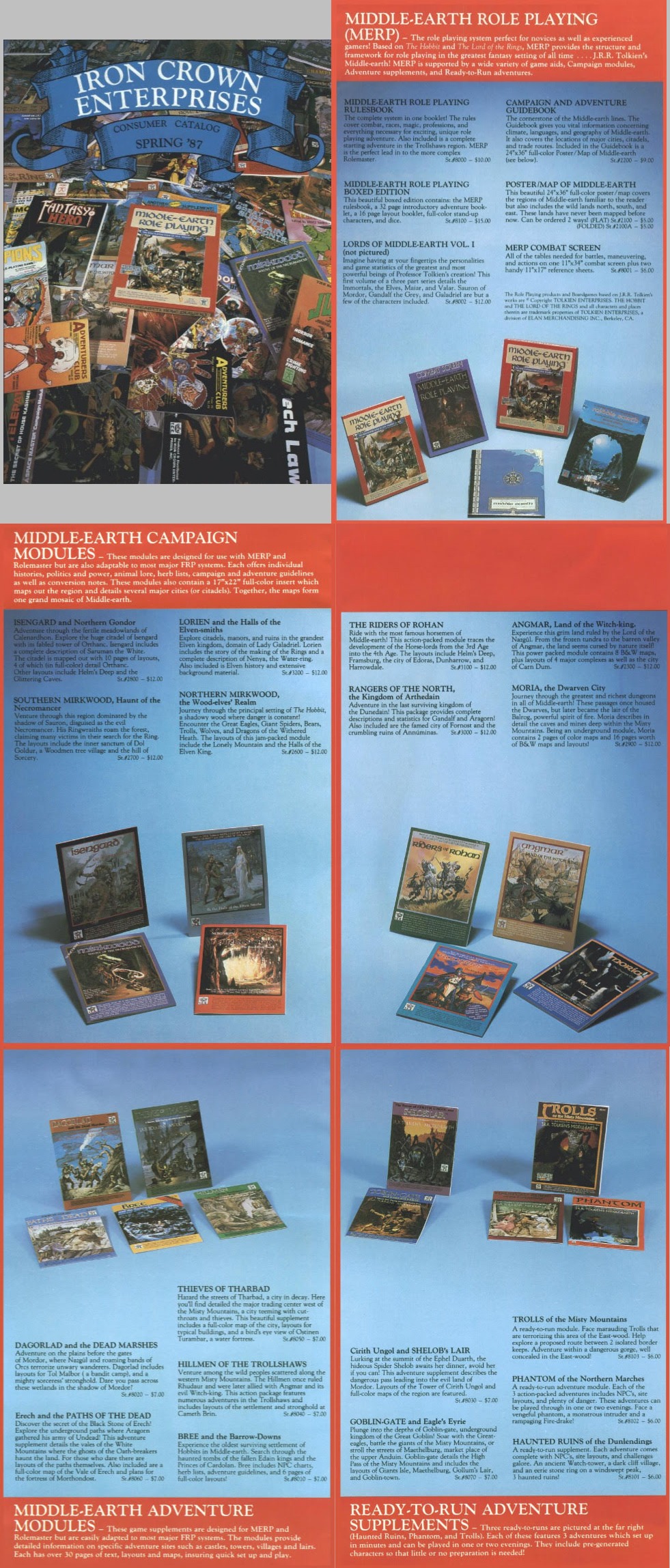
Also of interest as reference/inspiration for fan-fiction writers, though it seems that getting hold of a set in paper would cost a small fortune today.

Tolkien Gleanings #436

Tolkien Gleanings #436

* A new rolling issue of the open-access Journal of Tolkien Research is underway, Volume 24, Issue 2. This currently includes, among others, a lead article on “Tolkien, Modernism, and Mass Art”, a review of Arda Notebooks: The Best of I Quaderni di Arda (2026), and the conference paper “”Then Daddy began a story”: Storytelling in Tolkien’s home and our own”.

* From Finland, the new Masters dissertation, “Miehia, jotka rakastavat miehia: Miesten valinen emotionaalinen laheisyys Taru sormusten herrasta” (2026) (‘Men Who Love Men: Emotional Intimacy Between Men in The Lord of the Rings’). Freely available online.

* The new book Lunar Gothic: The Influence of the Moon on the Gothic Imagination (2025) has the 16-page survey chapter “Illuminating the Darkness: Lunar Representation in Children’s Literature”.

* The latest edition of the journal Literary Imagination has the article “Leavis, Lewis, Eliot, and the Prospect of Disciplinary Renewal” ($ paywall), which surveys the battle over Eng. Lit. between C.S. Lewis and the Leavis-ites. The free introduction appears to serve as a fairly good abstract for the paywalled article.

* More Tolkien letters are up for auction at Sotheby’s. Tolkien’s 1960s correspondence with Eileen Elgar, a resident of Tolkien’s favourite Miramar Hotel in Bournemouth. An August 1966 letter to her remarks that Tolkien was set to embark on a Mediterranean cruise that would travel as far east as Smyrna.

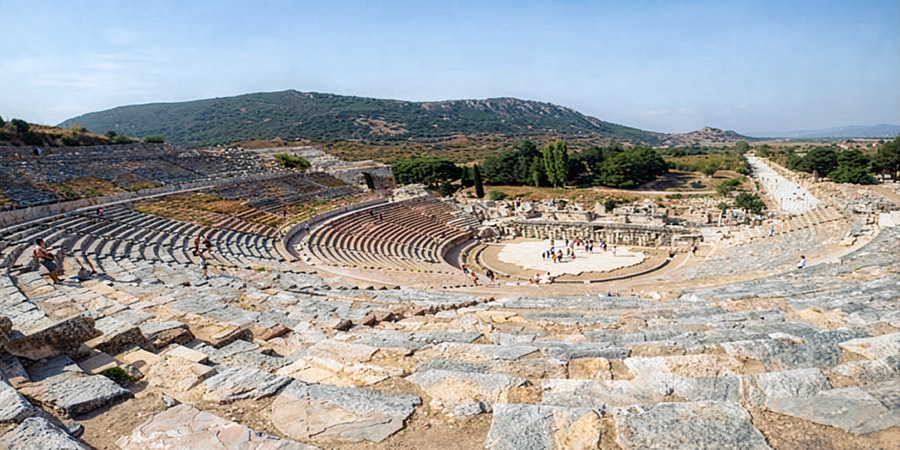
Turkish Smyrna in 1966 held little of the old Greek magic and Ionian free-thought, since in 1922 the invading Turks had totally burned the Greek and Armenian quarters of the city along with most of their inhabitants. Tolkien’s fellow passengers likely went directly from the modern Turkish port-city, on the day-trip to ancient Ephesus which was an hour to the south. That would have been the attraction, not the city. By 1966 the Austrian excavations there were substantial and allowed tourists to walk down the grand marble Arcadian Way and sit in the vast ancient drama theatre which once held 25,000 spectators. But it was the Christian associations that would have been the draw for many.

This theatre was later a gladiator arena, and at that time also a key site for the apostle Paul and his followers. Ancient Ephesus also has a Marian association, in that Mary would appear to have lived there after the resurrection of Jesus (John 19:26–27: “the disciple [John] took her [Mary, mother of Jesus] to his own home”). Possibly the tourists would also have visited a reputed ‘House of Mary’, conveniently located in the hills just a little south of ancient Ephesus, a house which had been ‘discovered’ via a 19th century nun’s religious visions.

Did Tolkien see the place? Perhaps. Edith was with him on the cruise, but had fallen and badly injured herself on the first day of the cruise. They thus did “little sightseeing” in Tolkien’s own words. She was however well enough to be carried ashore at the port, but if Tolkien then left her to take the coach to visit ancient Ephesus and the reputed ‘home of Mary’ must remain a mystery. It would be a pity if he hadn’t done so before returning home, after sailing so many thousands of miles.

Mallorn 22 also notes in passing… “Parallels between the ‘Seven Sleepers’ of Ephesus and the Seven Fathers of the Dwarves”. The legend, said to have been very popular during the mediaeval period, is also somewhat similar to that of the ‘sleeping King Arthur and his knights’ belief in Britain. The legend in brief…

The Roman Emperor Decius was engaged in vicious personal persecution of Christians, visiting his provinces in person to see that it was done. At Ephesus he had seven pious lads brought before him, but they courageously and eloquently testified for Christ before the Emperor. Due to their courage they were given some time to repent, which they rather sensibly used to flee together to a wilderness cave. Soldiers eventually found the cave, but miraculously saw no-one there and then took away the supplies and tightly sealed the cave entrance with rocks. Two hundred and eight years later the sleeping lads awoke in the cave, thinking they had only slept the night. The rock wall was now easy to push away, and they went back to the city to find food. There the lads — having aged not a day — were amazed to find crosses above the gates and that the people had become Christians.

* And finally, Tolkien Oddments has “More on Madlener”. You’ll recall that Josef Madlener’s painting “Der Berggiest” was once said to be the inspiration for the appearance of Gandalf. In the new article, the complete postcard set is considered. My own thoughts on Madlener’s shepherd appeared in August 2025 in Gleanings #329, concluding that the outfit was the traditional one for shepherds from the high parts of Provencal (SE France, neighbouring the Swiss Alps). The traditional outfit worn by the Swiss shepherds, which Tolkien might have noticed in the Swiss Alps in 1911, was very different. Thus he would not have seen a real-life ‘Madlener outfit’ on his Swiss walking trip.

Tolkien Gleanings #435

Tolkien Gleanings #435

* The latest edition of the French open-access journal Babel: Litteratures Plurielles has a review of the book Tolkien et la religion. Comme une lampe invisible (2024, Sorbonne University Press). A second edition, updated and expanded, of the 2016 first edition. The long review is in French, but sadly not easily auto-translated because the site blocks access with captchas. Thankfully Archive.org has no time for such blocking and happily archives it, from which one can then get an English translation done via Microsoft…

The review mistakenly places Birmingham in the “North” of England, but it has always been in the Midlands.

* New on YouTube from the University of Oxford, “A New-found Tolkien Translation”. Being their short official video on the newly-found and now published “Soul’s Ward”.

* The Spanish Tolkien Society has a new blog post which assembles an annotated links playlist, for the free YouTube podcast that reads and analyzes the letters of Tolkien in Spanish. This podcast has currently reached letter 181.

* The latest edition of the paywall book-journal Studies in Medievalism XXXV (2026) is a special issue with… “essays exploring the intersections of politics and theory through medievalism in film, literature, gaming, and political movements.” No Tolkien, but it may interest some.

* Fandom Pulse looks like it’s wrapping up its lengthy historical survey-series offering a “retrospective on Tolkien’s rise to superstardom”, seemingly with added attention to the various political lenses through which people have viewed his works over time. They now have a links-set for all 12 parts. (Substack and $ paywalled).

* Talking of the history of Tolkien fandom, Kalimac’s Corner was there, back in the day. This week he has a blog post recalling an aspect of “Tolkien in the old days”

One feature of the early Tolkien fandom days of the 1960s whose import is hard to recapture today is the little cries of bliss that Tolkien fans would emit whenever a major publication dared to acknowledge that Tolkien existed, and maybe was important, by publishing an article about him.

And yet, as his example shows, the journalists and editors concerned were almost always utterly cynical about such things.

* The new book Fairies: A History has been published, to good reviews. It’s billed as a more wide-ranging survey than the author’s previous British Isles-focused book on the topic, Twilight of the Godlings: The Shadowy Beginnings of Britain’s Supernatural Beings (2023). The author, an expert on both British and Baltic folklore, describes his new book as…

the most wide-ranging history of fairy belief attempted in modern times […] it is a history of fairies, written by a historian and seeking to apply historical methods to humanity’s centuries-long relationship with the fairy realm. [… It was written] in a post-religious, postmodern Europe [in which] the old prejudice against fairies as a serious object of study is breaking down. For the first time, it is possible to give fairies a proper history — and to share that history with a genuinely curious and open-minded reading public. [… as well as the British Isles, the new book] makes frequent excursions to Iceland, Scandinavia, and Central and Eastern Europe, in addition to the Americas and Australasia”.

Interviews about the new book can be found on the podcasts What Magic Is This? and I Might Believe in Faeries.

* And finally, talking of delightful and unexpected apparitions… a charity shop (U.S.: ‘thrift shop’) in Tolkien’s home city of Birmingham was given a “fairly ordinary” box of donated second-hand books. From which emerged… a £38k first edition of The Hobbit. Nice!

Tolkien Gleanings #434

Tolkien Gleanings #434

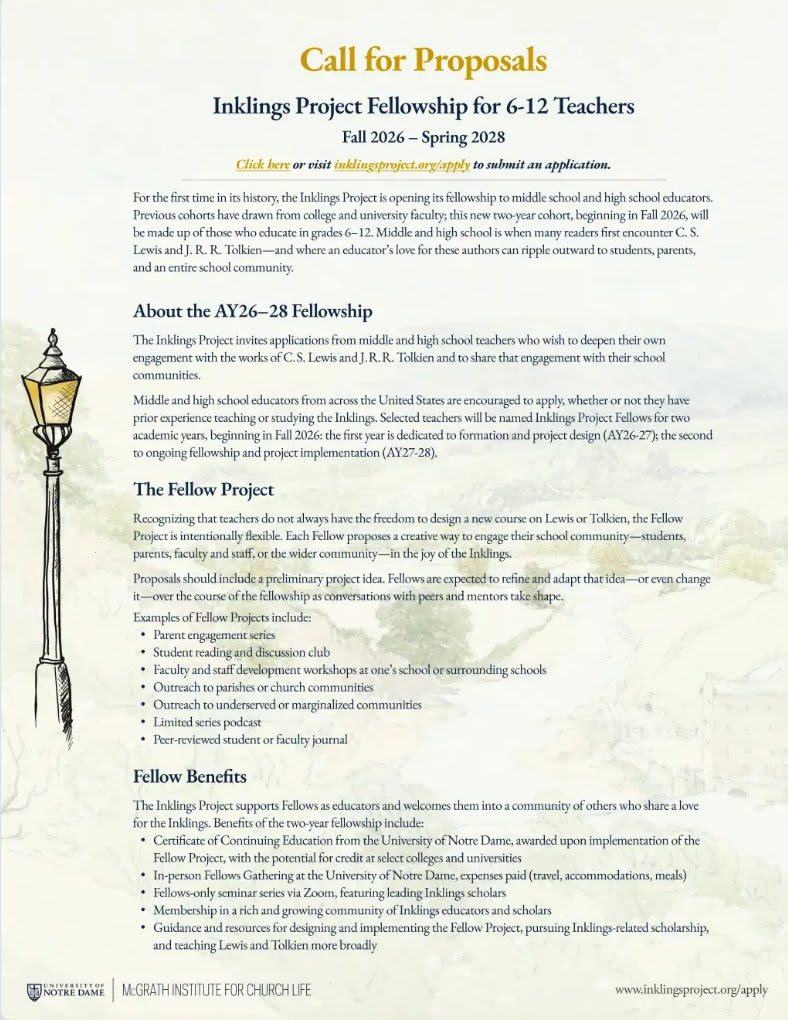
* Inkings Quarterly newsletter brings news that The Inklings Project is offering teaching fellowships for classroom teachers of U.S. school grades 6–12 (translates as ages 11 to 18). Deadline: 1st August 2026.

* The Inklings Quarterly also notes the 2026 “Undiscovered C.S. Lewis Conference” at George Fox University in Sepember 2026. On pursuing the speaker list, I note a keynote talk from John Garth on “The Undiscovered J.R.R. Tolkien”.

* New to me, the open-access journal Fandom | Cultures | Research, from the University of Marburg in Germany. Four issues so far, with some German but mostly English items. No Tolkien fandom items as yet. But the latest issue has a review of the book The Politics of Fantasy: Magic, Children‘s Literature, and Fandom in Putin’s Russia, while earlier issues have a couple of conference reports on the topic of doing archival / historical research on fandoms. (The journal and its fellow Marburg journals were not on JURN, but I’ve now indexed them).

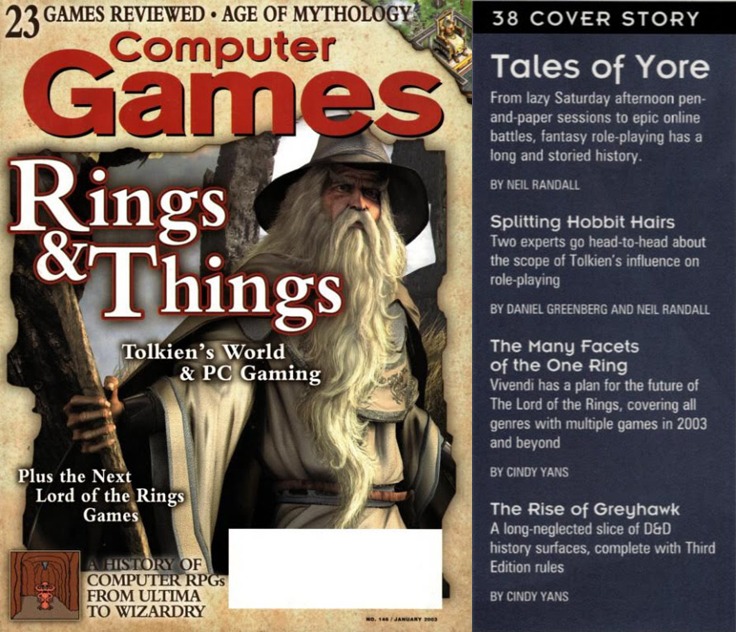
* Talking of archival materials… new on Archive.org is a scan of Computer Games magazine for January 2003. Which was a Lord of the Rings special-issue.

Has an informed article surveying the history of relevant fantasy RPG videogames, with a timeline. Plus a discussion across two articles on Tolkien’s influence on videogames to 2003. The second of these is from Daniel Greenberg, then “the Creative Director for the Tolkien Franchise”…

“Middle-earth has plenty of magic. Not the promiscuous magic-inflation of Dungeons & Dragons, but magic intertwines everything in Middle-earth [and it also offers] plenty of overt spells, cast not just by Wizards, but by Dwarves, Elves, Men, Wraiths, Dark Lords, etc. (Everyone but Hobbits). However, in order to tell a story about the little guy (literally) making a difference, the powerful magicians must be offstage most of the time. Some confuse this with a lack of magic in Middle-earth. Middle-earth also has lots of treasure hunts. The Hobbit is all about a treasure hunt. To a dungeon-like fortress. To kill a dragon. The Lord of the Rings is a treasure hunt, too, only in reverse. [And with plenty of RPG-like ‘valuable loot use’ as well]”.

* The annual conference of Germany’s Society for Fantasy Research will discuss the theme of ‘Violence and Fantasy’. Set to be held at the University of Cologne, 17th-19th September 2026.

* And finally… RAMzine reports that the band Hubris take on J.R.R. Tolkien for their White Shores album, and that the band will be touring the UK in October 2026…

“Swiss post-rock band Hubris are heading into Middle-earth. The instrumental quartet from Fribourg have built four albums on Greek mythology, but composer and founder Jonathan Hohl has turned to the source he keeps coming back to. […] More than a fantasy tribute, [their new studio album] White Shores sits with J.R.R. Tolkien’s writing on mortality and immortality.”

The album is not yet released, but the eight-minute lead track is free online, on Bandcamp.

Commando raid fail

Durn it. The perils of not being on Facebook. I find I missed another Commando and British Weekly Comic Swap Meet, held just across the valley in Wolstanton. It happened on 20th June. Still, the event write-up on Bear Alley has interesting details of a side-trip to Shrewsbury in search of vintage sci-fi. Apparently the town has several worth-browsing market stalls and the Welsh Bridge Books second-hand bookshop with a… “wall of science fiction from the era I like, A-format paperbacks, painted covers”.