“How the Third Floor Knew the Potteries” (circa 1863).
by Amelia B. Edwards.
I am a plain man, Major, and you may not dislike to hear a plain statement of facts from me.
Some of those facts lie beyond my understanding. I do not pretend to explain them. I only know that they happened as I relate them, and that I pledge myself for the truth of every word of them.
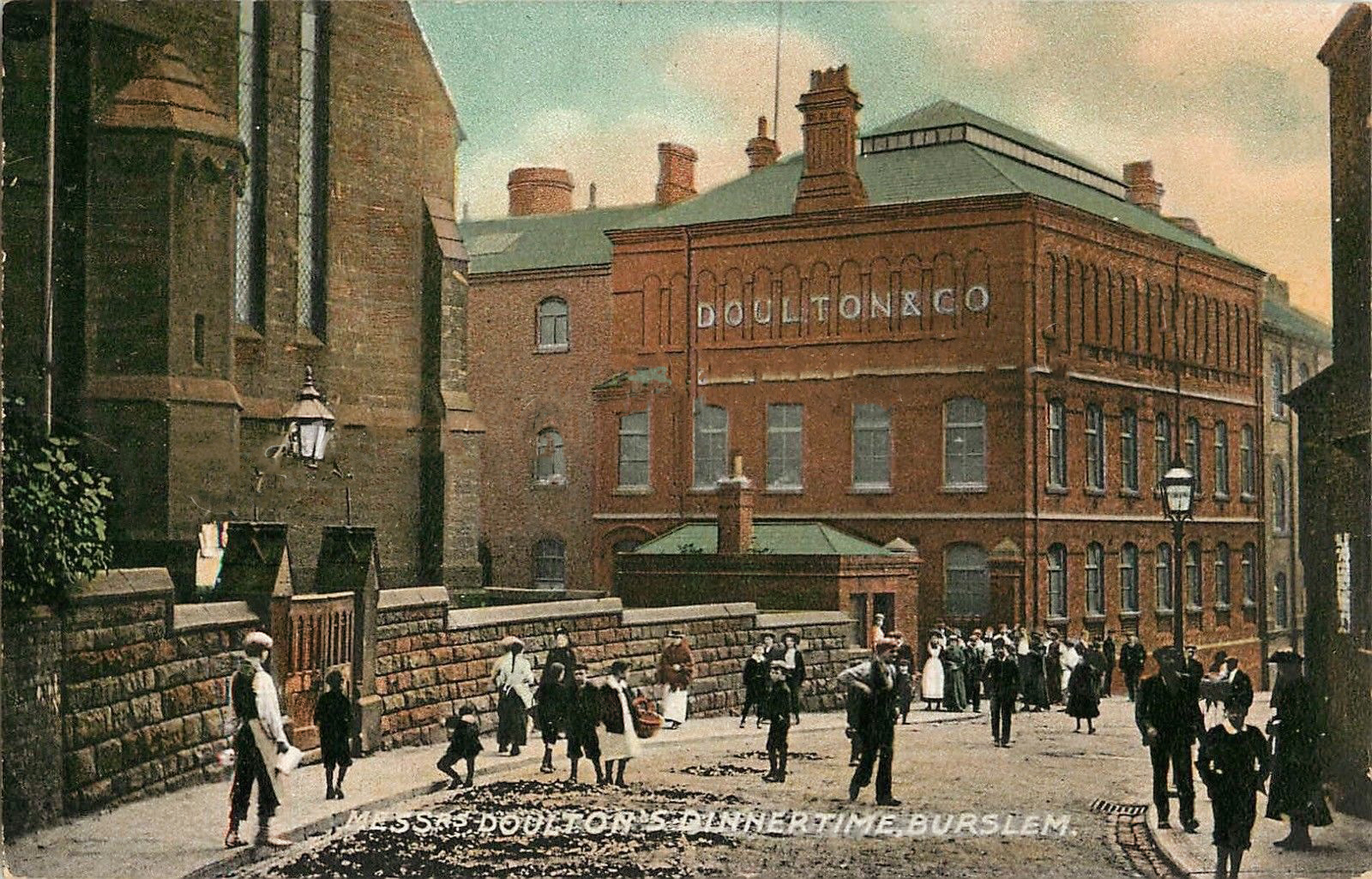
I began life roughly enough, down among the Potteries. I was an orphan; and my earliest recollections are of a great porcelain manufactory in the country of the Potteries, where I helped about the yard, picked up what halfpence fell in my way, and slept in a harness-loft over the stable. Those were hard times; but things bettered themselves as I grew older and stronger, especially after George Barnard had come to be foreman of the yard.
George Barnard was a Wesleyan — we were mostly dissenters in the Potteries — sober, clear-headed, somewhat sulky and silent, but a good fellow every inch of him, and my best friend at the time when I most needed a good friend. He took me out of the yard, and set me to the furnace-work. He entered me on the books at a fixed rate of wages. He helped me to pay for a little cheap schooling four nights a week; and he led me to go with him on Sundays to the chapel down by the river-side, where I first saw Leah Payne. She was his sweetheart, and so pretty that I used to forget the preacher and everybody else, when I looked at her. When she joined in the singing, I heard no voice but hers. If she asked me for the hymn-book, I used to blush and tremble. I believe I worshipped her, in my stupid ignorant way; and I think I worshipped Barnard almost as blindly, though after a different fashion. I felt I owed him everything. I knew that he had saved rue, body and mind; and I looked up to him as a savage might look up to a missionary.
Leah was the daughter of a plumber, who lived close by the chapel. She was twenty, and George about seven or eight-and-thirty. Some captious folks said there was too much difference in their ages; but she was so serious-minded, and they loved each other so earnestly and quietly, that, if nothing had come between them during their courtship, I don’t believe the question of disparity would ever have troubled the happiness of their married lives. Something did come, however; and that something was a Frenchman, called Louis Laroche. He was a painter on porcelain, from the famous works at Sèvres; and our master, it was said, had engaged him for three years certain, at such wages as none of our own people, however skilful, could hope to command. It was about the beginning or middle of September when he first came among us. He looked very young; was small, dark, and well made; had little white soft hands, and a silky moustache; and spoke English nearly as well as I do. None of us liked him; but that was only natural, seeing how he was put over the head of every Englishman in the place. Besides, though he was always smiling and civil, we couldn’t help seeing that he thought himself ever so much better than the rest of us; and that was not pleasant. Neither was it pleasant to see him strolling about the town, dressed just like a gentleman, when working hours were over; smoking good cigars, when we were forced to be content with a pipe of common tobacco; hiring a horse on Sunday afternoons, when we were trudging a-foot; and taking his pleasure as if the world was made for him to enjoy, and us to work in.
“Ben, boy,” said George, “there’s something wrong about that Frenchman.”
It was on a Saturday afternoon, and we were sitting on a pile of empty seggars against the door of my furnace-room, waiting till the men should all have cleared out of the yard. Seggars are deep earthen boxes in which the pottery is put, while being fired in the kiln. I looked up, inquiringly.
“About the Count?” Said I, for that was the nickname by which he went in the pottery.
George nodded, and paused for a moment with his chin resting on his palms.
“He has an evil eye,” said he; “and a false smile. Something wrong about him.”
I drew nearer, and listened to George as if he had been an oracle. “Besides,” added he, in his slow quiet way, with his eyes fixed straight before him as if he was thinking aloud, “there’s a young look about him that isn’t natural. Take him just at sight, and you’d think he was almost a boy; but look close at him — see the little fine wrinkles under his eyes, and the hard lines about his mouth, and then tell me his age, if you can! Why, Ben boy, he’s as old as I am, pretty near; ay, and as strong, too. You stare; but I tell you that, slight as he looks, he could fling you over his shoulder as if you were a feather. And as for his hands, little and white as they are, there are muscles of iron inside them, take my word for it.”
“But, George, how can you know?”
“Because I have a warning against him,” replied George, very gravely. “Because, whenever he is by, I feel as if my eyes saw clearer, and my ears heard keener, than at other times. Maybe it’s presumption, but I sometimes feel as if I had a call to guard myself and others against him. Look at the children, Ben, how they shrink away from him; and see there, now! Ask Captain what he thinks of him! Ben, that dog likes him no better than I do.”
I looked, and saw Captain crouching by his kennel with his ears laid back, growling audibly, as the Frenchman came slowly down the steps leading from his own workshop at the upper end of the yard. On the last step he paused; lighted a cigar; glanced round, as if to see whether anyone was by; and then walked straight over to within a couple of yards of the kennel. Captain gave a short angry snarl, and laid his muzzle close clown upon his paws, ready for a spring. The Frenchman folded his arms deliberately, fixed his eyes on the dog, and stood calmly smoking.
He knew exactly how far he dared go, and kept just that one foot out of harm’s way. All at once he stooped, puffed a mouthful of smoke in the dog’s eyes, burst into a mocking laugh, turned lightly on his heel, and walked away; leaving Captain straining at his chain, and barking after him like a mad creature.
Days went by, and I, at work in my own department, saw no more of the Count. Sunday came — the third, I think, after I had talked with George in the yard. Going with George to chapel, as usual, in the morning, I noticed that there was something strange and anxious in his voice, and that he scarcely opened his lips to me on the way. Still I said nothing. It was not my place to question him; and I remember thinking to myself that the cloud would all clear off as soon as he found himself by Leah’s side, holding the same book, and joining in the same hymn.
It did not, however, for no Leah was there. I looked every moment to the door, expecting to see her sweet face coming in; but George never lifted his eyes from his book, or seemed to notice that her place was empty. Thus the whole service went by, and my thoughts wandered continually from the words of the preacher. As soon as the last blessing was spoken, and we were fairly across the threshold, I turned to George, and asked if Leah was ill?
“No,” said he, gloomily. “She’s not ill.”
“Then why wasn’t she —?”
“I’ll tell you why,” he interrupted, impatiently. “Because you’ve seen her here for the last time. She’s never coming to chapel again.”
“Never coming to the chapel again?” I faltered, laying my hand on his sleeve in the earnestness of my surprise. “Why, George, what is the matter?”
But he shook my hand off and stamped with his iron heel till the pavement rang again.
“Don’t ask me,” said he, roughly. “Let me alone. You’ll know soon enough.”
And with this he turned off down a by-lane leading towards the hills, and left me without another word.
I had had plenty of hard treatment in my time; but never, until that moment, an angry look or syllable from George. I did not know how to bear it. That day my dinner seemed as if it would choke me; and in the afternoon I went out and wandered restlessly about the fields till the hour for evening prayers came round. I then returned to the chapel, and sat down on a tomb outside, waiting for George. I saw the congregation go in by twos and threes; I heard the first psalm-tune echo solemnly through the evening stillness; but no George came. Then the service began, and I knew that, punctual as his habits were, it was of no use to expect him any longer. Where could he be? What could have happened? Why should Leah Payne never come to chapel again? Had she gone over to some other sect, and was that why George seemed so unhappy?
Sitting there in the little dreary churchyard with the darkness fast gathering around me, I asked myself these questions over and over again, till my brain ached; for I was not much used to thinking about anything in those times. At last, I could bear to sit quiet no longer. The sudden thought struck me that I would go to Leah, and learn what the matter was, from her own lips. I sprang to my feet, and set off at once towards her home.
It was quite dark, and a light rain was beginning to fall. I found the garden-gate open, and a quick hope flashed across me that George might be there. I drew back for a moment, hesitating whether to knock or ring, when a sound of voices in the passage, and the sudden gleaming of a bright line of light under the door, warned me that someone was coming out. Taken by surprise, and quite unprepared for the moment with anything to say, I shrank back behind the porch, and waited until those within should have passed out. The door opened, and the light streamed suddenly upon the roses and the wet gravel.
“It rains,” said Leah, bending forward and shading the candle with her hand.
“And is as cold as Siberia,” added another voice, which was not George’s, and yet sounded strangely familiar. “Ugh! What a climate for such a flower as my darling to bloom in!”
“Is it so much finer in France?” Asked Leah, softly.
“As much finer as blue skies and sunshine can make it. Why, my angel, even your bright eyes will be ten times brighter, and your rosy cheeks ten times rosier, when they are transplanted to Paris. Ah I I can give you no idea of the wonders of Paris — the broad streets planted with trees, the palaces, the shops, the gardens! — it is a city of enchantment.”
“It must be, indeed!” Said Leah. “And you will really take me to see all those beautiful shops?”
“Every Sunday, my darling — Bah! Don’t look so shocked. The shops in Paris are always open on Sunday, and everybody makes holiday. You will soon get over these prejudices.”
“I fear it is very wrong to take so much pleasure in the things of this world,” sighed Leah.
The Frenchman laughed, and answered her with a kiss.
“Good night, my sweet little saint!” And he ran lightly down the path, and disappeared in the darkness. Leah sighed again, lingered a moment, and then closed the door.
Stupefied and bewildered, I stood for some seconds like a stone statue, unable to move; scarcely able to think. At length, I roused myself, as it were mechanically, and went towards the gate. At that instant a heavy hand was laid upon my shoulder, and a hoarse voice close beside my ear, said: “Who are you? What are you doing here?”
It was George. I knew him at once, in spite of the darkness, and stammered his name. He took his hand quickly from my shoulder.
“How long have you been here?” Said he, fiercely. “What right have you to lurk about, like a spy in the dark? God help me, Ben — I’m half mad. I don’t mean to be harsh to you.”
“I’m sure you don’t,” I cried, earnestly.
“It’s that cursed Frenchman,” he went on, in a voice that sounded like the groan of one in pain.
“He’s a villain. I know he’s a villain; and I’ve had a warning against him ever since the first moment he came among us. He’ll make her miserable, and break her heart some day — my pretty Leah — and I loved her so! But I’ll be revenged — as sure as there’s a sun in heaven, I’ll be revenged!”
His vehemence terrified me. I tried to persuade him to go home; but he would not listen to me.
“No, no,” he said. “Go home yourself, boy, and let me be. My blood is on fire: this rain is good for me, and I am better alone.”
“If I could only do something to help you —” “You can’t,” interrupted he. “Nobody can help me. I’m a ruined man, and I don’t care what becomes of me. The Lord forgive me I my heart is full of wickedness, and my thoughts are the promptings of Satan. There go — for Heaven’s sake, go. I don’t know what I say, or what I do!”
I went, for I did not dare refuse any longer; but I lingered a while at the corner of the street, and watched him pacing to and fro, to and fro in the driving rain. At length I turned reluctantly away, and went home.
I lay awake that night for hours, thinking over the events of the day, and hating the Frenchman from my very soul. I could not hate Leah. I had worshipped her too long and too faithfully for that; but I looked upon her as a creature given over to destruction. I fell asleep towards morning, and woke again shortly after daybreak. When I reached the pottery, I found George there before me, looking very pale, but quite himself, and setting the men to their work the same as usual. I said nothing about what had happened the day before. Something in his face silenced me; but seeing him so steady and composed, I took heart, and began to hope he had fought through the worst of his trouble. By-and-by the Frenchman came through the yard, gay and off-hand, with his cigar in his mouth, and his hands in his pockets. George turned sharply away into one of the workshops, and shut the door. I drew a deep breath of relief. My dread was to see them come to an open quarrel; and I felt that as long as they kept clear of that, all would be well.
Thus the Monday went by, and the Tuesday; and still George kept aloof from me. I had sense enough not to be hurt by this. I felt he had a good right to be silent, if silence helped him to bear his trial better; and I made up my mind never to breathe another syllable on the subject, unless he began.
Wednesday came. I had overslept myself that morning, and came to work a quarter after the hour, expecting to be fined; for George was very strict as foreman of the yard, and treated friends and enemies just the same. Instead of blaming me, however, he called me up, and said: “Ben, whose turn is it this week to sit up?”
“Mine, sir,” I replied. (I always called him “Sir” in working hours.)
“Well, then, you may go home to-day, and the same on Thursday and Friday; for there’s a large batch of work for the ovens to-night, and there’ll be the same to-morrow night and the night after.”
“All right, sir,” said I. “Then I’ll be here by seven this evening.”
“No, half-past nine will be soon enough. I’ve some accounts to make up, and I shall be here myself till then. Mind you are true to time, though.”
“I’ll be as true as the clock, sir,” I replied, and was turning away when he called me back again.
“You’re a good lad, Ben,” said he. “Shake hands.”
I seized his hand, and pressed it warmly.
“If I’m good for anything, George,” I answered with all my heart, “it’s you who have made me so. God bless you for it!”
“Amen!” Said he, in a troubled voice, putting his hand to his hat.
And so we parted.
In general, I went to bed by day when I was attending to the firing by night; but this morning I had already slept longer than usual, and wanted exercise more than rest. So I ran home; put a bit of bread and meat in my pocket; snatched up my big thorn stick; and started off for a long day in the country. When I came home, it was quite dark and beginning to rain, just as it had begun to rain at about the same time that wretched Sunday evening: so I changed my wet boots, had an early supper and a nap in the chimney-corner, and went down to the works at a few minutes before half-past nine. Arriving at the factory-gate, I found it ajar, and so walked in and closed it after me. I remember thinking at the time that it was unlike George’s usual caution to leave it so but it passed from my mind next moment. Having slipped in the bolt, I then went straight over to George’s little counting-house, where the gas was shining cheerfully in the window. Here also, somewhat to my surprise, I found the door open, and the room empty. I went in. The threshold and part of the floor was wetted by the driving rain. The wages-book was open on the desk, George’s pen stood in the ink, and his hat hung on its usual peg in the corner. I concluded, of course, that he had gone round to the ovens; so, following him, I took down his hat and carried it with me, for it was now raining fast.
The baking-houses lay just opposite, on the other side of the yard. There were three of them, opening one out of the other; and in each, the great furnace filled all the middle of the room.
These furnaces are, in fact, large kilns built of brick, with an oven closed in by an iron door in the centre of each, and a chimney going up through the roof. The pottery, enclosed in seggars, stands round inside on shelves, and has to be turned from time to time while the firing is going on. To turn these seggars, test the heat, and keep the fires up, was my work at the period of which I am now telling you, Major.
Well! I went through the baking-houses one after the other, and found all empty alike. Then a strange, vague, uneasy feeling came over me, and I began to wonder what could have become of George. It was possible that he might be in one of the workshops; so I ran over to the counting-house, lighted a lantern, and made a thorough survey of the yards. I tried the doors; they were all locked as usual. I peeped into the open sheds; they were all vacant. I called “George! George!” In every part of the outer premises; but the wind and rain drove back my voice, and no other voice replied to it. Forced at last to believe that he was really gone, I took his hat back to the counting-house, put away the wages-book, extinguished the gas, and prepared for my solitary watch.
The night was mild, and the heat in the baking-rooms intense. I knew, by experience, that the ovens had been overheated, and that none of the porcelain must go in at least for the next two hours; so I carried my stool to the door, settled myself in a sheltered corner where the air could reach me, but not the rain, and fell to wondering where George could have gone, and why he should not have waited till the time appointed. That he had left in haste was clear — not because his hat remained behind, for he might have had a cap with him — but because he had left the book open, and the gas lighted. Perhaps one of the workmen had met with some accident, and he had been summoned away so urgently that he had no time to think of anything; perhaps he would even now come back presently to see that all was right before he went home to his lodgings.
Turning these things over in my mind, I grew drowsy, my thoughts wandered, and I fell asleep.
I cannot tell how long my nap lasted. I had walked a great distance that day, and I slept heavily; but I awoke all in a moment, with a sort of terror upon me, and, looking up, saw George Barnard sitting on a stool before the oven door, with the firelight full upon his face.
Ashamed to be found sleeping, I started to my feet. At the same instant, he rose, turned away without even looking towards me, and went out into the next room.
“Don’t be angry, George!” I cried, following him. “None of the seggars are in. I knew the fires were too strong, and —” The words died on my lips. I had followed him from the first room to the second, from the second to the third, and in the third — I lost him!
I could not believe my eyes. I opened the end door leading into the yard, and looked out; but he was nowhere in sight. I went round to the back of the baking-houses, looked behind the furnaces, ran over to the counting-house, called him by his name over and over again; but all was dark, silent, lonely, as ever.
Then I remembered how I had bolted the outer gate, and how impossible it was that he should have come in without ringing. Then, too, I began again to doubt the evidence of my own senses, and to think I must have been dreaming.
I went back to my old post by the door of the first baking-house, and sat down for a moment to collect my thoughts.
“In the first place,” said I to myself, “there is but one outer gate. That outer gate I bolted on the inside, and it is bolted still. In the next place, I searched the premises, and found all the sheds empty, and the workshop-doors padlocked as usual on the outside. I proved that George was nowhere about, when I came, and I know he could not have come in since, without my knowledge. Therefore it is a dream. It is certainly a dream, and there’s an end of it.”
And with this I trimmed my lantern and proceeded to test the temperature of the furnaces. We used to do this, I should tell you, by the introduction of little roughly-moulded lumps of common fire-clay. If the heat is too great, they crack; if too little, they remain damp and moist; if just right, they become firm and smooth all over, and pass into the biscuit stage. Well! I took my three little lumps of clay, put one in each oven, waited while I counted five hundred, and then went round again to see the results. The two first were in capital condition, the third had flown into a dozen pieces. This proved that the seggars might at once go into ovens One and Two, but that number Three had been overheated, and must be allowed to go on cooling for an hour or two longer.
I therefore stocked One and Two with nine rows of seggars, three deep on each shelf; left the rest waiting till number Three was in a condition to be trusted; and, fearful of falling asleep again, now that the firing was in progress, walked up and down the rooms to keep myself awake.
This was hot work, however, and I could not stand it very long; so I went back presently to my stool by the door, and fell to thinking about my dream. The more I thought of it, the more strangely real it seemed, and the more I felt convinced that I was actually on my feet, when I saw George get up and walk into the adjoining room. I was also certain that I had still continued to see him as he passed out of the second room into the third, and that at that time I was even following his very footsteps. Was it possible, I asked myself, that I could have been up and moving, and yet not quite awake? I had heard of people walking in their sleep. Could it be that I was walking in mine, and never waked till I reached the cool air of the yard? All this seemed likely enough, so I dismissed the matter from my mind, and passed the rest of the night in attending to the seggars, adding fresh fuel from time to time to the furnaces of the first and second ovens, and now and then taking a turn through the yards. As for number Three, it kept up its heat to such a degree that it was almost day before I dared trust the seggars to go in it.
Thus the hours went by; and at half-past seven on Thursday morning, the men came to their work. It was now my turn to go off duty, but I wanted to see George before I left, and so waited for him in the counting-house, while a lad named Steve Storr took my place at the ovens. But the clock went on from half-past seven to a quarter to eight; then to eight o’clock; then to a quarter-past eight — and still George never made his appearance. At length, when the hand got round to half-past eight, I grew weary of waiting, took up my hat, ran home, went to bed, and slept profoundly until past four in the afternoon.
That evening I went down to the factory quite early; for I had a restlessness upon me, and I wanted to sec George before he left for the night. This time, I found the gate bolted, and I rang for admittance.
“How early you are, Ben!” Said Steve Storr, as he let me in.
“Mr. Barnard’s not gone?” I asked, quickly; for I saw at the first glance that the gas was out in the counting-house.
“He’s not gone,” said Steve, “because he’s never been.”
“Never been?”
“No and what’s stranger still, he’s not been home either, since dinner yesterday.”
“But he was here last night.”
“Oh yes, he was here last night, making up the books. John Parker was with him till past six; and you found him here, didn’t you, at half-past nine?”
I shook my head.
“Well, he’s gone, anyhow. Good night!”
“Good night!”
I took the lantern from his hand, bolted him out mechanically, and made my way to the baking-houses like one in a stupor. George gone? Gone without a word of warning to his employer, or of farewell to his fellow-workmen? I could not understand it. I could not believe it. I sat down bewildered, incredulous, stunned. Then came hot tears, doubts, terrifying suspicions. I remembered the wild words he had spoken a few nights back; the strange calm by which they were followed; my dream of the evening before. I had heard of men who drowned themselves for love; and the turbid Severn ran close by — so close, that one might pitch a stone into it from some of the workshop windows.
These thoughts were too horrible. I dared not dwell upon them. I turned to work, to free myself from them, if I could; and began by examining the ovens. The temperature of all was much higher than on the previous night, the heat having been gradually increased during the last twelve hours. It was now my business to keep the heat on the increase for twelve more; after which it would be allowed, as gradually, to subside, until the pottery was cool enough for removal. To turn the seggars, and add fuel to the two first furnaces, was my first work. As before, I found number Three in advance of the others, and so left it for half an hour, or an hour. I then went round the yard; tried the doors; let the dog loose; and brought him back with me to the baking-houses, for company. After that, I set my lantern on a shelf beside the door, took a book from my pocket, and began to read.
I remember the title of the book as well as possible. It was called Bowlker’s Art of Angling, and contained little rude cuts of all kinds of artificial flies, hooks, and other tackle. But I could not keep my mind to it for two minutes together; and at last I gave it up in despair, covered my face with my hands, and fell into a long absorbing painful train of thought. A considerable time had gone by thus — maybe an hour — when I was roused by a low whimpering howl from Captain, who was lying at my feet. I looked up with a start, just as I had started from sleep the night before, and with the same vague terror; and saw, exactly in the same place and in the same attitude, with the firelight full upon him — George Barnard!
At this sight, a fear heavier than the fear of death fell upon me, and my tongue seemed paralysed in my mouth. Then, just as last night, he rose, or seemed to rise, and went slowly out into the next room. A power stronger than myself appeared to compel me, reluctantly, to follow him. I saw him pass through the second room — cross the threshold of the third room–walk straight up to the oven — and there pause. He then turned, for the first time, with the glare of the red firelight pouring out upon him from the open door of the furnace, and looked at me, face to face. In the same instant, his whole frame and countenance seemed to glow and become transparent, as if the fire were all within him and around him — and in that glow he became, as it were, absorbed into the furnace, and disappeared I uttered a wild cry, tried to stagger from the room, and fell insensible before I reached the door.
When I next opened my eyes, the grey dawn was in the sky; the furnace-doors were all closed as I had left them when I last went round; the dog was quietly sleeping not far from my side; and the men were ringing at the gate, to be let in.
I told my tale from beginning to end, and was laughed at, as a matter of course, by all who heard it. When it was found, however, that my statements never varied, and, above all, that George Barnard continued absent, some few began to talk it over seriously, and among those few, the master of the works. He forbade the furnace to be cleared out, called in the aid of a celebrated naturalist, and had the ashes submitted to a scientific examination. The result was as follows: The ashes were found to have been largely saturated with some kind of fatty animal matter. A considerable portion of those ashes consisted of charred bone. A semi-circular piece of iron, which evidently had once been the heel of a workman’s heavy boot, was found, half fused, at one corner of the furnace. Near it, a tibia bone, which still retained sufficient of its original form and texture to render identification possible. This bone, however, was so much charred, that it fell into powder on being handled.
After this, not many doubted that George Barnard had been foully murdered, and that his body had been thrust into the furnace. Suspicion fell upon Louis Laroche. He was arrested, a coroner’s inquest was held, and every circumstance connected with the night of the murder was as thoroughly sifted and investigated as possible. All the sifting in the world, however, failed either to clear or to condemn Louis Laroche. On the very night of his release, he left the place by the mail-train, and was never seen or heard of there, again. As for Leah, I know not what became of her. I went away myself before many weeks were over, and never have set foot among the Potteries from that hour to this.