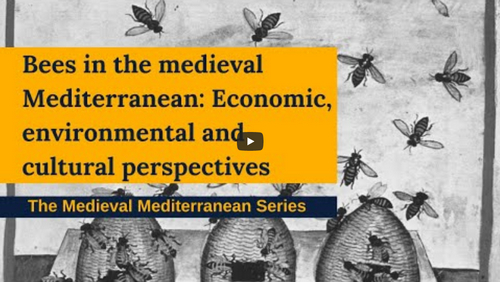
A new 53 minute YouTube seminar “Bees in the Medieval Mediterranean: Economic, Environmental and Cultural Perspectives”. Starts at 6:12 minutes.
Some of the accents are a little difficult, but if you listen closely and on headphones they’re not impenetrable. They’re giving an overview of a major pan-European project that’s been partly completed.
The short discussion of the religious aspect was interesting. The thinkers of the medieval world did not know how bees reproduced, even if perhaps the guilds of industrial-scale medieval bee-keepers came to discern something of this over the centuries. Thus bees were deemed “virginal” by the thinkers, and could then be closely associated in the minds of the religious with the chastity and sweetness of Mary and Christ. This made their wax especially suitable for church candles.
The seminar’s listener learns that the Baltic not only had amber, but also bees-wax as a major portable and durable export. One that went long distances across Europe. “Vast” bee-forests were created within the forbidding forests of the Baltic and Bavaria, leading to “vast” exports of wax to the Black Sea, and thence it found its way to the monks who specialised in making all sorts of religious church candles. The Bavarian wax was especially valued, since the white colour and non-smoky burning were deemed important in churches.
The project’s paper is “Beekeeping in late medieval Europe”, in open access. This adds some detail to the idea of the vast eastern bee-forests…
bee forests were created through hollowing out large spaces in tree trunks and allowing bees to naturally move from tree to tree as they swarmed, protected from the worst of the winter weather within the trees’ cavities.
Logs were also used in some places. One assumes that glades were also created, perhaps by controlled burning, for the flowers and shrubs required by the bees. Such methods obviously produced enormous amounts of wax for white candles. Apparently honey and wax production were quite different things, and such trades did not overlap.
This somewhat intersects with my Gawain book, since the Lord of Alton in North Staffordshire went to fight with the crusaders of the Teutonic Order in eastern Europe. The project’s article tells of how the vast bee-forests were pagan, and there was a quite a religious/political tussle with the highly efficient Order over their control and use. But it appears to have been normalised by the time of Gawain, or at least that is the impression I get from the article. It notes one aspect of the pagan beliefs of that area that I had not noted from the BBC In Our Time programme on the Teutonic Order — that the linden was an especially revered tree.
Ironically, it seems that medieval church candles came either from forests tended by the ‘nominally Christian’ ‘former’ pagans of the Baltic, or the Arabs along the coast of North Africa.
The speakers also touch on the British Isles at one point, and the fringes of the West Midlands. Apparently we know from Domesday and somewhat later census documents that the Welsh Marches were a big bee-keeping — and presumably even nationally exporting — area. For honey rather than candle-wax, was the impression I had from what was said. This was in hives rather than damp Welsh forests, and was likely not monastic in nature. The seminar suggests that northern monastic bee-keeping was often more for medicinal and symbolic purposes (i.e. to demonstrate to novices the ‘ideal community’ in connection with the heavenly, which the monastery should strive to be like), than for sale.
Neither the recording or paper has mention of the folklore of bees, re: the folk-idea that the bees woke and “sung” at Christmas “a drowsy echo of the angels’ song” in heaven. Or that one must go to quietly “tell the bees” of someone’s death. But this “heavenly messengers” old wives’ lore now makes a bit more sense to me, now I know of the long-standing Christian connection of bees with Christ/Mary.
See also the recent Kristine Larsen paper, “Tolkien’s Blue Bee, Pliny, and the Kalevala”.