On Stocc and Stoke

I found an interesting conjunction of Tolkien and the place-name of Stoke-upon-Trent. A review of Mark T. Hooker’s book A Tolkienian Mathomium: A Collection Of Articles On J.R.R. Tolkien And His Legendarium (2008) informed me that…

Hooker devotes an entire [ten page] chapter to the Shire place-name “Stock,” which he connects to English place-names, and eventually (via [the writer] Aelfric) to sacred trees (and St. Boniface and Owen Glendower), concluding that “Stocc would, therefore, appear to be the OE [Old English] name applied in pre-Christian times to a religious site”.

From Stocc comes Stoke. The reviewer demurs on the connection with a pre-Christian sacred grove, although obviously the original Stoke was sited at what is now the Minster where two large streams meet the Trent, and it’s well-attested that such ‘three watercourses meeting’ sites had symbolic meaning to pre-Christians — it would be a natural site to have once had a (sacred) grove serving Penkhull on the hill above. The reviewer adds that we cannot be sure that when Aelfric talked of “stock and stone” he meant ‘enclosed groves’ of trees and ancient standing-stones. The reviewer points to the 19th century uses of the phrase “over stock and stone” in Grimm’s tales [in English as German Popular Stories, 1823, in which the phrase is found translated], Asbjornsen and Moe’s Norwegian folktales [two possible books, 1847 or 1852?], and in later 19th century Swedish and Flemish [1873] poetry.

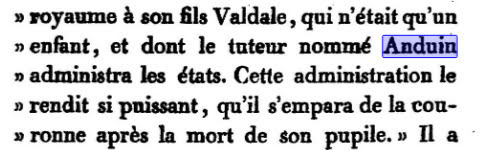
I find it in an 1837 edition of a Berlin bulletin on foreign literature (Literatur des Auslandes, No. 129), in an article on what appears to have been an English book on “Herne, the hunter”, which would be congruent with hunters who go ‘over stock and stone’ — meaning to traverse open country fast and directly, without reference to roads, tracks or local borders. The hobbits in LoTR do this, you’ll recall — resting in a sheltering wood, trespassing on a fearful farmer’s land, and later fatefully encountering a single standing-stone on the Barrow Downs.

The alliterative Gawain poet has it in Pearl (“We meten so selden by stok other ston”) and Tolkien echoes this in Treebeard’s parting lines “It is long, long since we met, by stock or by stone” (discussed by Shippey, Road to Middle-earth, page 181). Davenport (Art of the Gawain-poet) remarks that the poet evidently uses or alludes here to a “common idiom” of the time, but says nothing more about it. This would mean it was a “common idiom” in north and mid Staffordshire at that time (c. 1379 for Pearl, the phrase probably first encountered by the poet circa the early 1340s in the context of hunting). Here it would indicate liminal points in the open country, sheltered wooden enclosures for newborn white lambs, or high boundary-stones offering far and glittering views — both of these work as fitting allusions for a poem such as the Pearl.

The 1952 Brewer’s Dictionary of Phrase and Fable does not have it, and nor does the 1905 edition. In early examples I find it in a German collected edition of Goethe (1829), and an 1813 book-length account of the French retreat to the Niemen (title translated) has it, “…if at times there was an alarm at night, then it went [quickly] over stock and stone, and the [French, their torch-bearing scouts?] came close several times”. The first edition of Grimm’s Fairy-tales was 20th December 1812, so the text of this 1813 book could well have been written before encountering Grimm.

It can be found in a Faroes [Norse] ballad of battle between a boy Loki and a giant (Hammershaimb, Faeroiske Kvaeder, edited for the Nordiske Litteratur-Samfund, Copenhagen, 1851)…

[the boy Loki] struck off giant’s other shin.
He struck off the giant’s other shin [note: phrase is deliberately repeated].
And tossed in-between [i.e. between the lower legs] a stock and a stone [‘stokk og stein’]

But this would be presumably humorous, alluding to the vast size of the giant, so big that the distance of “a stock and a stone” could fit between his legs. A later superstitious folk-remedy for hand-pains in the Faroes does assume a small hand-sized stick and stone, true… but a puny stick and stone would not fit with giant’s size in the boy-Loki ballad.

The alternative un-poetic idea from the linguists is that stocc was simply a ‘wooden stick or post’ or perhaps even a mere ‘large log or stump’. Or simply just ‘a place’. Yet this is actually not incongruent with a known small enclosure, which would have been partly fenced and gated with wood and perhaps had a wooden stile. Especially if it was being used to enclose live-‘stock’ animals. In the context of the folk-tale idiom for rapid movement across open country, many such obstacles as fences and stiles would have been encountered and leaped ‘over’ (if on horseback, or if a large and nimble lad). Recall also the need, on moorland, to mark paths with wooden posts that would stand out above snow-drifts.

Anyway, those are my first thoughts. I can’t afford the £11 for Hooker’s book A Tolkienian Mathomium, but will provide an update on this if I can eventually get a copy.

Tolkien Gleanings #37

Tolkien Gleanings #37

* Published yesterday, the new book Tolkien’s Library: An Annotated Checklist: Second Edition Revised and Expanded. A simultaneous release in hardback, paperback and Kindle ebook.

* On Archive.org, free to borrow, J.R.R. Tolkien: a descriptive bibliography (1993). This is an out-of-print table-trembler of 434 pages. The book is deemed ‘collectable’, and thus appears to be effectively unavailable to scholars except at Archive.org.

* Newly announced at the Avila Institute, SSF279: Healing the Imagination: A Reading Course in The Lord of the Rings. Dates are “to be decided” but, judging by its position on the course-list, summer 2023 seems likely. Avila is a legitimate ‘Catholic online studies’ teaching service, with a global reach.

* A one-hour video from the “Tolkien et le monotheisme” conference in May 2022. On YouTube, with auto-translation of sub-titles to English. The conference was…

“organised by the CUFR of Dembeni in its amphitheatre. The conference is entitled ‘Tolkien and Monotheism: Religion in the life and work of J.R.R. Tolkien'” … “though the Catholic religion had a preponderant place in the life of the writer, his writing nevertheless reveals a cosmogony not simply reducable to this monotheistic religion.”

* And finally, a “family photo” of ‘Bag End’ made by a later owner. Uploaded 2018 by a descendent, and seemingly un-noticed by Tolkien historians. Regrettably a very poor and small picture, possibly taken out of an 8mm cine-reel by the look of it, with an ND grad filter on the lens. This is about the best I can do with it in Photoshop…

Definitely not a pristine glass-plate picture, but better than the source:

My guess would be post-war, maybe the later 1960s? There are of course many half-timbered buildings dotted about Dormston. But for confirmation of the site, cross-reference with the pictures of the real ‘Bag End’ at the Tolkien Library.

Tolkien Gleanings #36

Tolkien Gleanings #36

* New unseen Tolkien family photos, early 1930s. Tolkien himself is not seen, and presumably he was the one making the pictures with the camera. The discoverer of the pictures says…. “I’ll be sending high res versions over to the Bodleian shortly”, but has kindly posted low-res versions on Reddit. Tolkien is known to have gone to Lamorna Cove in 1932, but there’s no way these pictures show Cornwall. The scene could be anywhere on a lowland English river, south of the Peak and east of Exeter. Though the distinctive waterside thatched boathouse, boat-type and willow-pollarding might be able to be cross-referenced to a postcard, and thus the location identified. My guess on that would be that one would start looking around Evesham, where his brother was living. Possibly also along the River Stour over in Worcestershire or near Oxford.

* A book from late last summer, and new to me, The Road to Fair Elfland: Tolkien On Fairy-stories: An Extended Commentary (September 2022). This appears to offer the text with…

“references to Tolkien’s precedents and sources for the themes he treated in his essay” and also examples of how the famous essay “proved to be influential or even ahead of its time in the decades following”

The book is on the Kindle, so the free 10% ebook sample should get you the complete preface.

* Kent State University Press has announced the book To Rule the Fate of Many: Truth, Lies, Pity and the Ring of Power (forthcoming). Thankfully it appears to be nothing to do with That TV Series, despite using a similar name. Seems to consider how … “Tolkien could encompass in his sympathy Christian religion and pagan mythology” and thus was able to craft a dynamic place in which he could deeply consider “truth, lies, pity” and bring them “onward to a more philosophical and theological treatment”.

* Tolkien’s Mythic Meaning: The Reader’s Ontological Encounters in The Lord of the Rings. A 2020 thesis for the University of Manchester, now available online.

* And finally, “Australians are LARPing”.

Tolkien Gleanings #35

Tolkien Gleanings #35

* A new 2023 review of An Anthology of Iberian Scholarship on Tolkien (2022). “Iberian” here means both Portuguese and Spanish. The review is in German, but the page is in HTML and thus easily auto-translated.

“Simonson [examines] the function of the trees on the continents of Valinor and Numenor, in which beauty and utility are combined. […] only the balance between materialism and aestheticization can guarantee a responsible approach to nature.”

* Call for chapters: Theology, Religion, and Dungeons & Dragons. Relevant to Tolkien, given the formative influence LoTR had on Gary Gygax’s original classic D&D. Deadline: 15th February 2023, with the chapter to be submitted by the end of the summer.

* A public on-site talk titled “The Life and Thought of J.R.R. Tolkien”, in Houston, USA. 24th April 2023. Free and booking now.

“Professor Holly Ordway will provide an enriching presentation about the life and thought of J.R.R. Tolkien”.

* From Country Life magazine, rare images of J.R.R. Tolkien from 1961. Regrettably the magazine has sandwiched the online article with an unexpected auto-playing video of a mass of crawling insects. All video on the site can be perma-blocked, by pasting the following to your uBlock Origin ‘My Filters’ block-list…

! https://www.countrylife.co.uk
www.countrylife.co.uk##.jwplayer-margin-bottom.jwplayer-container

Or, if you want to perma-block all such nonsense in their online articles, videos or not…

! https://www.countrylife.co.uk
www.countrylife.co.uk##.injection

* And finally, on the BBC this week…

“Russell Kane and his guests discuss whether the writer [Tolkien] was evil or genius.”

Seriously. That’s their blurb. For BBC Radio Four. And they wonder why few pay any attention to the BBC these days.

Tolkien Gleanings #34

Tolkien Gleanings #34

* An update on Signum University Press. The Press is barely six months old, but now has a firm slate for 2023 and beyond. In Tolkien studies there’s news of the book Cardinal Vices of Middle-earth (September 2023), a new “comparative analysis of the role of chosen vices and virtues” from a Catholic perspective; and “An interview series with Verlyn Flieger”.

* A casting-call for Fellowship: Tolkien & Lewis… “an upcoming limited [screen] series, based on the friendship, faith, and fantasy of C.S. Lewis and J.R.R. Tolkien.” Filming in London in early spring 2023, and the call has a rather tight deadline. Why do such projects/jobs always seem to have a ‘rush-rush’ deadline of days, rather than at least a month or so?

* Wheaton University now has its list of summer school 2023 courses. Includes “The Makings of Middle Earth: Creation, Creativity, and J.R.R. Tolkien’s Lord of the Rings“, and the “Otherworlds of Imagination in C.S. Lewis”. Seems to be aimed at regional students who want a long taster of what the university can offer. I had to look up “Wheaton, IL”, and it turns out that this well-known university is on the edge of the city of Chicago.

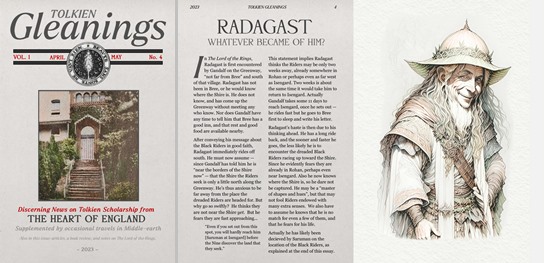
* Issue 2 of my Tolkien Gleanings as a PDF magazine, now available for download.

* And finally, oh dear… more PR piffle for bamboozled tourists from the city of Birmingham. The Birmingham University tower… “is famously believed to have been the inspiration for the tower of Orthanc, the black tower of Isengard”. Will the city ever learn that there’s a really moving true story to tell about Tolkien and Birmingham? They don’t have to make it up.

Tolkien Gleanings #33

Tolkien Gleanings #33

    “33, an important number”

* A two-day conference on “G.B. Smith and J.R.R. Tolkien: a meaningful friendship” at Corpus Christi College, Oxford. 22nd-23rd March 2023. Looks excellent. Booking now.

* Starting in May 2023, a new Signum University course titled “Tolkien Illustrated: Picturing the Legendarium”. “Two 90-minute live lectures and one 1-hour discussion sessions per week as assigned (4 hours total weekly).”

* A new issue of the open-access journal Fafnir. One review is of interest, of the book A Sense of Tales Untold: Exploring the Edges of Tolkien’s Literary Canvas.

Tolkien Gleanings #32

Tolkien Gleanings #32

* In the Canadian undergraduate journal Explorations, the new essay “The Birth of J.R.R. Tolkien’s Love-Child Culture in The Two Towers. An off-putting title, but it turns out to be a detailed and worthy essay on the insular and self-governing nature of the Rohirrim. It has kindly been placed under full Creative Commons. There’s a mistake to watch out for, though. Helm’s Deep was not the work of Rohan, as LoTR states… “Men [of Rohan] said that in the far-off days of the glory of Gondor the sea-kings had built here this fastness with the hands of giants.”

* At the Fantastic Metropolis blog I found a nice copy of “The Realms of Tolkien”. This being a late interview printed in the British science-fiction magazine New Worlds (Vol. 50, No. 168, November 1966), an issue not yet on Archive.org. In the interview Tolkien elaborates a little on Queen Beruthiel and her cats, among other topics.

* Libraries and Books in Medieval England is a new book due in April 2023. It promises to be a manageable survey of the topic in 192 pages, from an eminent authority with all the latest research at his fingertips.

* Due in a few weeks, the academic book J.R.R. Tolkien’s Utopianism and the Classics (February 2023), on the still-hot academic topic of utopianising tendencies in literature. Here ‘Classics’ means ‘the ancient world and our inheritance from it’. The blurb sounded quite interesting, until I read the names of the usual suspects… Plato, Homer, Ovid. The contents are…

Introduction: Utopianism and Classicism: Tolkien’s New/Old Continent.

1. Lapsarian Narratives: The Decline and Fall of Utopian Communities in Middle-Earth.
2. Hospitality Narratives: The Ideal of the Home in an Odyssean Hobbit.
3. Sublime Narratives: Classical Transcendence in Nature and Beyond in The Fellowship of the Ring.

Epilogue

The book follows last year’s theologically-informed Utopian and Dystopian Themes in Tolkien’s Legendarium (February 2022) by a different author, which had a chapter that surveyed… “elements of anarchism, distributionism, and Toryism in Tolkien’s political philosophy”.

* And finally, a newly discovered pithy marginal note from Christopher Tolkien

“What’s the point of all this pedantry if you can’t get a detail like this right?”

Tolkien Gleanings #31

Tolkien Gleanings #31

* Now public, a recording of a new public lecture on YouTube ““I hold the key”: J.R.R. Tolkien through interviews and reminiscences”. Given by Dimitra Fimi at the University of Birmingham, in May 2022.

* My unearthing of the location of C.S. Lewis’s 1936 walk near Buxton, Derbyshire, plus a small correction to an important memoir of Tolkien.

* New on Archive.org to borrow, the book There and back again: in the footsteps of J.R.R. Tolkien (2004). This reflects on a series of walks, presumably made in the late-1990s / early 2000s, in the following places…

So far as I know, Tolkien never visited the Lyndey excavations. But he certainly wrote the “Nodens” paper.

* And finally, “The Magic of Middle-earth” exhibition is travelling to West Sussex in 2023. The show opens at the museum in Chichester in April, and will require paid tickets.

C.S. Lewis’s 1936 walk near Buxton, Derbyshire

A bit more on walking and fantasy writers, following my last Tolkien Gleanings. I found a list of long walks taken by C.S. Lewis and his brother. One walk had possibly been taken near me, in Derbyshire.

“13th–16th January 1936 in Derbyshire”

So I briefly looked into it. Tolkien was not with them, and according to the Chronology was hard at work preparing for his new academic term and dealing with tedious Early English Text Society business. But I wondered where the walk was anyway, perhaps for the benefit of some future Tourist Board leaflet. Was it on the west or the east of the Peak? The location took a bit of tracking down, but Lewis’s brother kept a diary that records a visit to the church at Taddington, which is rather amusingly described by the American diary annotator as “north of Oxford”. England may be a very small place, compared to America, but we’re not that small. More precisely Taddington is just a little east of the spa-town of Buxton, in the far west of the Peak. No further details of the precise spot are known. But logically the trip would then be on the train from Oxford – Birmingham – Derby – then onto the local milk-run train through the Peak and then off at Miller’s Dale station just before Buxton… and then brisk and chilly walking in and around the fabulous Miller’s Dale (aka Millers Dale) and probably staying in the local pub there.

Walking in the snow, since “lovely snow clad trees” feature in the diary in the entry for their final day there. A 1930s winter, with heavy snow, in the Peak, in January. Not something that even the most ardent Lewis-ite would want to re-create today, I’d imagine. Even if they could. Today even the fall of a few snowflakes could be enough to stop all transport and prevent you from getting there on public transport. Not so back then, when we had more grit and gumption.

Along the way I found a small transcription error re: another walk, the error being caught in George Sayer’s important 1992 speech “Recollections of J.R.R. Tolkien”…

I had the impression that he [Tolkien] had never walked the [Malvern] hills before [August 1947] though he had often admired the distant view of them from [his brother’s at] the Avon valley near Evesham. Some of the names of the places we saw from the [Malvern] hills produced [in his talk] philological or etymological footnotes. Malvern was a corruption of two Welsh words, “moel” meaning bear, and “vern” derived from bryn or fryn meaning hill. This of course told us that the area was in early times heavily wooded, though the ten-mile ridge of the hills was not.

I was puzzled for a moment by this, unable to ‘see the bear for the woods’. But I realised that “bear” (animal) should be “bare” (bald), from the Welsh moel (bare, bald, often applied to a prominent hill). From the Malvern Hills one looks east across Herefordshire and into Wales.

The error is repeated in Tolkien: A Celebration (1999), in which the speech is reprinted. So, no… sadly Malvern does not mean Bear-hills, but simply Bare-hills.

Tolkien Gleanings #30

Tolkien Gleanings #30

* In the new issue of the scholarly journal 1611, a new Spanish-language article on the reception of Tolkien’s works in Spanish translation. …

“this study constitutes a contribution to the still-scarce academic bibliography on the reception of a British author, one who has come to occupy an important place in the Spanish-speaking publishing world.”

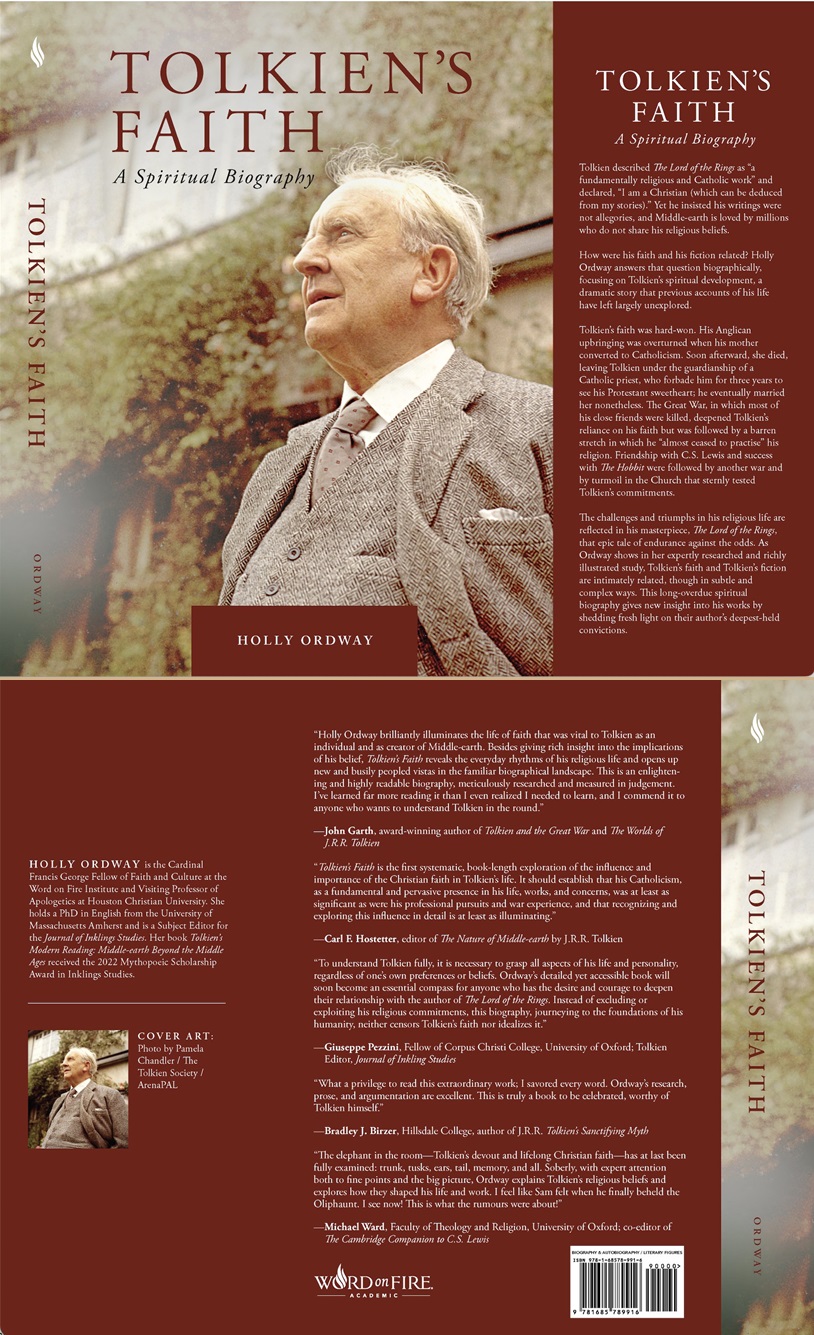
* The Chairman in Humanities at Houston Christian University has a glowing review of the new book Tolkien Dogmatics by Austin M. Freeman…

Austin Freeman has given a gift to Tolkien scholars and aficionados alike in a work I didn’t think could be written. Tolkien Dogmatics: Theology Through Mythology with the Maker of Middle-Earth painstakingly assembles, collates, and cross-references Tolkien’s legendarium, academic essays, and letters to construct a systematic theology. Though informed by the copious secondary material on Tolkien, Freeman’s work is firmly and faithfully grounded in the depth and breadth of the primary material. Broken into 12 chapters that explicate Tolkien’s views on God, revelation, creation, humanity, angels, the fall, evil and sin, Satan and demons, Christ and salvation, the church, the Christian life, and last things, Tolkien Dogmatics takes a deep dive into the theological convictions that grounded, inspired, and guided the maker of Middle-earth. In his aptly titled “Prolegomena,” Freeman makes clear his goal: “To set out as accurately as possible what Tolkien thought, without letting my or other people’s views intrude upon the matter”. He stays true to his promise.

* The Index of Medieval Art Database will become ‘free to use’ from 1st July 2023 onward. The largest online database of such research, it is well-established and includes a huge “photographic archive” with cross-reference links to the relevant texts which the pictures illustrate or allude to. The service currently requires a university subscription.

* “Hill Is a Hasty Word” is a new blog post from the English West Midlands. It helped me make the link between Treebeard’s approach to things and ‘Tolkien as a walker’. It appears that Tolkien was an ‘artist-rambler’ type of walker — relatively slow in walking and curious about his surroundings, stopping frequently to collect his thoughts and/or to consider the things he encountered big or small. Whereas Lewis appears to have been an ‘exercise-hiker’ of the brisk 1930s type — wanting to walk fast to ‘cover the ground’ and get to the destination. A slow “Cretaceous Perambulator” Lewis was not, though apparently that was how he liked to style himself as a walker. Another earlier blog post from 2019 looked at this topic of walking and has taken the time to find various quotes. Lewis said (1947, Malvern) that Tolkien was…

“not our sort of walker. He doesn’t seem able to talk and walk at the same time. He dawdles and then stops completely when he has something interesting to say”.

In 2022 First Things had another post on the topic, but with a contradictory quote (c. early 1950s, published 1955) from Lewis…

“Walking and talking are two very great pleasures, but it is a mistake to combine them.”

So, what is one to make of that? Perhaps Tolkien changed Lewis’s mind on the combination of talking and walking, between 1947 and the early 1950s, as he did with other things? Well, I’ll leave that one for the Lewis scholars to puzzle over. Another 2022 article “Walking with Chesterton and Lewis (and Tolkien)” also mused on this topic, and related the walking styles back to the writing styles…

“The Lewis brothers liked to walk vigorously, covering lots of ground; Tolkien preferred to amble, stopping every few hundred yards to look at a flower or a tree. The brothers became increasingly frustrated with their lack of progress and increasingly impatient with Tolkien’s dilatory perambulations. They strode off ahead, leaving Tolkien and Sayer to meet them in the pub when they eventually arrived. […] This difference in approach to a country walk is evident in the difference between the respective writing styles”.

* And finally, take a walk in the rich fields of Brewer’s Dictionary of Phrase and Fable (1895) in its 1905 printing. This was the standard edition until the major revision of 1952, and thus the one available to Tolkien prior to the creation of The Lord of the Rings. This online version has very poor OCR (see the .ePub file), but is a good scan otherwise.

Tolkien Gleanings #29

Tolkien Gleanings #29

* “Song Lyrics in The Hobbit: What They Tell Us”, a 2022 undergraduate dissertation by a mature student, for the University of Southern Mississippi in the USA. Open access and public.

* News of a forthcoming book, via a slightly-expired call for papers. Titled Tolkien as a translator: investigations on Tolkien translation studies, and at a guess probably pencilled-in for 2024. The topic is…

“Tolkien as a great translator [who deserves] a collection of essays on his way of translating, the criteria he used, the choices that distinguished his style and that inevitably influenced his sub-creation(s), and the author’s thoughts on translation itself.”

* Since I’m no longer listening to the BBC, it’s taken me a while to twig to the existence of their recent Open Country podcast. This ‘audio countryside ramble’ took a November 2022 open-air walk in the Cotswolds, with Tolkien scholar… “John Garth to find traces of Tolkien Land at Faringdon Folly and the Rollright Stones”. The .MP3 is available at Listen Notes

The tower is debatable. Probably Tolkien’s initial Oxford audience for the famous Beowulf lecture would have recognised the similarity, but in Worlds Garth wants a poster of it to be the inspiration for the hill of Hobbiton. I wasn’t convinced. Yet evidence for the ancient Rollright Stones is clear, for instance when in 1948 Tolkien berated his publisher on the topic of the Farmer Giles of Ham illustrations…

The incident of the dog and dragon occurs near Rollright, by the way, and though that is not plainly stated at least it clearly takes place in Oxfordshire. [As currently illustrated] The dragon is absurd. Ridiculously coy, and quite incapable of performing any of the tasks laid on him by the author.”

* And finally, according to the Pipedia, there has yet to be even a “list of literature where the pipe plays a major role in character and/or plot development”, let alone a book survey of such. That’s an opportunity for someone, though Middle-earth is already well-served by the new third edition of Pipe Smoking in Middle Earth (2022). Tolkien himself used a standard Dunhill briar pipe, of the sort common in the trenches at the time of the First World War — partly due to Mr. Dunhill sending them out to front-line soldiers and officers. The type of pipe-bowl also causes some aficionados of pipe-weed to call it a ‘pot’ or ‘billiard’ type of pipe, which I have to assume is correct. Sadly Tolkien did not sport a long Gandalf-ian ‘Churchwarden’ type of pipe. His favoured tobacco came in tins of Capstan Navy Cut ‘Blue’ flake pipe-tobacco, apparently a smooth and creamy Virginia blend today referred to as ‘Capstan Navy Cut Ready Rubbed’.