The old Museum?

A curious postcard, currently on eBay (not from me). The city of Stoke-on-Trent’s Museum and Art Gallery in an early view. It is a back view of the current one? It seems too small, and there would not be the distant views at either side. Perhaps there was something temporary in the city before the one that Prince Charles opened in Hanley, maybe as an annexe of a modernist secondary school in somewhere like Fenton?

Also, in the news today…. “Stoke-on-Trent City Archives has been officially opened at the Potteries Museum and Art Gallery, its new home.” It was up in the now-defunct City Central Library tower-block.

Tolkien Gleanings #200.

Tolkien Gleanings #200.

Welcome to the 200th edition! If you value these ‘gleanings’, please consider becoming my patron on Patreon.


* In Italy, the three-day Chianciano Terra di Mezzo event returns, 28th–30th June 2024…

“an extraordinary event entirely dedicated to the writer J.R.R. Tolkien and his work […] meetings, exhibitions, shows, music, films […] evening concerts, shows […] This year we take our key inspiration from one of Tolkien’s first poems [“Kortirion”] which is a celebration of Warwickshire, envisaging Warwick as the city of the Land of Elms, and as Alalminore of the faerie realm.

        … amid this sleeping land
of silver rain, where still year-laden stand
in unforgetful earth the rooted trees    (— from Book of Lost Tales 1)

* Newly republished online and freely available, Tolkien’s 1945 letter to The Catholic Herald on ‘the Name of Coventry’, the West Midlands city…

“The settlement and naming of the Midlands lies far back in English history, and in the main preceded the conversion [to Christianity] of the Angles. Indeed, the giving of names often preceded the formulation of the ‘places’, that is of the villages and towns, and so originally denoted isolated swellings, boundary-marks, and local features, near which communities were later formed.”

He roots the name Coventry to the Anglo-Saxon “Cofa’s tree”, and Cofa to “cove”, which he ‘nods through’ as being a word used by later men to recall the shrewd original “farmer-settlers” — those who left behind them only a tamed lowland landscape and their burial mounds on the heights…

The name Cofa appears in other place-names in other parts, Covington, Covenham, and Cobham: but these names are the only records that these long-forgotten “coves,” these farmer-settlers, have left on the pages of history to-day.

Thus he appears to claim the word “cove” as the origin of that which survived into the common speech of the 19th and early 20th century. An “old cove” being a canny and somewhat rascally old man, still sharp and knowledgable but somewhat antiquated and withdrawn from the main stream of life. Possibly also reluctant to give sums of money to his relations (a “stingy old cove”). This would sit somewhat alongside the more accepted meaning for the Anglo-Saxon cofa, a cave-like chamber scooped out under a mounded hillock (the still-current modern sea-shore word “cove”, as a scooped-out inlet between rock walls, is similar). In that, the phrase “old cove” also implies that the old man has ‘one foot in the coffin’. Or the barrow-mound, in the case of the early Angles of Mercia. Tolkien’s earlier mention of “isolated swellings” in the landscape then suggests for Coventry a large pre-Christian Anglian burial mound, from which a large and notable tree grew.

* At Signum University, an eight-class online course on ‘Tolkien and the Classical World’. Forthcoming in July 2024, though only if enough students sign up for it.

* A new YouTube recording of a Signum University Thesis Theater: On The “Notion Club Papers and Tolkien’s Vision of Creative Mysticism”.

* The Tolkien Guide has a new post containing an article on “Tolkien-Inspired Art from the ‘Hobbit Craze’ Years, 1965-1969: Untraced Works”. Freely available online.

* The Tolkien Society Annual Guest Speaker 2024 is announced

“Dr. Andrew Higgins is the Director of Development at Imperial War Museums [and a Tolkien scholar…]. His talk to the Society, in honour of the publishing of the new extended version of Tolkien’s Letters, will be ‘Epistolary Glossopoeisis: Tolkien’s Letter Writing and Language Invention'”.

* In the latest issue of The Criterion, student journal of the College of the Holy Cross, an article on “Language and The Lord of the Rings: The Expansion of a Universe”. The author aims to show how, with the aid of its many “linguistic markers, […] Tolkien hints at a larger world outside the narrative”. Freely available online.

* From 2018, but new to me, ““Learn Now the Lore of the Living Creatures”: On J.R.R. Tolkien’s Alliterative Poetry”. Freely available online.

* Another worthy blast-from-the-past. The early Tolkien fanzine Niekas #16, now freely available online as a PDF via the Fanac History Project. #16 has the full version of an essay that Amon Hen No. 9 recalled as “the most penetrating commentary on The Lord of the Rings that had yet appeared” by the early 1960s, “Men, Halflings and Hero worship”. Note that this same essay was severely truncated in the later book Tolkien and the Critics (1968), and the truncation was repeated by the same editors in their updated volume Understanding The Lord of the Rings (2004). If you think you’ve read this seminal essay there, you haven’t.

* Note that April 2025 will be the 100th anniversary of the publication of Tolkien and Gordon’s edition of Sir Gawain and the Green Knight. Surprisingly I don’t see the 1925 edition on Archive.org. Superseded in 1967, true, but the 1930 corrected reprint “remained the most widely used text of the poem for forty years” and it appears to have gone through eight reprints. As such the original as-printed edition should really be readily available for study as a historical document. It isn’t, so far as I can tell, except in the dead-tree form now made expensive by book collectors.

* Advance notice of a new lecture-series class from the high-quality Great Courses company, to be titled The Inklings: C.S. Lewis, J.R.R. Tolkien, and Others. Due in 2025.

* Apparently, Tolkien once wrote something about Chelsea, London? Or so claims the UK’s Royal Philharmonic Orchestra in their blurb for a Chelsea-themed concert in June 2024… “hear words written in and about Chelsea from authors including A.A. Milne, Jane Austen, J.R.R. Tolkien…”. The Chronology only has him present at the 1968 Chelsea launch of the song-cycle “The Road Goes Ever On”, so perhaps some late writing arose from that? One likes to imagine him using the opportunity to have a quick potter down the famed Kings Road in 1968, sampling — with raised eyebrows — the swinging dandy fashion and psychedelic rock-music of the time. But perhaps not.

* Severely overcrowded with tourists, partly due to its Tolkien claims, the Swiss village and valley of Lauterbrunnen… “plans to charge visitors to experience ‘Middle-earth'” according to various news reports.

* And finally, Games Beat magazine has a long and well-padded interview with Lee Guinchard the CEO of Embracer Freemode. No surprise revelations, but interesting background if you can slog through it all. Here’s the digest for the rest of us. Guinchard is a highly experienced game producer and sees “big opportunities for further exploration and expansion” in the Middle-earth IP, envisaging something multi-platform and akin to the ‘Marvel Universe’. But based around the “games [i.e. videogames, that] are going to be made to fully explore the new universe being created”, possibly with AI character enhancement and the maturing “new technology for how people immerse themselves in worlds”. This is as part of “a 10-year or 20-year plan” while Tolkien is still in copyright, which will aim to align with other companies (making new movies, TV series, card games etc). Current videogames (such as the dire Gollum, the soon-to-close Heroes of Middle-earth, the imminent and icky Tales of the Shire, and the mediocre Return to Moria) were approved before he arrived on the scene. He sees no “rights issues” for stories set in the Second Age of Middle-earth. The overall aim will be to “reach billions” of buyers and “work with a wide variety of merchandise companies” to generate income. This likely includes reaching the big Chinese audience, and he poses the question “how would it be visualized for them?” Personally I’d be happy with interactive AI-driven audio, where I can imagine my own visuals.

Tolkien Gleanings #199

Tolkien Gleanings #199.

* The latest edition of the journal Thersites has a review of J.R.R. Tolkien’s Utopianism and the Classics.

* Dr Lynn Forest-Hill blogs that she has… “received the news that the new version of my translation of Sir Bevis of Hampton is now officially forthcoming in 2024. […] the Introduction is completely revised to suit a wider audience, and extended and updated with my most recent research. The new edition includes a more extensive bibliography and footnotes.”

* The latest The Imaginative Conservative has a new article musing on “The Screen & the Abolition of Imagination”

“my objection to the film version of The Lord of the Rings is at a more fundamental level […] filmic versions of fantasy fiction serve to abolish the imagination. […] you read his story [on the page and] you interpret it through the filter of your experiences, memories, literature, and learning. […] This is the powerful covenant between the sub-creator of a fantasy world and the reader.”

* The Family Tree of the Tolkien Legendarium is back online, and this wall-chart now has its own expensive .com Web domain at https://lotrtree.com. Currently at version 8.2 (May 2024). Note also the link to the PDF companion guide.

* I didn’t know that Arthur Ransome (Swallows and Amazons) read The Hobbit after publication, and that he boldly suggested tweaks for the next edition. Tweaks which were actually accepted by Tolkien, with the proviso that there might not be another edition — since the book wasn’t selling well.

* The 2023 Anor No. 60 from the Cambridge Tolkien Society. Articles musing on sanitation and food-supply in Middle-earth, and the perennial question of dwarf-women. Freely available online.

* And finally, Neil Gaiman and P. Craig Russell’s The Complete Norse Mythology is now complete and in a deluxe oversized edition, with three volumes slipcased. In total a 450-page graphic-novel of the mythology, with excellent artwork.

Tolkien Gleanings #198

Tolkien Gleanings #198.

* The “New York Tolkien Conference Returns in 2024” and the guest of honour has now been announced as… “Professor Nicholas Birns of NYU, who will present on his forthcoming book, The Literary Role of History in the Fiction of J.R.R. Tolkien.” This book is actually available now, albeit at such hefty prices that Amazon offers ‘instalment plans’ for would-be purchasers. But it looks like an interesting read. The TOCs are…

* Full List of Incoming and Returning IRH Fellows 2024-2025… “Sarah Schaefer (Art History, University of Wisconsin–Milwaukee), “Tolkien’s Art Histories””.

* Amazon has Tom Shippey’s Author of the Century being published as an affordable ebook in Spanish translation, on 10th July 2024.

* Amazon also shows that Polish translations of The History of Middle-earth are appearing, with Vol 4. due at the end of May 2024.

* The Tolkien Society reports that Peter Jackson is working on a new LoTR film as a hands-on producer. The film is titled The Hunt for Gollum and directed by and starring the Gollum actor Andy Serkis. Some readers will recall this tale has already been a well-reviewed fan-film, and will perhaps also recall last year’s videogame disaster Gollum (May 2023). 2026 is the pencilled-in date for the new Gollum movie.

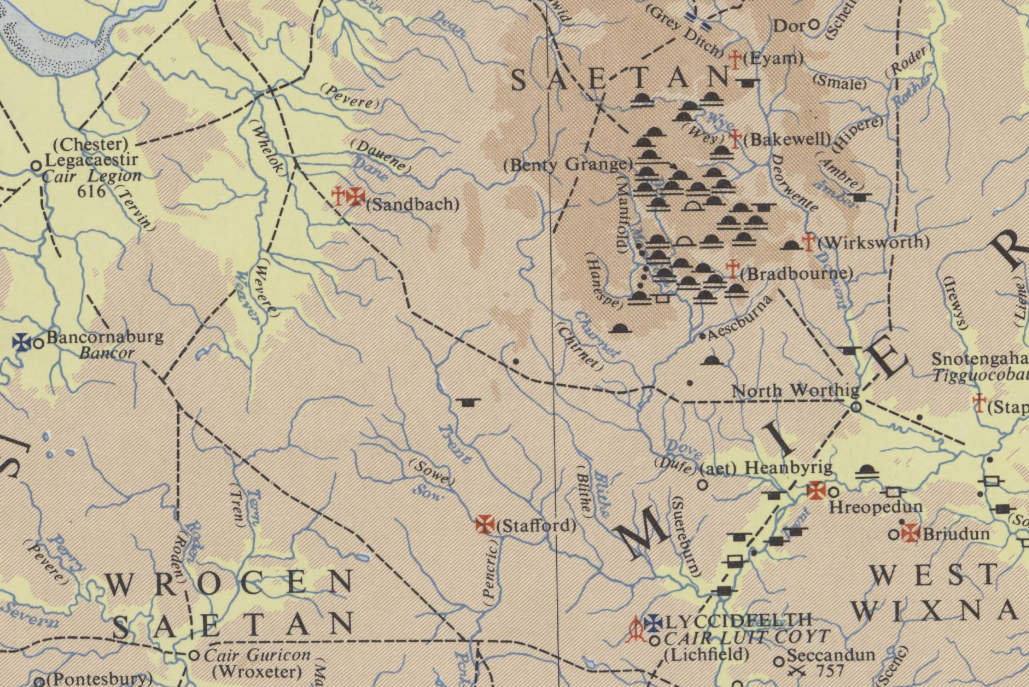
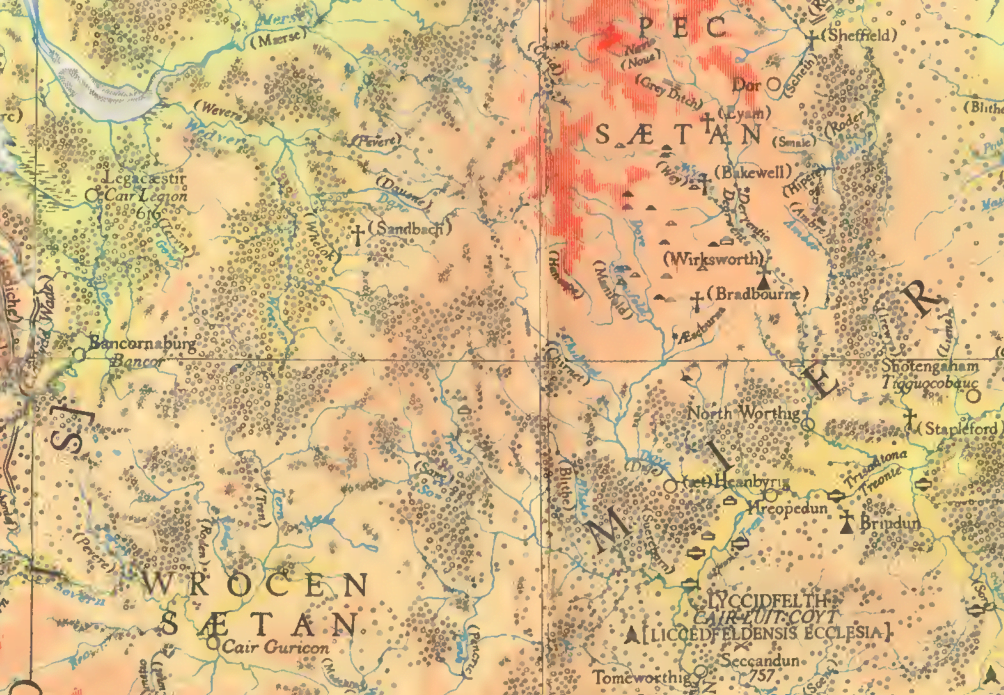
* A thorough and highly illustrated local history article on the Essex Bridge in mid Staffordshire, along with its nearby iron cousin. The writer has also used one of the book plates of the bridge that I found and colourised. Interestingly, the iron bridge would have been longer in Tolkien’s time…

“the length of the Iron Bridge that spanned over the River Trent was removed during the 1950s. This modification left only the section that crosses the Trent and Mersey Canal intact. Although if you head into the woods opposite the gatehouse to Shugborough, you will find the remains of the footing of the Iron Bridge, and some of the old railings still standing.”

This could have given, even if the way was perhaps barred at the Shugborough end, an alternative vantage point on ‘The House of a Hundred Chimneys’.

* The Lord of the Rings: An imaginary geography of Europe”, a free chapter from the open-access book Signs of Europe (2023), being the EU-centric proceedings of the 12th conference of the Hellenic Semiotics Society. The chapter notes the… “marked geographical affinities between Middle-earth and Europe”, outlines how Tolkien’s semiotics at the “spatial level reflects the logic of the narrative as a whole”, and then more ambitiously tries to “identify Tolkien’s views on the political structure of his fictional Europe”. Which apparently “represents a pretty good metaphor for the principle behind the EEC [i.e. the EU] of Tolkien’s times.”

* And finally, alien metal from outer space. In the new Stuff To Blow Your Mind podcast… “Before the dawn of the Iron Age, ancient humans had but one source of workable iron for their artifacts and weapons: meteorites. Robert and Joe discuss various examples of meteoric metal artifacts, including several precious sky-weapons of antiquity.” And Part 2 and Part 3. See also Kristine Larsen’s “Swords and Sky Stones: Meteoric Iron in The Silmarillion (freely available online).

Proper weedkiller… still available, for now

Proper weedkiller is not sold at B&Q any more, it seems. All they had on the shelves was just variations on ‘acetic acid’ at 6% solution, which is basically vinegar. Expensive politically-correct vinegar.

So I popped onto Amazon. Yup, there’s no nonsense here. Glyphosate galore. They even have branded Roundup with glyphosate. I ordered enough Roundup for this summer and next, and as a longer-term backup also got Hygeia’s “Weedfree Glyphosate 1 Litre” — which it’s claimed can dilute to 10 litres in 1 litre sprayers and still be effective. Amazon is happy to send both brands to a locker.

Why the need for a “longer term” backup in storage? Well apparently glyphosate (aka ‘glycophosphate’) weedkiller is currently legal to buy “until December 2025”, when its status will be reviewed yet again (how many times do they need to be told it’s safe?). But I’d say there’s a strong possibility a UK Labour government would quickly cave to the eco-worriers and ban it. Stock up on it now, is my suggestion.

Pinball tables from Tunstall

Maybe the ‘Silicon Stoke’ prospectus is starting to pay off. I was pleased to read “Pinball manufacturer signs deal at Stoke-on-Trent industrial estate” at the top end of Tunstall. Not quite a videogame developer, but in a way better. A high-value hardware/software fusion, in the form of a traditional pinball table able to load and play virtual/digital tables.

I’ve always been keen on pinball, but Pinballia’s website shows that their current range of tables goes from £1,279 to £5,920. Yeowch. Although, if they could get the late-great Pro Pinball: The Web running on a table emulation, even I might be tempted.

Also good to hear that the three tall bottle-kilns on Bournes Bank, Burslem, have been saved and restored. Apparently someone’s now going to try to put 40+ houses on that slope, though the last I heard it was unstable and sliding down the hill. Good luck to them.

Tolkien Gleanings #197

Tolkien Gleanings #197.

* Tonight at Ronde College in Denmark, a talk by Casper Clemmensen on ‘Tolkien and Jutland’. He offers…

“an insight into how elements from Jutland’s landscape and characters from its legends were woven into Tolkien’s descriptions of his creatures and worlds. However, it is not just geography that inspires Tolkien. Deeper themes and symbols in Jutlandic mythology, such as the battle between good and evil and the vagaries of fate, resonate in Tolkien’s works and add depth to his tales.”

The event poster suggested a book, so I went in search of one…

Only Amazon Germany knows about it. Published May 2022 as Tolkien og det mytiske Jylland, under the Hovedland imprint. Now “Currently Unavailable”. But there’s a long review by a historian which shows several of the appealing interior illustrations and concludes… “The book is fascinating and well written and, with its rich apparatus of notes, sources and references, it is also quite convincingly professionally presented.”

* Oronzo Cilli has a new and long article, “Tolkien, Shakespeare, and the Stocks Tree in West Wickham”. Freely available online.

* In the U.S. the Marion E. Wade Center will have a new Director from June 2024. The press-release has a profile and picture of the successful candidate.

* At the UK’s venerable Chichester Centre for Fairy Tales, Fantasy and Speculative Fiction in May, a talk on “Fairy God(s) Mother? The Virgin Mary and the Fairy Godmother in Western Fairy Tales”

“As part of on-going research on the relationship between Christianity and the fairy tale, Dr Paul Quinn will examine the role of the Virgin Mary, and Marian-like figures, in a range of Western fairy tales”

* The New York C.S. Lewis Society Student Essay Contest, now open. Cash prizes, and (in the small print) seemingly open worldwide to bona fide students. Deadline: 29th June 2024.

* A new CTO podcast on “Crafting Code and Conquering Fear: A Journey Through Middle-earth and Conway’s Law”. A veteran software engineer, here interviewed in depth, offers… “his unique perspective [which] illuminates the profound impact of literature on technological creativity and problem-solving.”

* And finally, currently still online is a virtual interactive tour of the recent ‘Tolkien memorabilia’ exhibition at Barnsley Museum in the UK. Access through a normal Web browser.

Tolkien Gleanings #196

Tolkien Gleanings #196.

* Forthcoming, a short introductory book on Tolkien and the Kalevala. From the publisher Routledge, and due in mid-October 2024. The table-of-contents is already available…

* Tomorrow, a new online Thesis Theatre at Signum University. The thesis being defended has examined the story “Smith of Wootton Major”, in terms of expressing Tolkien’s final understanding of… “Faërie as necessary, universal, beneficent and transformative to humanity”.

* Abstracts for three of the papers presented at the April 2024 ‘Tolkien: the relevance of myth’ event in Rome.

* Now open in Oxford, the exhibition ‘C.S. Lewis: Words & Worlds’ at Magdalen College’s Old Library. Runs until 11th September 2024, and a catalogue is planned.

* New in The Iron Room (blog of the archivists at Birmingham’s central public library), a new illustrated article on the city’s Barrow’s Stores. With good b&w interior pictures, albeit from the 1920s after the department store had expanded and re-fitted.

* And finally, a new glimpse of one of the great many filmed-but-not-released scenes from the LoTR movie trilogy. It comes from near the start of The Fellowship of the Ring and lacks the digital backdrop which would have depicted the Shire. Gandalf and Frodo are on the fireworks cart approaching Hobbiton and we hear an additional fragment of their talk. Gandalf very briefly teaches Frodo a bit of what he says is “Sindarin, the language of the Elves”. Online here with audio, for now. So far as a practised eye can tell, it is not an AI generated prank.

Tolkien Gleanings #195

Tolkien Gleanings #195.

* The book The Medieval North and Its Afterlife: Essays in Honor of Heather O’Donoghue (2023) ($ paywall) has, among others, a chapter on “Tolkien and Mirkwood”.

* The latest Journal of Tolkien Research is filling up. Now the first peer-reviewed article has appeared, “Middle-earth’s Middleman: Exploring the Contradictory Positionalities of Faramir in J.R.R. Tolkien’s The Lord of the Rings”. Freely available online.

* “Professor Receives Fulbright Award to Teach and Research in Slovakia” in Eastern Europe…

“Among the topics Murphy will investigate is ‘samizdat’ […] “There was a whole underground of people who had typewriters and were making copies of books and manuscripts,” says Murphy. “The government saw books such as J.R.R. Tolkien’s Lord of the Rings as being a threat to a communist ideology and people could go to jail for reproducing these books. I’m very interested in finding out more about how people accessed literature.””

* Useful for scholars, the free ePub translator plugin for the free Calibre ebook management and conversion software. Supports the free and fast Microsoft Edge translation service, and several others that offer large banks of languages and AI assistance. You install the plugin .zip file from inside Calibre.

* A current course module at the University of York, ‘From Tennyson to Tolkien: The Middle Ages & Modern Literature, 1840-1940’.

* On the Malvern Hills, a new spring and Well Dressing Festival, following the similar tradition found in the Derbyshire Peak District and parts of the Staffordshire Moorlands. 4th-12th May 2024. Might be a nice event for Tolkien tourists to coincide with, in future?

* And finally, the South Essex Echo News has “Essex’s links to Lord of the Rings author J.R.R. Tolkien”. This local newspaper story claims “it is believed” locally that Barad Dur = Colchester Castle. Though I can’t find that startling claim in any source I have access to. Unmentioned by the article is that mid Essex at least has the site of the Battle of Maldon, and thus Tolkien’s work on it and its topography, together with its symbolic later resonance. As Garth points out, in April 1915… “Zeppelins struck the Essex coast just where the Anglo-Saxon earl Beorhtnoth and his household troop had been defeated by Viking raiders almost ten centuries before.” Tolkien would play his part in the defence against the Zeppelin menace, albeit on the Yorkshire coast. South-west Essex also has a slight tangential connection, when one learns that Tolkien’s hero-writer William Morris had ridden and walked the depths of the Essex greenwood as a boy… “as a young boy, he would dress up in his child-size armour and ride his pony through Epping Forest” (The Prose Romances of William Morris). One recalls here Theoden’s gift to Gimli of his own child-armour, in LoTR. But that, so far as I can tell, is it for Essex and Tolkien connections.

Tolkien Gleanings #194

Tolkien Gleanings #194.

* Walking Tree has just published the book The Songs of the Spheres: Lewis, Tolkien and the Overlapping Realms of their Imagination (2024). They have a table-of-contents and description. I see the book includes, among what sound like heavier articles, “The Nostalgic Fantasy of “Good Plain Food” in Narnia and Middle-earth”.

* The Herbal History Research Network will have a… “celebration of 15 years since the network was founded”, in London on 16th October 2024. At their blogs you can find things such as an overview of the curious Anglo-Saxon Nine Herbs Charm which talks of “waybread” as one of the nine ingredients. The relevant section is given in translation.

* A new Masters dissertation “J.R.R. Tolkien’s The Hobbit in ELT”. ELT being edu-speak for English Language Teaching, in this case with children in a “lower secondary school” some 100 miles east of the city of Prague. Lesson plans are included. Freely available online, in English.

* One I seem to have missed in the Christmas 2023 rush. The blog Tolkien & illustration posted “John Howe in Tolkien’s footsteps: exhibition review”, illustrated with photos. The solo art show was in Brittany and ran until the end of January 2024. Howe’s exhibition has since been shipped to Finland, where it will be on show again from 6th July to 18th August 2024.

* New at Signum University for May, the first session of “A Journey Through The History of the Hobbit”. Booking now.

* I’m still skimming my way back through the 300+ Amon Hen issues, focusing on reviews and articles. Found in Amon Hen No. 173… a note on “Vinyar Tengwar Number 41 (July 2000). This issue boasts of three unpublished linguistic items by Tolkien to which Carl Hostetter provides notes. […] The third piece is Tolkien’s exacting study of the word “óre”.” I find that the Vinyar Tengwar Web Shop now offers a link to the Collected Vinyar Tengwar 41-50 as a 400-page paperback for less than £10. However, this must be óre the Quenya word, and Tolkien Gateway website confirms this. Thus it’s not a study of the first part of the primary-world name Orendel (12th century German cognate for the Anglo-Saxon earendel).

* Talking of Orendel I stumbled on the book Bridal-Quest Epics in Medieval Germany. A Revisionary Approach (2012). Still available from The University of London at £20 (Amazon UK has it, but at high ‘academic library’ prices), the book covers four epics including Orendel and has “a detailed history of the textual scholarship” given in English. If the book has a concise and complete overview in English of the pre-1939 black-letter German scholarship on Orendel, then it would certainly be of interest to me. A review of the book is encouraging. Not only do we get a lucid history of the scholarship in English, it seems, but also… “The chapter on Grauer Rock: Orendel was my favorite. Its brilliant analysis puts at the center of its inquiry the text’s eponymous gray robe, a wonder-working robe or tunic worn first by Christ and later by the epic’s hero, Orendel.”

* On YouTube, Tolkien’s poem: Bagme Bloma, but in Proto-Germanic… “Tolkien wrote this poem in Gothic, but I have reconstructed it for you in its father language.”

* And finally, The Exeter Book, source of the word earendel, has been newly read aloud by the Librivox audiobook volunteers. Now available, free and public domain.

Tolkien Gleanings #193

Tolkien Gleanings #193.

* An update on the forthcoming Tolkien’s Collected Poems, from the editors. The book will be in three volumes, not one volume as previously mooted, and these will be slip-cased in a box. 1,620 pages in total. The mid-September dead-tree release date is currently holding. There will be an index (my guess: presumably an index to the names, places, and themes in the poetry, as well as all the other material). I can add that Amazon UK also now lists a £45 Kindle ebook version, set for the same release date.

* Peter Jackson’s “remastered” and “extended” original LoTR movie trilogy is to be shown in cinemas for the first time. Sadly it’s not a general-release run for the “4K Ultra HD” extended versions, despite cinemas desperately needing box-office after suffering strings of flops. It’s just a very limited showing in the USA. Tickets on sale now, for June 2024.

* Released early next week, the short book J.R.R. Tolkien: A Catholic Life. From an American writer who apparently worked on the topic for a number of years, independently of and unconnected with Holly Ordway. It will be interesting to see if he can fill any of the ‘gaps’ in Ordway’s work (e.g. early influence of the poet Francis Thompson, late religious life while in Stoke-on-Trent with his son), although it seems it’s not a table-trembler — Amazon UK has it at just 126 pages. The cover is artfully blended, but one hopes the licencing fees have been paid… it contains a collage of movie-actor stills above a central Tolkien picture rights-managed by Getty Images.

* A new undergraduate dissertation, “Where the Blue Flowers Grow: Sehnsucht and Eucatastrophe in Christian Fantasy Literature” (2024). Freely available online.

* New on YouTube, The Catholic Current podcast on “Hope for the Hopeless/The Philosophy of Tolkien”, talking with the author of the book The Philosophy of Tolkien (2005).

* John Garth is set to give a talk in Leeds tomorrow. Last time I looked, £15 tickets were still available…

* Late news of an American lecture which was set for 26th April, “Ariosto, Tolkien, and the Italian Way to Fantasy”. The event has now been and gone, but one can hope a recording will show up on YouTube at some point. I believe Tolkien is on record as never having read or encountered Ariosto.

* The British Fairies blog has a new post on “Faery cups — thefts & punishments”.

* And finally, a new PhD thesis on Mythical Middle England: A Quest to Capture Cinematic Imagery in Suburban Worcestershire which among other things… “provides a theoretical toolkit for academics and artists to better understand how genius loci can be represented” on the screen. Or will provide, since it’s under embargo at the Kent University repository until March 2027.