Tolkien Gleanings #219

Tolkien Gleanings #219

* J.D. Vance is likely to be the next U.S. Vice-President by November, barring further assassination attempts. He tells the enquiring media… “A lot of my conservative worldview was influenced by Tolkien”. See also the new article “The Political Vision of The Lord of the Rings”, posted at the Gerald R. Ford Leadership Forum. This appears to be intended as a brief backgrounder, for those in the American political class who are now curious about Tolkien.

* “Death and the Soul in Tolkien’s Middle-earth”, a recording of a conference paper given by Stratford Caldecott in 2013, but which has only now surfaced online (via his family).

* In the latest ANQ journal, “Two Norse Literary Analogues of J.R.R. Tolkien’s Beacons of Gondor” ($ paywall). The first page is free.

* Now on Archive.org, a scan of Marion Zimmer Bradley’s Fantasy Magazine #45 (Fall/Autumn 1999). This has an interview with Guy Gavriel Kay, who helped Christopher Tolkien edit The Silmarillion.

* A poetry and plaques walking-tour in Oxford

“We stood outside the former rooms of C.S. Lewis and read the feverishly atheistic poems he’d written there as an undergraduate, long before he became a noted voice for Anglicanism. We read wayfaring poems by Tolkien, playfully claiming him for Univ’s history (our [University College Oxford] College Archivist notes that early in his career, Tolkien was a peripatetic tutor and taught the occasional Univ student; Merton’s Fellows were graciously amused to hear that we included Tolkien in our tour and several have already signed up for Univ’s 2024 poetry tour in Michaelmas term.)”

* An online Signum University course potentially starting September 2024, “Sir Gawain and the Green Knight: Text, Translation, Film”. It will only run if enough people sign up for it.

* And finally, TheOneRing.net has a new Exclusive Interview with Sir Richard Taylor of Weta Workshop. For the movie’s Minas Tirith…

“we literally piled a whole lot of cardboard boxes together, sprayed them with urethane foam, carved them back, and then started building onto them. Never could we think that this miniature would end up going on to be exhibited in a museum, having a life well beyond the movie. If we had known, we would have built it a little better. But we were building them so cheap, so fast, that I really was of the view that the only thing that mattered was that they just needed to hold up for the filming.”

Tolkien Gleanings #218

Tolkien Gleanings #218

* Those with a small dragon-hoard to hand may be able to swop it for Tolkien’s calligraphic transcripts of the poems “Namarie” and “A Elbereth Gilthoniel”, along with his notes…

“… As a ‘divine’ or ‘angelic’ person Varda/Elbereth could be said to be ‘looking afar from heaven’ (as in Sam’s invocation); hence the use of a present participle. She was often thought of, or depicted, as standing on a great height looking towards Middle-earth, with eyes that penetrated the shadows, and listening to the cries for aid of Elves (and Men) in peril or grief. Frodo (I 208) and Sam both invoke her in moments of extreme peril. The Elves sing hymns to her. There is said to be no religion in The L.R., but if this is not ‘religion’, what is it?…” (Tolkien)

* Also recently at auction in the UK, the original of Eric Fraser’s map of Middle-earth. The map was “…drawn by Eric Fraser in connection with the 1981 BBC radio adaptation. It appears, however, to be entirely unpublished”. Looks to me like it was made to be a double-page pull-out for the BBC’s flagship Radio Times magazine, anticipating a listing of programme dates in small type as a side-column. Now sold.

* Now on YouTube in full, Neil Gaiman’s recent major Tolkien Lecture 2024 in Oxford, in which he talks about “Libraries and the Fantastic”.

* The Catholic Herald podcast this week talks with Holly Ordway about Tolkien and faith.

* The new book Fantasy Aesthetics: Visualizing Myth and Middle Ages, 1880-2020 (July 2024) has Tolkien scholar Thomas Honegger on “Visualising the Elves throughout the Centuries”. Also a chapter suggesting William Morris has had an enduring influence on fantasy visuals, and another on the challenges of fantasy map-making. I find the book can be freely had in open-access from the publisher as a single .PDF file.

* Happening this weekend, the 3rd Faith, Art and Myth Congress in Argentina, 19th-21st July 2024. Centred around Tolkien, C.S. Lewis and Chesterton.

* And finally, Warwick Castle Hotel re-opens with a full-size…

“Animatronic Knight and Horse which comes to life. […] The 60-room Warwick Castle Hotel officially opens on 22nd July 2024. Blending beautifully into the castle’s surroundings, the exterior of the hotel resembles a medieval long hall, with a rough-cast render, timber cladding and shingle roof tiles.”

Sounds like a possible location for a small select Tolkien conference, especially given Tolkien’s Warwick connections in his youth?

Tolkien Gleanings #217

Tolkien Gleanings #217

* The French journal Rencontres No. 612 (spring 2024) is themed around Tolkien et l’Antiquite (‘Tolkien and antiquity’). I see it can now be had via Amazon UK and with UK shipping. Note that single chapter PDFs can also be purchased on the publisher’s site for a few $s, thus opening an easy route to affordable auto-translation. Titles, in English translation:

    – The Third Age as Medium Aevum.

    – The Vergilian Golden Age in Tolkien’s Legendarium. [in English]

    – “All … that walk the world in these after-days”: Classical Receptions as Gothic ‘Haunting’ in J.R.R. Tolkien. [in English]

    – The Language of Knowledge: The Influence of Latin on Quenya by J.R.R. Tolkien.

    – Vestiges of Antiquity among Hobbits.

    – From Babylon to Numenor: The Reception of Near Eastern Antiquity and the use of Akkadian sources in the work of J.R.R. Tolkien.

    – Rome in Middle-earth: Echoes of a Past to Come.

    – Velleda and Galadriel, the Antiquities of Chateaubriand and Tolkien.

* Publisher McFarland plans a new monograph series under the title ‘Critical Explorations in Tolkien Studies’. This sounds to me like it might start publishing in 2026, since this week the editor states that… “The series will open for proposals in 2025 after I assemble an advisory board.” McFarland produce a vast range, and they have developed a questionable reputation for their fan / genre studies books, with some items being excellent while others are dire. But hopefully some firm editorship will keep this new Tolkien series on an even keel.

* An M.A. dissertation from the University of Toronto, Shakespeare’s Faerie Art of Enchantment through Tolkien’s Lens: A Historiographical Introduction (November 2022). Freely available online.

* Don’t know where to start with The Silmarillion? Forthcoming from Signum Press is…

“a bit of ‘popular scholarship’ called The Silmarillion Primer. This is the revised and upgraded version of the Primer that first appeared on Tor.com back in 2017. […] yes, [after much revision] it will be a real book! — published through Signum Press.”

* Online and zoom-able as a large crisp scan, the large-sheet Ordnance Survey Map of Britain in the Dark Ages (1965 edition).

The more attractive 1939 edition, showing woodland as well as elevation, is on Archive.org as a poor scan.

One assumes Tolkien had a copy of the two 1939 editions (‘South’ and ‘North’ separately, the latter being effectively Scotland). I recall having a later Dark Ages O.S. map when I was a lad, but these earlier editions were discovered via the long article “On ‘Tom Bombadil and the Anti-Matter of England'”, from the Institute of Intellectual History, St. Andrews, UK. This 2020 article addresses, at length, the important intellectual historian Professor J.G.A. Pocock’s misunderstandings of Tolkien in his essay “Tom Bombadil and the Anti-Matter of England”, in terms of the frameworks of what Pocock termed “paleo-English” prehistory.

* From Reactor magazine this week, a quick popular guide-article on “Tracing the Origins of Modern Fantasy in Five Classic Viking Tales”, with the article also suggesting accessible translations.

* In Catholic 365 this week, an article on why “Aragorn’s Coronation Needs the Priesthood”

“Aragorn’s kingship only follows the priestly act of Frodo carrying the ring to Mount Doom. Aragorn wisely recognizes this, and will not accept his kingship without acknowledging its dependence on the priestly work of Frodo and the prophetic leadership of Gandalf. [… yet the film adaptation] removes Frodo’s participation in the coronation”

* The latest Ecozon@: European Journal of Literature, Culture and Environment is a themed issued on ‘Plant Tendrils in Children’s and Young Adult Literature’. The journal is freely available online. Nothing specifically tree-ish in the Tolkien sense, but the book review of Animal Soundscapes in Anglo-Norman Texts may interest. The book…

“successfully identifies a broadly shared Anglo-Norman understanding of animals and humans as creatures with ineluctably shared destinies. As the chapter on St. Francis makes especially clear, humans and animals become subjects by making meaning through the production of noise, song, and sound.”

* And finally, Harvard Magazine reports “Harvard Lampoon Donates Historic Materials to University Archives”. Including the paperback Bored of the Rings, the 1969 student parody of LoTR.

Tolkien Gleanings #216

Tolkien Gleanings #216

* Leeds International Medieval Congress call-for-papers for the July 2025 conference. The 2025 Tolkien sessions are to be: “Tolkien: Medieval Roots and Modern Branches”; “Learning, Lore and Craft in Tolkien’s Medieval World”; “Oral Tradition and Medieval Transmission in Tolkien’s Works”; “Tolkien as Teacher and Mentor at Leeds and Beyond”; and “Teaching Tolkien”.

* Another two additions to the latest Journal of Tolkien Research, “A Medievalist Myth-making Crisis: Tolkien’s Tychonic Cosmology” (on Tolkien’s late attempts to reshape Middle-earth’s cosmology, to conform with 20th century science); and “From Ghitterns to Harps” (Tolkien’s personal musical sense, awareness of British ‘early music’ movement, preferences for song). Freely available online.

* The latest John Henry Westen Show on YouTube… “in this special episode, music theory expert Paul List explores how music’s complex language is central to Tolkien’s Catholic vision of Middle-earth”.

* “The Responsibilities of the Reader”… “This thesis will discuss Tolkien’s ‘applicability’ and how it differs from allegory. The main concern is how Tolkien’s view of allegory, and consequently applicability, has been misunderstood as wanting to control the reader’s interpretative freedom”.

* The July edition of The Critic magazine has an article responding at length to the sumptuous Bodleian Library book C.S. Lewis’s Oxford (May 2024), by relishing what are apparently new or up-to-date biographical details. Not a review of the book, as a book. Freely available online.

* The Priestly Fraternity of St Peter’s latest Dowry magazine No. 62 has a short article in which… “Tolkien scholar Prof. Robert Lazu Kmita explains how Sir Gawain and the Green Knight, honouring chastity, influenced the author of The Lord of the Rings.” Freely available online.

* On Amazon I see a follow-up book to The Wisdom of Hobbits, Mimetic Theory & Middle-earth: Untangling Desire in Tolkien’s Legendarium (March 2024). Judging by the blurb it cleaves to the unconvincing explains-everything French social theory of Rene Girard. Thus the “desire” in focus is the desire to be like others who we admire and/or who have things we want to possess. No amorous hobbits.

* New on Archive.org and free to download in .PDF format, a good new scan of Lewis Spence’s A Dictionary of Medieval Romance and Romance Writers (1913). Handy to have in your pocket when hacking your way through thickets of passing mentions of obscure authors.

* And finally… Andrew West’s 2008 BabelStone Goblin, two .TTF fonts for Tolkien’s ‘Goblin’ alphabet, mapped to the modern keyboard. Also the Moon Runes from The Hobbit, again as a font. Still freely available online.

It strikes me that there’s a potential small art/museum show on “Tolkien’s Runes”. Paired with actual historical runic artefacts (from stones to Cynewulf’s runic signature), plus artistic interpretations of Tolkien’s invented runes by undergraduates on an illustration degree.

Ashmole’s 1663 notes on Staffordshire

New on Archive.org, The Diary and Will of Elias Ashmole, of Lichfield and Oxford.

1663. March. “I accompanied Mr. Dugdale in his Visitations of Staffordshire and Derbyshire.” [Note: “Ashmole’s notes made on this Visitation are preserved in MS. Rylands, e 27.]”

This followed his 1652 Noates in my Peake Journey into the Peak District. Which I see are now online with annotations…

Mostly the names of things and the diet of the people. But also an interesting naming of “Wagge of Wetton, the Staffordshire astrologer”, and at Dove bridge he met a diviner called Thompson who seems to have used a ‘call’ made under the bridge as a method of divination. Either listening to the echoes and water-sounds, or with an accomplice at the other end of the bridge making the ‘soft voice’ in reply.

Tolkien Gleanings #215

Tolkien Gleanings #215

* Signum University’s fledgling Signum Press has a repeat of the call for papers for an edited volume to be titled Creative Philology: Studies in Speculative Fiction — Tribute to J.R.R. Tolkien. This new call is dated 1st July 2024. I guess the previous call didn’t yield enough contributors, or some have since dropped out, and they now need more? Just my guess.

* A pre-Christmas two-day seminar from the Tolkien Society, on Tolkien as Heritage. Set for 7th-8th December 2024, at the University of Belgrade and online. To be specifically focused on… “the idea of Tolkien’s work as heritage in and of itself”.

* New on YouTube, Word on Fire magazine interviews Holly Ordway on exploring Tolkien’s Catholic faith.

* From 2022 and 2023 but new to me, a long blog post on “How Tolkien Disguised Ice Age Europe as Middle-Earth”, followed by a part two. Presents the case, with maps, that… “Tolkien’s Middle-earth, when correctly scaled, perfectly matches the landscape of Ice Age Europe”. The outlines of the old coasts were indeed newly known by the time Tolkien was writing, in the 1930s. For instance what is now called ‘Doggerland’ off the east coast of England, long ago totally submerged by ongoing natural sea-level rise.

* Also from circa 2022, The Tree Of Tales — Virtual Tolkien Exhibition. Online and freely accessible. Including a one-hour video introduction to the Italian exhibition, which YouTube will auto-translate from Italian if you switch on subtitles.

* The travelling exhibition The Magic of Middle Earth is now at St. George’s Guildhall in King’s Lynn. This is a former port town in Norfolk, on the east coast of England. Free entry, for this stop, and the exhibition runs until 14th September 2024.

If you can’t get there, take a look at this new article on another Lord of the Rings collection, which with fine photographs gives a flavour of the high quality fan-items and merchandise that is being produced.

* A potential Tolkien art show / open studio in Brooklyn, New York City. Muddy Colors writes…

“This coming fall [autumn] I will host another Open Studio showcasing “The Bridge of Khazad-dum” among other works here in Brooklyn. The date is tentatively set for Saturday, 21st September 2024.”

* This autumn the Malvern Festival 2024 (Malvern Hills, England) will include a John Garth public talk on Tolkien, which I assume will reference the associations that Tolkien, Lewis and Auden had with Malvern. Bookings open on 1st August 2024.

* Now scanned and on Archive.org, the manuscript studies / palaeography review journal Scriptorum, as annual issues from the 1940s and 50s.

* The British Fantasy Society is currently seeking mentors

“We’re recruiting mentors from around the publishing industry, which means we’re seeking not just writers, but also editors, publishers, agents, and anyone else involved in the world of publishing (not just tradpub, either; indie and self-pub are more than welcome!).”

* And finally… a forthcoming major exhibition in 2025 at the Musee d’Orsay museum in Paris, “Christian Krohg: The People of the North” (spring-summer 2025). Krohg was a Norwegian realist artist who recorded the folk life of the nation in his paintings, before modernity hit. The show will include, one hopes, the recently censored “Leif Erikson discovers America” (1872), which was removed from the walls of the National Gallery in Oslo due to its apparent political incorrectness. The Krogh painting was itself a replacement for a painting (originally on the museum’s grand staircase) banished from the walls because deemed even more politically incorrect, “The Ride of Asgard” (Asgardsreien) (1872) by Peter Nicolai Arbo.

Christian Krohg, “Leif Erikson discovers America” (1872)

Tolkien Gleanings #214

Tolkien Gleanings #214

* The Tolkien Society’s recent Tolkien and Romanticism conference now has a host of speaker videos online, newly uploaded to YouTube.

* Also new on YouTube, the Tolkien Society interviews Eric Reinders about Tolkien in Chinese translation.

* Newly added to the latest Journal of Tolkien Research, a long review of the catalogue for the recent large Tolkien exhibition in Paris.

* In French in a Polish university journal, “Les heros mythiques et leurs doubles dans les labyrinthes de Tolkien”, on mazes and labyrinths in Middle-earth. Sees Moria, Mirkwood, and Shelob’s tunnels as mazes. But overlooks the passage of the Dead Marshes, the winding paths to Ithilien’s secret cave/pool, and the maze-like Old Forest. The primal maze+monster myth (‘Theseus & the Minotaur’) has survived in art, painting, and literature for some three thousand years, and it seems interesting to try to see Tolkien as a contributor to that. The article is under Creative Commons Attribution.

* “Publisher overwhelmed by response to Welsh Hobbit”.

* New on Librivox, a free public-domain audiobook of the book Myths of Northern Lands: narrated with special reference to literature and art (1895). Gives an account of each hero / deity in turn.

* And finally… hand-written source notes for fairy-tales (and more), written by the Brothers Grimm. These are now to be scanned and placed online. The project will start on 1st September 2024 and run for three years. It will be especially challenging, as it’s said that current handwriting, “font, and layout recognition [systems] are not capable of producing usable full texts of annotated prints and simultaneously evaluating handwritten artifacts.” Sounds like Microsoft OneNote on a Microsoft Surface tablet to me, but what do I know? Assuming the project is a success, presumably with the aid of AIs, the results will be freely available online.

Dampening the turnout

A classic example of how the BBC lies about the likely weather. A chance of a light shower at 7pm becomes headlined as “Light Rain” for the entire day. And on a General Election day, too. How many will see this, look no further than the day’s summary, and decide to stay at home tomorrow?

Tolkien Gleanings #213

Tolkien Gleanings #213.

* A substantial new 422-page book, The Mirror of Desire Unbidden: Retrieving the Imago Dei in Tolkien and Late Medieval English Literature (2024). Generously available in open access and freely downloadable as an .ePUB or .PDF file. Also, note the Creative Commons Non-Commercial licence.

* Noticed at the back of the book Tolkien and Philosophy (2014), the chapter “Tolkien at King Edward’s School” in Birmingham. A review in Tolkien Studies reveals its contents…

a series of documents with brief commentary, [drawn] from Tolkien’s time at King Edward’s School, Birmingham (1900–1911). Canzonieri uses these archival records to attempt to illuminate Tolkien’s earliest study of philosophy. [The first] dating from 1906, describes the types of classes Tolkien would have taken [and this information] suggests that Tolkien would surely have been exposed to some of the Classical philosophers. [The second, a report on the Roman History class exams] noted… “Tolkien gave signs of a more acute and independent judgement than anyone else; his style was more matured, but he seemed to have no control over it and sometimes became almost un-intelligible”. Tolkien’s [exam room] enthusiasm is highlighted with the point that he attempted to answer four of the board’s questions when all he [was] asked to do was answer one.

* Phuulish Fellow blog examines Frodo’s choice… “via the lens of ancient Roman philosophy”.

* From South America, the Costa Rican university journal Comunicacion has a new Tolkien special-issue. Freely available online, as is the way with nearly all Spanish and South American journals.

   – Indoors, outdoors and hospitality in The Lord of the Rings.

   – The music of the Ainur and the problem of freedom.

   – The symbology of evil in Tolkien’s Middle-earth.

   – Songs of power in the work of J.R.R. Tolkien.

   – The garments of humility. [Tolkien’s depictions of humility vs. arrogance. In English]

   – Glimpses of barrow daggers. [The Roman pugio dagger, of Celtiberian origin, as possible inspiration for the barrow daggers in LoTR]

* The Children’s Literature Association Quarterly has a call-for-papers, for a forthcoming special issue on J.R.R. Tolkien & Children’s Literature. They hope to focus on: the first edition of The Hobbit (which would include its 1942 wartime reprinting at a vital time for the nation, I’d add); Tolkien’s fairy tales; his thoughts on illustration and book design for children; and influences stemming from his own childhood reading.

* Newly released on YouTube, episodes of the slick Catholic Theology Show from Ave Maria University, including one on “The Theology of Tolkien”.

* New in the latest edition of the journal Brumal, the essay “The Vengance of the Natural” compares John Wyndham’s triffids to Tolkien’s ents. Freely available online, though in Spanish.

* And finally, an art gallery exhibition this autumn on Ancient Trees. 12th September until 14th October 2024 at the Nature In Art Gallery, Gloucester, UK. “This exhibition is a unique collaboration between The Arborealists [a long-running group of tree painters] and Julian Hight, celebrated authority on ancient trees and author of Britain’s Tree Story among others”.

Tolkien Gleanings #212

Tolkien Gleanings #212.

* New thoughts from the venerable Tolkien scholar Verlyn Flieger, on “The Literary Power of Hobbits”

“Hobbits were no part of Tolkien’s original plan. They entered rather late and through a side door [ … Their addition] shouldn’t have worked. But it did. The world can be grateful.”

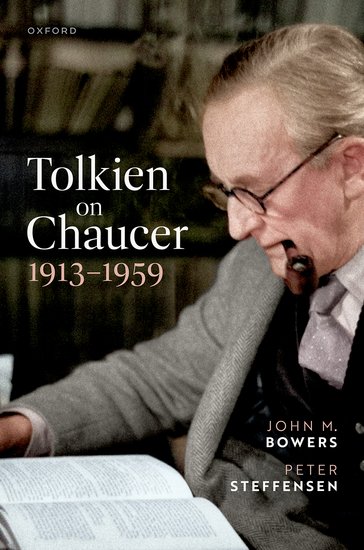
* Listings for the heavily delayed book Tolkien on Chaucer, 1913-1959 now show a pleasing cover.

“He lectured on Chaucer, edited Chaucer, and published essays on Chaucer. Tolkien on Chaucer, 1913-59 reprints many of these works for the first time, and documents Tolkien’s career-long engagement with the poet and traces [Chaucer’s] influence in Tolkien’s own works.”

* The Thoughts on Tolkien blog, exploring Tolkien’s use of a Latin phrase, sursum corda.

* The annual Aelfwine Essay Awards, for which the Spanish Tolkien Society invites entries. Essays can be up to 10,000 words and can be submitted in English, but must also have an accompanying Spanish translation. Deadline: 31st October 2024.

* Due 26th September 2024, and well-timed for the “back to university, got my grant-cheque” period, J.R.R. Tolkien: A Very Short Introduction. Part of the ‘Very Short Introductions’ pocket-book series from Oxford University Press. The author is a lecturer in Mediaeval Studies at the University of York.

* On YouTube, the Digital Tolkien Project has another monthly progress update, for June 2024.

* A YouTube recording of Holly Ordway on Tolkien’s Faith, speaking recently in a lecture at an American theological seminary.

* New on Project Muse, “The Character of Time in Sir Gawain and the Green Knight ($ paywall), which seems to me relevant to the development of Tolkien’s own thinking on time…

“Gawain elaborates its own vision of dynamic, social time in its descriptions of time and characters. Through its evasion of teleologies, the poem offers a critique of discourses of inevitability. Gawain complicates an already complex picture of medieval time-schemes”.

Talking of Gawain, I have acquired a crunchable copy of The Gawain Country (1984). I’ll hope to produce an expanded free edition soon, which will include the author’s later follow-on essays.

* A links-listing of Columbia University undergraduate prizes for 2024 dissertations. Note the list includes “The Enduring Impact of World War I in the Works and Lives of Dorothy L. Sayers, Agatha Christie, J.R.R. Tolkien, and C.S. Lewis, and on British Society between the World Wars”. Freely available online in PDF.

* Tolkien’s great nephew, Tim Tolkien… “will be sculpting a life-size statue of Cardinal John Henry Newman for Birmingham’s Cofton Park.” I’m fairly sure the article is a little misleading, in casually saying Newman was buried at the “Birmingham Oratory”. So far as I know his grave is still out at Rednal in the Lickey Hills, in the grounds of the Oratory’s Retreat House (which Tolkien knew well as a boy).

* And finally, a fantasy fan. No, really… Gustave Dore’s vision of butterfly-riding cherubs vs. dragon-riding demons, painted on a ladies’ flutter-fan. Now at the Fan Museum in London.

Tolkien Gleanings #211

Tolkien Gleanings #211.

* Fine Books Magazine reports “Tolkien’s Page Proofs in Folger’s New Special Exhibitions Gallery”. These are his hand-corrected proof-copies of The Lord of the Rings. On show until 5th January 2025, in Washington, DC, USA.

* The new Tolkien memorial in Oxford, in the artist’s local Stourbridge News newspaper (which covers the southern parts of the Black Country near Birmingham). With excellent pictures.

* Due in October 2024, a new book from the Catholic University of America Press titled Tolkien, Philosopher of War. Exploring Tolkien’s “philosophical and theological understanding of war”, the book appears to focus around the dangers of vanity in relation to militarism and war. Vanity is here seen as a key factor in the first emergence (Italian Futurism) of what would become the paramilitary political platforms of the inter-war years. Tolkien’s LoTR can thus be seen to… “dramatize[s] an aesthetic resistance to Futurism” and its “apocalyptic politics”.

* Talking of war, new on YouTube is a new 50-minute podcast aiming to present “The Real ‘War of the Rohirrim’, According to Tolkien”. This will be useful for many, as the mass marketing for the new animé movie starts to reveal a radically different and non-Tolkien plot. Skip to 18.15 minutes in the podcast/video to save yourself some time, and to arrive at the promised focus.

* Also new on YouTube, the podcast “Tolkien & Lewis & Wesley” in which… “Nick Polk of Tolkien [discusses] his involvement with Mallorn, the Tolkien Society journal”.

* In the second issue of the new journal Nexus, a short student essay on “J.R.R. Tolkien and Escapism”.

* Seemingly released under Creative Commons as part of Archive.org’s recent ingestion of newly Open Access books, Tom Shippey’s Beowulf and the North Before the Vikings….

“What follows is a challenge to a well-established consensus, which as I argue below was created in large part by Professor Tolkien. It is also in some respects a dialogue with Tolkien, and moreover points to a kind of dialogue between Tolkien young and Tolkien old — a dialogue which has hardly been noticed within the scholarly world.”

* And finally, a nerdy computerised comparison of the writings of Tolkien and Lewis. These are crunched…

mathematically by using an original multi–dimensional analysis of linguistic parameters, based on surface deep–language variables and linguistic channels. [This reveals] strong connections between The Lord of the Rings (Tolkien), The Chronicles of Narnia, The Space Trilogy (Lewis) and novels by [George] MacDonald.”