Tolkien Gleanings #436
* A new rolling issue of the open-access Journal of Tolkien Research is underway, Volume 24, Issue 2. This currently includes, among others, a lead article on “Tolkien, Modernism, and Mass Art”, a review of Arda Notebooks: The Best of I Quaderni di Arda (2026), and the conference paper “”Then Daddy began a story”: Storytelling in Tolkien’s home and our own”.
* From Finland, the new Masters dissertation, “Miehia, jotka rakastavat miehia: Miesten valinen emotionaalinen laheisyys Taru sormusten herrasta” (2026) (‘Men Who Love Men: Emotional Intimacy Between Men in The Lord of the Rings’). Freely available online.
* The new book Lunar Gothic: The Influence of the Moon on the Gothic Imagination (2025) has the 16-page survey chapter “Illuminating the Darkness: Lunar Representation in Children’s Literature”.
* The latest edition of the journal Literary Imagination has the article “Leavis, Lewis, Eliot, and the Prospect of Disciplinary Renewal” ($ paywall), which surveys the battle over Eng. Lit. between C.S. Lewis and the Leavis-ites. The free introduction appears to serve as a fairly good abstract for the paywalled article.
* More Tolkien letters are up for auction at Sotheby’s. Tolkien’s 1960s correspondence with Eileen Elgar, a resident of Tolkien’s favourite Miramar Hotel in Bournemouth. An August 1966 letter to her remarks that Tolkien was set to embark on a Mediterranean cruise that would travel as far east as Smyrna.

Turkish Smyrna in 1966 held little of the old Greek magic and Ionian free-thought, since in 1922 the invading Turks had totally burned the Greek and Armenian quarters of the city along with most of their inhabitants. Tolkien’s fellow passengers likely went directly from the modern Turkish port-city, on the day-trip to ancient Ephesus which was an hour to the south. That would have been the attraction, not the city. By 1966 the Austrian excavations there were substantial and allowed tourists to walk down the grand marble Arcadian Way and sit in the vast ancient drama theatre which once held 25,000 spectators. But it was the Christian associations that would have been the draw for many.
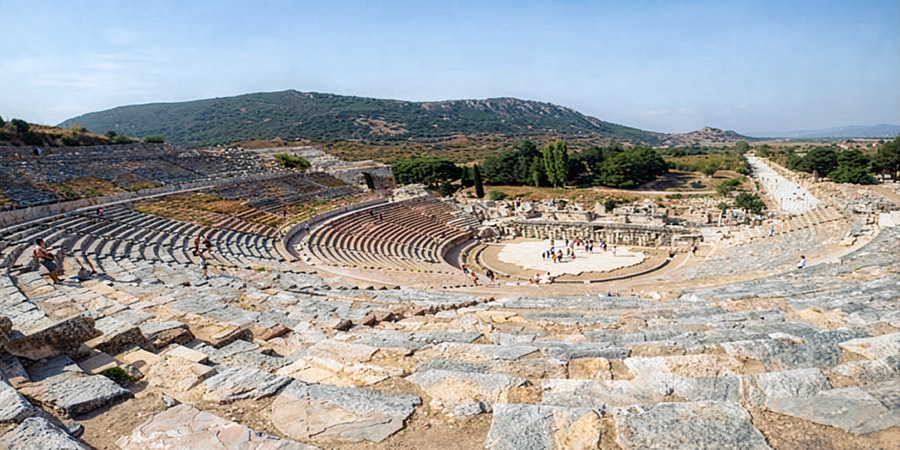
This theatre was later a gladiator arena, and at that time also a key site for the apostle Paul and his followers. Ancient Ephesus also has a Marian association, in that Mary would appear to have lived there after the resurrection of Jesus (John 19:26–27: “the disciple [John] took her [Mary, mother of Jesus] to his own home”). Possibly the tourists would also have visited a reputed ‘House of Mary’, conveniently located in the hills just a little south of ancient Ephesus, a house which had been ‘discovered’ via a 19th century nun’s religious visions.
Did Tolkien see the place? Perhaps. Edith was with him on the cruise, but had fallen and badly injured herself on the first day of the cruise. They thus did “little sightseeing” in Tolkien’s own words. She was however well enough to be carried ashore at the port, but if Tolkien then left her to take the coach to visit ancient Ephesus and the reputed ‘home of Mary’ must remain a mystery. It would be a pity if he hadn’t done so before returning home, after sailing so many thousands of miles.
Mallorn 22 also notes in passing… “Parallels between the ‘Seven Sleepers’ of Ephesus and the Seven Fathers of the Dwarves”. The legend, said to have been very popular during the mediaeval period, is also somewhat similar to that of the ‘sleeping King Arthur and his knights’ belief in Britain. The legend in brief…
The Roman Emperor Decius was engaged in vicious personal persecution of Christians, visiting his provinces in person to see that it was done. At Ephesus he had seven pious lads brought before him, but they courageously and eloquently testified for Christ before the Emperor. Due to their courage they were given some time to repent, which they rather sensibly used to flee together to a wilderness cave. Soldiers eventually found the cave, but miraculously saw no-one there and then took away the supplies and tightly sealed the cave entrance with rocks. Two hundred and eight years later the sleeping lads awoke in the cave, thinking they had only slept the night. The rock wall was now easy to push away, and they went back to the city to find food. There the lads — having aged not a day — were amazed to find crosses above the gates and that the people had become Christians.
* And finally, Tolkien Oddments has “More on Madlener”. You’ll recall that Josef Madlener’s painting “Der Berggiest” was once said to be the inspiration for the appearance of Gandalf. In the new article, the complete postcard set is considered. My own thoughts on Madlener’s shepherd appeared in August 2025 in Gleanings #329, concluding that the outfit was the traditional one for shepherds from the high parts of Provencal (SE France, neighbouring the Swiss Alps). The traditional outfit worn by the Swiss shepherds, which Tolkien might have noticed in the Swiss Alps in 1911, was very different. Thus he would not have seen a real-life ‘Madlener outfit’ on his Swiss walking trip.