My recent linking to an article on J.R.R. Tolkien in Bournemouth made me wonder exactly how “rich” he was in his time there. I spent a little time looking into the matter.

At Branksome Chine, on the beach, near Bournemouth. Tolkien’s new bungalow was a short walk back up that wooded gorge.
“Don’t speak to me about ‘Income Tax’ or I shall boil over. They had all my literary earnings until I retired [in 1959, his teaching salary then approx. £2,500 per year. Even now…] I am being mulcted next January of such a sum as will cripple my desire to distribute some real largesse to each of you [i.e. to his sons and daughter]” — Tolkien writing to his son Michael Tolkien, November 1963.
The word “mulcted” = appears to be a mediaeval legal term for an onerous legal fine that one has to pay.
Thus according to the senior Tolkien’s own words, all of his books income was taken directly by the taxman from 1956 to 1960 (the tax-year after he retired in 1959). Thankfully due to retirement in 1959 he had fallen out of the ‘Surtax’ (a kind of supertax) bracket by 1961…
5th May 1961: Tolkien writes to [his publisher] Rayner Unwin. He thanks him for the cheque and explains that his difficulty was caused by… “Income Tax delayed from a time when The Lord of the Rings, plus a salary, put me in the Surtax class — out of which I have now fallen’ (Chronology)
Yet even by 1963, his level of taxation was obviously such that he could still not afford to “distribute some real largesse” to his own children. Since in October 1965 he again wrote to Michael…
“I am not ‘rolling in gold’, but by continuing to work I am (so far) continuing to have an income about the same as a professor-in-cathedra, which leaves me with a margin above my needs nowadays. If I had not had singular good fortune with my ‘unprofessional’ work, I should now be eking out a penurious existence on a perishable annuity of not ‘half-pay’ but more like one quarter pay. Literary capital is not, however, by its originator realizable. If an author sells any of his rights the proceeds (unlike those of other property) are reckoned to be part of his income for the year, and I. Tax and Surtax pocket all or nearly all of them. So I certainly cannot provide the thousands now asked for a flat or bungalow near the sea.” — Tolkien writing to his son Michael Tolkien, October 1965.
Why was this? Because very punitive taxation was then in force in the UK for higher earners. I won’t bore with the fine details, but this simple chart gives the levels and years…
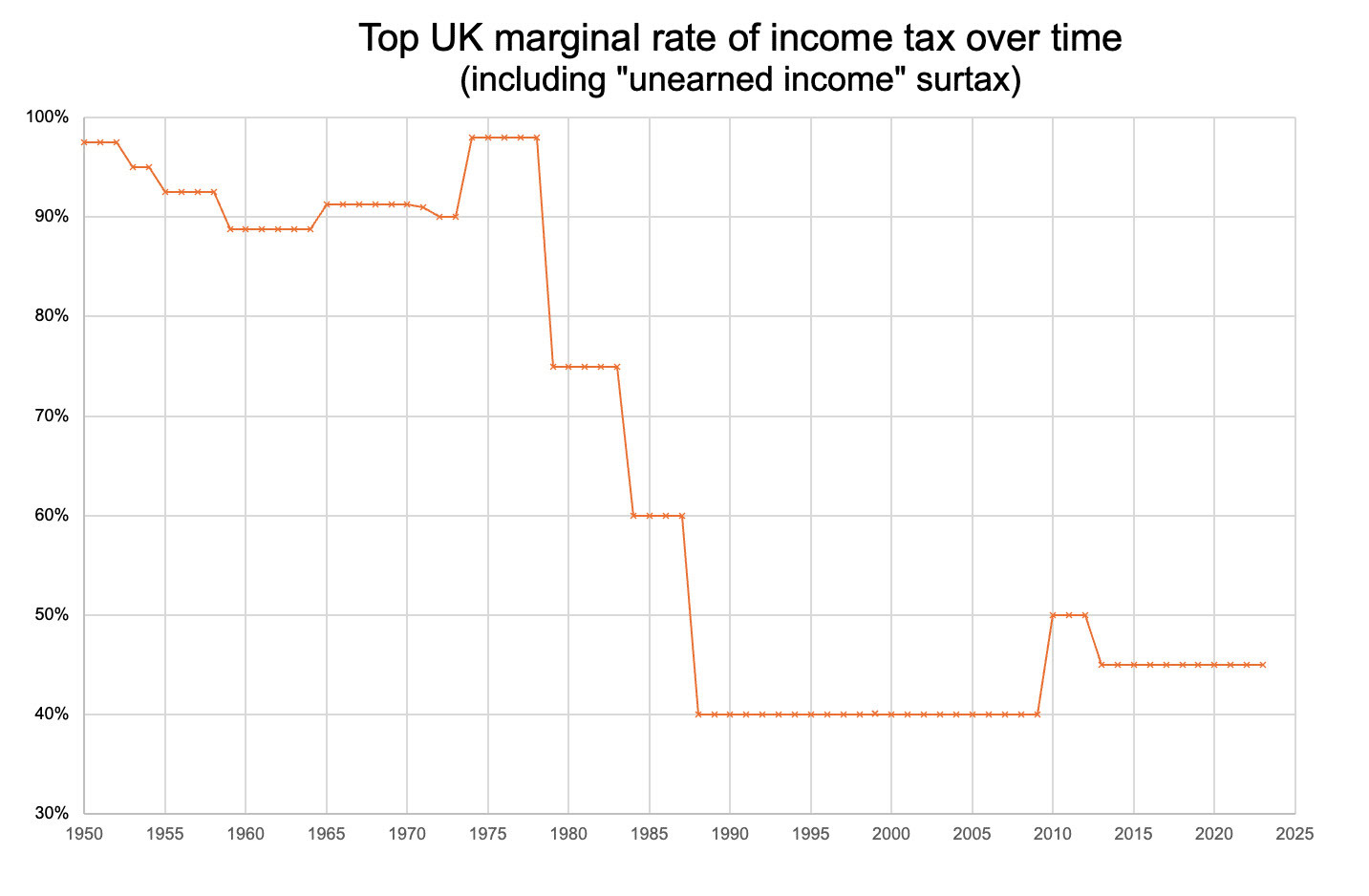
By December 1966 he was employing what sounds like multiple specialist “agents” to deal with the pressures…
“my income tax agents are busy reviewing and arranging all my property with a view to immediate tax and also to will-making” (letter quoted by the Chronology).
Later he did sell his worldwide stage and movie rights, a sale which dragged out but was eventually concluded in 1969. The movie rights were apparently sold for “£100,000 to help settle a tax bill”. £100k would be roughly £2.5m today, but a large chunk of it went to the taxman, and the rest was sunk into a house purchase in 1968. Which suggests some of the money was advanced before the deal concluded. Yet he writes that even £100k still left him in debt to the taxman for the years 1969 and 1970…
“I myself am feeling a severe pinch. I have to find money for a colossal bill of I.[ncome] Tax and Surtax on my swollen income before the Trust became operative [… ] I blew a large part of my surplus on this house [in Bournemouth], and more than all that remains is now demanded [by the taxman] in 69 and 70. (Many thousands of pounds.)” — Tolkien writing to his son Michael Tolkien, December 1968.
The bungalow, a few miles to the west of Bournemouth and technically in Poole, is said to have been “luxury” by the standards of the time. A fitted kitchen with all mod-cons, and central heating, which in 1968 were ‘new-fangled luxury things’ for even middle-class people in England. Being very near the sea also made the place more expensive to buy, and judging by a quick look at the house prices of the time I guess it might have been purchased for around £10,000? He appears to have been well-off in his Bournemouth retirement, once he had got over the ‘hump’ of 1968, and as (presumably) more money from the books came in to more-than cover the 1969-70 tax bill. But he doesn’t appear to have had millions of pounds in the bank, as some have supposed. At Bournemouth he was able to afford extended hotel stays and meals, taxis into town, and apparently he treated himself to first-class train travel. He would thus have been “rich” to most people, but only by the limited pre-1980s standards of the time. More importantly, he and his wife had a few years in which to enjoy their well-deserved affluence at Bournemouth. He was not however flush with 1970s footballer-style millions in the bank or ‘rolling in gold’ like Smaug in The Hobbit. He left a net estate of £144,159 on his death.
In an unpublished Letter to his brother, https://www.tolkienguide.com/guide/letters/716, Tolkien mentioned that he was only using earnings from The Hobbit as income, and I think earnings from The Lord of the Rings went into the Trust that he set up for his family.