“Bodleian Library Publishing (BLP) will release the largest collection of material by J. R. R. Tolkien in a single volume [an illustrated hardback] as a companion to an upcoming exhibition. Tolkien: Maker of Middle Earth launches on 1st June 2018, to coincide with an exhibition of the same name at the Oxford University library.”
Dead by age 50?
Today I heard a passing claim that in the 1950s… “Workers in the Potteries couldn’t expect to live far beyond 50”.
Given the source I suspect this claim must arise from a footnote on page 48 of the oral history book Missuses and Mouldrunners (1988), which had a footnote that “Life expectancy for anyone who survived his or her fifth birthday was an average of forty-six years”. This assertion referenced the local historian J. H. Y. Briggs in his A History of Longton (1982), though the author curiously fails to give a page number for this reference. Nor are dates or a location given, other than that implied by the Longton title of the book.
However, the author of the footnote was obviously talking of the pre-1914 period. Since the Briggs reference is followed by the statement that, across the UK, the 1901-1912 average was “51.5 for men and 55.4 for women” (referencing Gittins, 1982, p. 210). In that case, taking into account the amount of deep coal miners working in North Staffordshire, it looks to me like a pre-1914 Stoke worker who was not a coal miner or in a similarly hazardous occupation might have been likely to be fairly average in terms of their overall UK life expectancy. The national average was then low, admittedly, but improving along with healthcare, nutrition, sunshine exposure, and industrial safety measures.
Further, the full title of Briggs’s 113-page book, issued by the Dept. of Education at Keele, was A History of Longton. Part 1: The Birth of a Community. So it seems likely he was only addressing the early period of Longton, then ‘the worst’ bit of the Potteries. There never seems to have been a “Part 2” book. I’ve been unable to see the book, to see if Briggs used a valid reference for his claim. [Update: now seen at April 2022, see appended section below].
Still, I’ve had a very good look for a source that he might have used, searching among all the major public online resources. Archive.org is a mess to search, these days, but there seems to be a curious lack of data and tables from 1920s-1980s. I also looked on Hathi, Google Books, Scholar etc. From what little I can find, mostly post-1970s, the Potteries district appears to have followed along with the general UK upward rise in good health, usually lagging behind by a decade or so. Presumably, as other areas raced ahead in health, our averages were then dragged down for the obvious reasons in the 1990s and 2000s — such as 1990s deaths among pensioners who had been miners in the 1970s, the inner-city heroin epidemic of 1985-2005, and often poor elderly healthcare (the Stafford hospital scandal and the post-1998 pressure on the NHS etc).
I’m also made suspicious of the claim because academics dealing with demographic matters usually make gender-specific claims such as… “For babies born in 1901, life expectancy was then estimated to be 45 for boys and 49 for girls.” (from Life in Britain: Using Millennial Census Data, 2005). Thus a broad-brush claim that for the Potteries… “Life expectancy for anyone who survived his or her fifth birthday was an average of forty-six years” fails to make the expected gender distinction. The lack of a date-range or page number for the Briggs reference in Missuses and Mouldrunners also adds to the impression of imprecision.
One then has to wonder if Briggs was referring to some specific Longton data (and presumably from the pre-1914 period since that was the topic of his book), and if the imprecision of the reference to Briggs in Missuses and Mouldrunners then allowed his claim to be grabbed and implied to cover the whole of the Potteries?
Sadly there seems to be no chart of actual life expectancy of workers here, from say 1901-1981 (i.e.: prior to the heroin epidemic, and mass retirement of miners). Still less a simple and reliable one. Certainly there appears to be no solid public data on life expectancy in the Potteries at the end of the 1950s, and indeed one might expect that the death-rate in the Second World War would have anyway made the meaningful assembly of such figures impossible.
A claim of “Workers in the Potteries couldn’t expect to live far beyond 50” is anyway highly misleading. Even if the Potteries of the 1950s had actually been stuck at 1900s levels for about 50 years (which is doubtful, given the huge medical and other advances), then age 50 would still have been the average. Some would have lived far longer, a few far less. The phrasing of “Workers in the Potteries couldn’t expect to live far beyond 50” wrongly suggests that nearly everyone dropped dead within a couple of years of their 50th birthday. It seems to be politically convenient modern shorthand for point-scoring, not reliable population science or history.
Further reading: I’ve previously looked at the 1990s life expectancy figures here, and at Marx’s oft-repeated but very shaky 1860s claims here. I’ve also taken a close look at “Air pollution in the Potteries”, including a big study that appears to show that of a “cohort of 7,020 male pottery workers born in 1916-1945” only “47 deaths could be even tentatively tied only to silica dust exposure.” I’ve also looked at claims of past cobalt poisoning among the Potteries workforce.
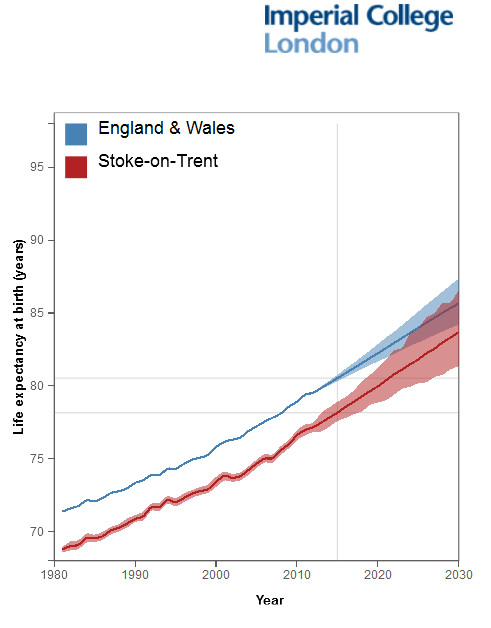
Here are the 1980-onward life expectancy figures for Stoke-on-Trent, with future projections…
An update in April 2022:
I’ve now been able to see the Briggs book A History of Longton (1985) which is newly on Archive.org in spring 2022. I can thus can check the reference given in the book Missuses and Mouldrunners (1988). This reference is given no page number or date range in Missuses, but is found on page 73 of A History of Longton and the date range is actually 1900…
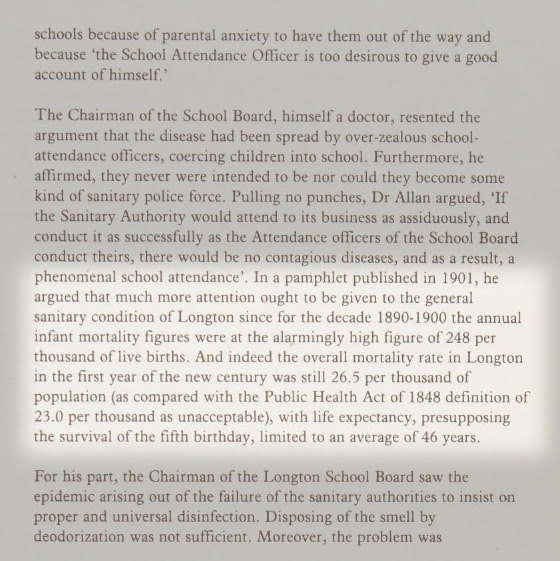
This is the only occurrence of “life expectancy” in the book. It occurs in reference to over-zealous 1890s truancy inspectors rousting sick and dirty kids out of their homes and into schools, where they were claimed by a local doctor to spread disease. The “48 years” figure given clearly relates to the year 1900 in Longton (as “the first year of the new century”). Though the source for his 1900 data point is not cited. Missuses and Mouldrunners‘s citation of this as “Life expectancy for anyone who survived his or her fifth birthday was an average of forty-six years” is therefore slightly misleading. The lack of precision makes it appear to the reader that life-expectancy figures from the worst bit of Stoke-on-Trent at the end of the 1890s can ‘stand in’ for the whole of the city. They can’t, and this imprecision is presumably what has led to the small local myth I encountered… it allowed a reader to assume that these figures were for the whole city, and then further to elide this into a claim that the city’s overall life expectancy had somehow remained at 1890-1900 ‘Longton levels’ into the 1950s.
Two Universities Way walk booklet
For some reason my free Two Universities Way walk booklet / PDF is no longer find-able via Google Search. So I’m re-hosting it here, to see if there’ll be any change. The mostly off-road route takes one from Staffordshire University at Stoke-on-Trent, out to Keele University.
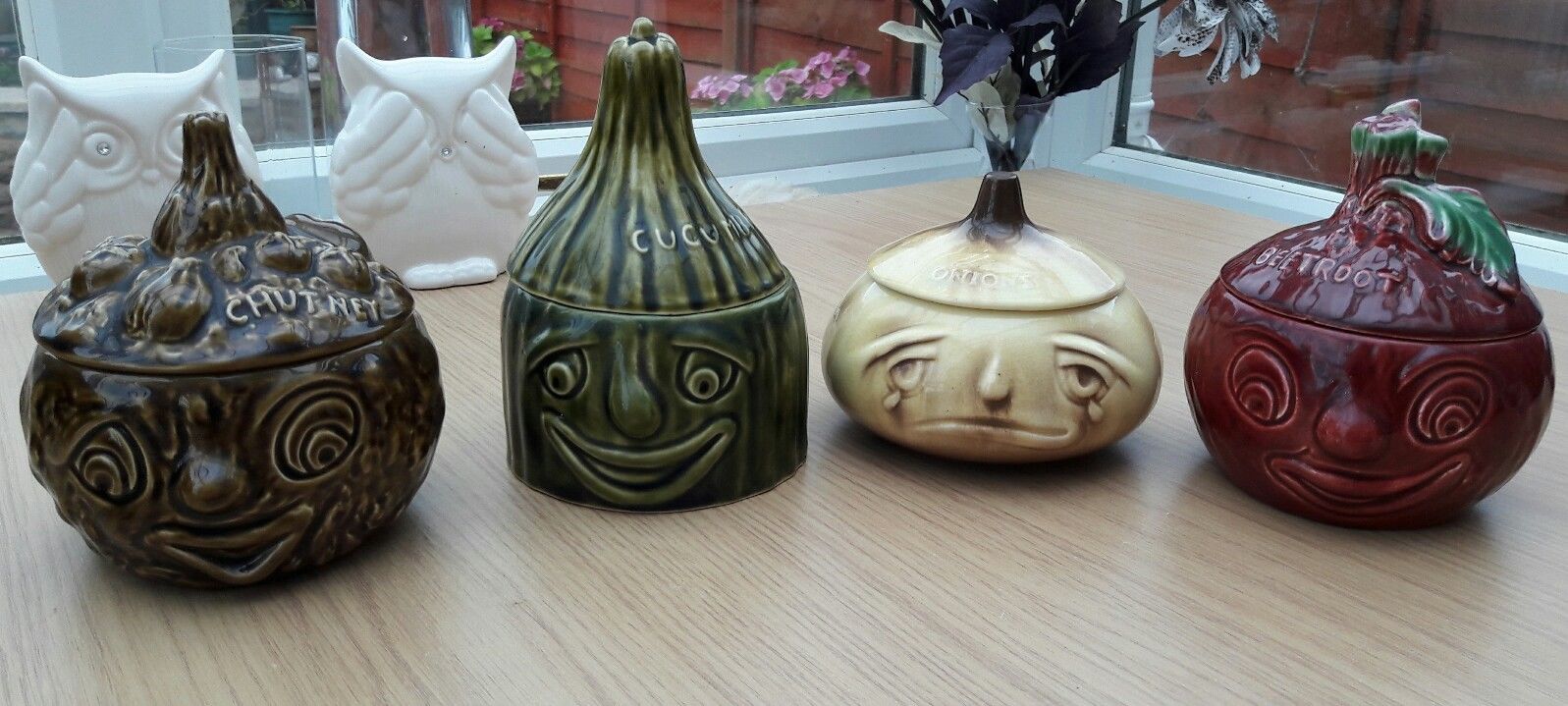
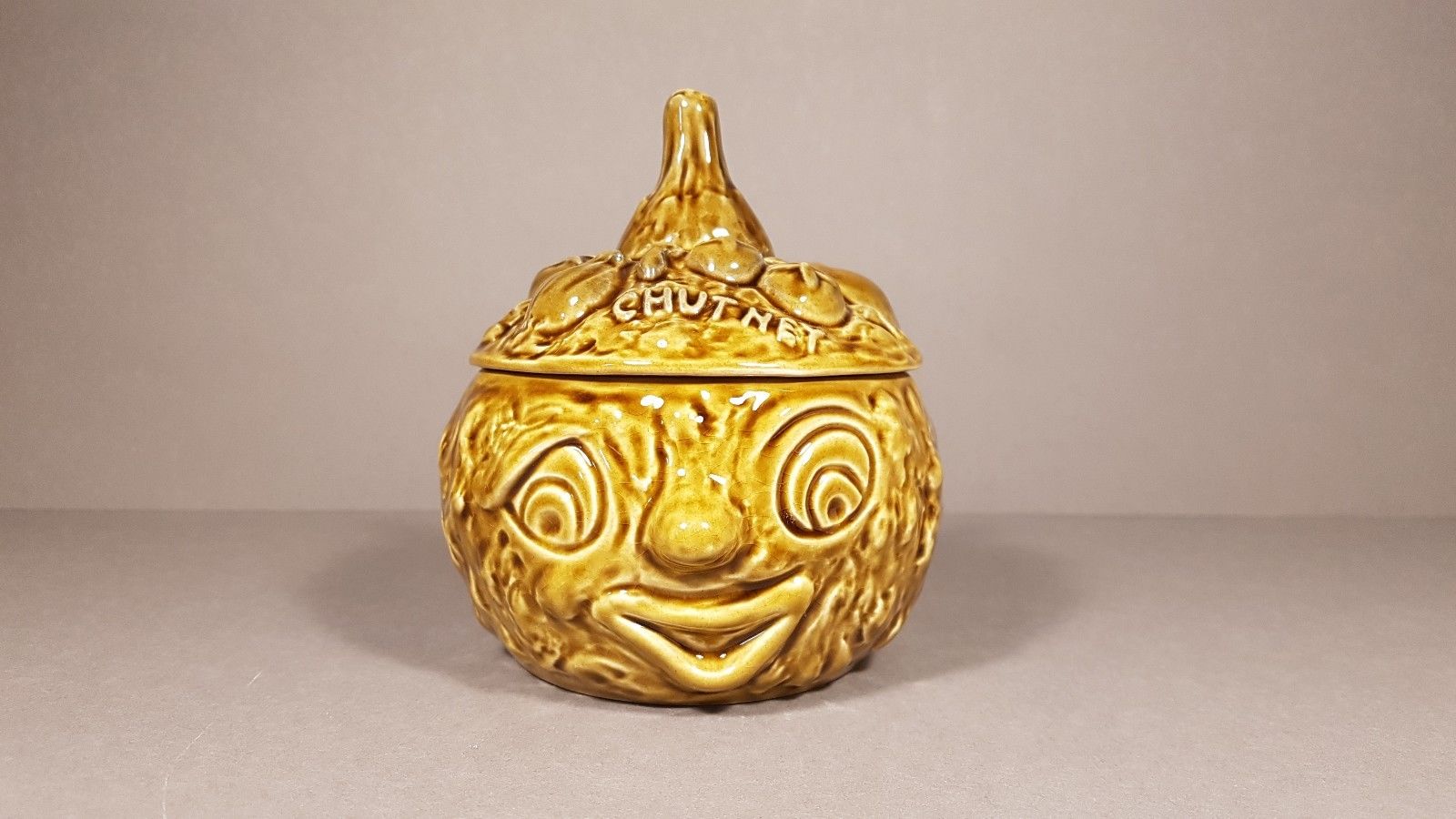
Trent Walk jars
From the Trent Walk pottery in Stoke, apparently from the 1960s.



Ordeal by Music
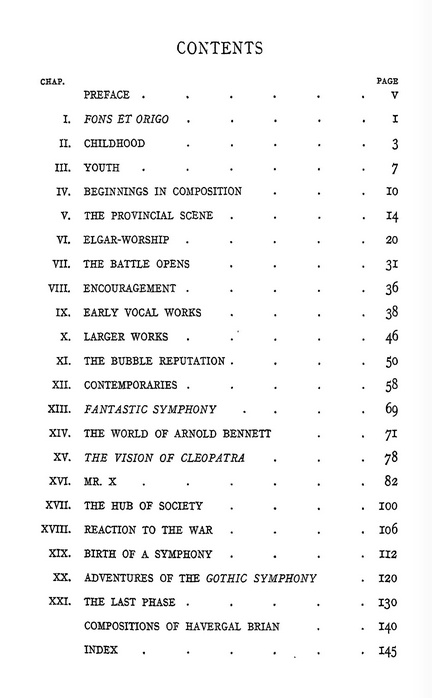
Now free on Archive.org, a 1947 biography of Stoke-on-Trent composer Havergal Brian, Ordeal by Music, from the Oxford University Press.
The Contenders
John Wain’s novel of the post-war ambition and careers of two men, The Contenders (1958) was made into a 1969 ITV drama “set in the Potteries”. 4 x 60-minute episodes according to IMDB. It seems likely that the tapes have not survived, but I wonder if the scripts are still around?
Walker Scott
A name new to me, Walker Scott, oil painter the North West and North Staffordshire.
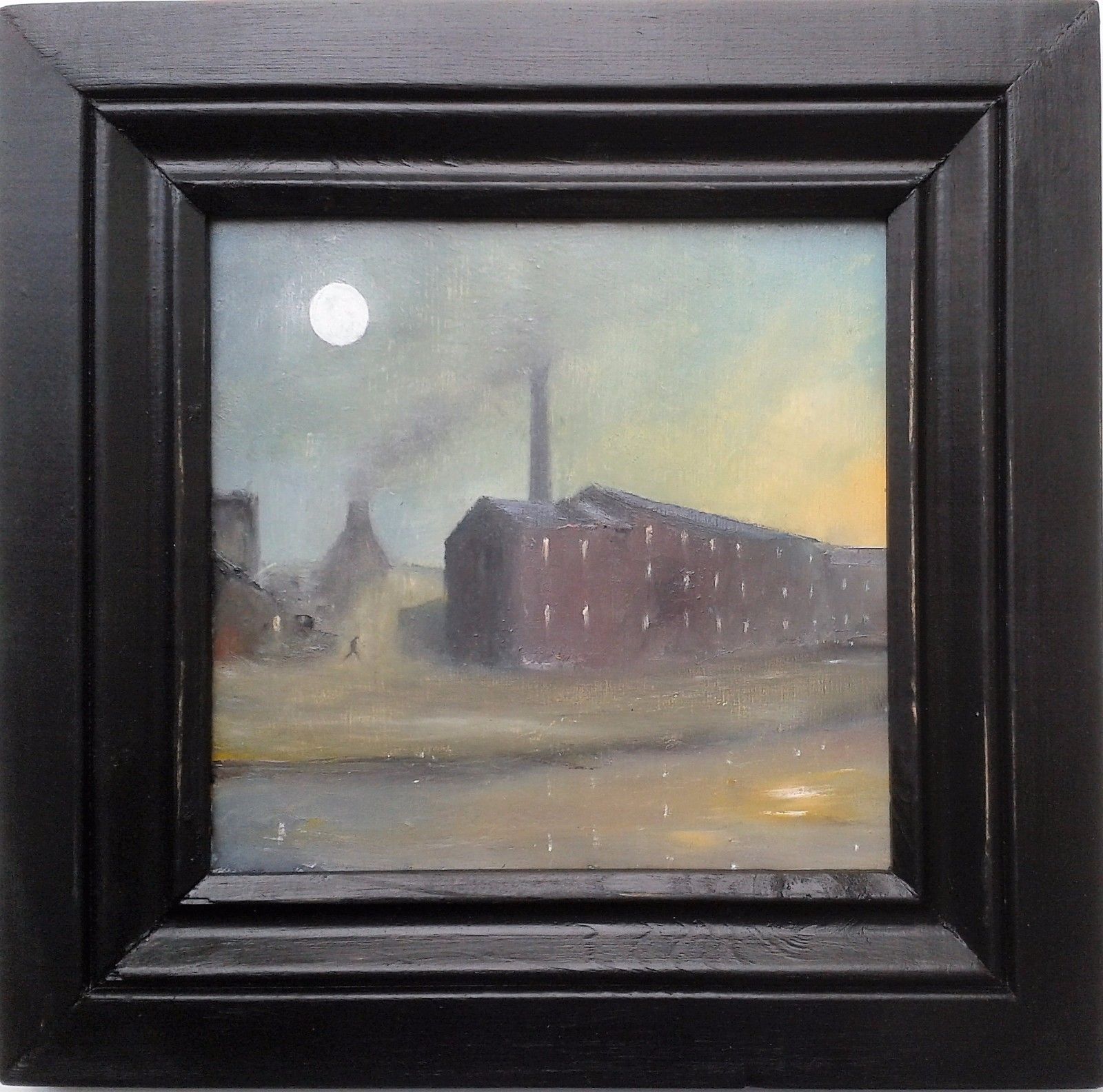
Middleport Pottery, Stoke-on-Trent.
Charles Dickens in Staffordshire
Charles Dickens visits the Potteries in the early 1850s…
PUTTING up for the night in one of the chiefest towns of Staffordshire, I find it to be by no means a lively town.
I have paced the streets and stared at the houses, and am come back to the blank bow window of the Dodo [Inn]; and the town clocks strike seven. I have my dinner and the waiter clears the table, leaves me by the fire with my pint decanter, and a little thin funnel-shaped wine-glass and a plate of pale biscuits – in themselves engendering desperation.
No book, no newspaper! What am I to do?
The Dodo Inn was actually a lightly disguised name for the Swan in Green inn, Gate St., Stafford. Apparently he merely visited a small bit of the Potteries for part of a day, taking the train from Stafford then a tour of a pot works in Stoke, though he managed to get a long article out of it. The tradition obviously started early, of a London journalist spending a few hours here and becoming an ‘instant expert’ on the district.
Portraits of Erasmus Darwin
The three best portraits of Erasmus Darwin, that aren’t cloistered away in some obscure museum. Large size, two of them newly colourised.
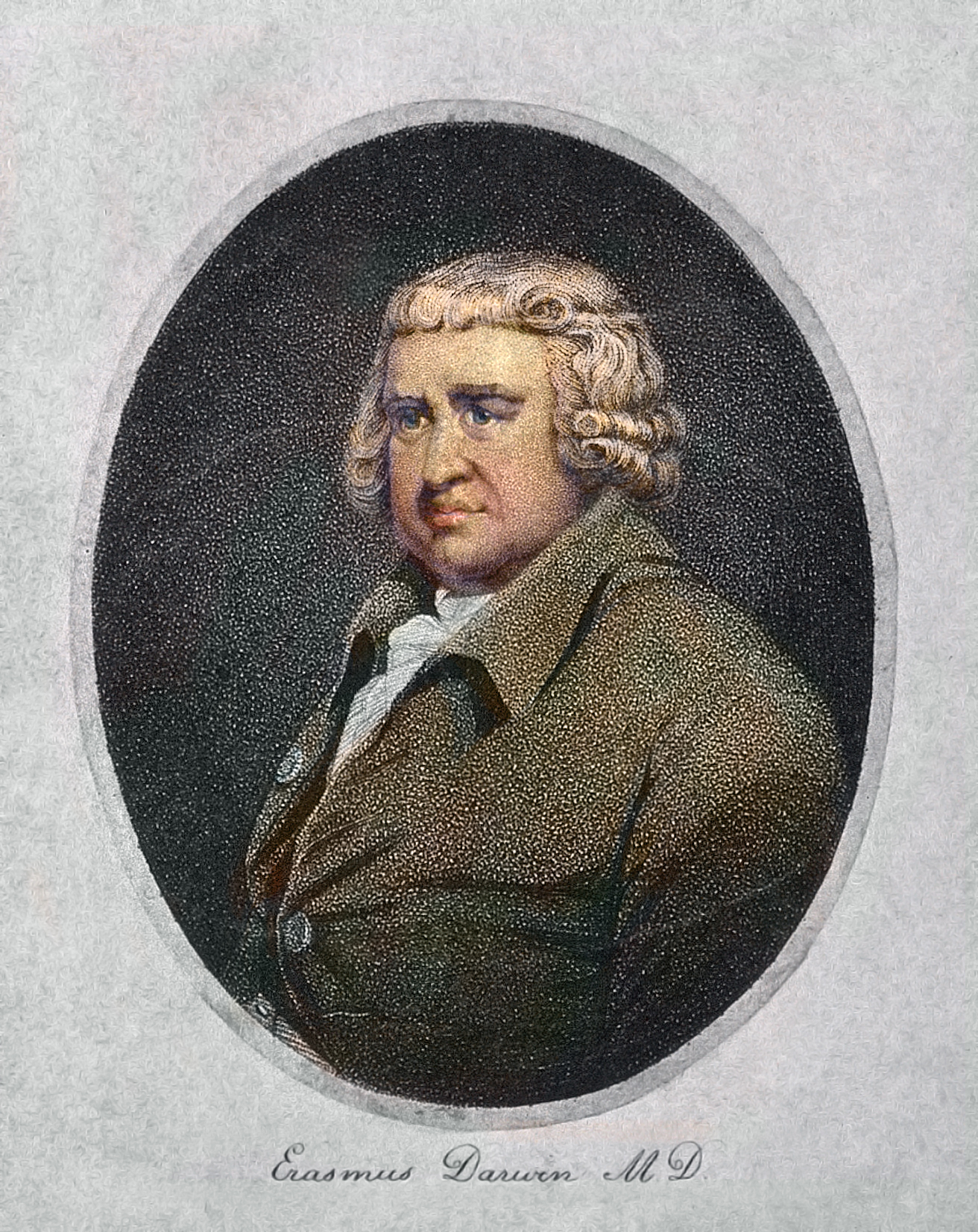
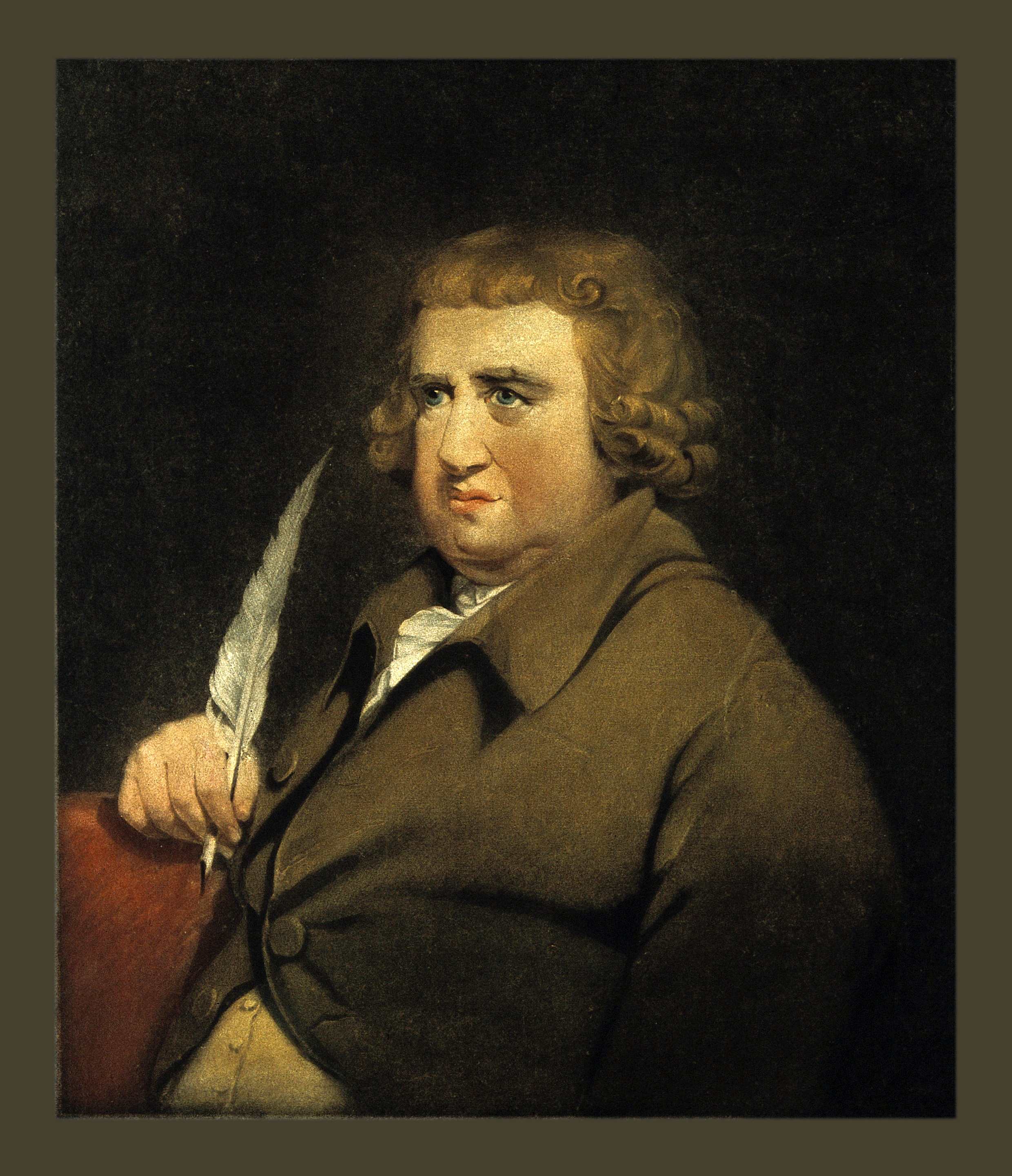
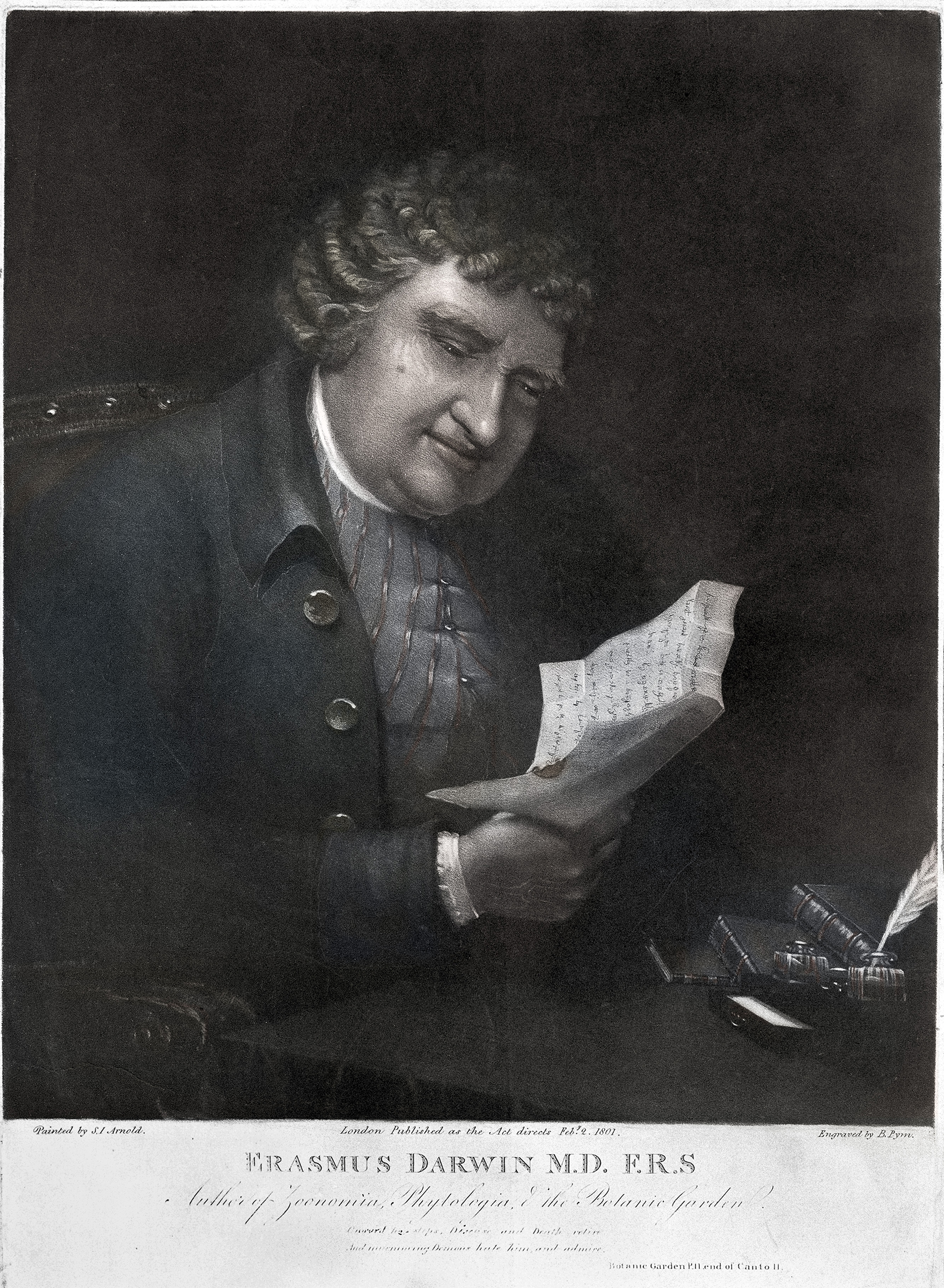
The last not ideally colorised, but perhaps “reading by moonlight”.
With thanks to the Wellcome Library.
Found: three more novels set in Stoke
I’ve found another three novels set on Stoke-on-Trent.
1) Annie Keary’s children’s novel Sidney Grey: A Tale of School Life (1857), written while raising her children in Trent Vale. Her fiction was well regarded, and the survey book Masterworks of Children’s Literature states the novel was written for her own children and… “dealt with their [north] Staffordshire region and its brick kilns”. The novel was also a “picture of grammar-school life” in the 1850s, with a disabled boy hero. I’m guessing that the school would then have been in Newcastle-under-Lyme, and that the novel drew its impetus from the tensions between school life and life in the brickyards. The Cambridge Guide to Literature in English calls it a “notable children’s book”. For some reason there’s no free copy on either Archive.org, Hathi or Gutenberg.
Update: there was also a later sequel, now online.
2) Cedric Beardmore‘s Dodd the Potter (1931) has an embossed board cover that “depicts an industrial building with chimneys” according to an unillustrated record page for the V&A collection. The novel is apparently a frank Potteries coming-of-age story with what were — in those days — some titillating aspects. A syndicated review in an Australian newspaper remarked…
“Dodd is an employee at a pottery. So are some of the other people — most of them in fact — and their life story, if it is correctly shown by the author is suggestive of curious social relationships in the well known ‘five towns’.”

Beardmore was a Stoke lad, so it was evidently drawn from life, or perhaps life as he would have liked it to be. Arnold Bennett was the author’s uncle, though the novel was written without Bennett’s help. After the war Beardmore went south and into children’s comics. He wrote at least one Dan Dare story for the famous Eagle comic of the 1950s, but his mainstay was writing Belle of the Ballet for Girl comic (the girls’ equivalent of Eagle).
3) Under the pseudonym ‘Cedric Stokes’ Cedric Beardmore also published a historical novel titled The Staffordshire Assassins (1944), set around Bucknall in the 19th century. The Sydney Morning Herald review stated…
“This strange story of an ancient family and a band of renegade monks depends for its interest upon a macabre atmosphere and psychological abnormalities.”
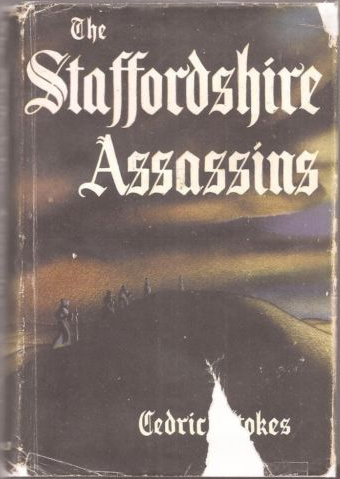
He wrote many other popular novels, and it’s possible that some of those also draw on his life in Stoke-on-Trent.
The Microcosm
“IN the autumn of the year 1765 the ladies and gentlemen of Chester and the country round about were in a state of great excitement over the Microcosm, a mechanical exhibition of moving pictures. The movements of the figures, both men and animals, were considered highly ingenious, and the various motions of the heavenly bodies were represented with so much neatness and precision that the gay life of the city was almost suspended, while the exhibition was crowded day after day by the nobility and gentry, who could talk of nothing else for weeks.” (from Doctor Darwin, 1930, by Hesketh Pearson)
Clocks in the British Museum (1968) states… “‘the microcosm’ was made by Henry Bridges” and suggests it was “probably finished shortly before 1734.” By the time it reached Chester the Microcosm had then been on the road for some years, visiting Lichfield among other places. The poet Pope wrote a poem its praise in 1756. It was made by… “the eldest son of Henry Bridges of Waltham Cross, architect and builder of the amazing Microcosm Clock.” Very little more can be found about it, if a quick search of Google Books and Google Scholar is anything to go by.
Sir Gawain as an audiobook: the options
I see that the 2006 BBC Radio adaptation of Sir Gawain and the Green Knight is now free on Archive.org. At the climax of the story Gawain crosses from Cheshire, somewhere around Congleton, rides past Leek and then takes a road up into the Staffordshire Peak District, so in part Gawain is a local tale and the poet was a man of the northern part of the West Midlands. Be warned that the BBC’s reading was from the Simon Armitage ‘modern vernacular’ version, and was radically abridged down to just 42 minutes. Still, it’s probably a good introduction for older children who might not listen to anything longer and who would be confused by thee‘s and thou‘s and other archaic language.
In comparison other free readings run far longer, usually around 2.5 hours. Such as the best Archive.org/Librivox version which is Tony Addison’s steady reading of the early translation by Jessie Laidlay Weston. Hers was a spritely early translation published at the turn of the 20th century, and was only very occasional sprinkled with thou and ye, quoth and bade.
Tolkien’s translation, probably the best available in terms of a listening experience despite also having many thee‘s and thou‘s, is available as a 2006 HarperCollins audiobook. It’s professionally read by Terry Jones in around 2.2 hours, not including Tolkien’s 15 minute scholarly introduction. Jones sounds a little fast and sibilant/breathy. For me his reading works best when played in the free Impulse Media Player, which on a desktop PC allows real-time pitch shifting and other tweaks. Slow him down by -10, and use the following graphic equaliser settings, and see if he improves for you…
