Great British Spring Clean 2025 – dates

Coming soon, the Great British Spring Clean, 21st March to 6th April (although note that the weather / wind is fine for it now, and may not be then).

Best place to get the best ‘Helping Hand’ litter picking-stick in Stoke, in person, is the AbleWorld superstore on the edge of Hanley. Sadly the sticks can’t be sent to Amazon lockers because they’re too long, though you can sometimes ‘Click and Collect’ via eBay. Stoke Council may be able to supply residents with sticks and also branded bags, or at least I’ve heard they have in the past. Not sure now, what with the bankruptcy/cuts and a likely high springtime demand.

Anglo-Saxon Southern Derbyshire & North East Staffordshire

An interesting curiosity, Hand Drawn Map of Anglo-Saxon Southern Derbyshire & North East Staffordshire, drawn from the data in the Domesday Book. Prints are currently being sold by the map-maker on eBay (no website or blog, but it appears he might be contacted via Reddit or eBay messaging). Regrettably it only starts at Stapenhill and is way too far over toward Derby for my interests, but some readers may be interested.

£50k Lemmy statue for Burslem

A statue of the singer Lemmy, of the band Motörhead, is to be erected in Burslem in May 2025. The statue is by Andy Edwards, who I recall has done a lot of Stoke-on-Trent’s new statues in the past 20 years. He’s sculpting it in local clay, and it will be on a tall sandstone plinth. On the east side of the old Town Hall, just over the road from the Queens Theatre with its back to the main road, apparently. £11k has so far been raised by crowd-funding of the £50k cost.

William Dean, bookseller and printer of Stoke circa 1840s-1860s

New on eBay, a trade token (‘unofficial farthing’) revealing the name of a Stoke bookseller and printer.

Apparently in the book Unofficial Farthings, 1820-1870, so that gives the broad date-range. In the 1840s he was a printer in the High Street, Stoke-upon-Trent and published engraved Views in the Potteries. A “William Dean” was owner of the Staffordshire Potteries Telegraph newspaper, which produced 125 issues from 1852 to 1855, which seems likely. The Engineer (June 1865) later reported that a “WILLIAM DEAN, Stafford Street, Longton” in Stoke-on-Trent had been given leave to proceed with a patent application for a method of printing from wood-blocks.

Trent and Mersey canal to get the chop…

Good news for the Trent and Mersey canal in Stoke-on-Trent. The three-miles of canal towpath which run south from the city’s train station is to get a hack-and-chop of the vegetation and some bump-flattening…

“The work will include cutting back overgrown hedges and trees in order open up and improve visibility of the towpaths. [plus] repairs to the towpath where tree roots have cracked or lifted the cobbles [with the work to be] completed by the end of June”.

It seems to be funded by the last dribble of the Levelling Up funds, though no costing for this particular bit of work is given. No mention of renewing seating, though I recall from about 18 months ago that several seats along the way are badly in need of repairs. Though the semi-circle of steel benches on the towpath opposite the Civic Centre should probably be left in their destroyed state, or they’ll once again become a junkie gathering place. That’s the sort of “vibrant space” that the city doesn’t need.

Still, at least the funding is to be spent on practical things and not on more political wall-murals or vanity signage. Hopefully there will also be a bumper litter-pick this spring, on the stretch.

Update: the local Stoke Nub News adds a very important detail, which the BBC missed… “new top dressing will be applied to the whole length” of this three mile stretch. Sounds good, though possibly rather disruptive for bicycle commuters this springtime. Ah yes, here we go, I just found the official notice for Towpath stoppage from Lock 38 at Cliffe Vale to Bridge 106, the Hem Heath Bridge, mainly “for installation of new tar spray and chip surfacing”. No further details on closed sections or precise section-dates. The stoppage notice reveals (apparently) that the resurfacing works will also go north way past the train station, up to Lock 38 (presumably for the cyclist connection-point there across to Newcastle-under-Lyme). That bit’s not reported by either the BBC or Nub News. In fact, if one looks at the stoppage map, the resurfacing may even go on as far north as Festival Park.

The main southern stretch to be tackled runs from the train station down to the Stoke City F.C. football stadium and then the workers will down tools at Hem Heath. After which the canal towpath gets remarkably dull, if memory serves me. If walking south from Hem Heath, from there it’s better to cut across country through the Hem Heath woods and around the back of Wedgwood (note there’s a cafe at the Visitor Centre, or was last time I looked) to reach Barlaston. From there over the Downs Banks (National Trust), through some lanes, and then across the Common Plot and down into the town of Stone (to get the train back to Stoke). Not as flat as the canal-towpath, and definitely not something for cyclists to try, but far more varied and interesting.

How to fix a litter-picking stick to a bicycle

As the ice melts here in the UK, and we enter the first wombling-about of the litter-picking season, here’s a handy tip for cyclists who want to pick small amounts of litter while still seated. A standard litter-picking stick can be fitted to a bicycle with a £5 roll of the 12mm self-adhesive magnetic tape made by 3M. This can be easily had from eBay.

Aluminium bike frame and aluminium picker-stick? Neither are magnetic, but that’s no problem once you have the tape. Assuming you have a bike with a cross-bar, not a step-through, that is. Once there’s a 15 inch strip of the tape stuck to the side of the crossbar of the bike frame and also along the picker, and they’re able to firmly touch all the way, then they will firmly lock magnetically with a ‘snap’. The strength is sufficient for a standard 32″ Helping Hand stick not to fall off as you go over bumps. Yet the picker can also be easily separated by a simple ‘reach-down and upward pull’ while the rider is seated on the bike. And then easily re-clipped once the litter is bagged. The bag is hanging on one of the handlebars, or some people may have a pannier-basket.

Be sure to let the bike turn without the movement of the front brake-cables pulling the stick off the magnetic grip. Try sliding the stick’s handle / trigger-pull round the seat-post, and having the pincers sticking out just beyond the handle-bar post (but not far enough to entangle the brake-cables).

On days when the stick is not needed, the grey-black magnetic strip on the bike is not too conspicuous. Since it follows the lines of the bike and is only on one side. The alternative solution, for those just going long-distance to a litter-picking spot and then getting off the bike, is to fasten the stick in the same position — but to use velcro straps instead.

Obviously you don’t pick at busy times on a bicycle-path, since you might catch someone with the stick as they go past.

Not quite as cool as the Samurai litter pickers of Japan, but it’ll do for Stoke-on-Trent.

Strange Country: Sir Gawain in the moorlands of North Staffordshire – an update

I thought it was about time for a short survey of some of the academic findings that have emerged, or been found, after my book Strange Country: Sir Gawain in the moorlands of North Staffordshire.

1. I’ve since found that Ordelle G. Hill’s now-unobtainable book Looking Westward: Poetry, Landscape, and Politics in Sir Gawain (2009) opens by examining the similarities with… “the two most significant Welsh poets … Iolo Goch (1325-98) and Dafydd ap Gwilym (1320-80)”, wandering Welsh bards “well known throughout Wales”. Their dates certain align exactly with my timeline, since my candidate has the dates 1326-1383. And also note the major minstrel court meeting at Tutbury in Staffordshire from 1372 onward, supported by lavish patronage. Just the sort of thing to lure the best poets out of Wales. And with Tutbury being just 13 miles SE of my Gawain candidate (then 46 years old).


2. I read that in 2012, a lecture by Joel Fredell made a good argument that the Cotton Nero ms. (containing the surviving copy of Gawain) was scribed in York in the early fifteenth century. Quite possible, given that my candidate had strong connections to York as well as to Alton in Staffordshire. However, Fredell’s additional claim that this new… “evidence refutes many assumptions about the Gawain-poet’s connections” to Cheshire etc seems rather a dramatic over-reach. The man simply had, on my evidence, homes in North Staffordshire and York and moved between them as was common in the period.


3. In 2020, I spotted a new M.A. dissertation which considered “The Gawain-poet as Monastic Author”. I read this and found the case unconvincing, but the author usefully highlighted the work of Philip F. O’Mara (1992). O’Mara had proposed that one Robert Holcot could have been a possible tutor for the young Gawain-poet. I found the dates matched well, since the timeline for my candidate would have had a 16-18 year-old available to lodge with Holcot for a year. Perhaps so as to ‘polish him up a bit’, in terms of education and also spirituality, perhaps even after previously lodging at somewhere like Swythamley near Alton. The polishing would thus have been when Holcot was assigned, c. 1343, to serve with a Dominican religious house in Northampton. So the dates fit. But… it could just be that the Gawain-poet came to know Holcot’s writings later and a literary and philosophical influence came that way.


4. I was unaware of Helen Cooper’s 2021 Gollancz lecture (not online), which is reported to have suggested the patron could have been Richard Scrope. He became Bishop of Lichfield in Staffordshire, from 1387 onward. This connection with Staffordshire is too late in time, by my timeline. And there seems to be no prior connection of Scrope to Staffordshire. But it’s not impossible there was an interest in such works. One should note that Walsingham wrote of Scrope’s “incomparable knowledge of literature”, and that in 1378 Scrope became chancellor of Cambridge University. It is not therefore impossible that in 1378 or next year this friend of literature read a copy of the new Gawain-poem, originally written (as I reckon it) in time for a possible visitation at Alton Castle in Christmas 1377. Scrope was a northerner from Bolton, so may have been able to read the Midlands dialect.

Later, Scrope was the new Archbishop of York from 1398. Scrope would thus have been located in a city that still had strong family connections with my candidate, some 15+ years after the man’s death.


5. In 2022 there was another try at the claim for Sir John Stanley (1350-1414). I blogged about this journal article here. But by my reckoning, Stanley was too late in time by a good 20+ years. Further, it seems to me unlikely that such an ugly and murderous character would also have been one of our finest and most sensitive poets.

I’d further note re: the claims for Cheshire, the telling point in Bowers, An Introduction to the Gawain poet (2012), that (summarising Bennett, 1979)… “The Poll Tax returns of 1379 found that Cheshire and South Lancashire had only four university graduates who could have appreciated, never mind written, an intellectually challenging poem like Pearl”. I further note that I’ve also since heard a podcast with Tom Shippey, who pours very cold water on the idea that the Gawain-poet hailed from Cheshire.


6. In 2024 I noted Leo Carruthers new book Pearl / Perle: suivi de “Tolkien et Perle”, in paperback in French. The introduction apparently proposes… “a new theory about the poem’s patron … one of the most famous English princes of his time, son and father of kings”. I have not yet seen the book, or a review. However, a Google Books snippet in another French book of 2024 usefully informed me that (I translate)…

“Carruthers advances a series of arguments suggesting that Perle was composed for the family of John of Gaunt in memory of Blanche”.

Not strictly “new”, I think. Since I recall I’ve heard Gaunt named as a possible patron before. But possible in terms of dates, if a bit early by my reckoning. Not his wife who died 1368, at age 23. Rather his granddaughter Blanche of Portugal (1388-1389), who died as a babe. Rather late, I’d say, and if he were that close to John of Gaunt then surely we would know more about the author?


I’ve also found a Country Life magazine feature of 1960 on Alton Castle, that would have made many aware that the castle was built atop a mediaeval castle. Country Life having an immense readership at that time. Thus it’s all the more puzzling that Gawain academics have completely overlooked a mediaeval castle that is a near-perfect ‘fit’ both in terms of location and architecture.
Deepdale Cave and Gawain?

An interesting snippet from a review of Ordelle G. Hill’s now-unobtainable Looking Westward: Poetry, Landscape, and Politics in Sir Gawain (2009).

Apparently in tracing Gawain’s journey, Hill had Gawain reaching Blackshaw Moor near the North Staffordshire town of Leek. In my own book on the topic Strange Country I also get Gawain to the vicinity of the same Moor, but… then I have him following the ‘Earlsway’. Thus Gawain hooks south along a long ridgeway path and is then headed straight for Alton Castle, which matches the poet’s description very well indeed — and yet curiously no other scholar seems even to have noticed this castle.

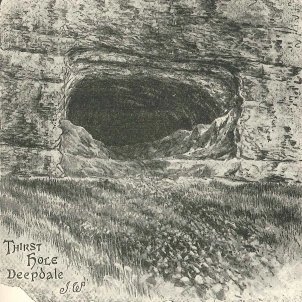
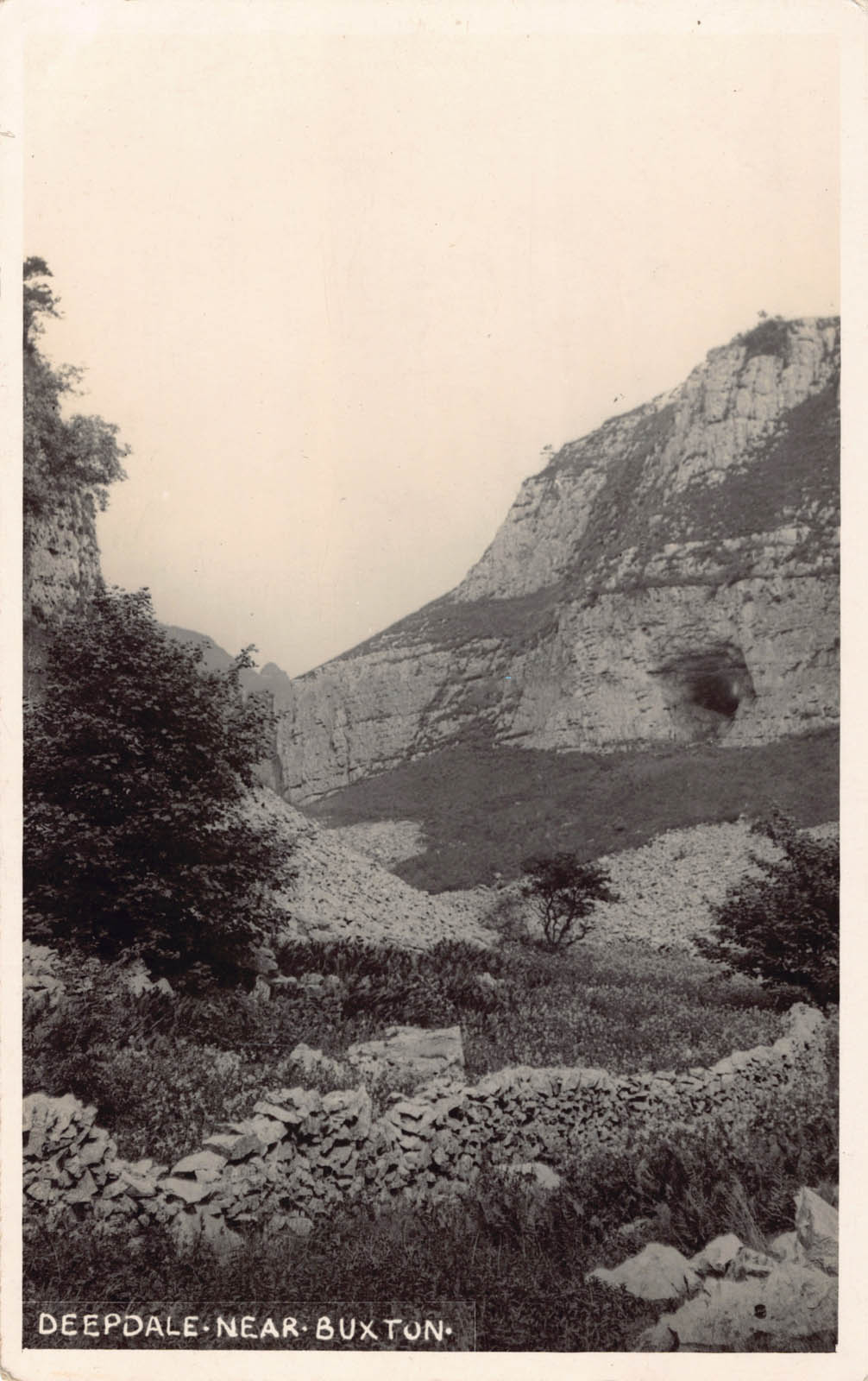
Instead, Hill’s book has Gawain heading north from Blackshaw Moor, toward the town of Buxton and away from the dialect area. Hill then identifies “the Green Chapel with Deepdale Cave near Buxton”, according to the review I read. The cave is also known in the local antiquarian literature as the ‘Thirst Hole’.

Deepdale Cave looks physically very unlikely to me, though, judging by postcard images of the cave. More like an aircraft-hangar entrance, though I guess it may be been enlarged since the 1370s?

Still, Hill offers a closer suggestion than a recent unsupported claim from another author that Gawain’s journey has him journeying ultimately “into southern Yorkshire”, or the unsupportable notion among dogged Cheshire/Stanley advocates that he must have remained in the Wirral.


Incidentally, there’s another snippet of evidence that Gawain’s likely route had dramatic rock formations…

“Blackshaw Moor, where you are greeted by a dramatic panorama of intimidating rock formations. They rise up suddenly, looking like a row of ancient fortresses.” (Staffordshire Folk Tales, 2011)