Tolkien reviewed

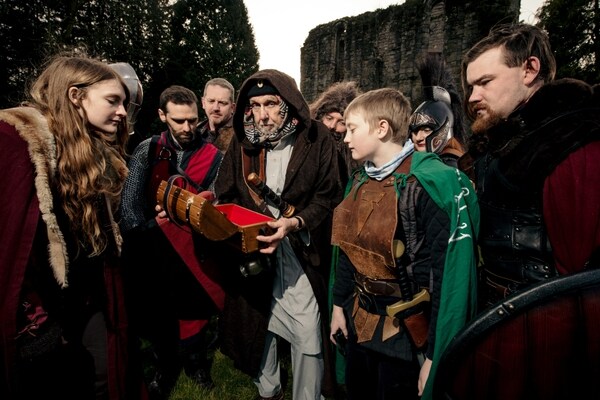
Oh dear, SFX magazine is not so keen on the first of the new ‘young Tolkien’ biopic movies. Their review gives Dome Karukoski’s Tolkien (May 2019) just three stars and barely a quarter of a page. The dire new Hellboy gets two and a half stars, by comparison, in the same issue. The main complaints seem to be un-engaging acting and lack of cinematic flourish…

[The love] scenes are earnestly performed, but don’t feel particularly cinematic or engaging. The better sequences are those that follow Tolkien while he’s suffering from trench fever during World War I, where – delirious – he starts hallucinating the bones of future ideas.”

In the Midderlands

Good to hear, from the Lovecraftian Rlyeh Reviews, that…

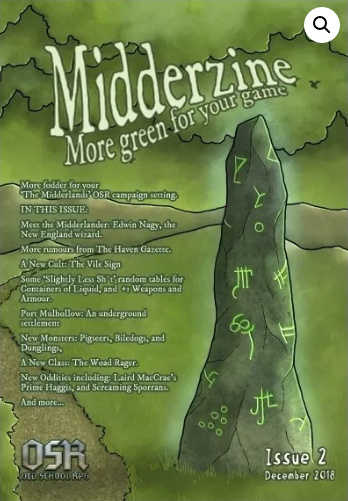
“On the tail of Old School Renaissance* [in tabletop RPG gaming] has come another movement — the rise of the fanzine.”

There’s more good news. The article unwittingly made me aware of a new British Midlands-based fantasy game, which the particular fanzine in question is dedicated to celebrating and exploring…

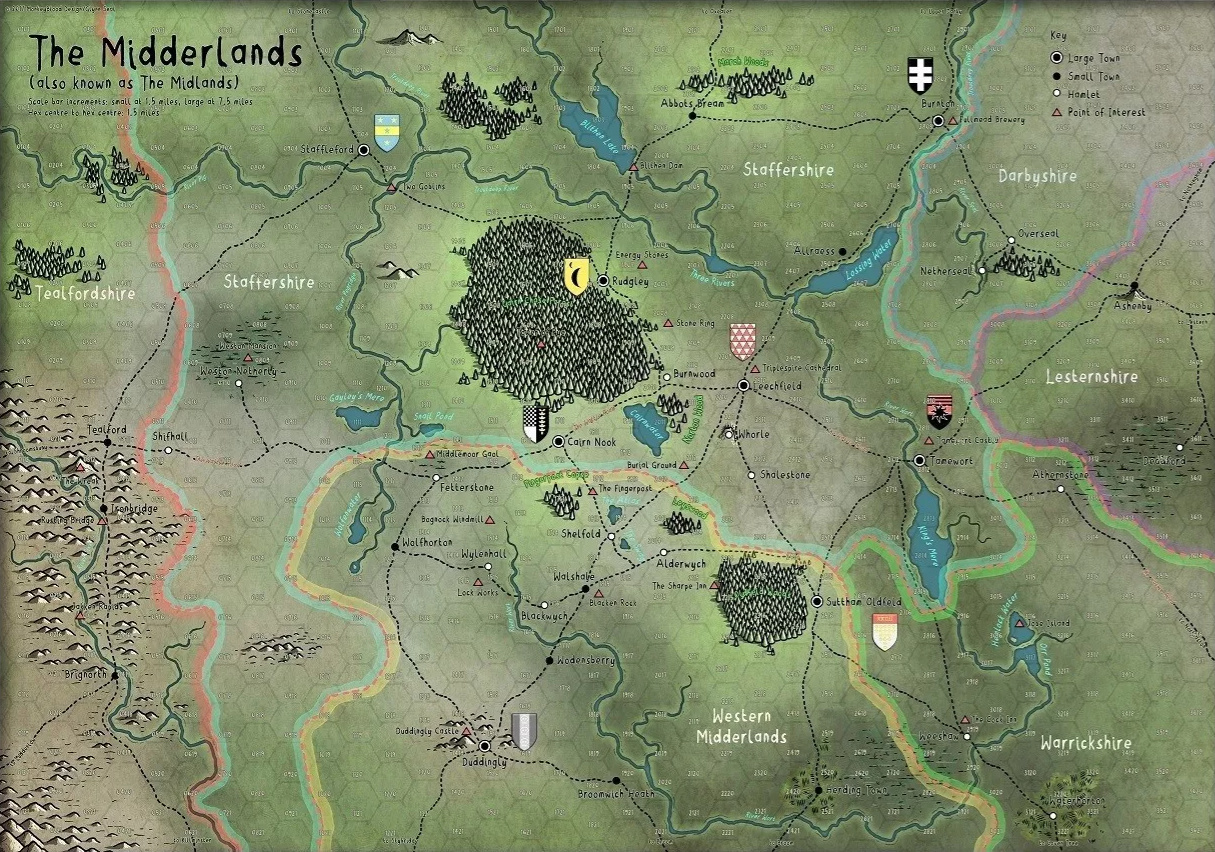
“The Midderlands, the horror infused, green tinged interpretation of the medieval British Isles flavoured with Pythonesque humour and an Old School White Dwarf sensibility, published by Monkey Blood Design and first detailed in [the book] The Midderlands – An OSR Setting & Bestiary.”

The game is made by MonkeyBlood and Glynn Seal, who is presumably based somewhere in the Midlands. A 2018 review of this points up the transmuted West Midlands setting for the game…

“the Midderlands goes a step further [than most medieval-ish RPG fantasy], taking the English West-Midlands and twisting them into a grim, grimy, gritty, green-tinted land full of monsters, weirdness and subterranean horror.”

The author is in Walsall. I wonder if he might care for a Brummagem add-on? There seems to be a big space on the map where a surreal steampunkish Birmingham might arise, filled with Broomies and mysterious Buzz Tins…

Ey… or what about a Stoke-on-Trent addon? Stoke seems to be slightly off the north of the Midderlands map, even though we’re in the Midlands. We could be all liminal and mysterious to the game’s dwellers. [Update: I wrote one]

Anyway, looking at The Midderlands online store I see not only a second issue of the fanzine and the original book (£30, successfully Kickstart’d, seemingly paper only), but also some award-winning mapping.

Apparently it runs on Swords & Wizardry Complete, which looks fairly short and is now officially free as the Revised PDF.


* Old School Renaissance — “seeks to recapture the magic of the early days of tabletop RPGs, particularly early Dungeons and Dragons” (Fantasy Faction).

The Middleport and Longport work of Maurice Wade

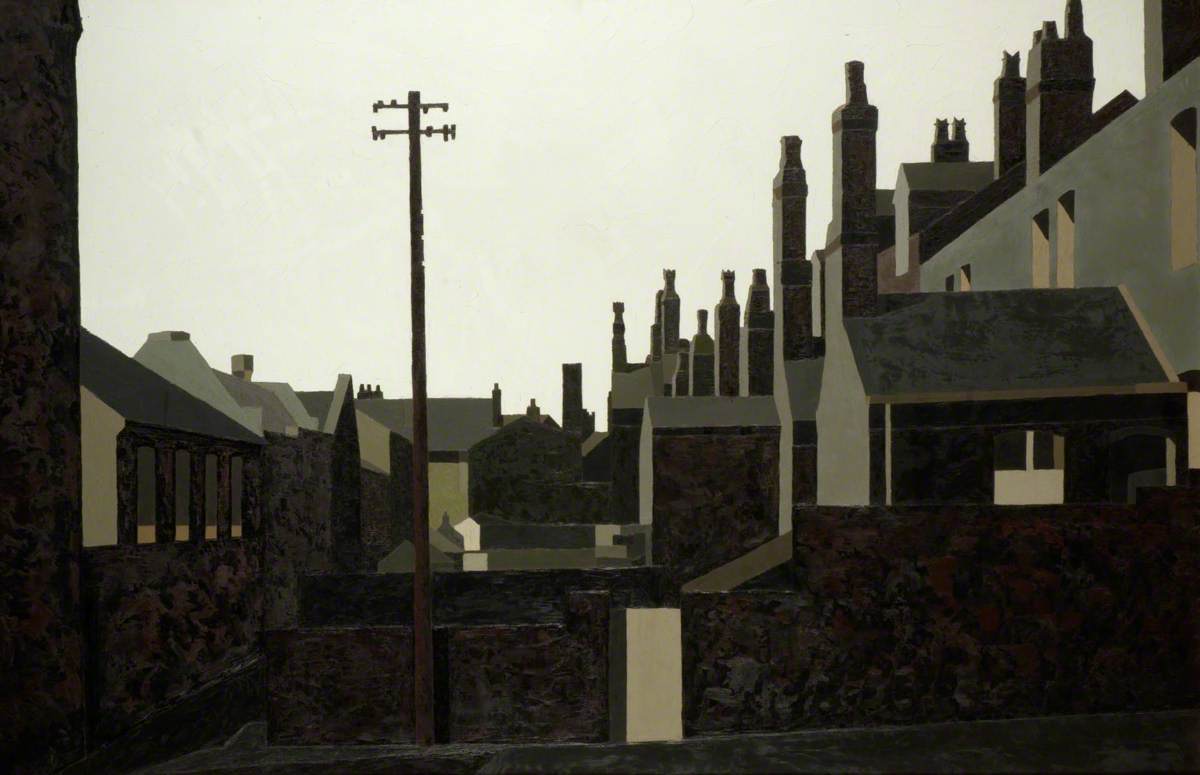
Art UK now has images of the Stoke-on-Trent paintings by Maurice Wade. Specifically, Longport and Middleport on the edge of Burslem, plus widely-seen pictures from Etruria and some obviously commissioned for the new Wedgwood factory at Barlaston. It’s similar to the more colourful work of his fellow Potteries painter Jack Clarkson. Here are Wade’s Longport and Middleport pictures, with my explication of exactly where they are and what they show…
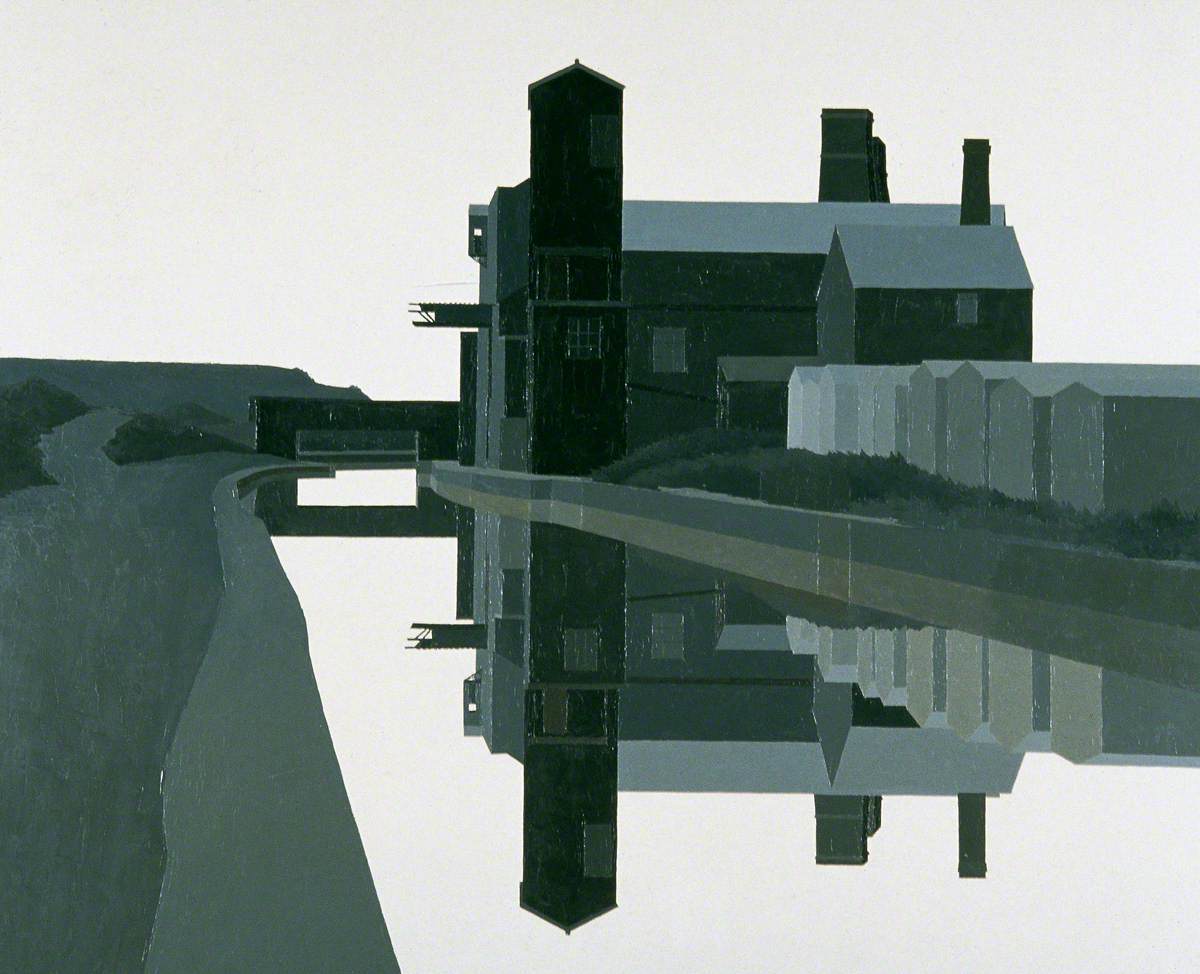
On the Trent and Mersey Canal towpath at the edge of Middleport, looking north. On the right are the garages sited at the foot of Middleport Park alongside the canal. Ahead is the point at which the footpath from Wolstanton to Burslem crosses the canal on a bridge and enters into Middleport from the west, passing from the left to the right of the picture.
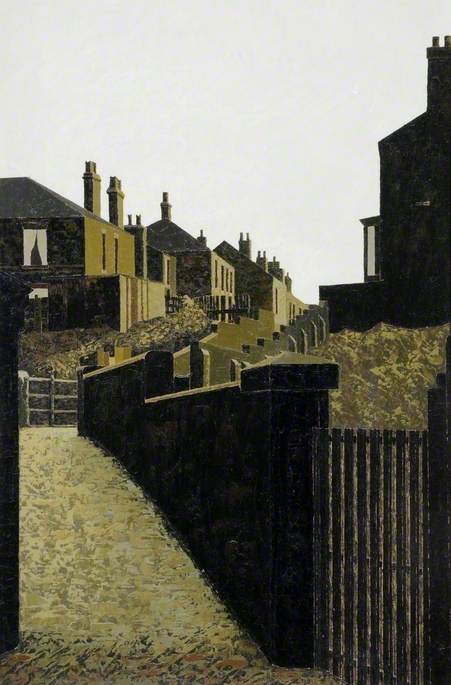
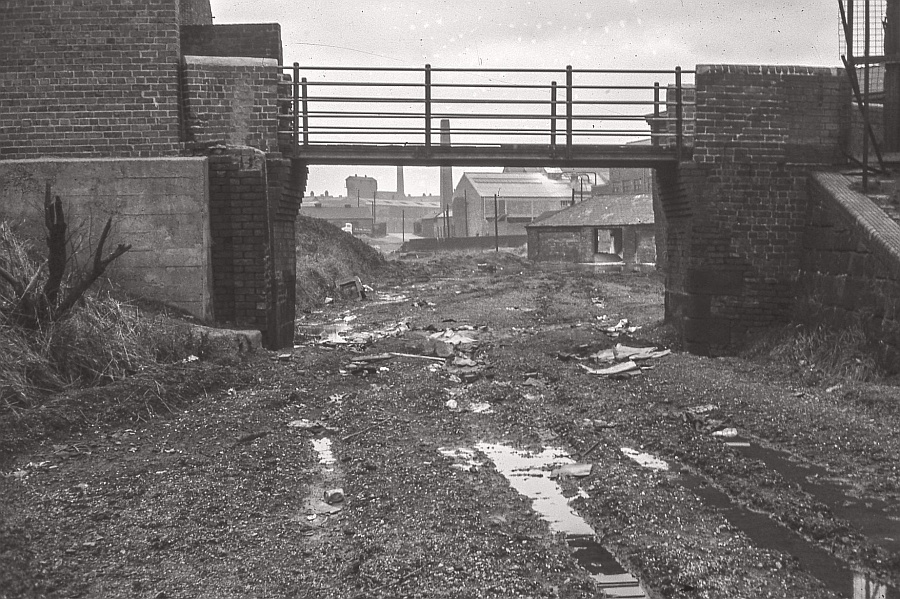
This is the other end of the Wolstanton to Burslem footpath-way (seen crossing the first picture in this post, above), but here we see the the point at which the footpath enters/exits Middleport on the east side. The viewer of the picture is placed in the position of a visitor from Burslem who has walked ‘down the back’ by the quiet Navigation Lane, has gingerly crossed the often-flooded patch of the lane at the corner by Rogerson’s Meadow, and is about to enter into Middleport (probably with trepidation, if not a local) by ascending by the sloped path up to Dimsdale St. Usually known as ‘the Dimsdale St. bridge’, it crosses a disused dry canal spur. Here’s a 1960s photo from the bed of the dry canal, looking south under the bridge…
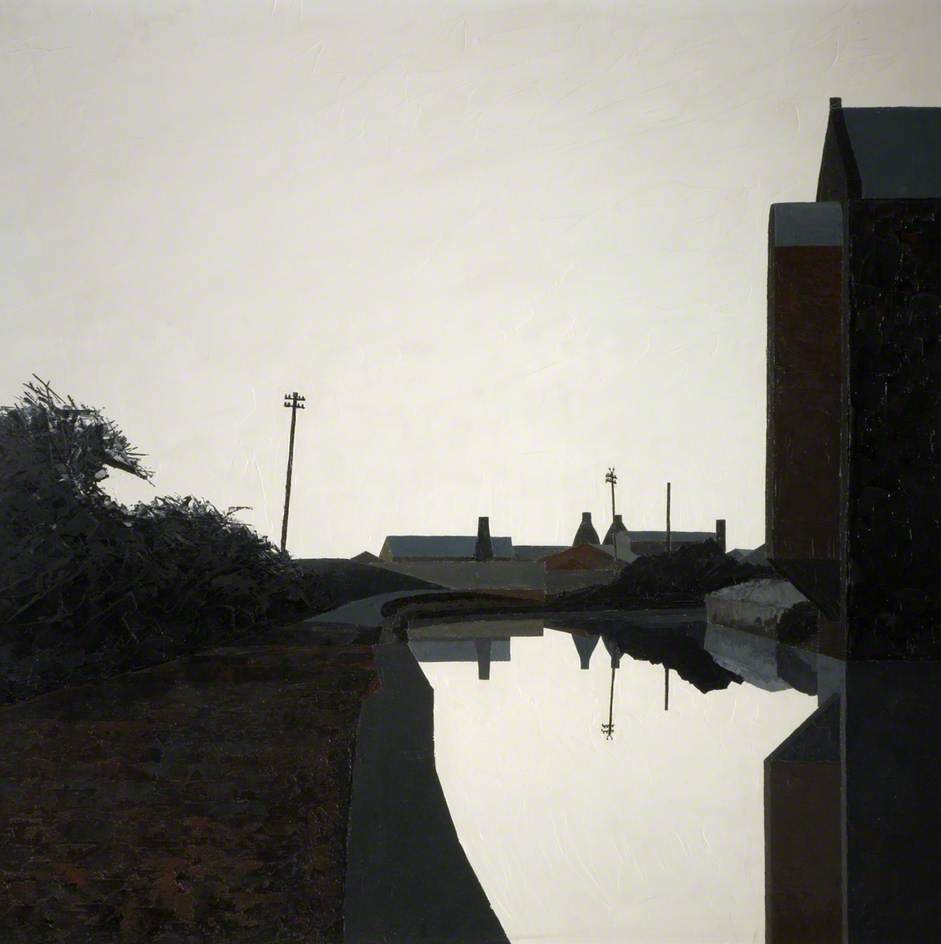
On the Trent and Mersey Canal towpath at the edge of Middleport, headed north toward Longport. The tall buildings are part of Burgess and Leigh, aka Burleigh, aka Middleport Pottery. Behind the hedge on the left, allotments slope down to the Fowlea Brook.
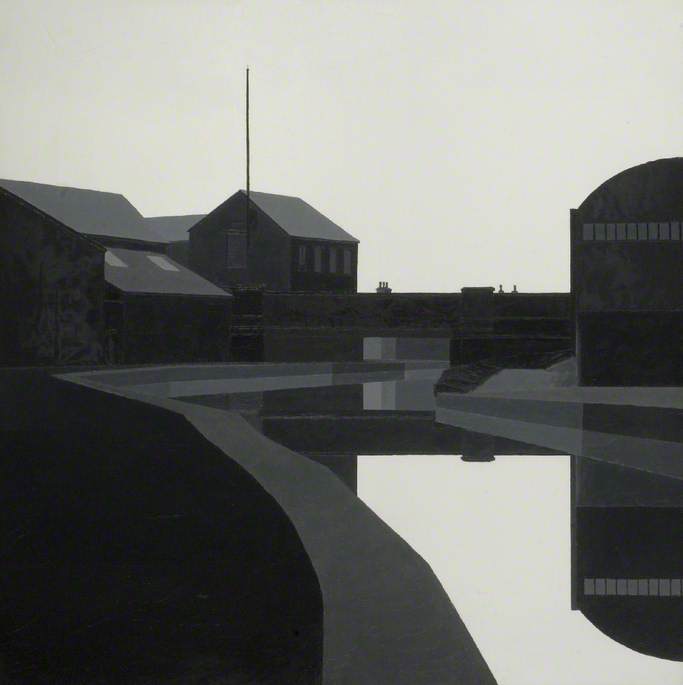
Seems to be the Trent and Mersey Canal towpath at Longport, looking north toward the Bradwell Wood (would be visible behind the line of the bridge), with what is now the boat-building yard and Steelite on the right. One can just make out the grilled gate-fence that gave canal-access to the beer-garden of the pub which was sited just before the bridge and to the left of the towpath.

A typical Middleport/Longport scene, with a slightly sloping road letting onto a back-alley. He’s got the telegraph pole exactly right.

What’s missing here is the people, for which you need to go instead to the paintings of Arthur Berry. Middleport was one of the strongest communities in the city, until its deliberate destruction as a community — first by twenty years of official neglect and then by the Council bulldozers levelling the most important parts of it.
New book: Words Derived from Old Norse in Sir Gawain

There’s an interesting new forthcoming book for those interested in the language of Sir Gawain, and also for those seeking to place the Gawain-poet geographically via the dialect.

Back in 2013 Richard Dance published his fine and detailed study titled “”Tor for to telle“: Words Derived from Old Norse in Sir Gawain and the Green Knight“, to be found in the volume Multilingualism in Medieval Britain (c. 1066-1520): Sources and Analysis. My heart sank when I learned this was from a AHRC-funded project, but on reading it I was pleased to find that Dance’s work proved a magnificent exception to the rule.

In this Dance found that…

“One could hardly, therefore, describe the Norse-derived words at this ‘fundamental’ end of the lexical spectrum as unusually deeply embedded within the author’s language; and, for all their interest in terms of the Gawain-poet’s stylistic strategies, their evidence does not justify searching for his home in parts of England reckoned to be especially densely settled by Scandinavian speakers”.

In a 2014 paper for the British Academy he mentioned that a… “full etymological analysis of the words derived from Old Norse in Sir Gawain will appear in a future
publication”.

Now Amazon brings a date for this future publication. Dance’s full book Words Derived from Old Norse in Sir Gawain and the Green Knight: An Etymological Survey will weigh in at chunky 256 pages. Published by Wiley-Blackwell, the book is set to appear on 7th June 2019.

Ebenezer Rhodes, in his Peak Scenery (1824)

Ebenezer Rhodes, in his travel book Peak Scenery (1824 reprint)…

* he suggests the Derbyshire Peak as one of the roots of the landscape of the gothic novel… “Mrs. Ann Radcliffe, who was a native of Derbyshire, often visited Haddon Hall, for the purpose of storing her imagination with those romantic ideas, and impressing upon it those sublime and awful pictures which she so much delighted to pourtray: some of the most gloomy scenery of her “Mysteries of Udolpho” was studied within the walls of this ancient structure.”

* an apparently Roman eyewitness letter on the erecting of stone circles is recalled and quoted by him, on visiting the ancient stones of Stanton Moor. However, he was not to know that “Quintus to M. Tullius Cicero” was actually a fake devised by one of the antiquarians of the time. It seems to have been produced by the Earl of Buchan.

* [At Tissington he finds the survival of the…] “WELL-FLOWERING, and Holy Thursday is devoted to the rites and ceremonies of this elegant custom. The day is regarded as a festival; and all the wells in the place, five in number, are decorated with wreaths and garlands of newly-gathered flowers, disposed in various devices. Sometimes boards are used, which are cut to the figure intended to be represented, and covered with moist clay, into which the stems of the flowers are inserted, to preserve their freshness; and they are so arranged as to form a beautiful mosaic work, often tasteful in design and vivid in colouring: the boards, thus adorned, are so placed in the spring, that the water appears to issue from amongst beds of flowers. On the occasion the villagers put on their best attire, and open their houses to their friends. There is service at the church, where a sermon is preached; afterwards a procession takes place, and the wells are visited in succession: the psalms for the day, the epistle and gospel, are read, one at each well, and the whole concludes with a hymn, sung by the church singers, and accompanied by a band of music. This done, they separate, and the remainder of the day is spent in rural sports and holiday pastimes.”

* on the silence of a Peak town at night… “There is hardly any silence more solemn and profound than that which pervades a country town at midnight. In the fields the sighing of the winds is heard amongst the branches; whenever the breeze stirs the very quiver of the leaves is audible, and there is a voice in every grove and thicket. Sometimes the low of cattle, the twitter of a lone bird among the bushes, or the purling of a stream, breaks the stillness of the night, even where the dwellings of men are few and far apart; but in the midst of a throng of houses, the habitations of beings like ourselves, the idea of silence is alien to the feeling that prevails, and the mind being sometimes more powerfully influenced by associations than actual existences, the stillness of a town is more awful and impressive than the stillness of the country.”

* his account of a a hobbit-like hill near Buxton has already been noted here.

A hobbit-hill near Buxton, in the 1820s

On the hobbit-y inhabited ‘hill-warrens’ near Buxton, by Ebenezer Rhodes in his book Peak Scenery (1824 reprint)…


“The lime hills beyond Buxton have a curious and delusive effect [to the eye]; they appear like an assemblage of tents, placed on a steep acclivity, in regular stages one above another […] Many of them have been excavated, and they now form the habitations of human beings. Some of them are divided into several apartments, and one aperture serves to carry off the smoke from the whole. The roofs of these humble dwellings are partially covered with turf and heath, and not infrequently a cow or an ass takes a station near the chimney, on the top of the hut, amongst tufts of fern and thistles, which together produce a very singular and sometimes a pleasing effect. One conical hill that I observed, contains within it five or six different habitations, and to the whole there appears but one or two chimneys: by what contrivance these are made to answer the common purposes of so many families, I have not been informed. When Faugas St. Fond [the fossil-hunter] visited Buxton, he was astonished to see human beings entering into and emerging from these excavations in the earth, like rabbits in a warren.

Strangers beholding these places would never imagine them the residence of creatures like themselves. When I first saw them, I knew not to what uses they were applied, for I did not then recognise them as objects I had previously met with in description, and none of their inmates appeared at the threshold to mark them out as dwellings. [It is later revealed that this was “the first day of the shooting season”, so the inhabitants were likely being extra cautious of strangers…] On a second look, they [the inhabitants] had issued from their hovels as if by general agreement, and I found the whole hill was peopled […] with boys and girls, and men and women; who having gazed for a moment upon us, suddenly disappeared, leaving us to reflect at leisure on the unusual sight.”

Novacon 49

Novacon 49, the literary science-fiction convention for the Midlands. Great to see it still continuing (I was on the committee for a couple of years), but why the heck does the Birmingham Science Fiction Group continue to hold its convention over in Nottingham? Did Birmingham do something to irk them, back in the day?

On the hunt

Considering an expanded ebook edition of my June 2018 book on Sir Gawain, I undertook a quick hunt for the scholarly work produced since then. I came back with a plump catch-bag of new scholarly works on the (North Staffordshire) hunting scenes in Sir Gawain:

* ABSTRACT: The Hunting Scenes in Sir Gawain and the Green Knight Revisited

“this essay explores the hunt scenes in terms of the poet’s representation of the hunted animals — the deer, boar and fox — and demonstrates that the descriptions of the hunt are designed to arouse our compassion for the quarries. The sympathy for the hunted serves to both clarify and highlight the direct connection between Gawain and the hunted animals.”

* OPEN ACCESS: The human animal: strange transformations in fourteenth-century Middle English romance

“the second chapter explores the depiction of Sir Gawain’s courtly test as a hunting sequence all its own in which Gawain ultimately skins himself of his hide.”

* OPEN ACCESS: Sir Gawain and the Green Knight y la restauracion literaria de un heroe Arturico: de las artes venandi al romance caballeresco (in Spanish)…

“the narrative functions assigned by the poet to the long descriptions of the hunting adventures of Sir Bertilak, pointing to the close relationship that links it to the artes venandi composed during the period and the models of virtue and masculinity proposed by its texts.”

* SHORT ABSTRACT: Hunting and fortune in the Book of the Duchess and Sir Gawain and the Green Knight

“Some Middle English narratives juxtapose representations of hunting and histories of aristocratic loss. The Book of the Duchess and Sir Gawain and the Green Knight redirect anxieties about the contingency and precariousness of lordly advantage in a world that sometimes seems to be ruled by Fortune.”

* OPEN ACCESS: A detailed ‘in progress’ 2018 paper on the seasonal feasting that followed the hunt, Feasts and feasting in the fourteenth century — Gawain and the Green Knight at Christmas.

* ABSTRACT: Tangentially relevant to the topic is a new and partly Tolkien-related article which ambitiously considers… “to what extent Germanic mythology may inform the representation of magic, nature, and wisdom in Sir Gawain“, “Etaynez þat Hym Anelede of þe Heӡe Felle”: Ghosts of Giants in Sir Gawain and the Green Knight. (Broadly plausible on the ‘Thor and the giants’ — Gawain similarities, and builds on the 2013 article “A Scandinavian Link to Sir Gawain and the Green Knight?”).

* OPEN ACCESS: Also a 2017 article, Sounding the Hunt in Sir Gawain and the Green Knight on the sounds of Gawain.

Blue flashers in Stoke

“Mystery surrounds ‘strange’ flash of electric blue light in skies above Stoke-on-Trent”

“It was a green-turquoise flash. The lights in the house flickered”.

Yes, I noticed that too, a bit further down the valley at Etruria. Sometimes there’s the flash of an ambulance going past on the distant road, but it wasn’t like that, it was higher in the sky and more diffuse, a different colour, and not with such a regular pulse.

There was a possibly related phenomenon in 1896…

“The Earthquake of December 1896”: the North Staffordshire Naturalists’ Field Club, Annual Report and Transactions, 1897 offered a collation of reports from all around the district of the “earth-wave”. “Dr. McAldowie estimated that about two-thirds of the adult inhabitants of Stoke were roused [in their beds] by the shock.” Also reports of atmospheric disturbances, flashes of light like lightning. The Revd. G. T. Ryves was investigating the strange local reports of ‘lightning’, but he died before his investigations could be completed. A national report on the “luminous phenomena” was published by another researcher in the Meteorological Magazine, and a summary list is given of the observed phenomena noted in the article: at Bridgenorth the “streets seemed to be on fire”. A large collation of press notices of the earthquake is given, drawn from further afield.

Wilum Pugmire, rest in peace

This is a re-posting from my H.P. Lovecraft blog, Tentaclii. When posted the blog was private, but I thought this post should also be public. This seemed the most suitable place to post it in public.

S. T. Joshi’s blog has two new posts, both on the passing of Wilum Pugmire — delectable author and painstaking student of H.P. Lovecraft’s works. Joshi’s first post is a tribute, “My Friend, Wilum Pugmire”, and the most recent is “More on Wilum”.

The latter post brings news of a Memorial Event on Saturday 4th May 2019.

Joshi’s second post also usefully points to Brian Keene’s podcast ‘The Horror Show’, where the most recent episode is a “podcast full of tributes to Wilum”.

There are blog tributes to be found from his good friend David Barker, reporting the news that Lovecraftian author W. H. Pugmire has died. John D. Haefele sent an in memoriam statement to Don Herron’s blog and Herron himself posted Mort: Hopfrog Nevermore. Bobby Derie has penned the tribute W. H. Pugmire; and William Tea has posted a short goodbye. Possibly there are others, though I haven’t found them, and there will surely be more to come over the next few weeks and months.

The science-fiction news magazine Locus swiftly published a short obituary W.H. Pugmire (1951-2019) and his Wikipedia page has full details of his life and works. The Classic Horror Film discussion board has a less dry and, I’d like to think, rather more Pugmirish memory of him which seems fitting to end this post on. I only knew him through his audio interviews and some of his YouTube book reviews, and I don’t think he read my blog Tentaclii, but from hearing that audio I have the feeling that he might have enjoyed this being re-told (by one ‘Gef the talking mongoose’)…

In probably his late teens & 20s he worked at an attraction in Seattle called Jones’ Fantastic Museum…

“For 13 years the museum featured a real live vampire named Count Pugsly who roamed around scaring children and adults alike, even outside the museum. Sometimes he would appear to be a mannequin, standing still until an unsuspecting visitor stepped in front of him. As soon as the realization struck the visitor that no activating floor mat was there, he would walk towards them, often eliciting loud screams of fright.”

That was Wilum.