Tolkien Gleanings #389
* Available from today, a new ‘Collectors Edition’ of Unfinished Tales, retitled by the publisher on Amazon as Unfinished Tales: A Special Hardback Anthology of Epic Fantasy and Middle-earth Legendarium (2026). Though the cover keeps the usual title.
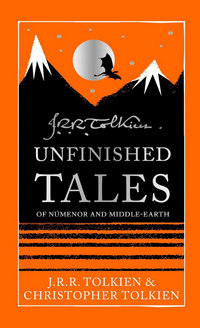
Frankly not appealing, with no additions (such as a folder of new maps), and a selling-point that’s simply ‘hey, it’s a hardcover with an embossed picture’. Although admittedly the price is right, at £14 for a chunky hardback inc. delivery. But really… a lurid orange picture, with unappealing typography that would barely merit a glance in a sixth-form art show? Look at the huge gap between the words Unfinished and Tales, for instance. Ugh. Surely HarperCollins could have done better than this, for the reissue of a key book by Tolkien?
* The U.S. Library of Congress blog has a long post that tells us exactly how readers can get their hands on a print copy of A Gateway to Sindarin: A Grammar of an Elvish Language from J.R.R. Tolkien’s Lord of the Rings (2007).
* On YouTube, a recording of Brad Birzer’s 90-minute Tolkien seminar on “Treebeard and Gandalf the White” (March 2026).
* In this week’s Church Times newspaper, Malcolm Guite reflects on “All the music of the spheres” in Tolkien.
* Are large online AI’s improving at the task of discussing Tolkien? Lingwe investigates with the aid of one of the best, Google’s Gemini. One of the tests was to provide a list of “hapax legomenon [i.e.] a word that occurs only once within a specific context”, in LoTR. Though without the AI being fed the LoTR text. As such, Google’s Gemini provided a mostly-invented list of words, along with eyot which occurs a gazillion times in the text. Such hallucinations may matter, at a time when many YouTubers are using AI to help generate the scripts for their endless waves of ‘Tolkien explainer’ clickbait videos.
Anyway… inspired by Lingwe’s test, and with the help of the desktop freeware AntConc and Jan.ai+Qwen3.5 I then had a go at finding such one-time unique words in the actual provided text of LoTR. From there I whittled the list down to 15 one-use words that are not personal names or names that can only apply to just one place:
– barrowfield (a field or open terrain of ancient burial barrows)
– downlands (an “open and fairly level” landscape of turfy downs)
– crowhaunted (dark ghost-like crows inhabiting shadowy cliffs of dark rock)
– flammifer (one who carries a burning lamp aloft)
– hell-hawks (foul flying beasts, large enough for a man to ride on)
– jaw-cracker (unfamiliar language, very difficult to pronounce)
– lithlad (a wide ashen plain, see also Tolkien’s “ash-ridden”)
– moonset (the setting moon, casting a bright white light)
– neekerbreekers (invented hobbit word for horrid marsh-crickets, named for the sound they make at night)
– ninnyhammer (a hobbit who does a stupid ‘numbskull’ thing, mild insult)
– shirriffing (activities involved in being a hobbit Sherrif in The Shire)
– springle-ring (a pretty but vigorous hobbit dance for two people)
– treegarth (arboretum of differing trees set in a wide circle around a central point, guarding and protective)
– tussocky (area of thick long grass, starting to become many wind-raised tussocks, see also Tolkien’s “hummock”)
– willow-wand (a thin stiff-but-pliable willow-tree withy or thin branch, partly dried, can be wielded in childish play).
Tussocky was once known to agriculturalists and farmers. Moonset was also once well-known to sailors / weathermen / soldiers. Willow-wand was known to Edwardian children’s play-culture and can be found in pre-Tolkien children’s literature (“The Willow Wand” is a chapter in the famous novel Ivanhoe, in which the wand provides a tricky target for an archery contest). Note also the annual British folk-practice in which boys participated in beating the bounds during wassail processions of a parish boundary, by ‘whipping’ the boundary trees with withies. Arguably, treegarth does refer only to one specific place in Middle-earth, though Treebeard needs to specify it by location when he calls it the “Treegarth of Orthanc”. Such specification implies there may be other treegarths elsewhere.
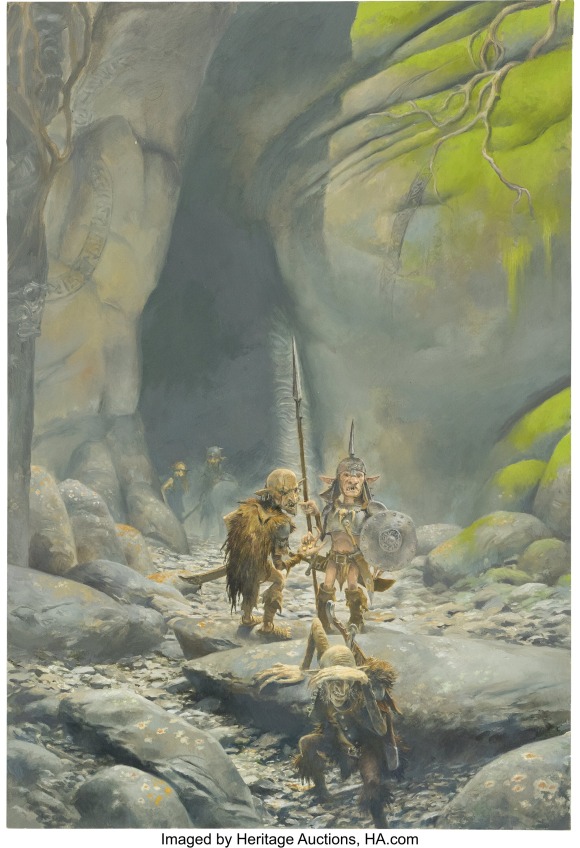
* Up for auction at Heritage Auctions towards the end of March 2026, the original of an early Adrian Smith painting to illustrate The Hobbit. Possibly 1980s or 90s for an RPG game company, and thus showing pre-movies orcs. My guess is that the scene illustrates the moments just after Bilbo has popped his waistcoat buttons and invisibly escaped down the mountain? Lots of space for words in the top half, so possibly it was painted for a game booklet? Perhaps a back-cover?
* And finally, artist Miriam Ellis has a fine new print available of her tender painting of “J.R.R. and Christopher Tolkien, 1928”.