A Midsummer Tempest – a Midlands fantasy novel

The prolific American science-fiction author Poul Anderson also wrote historical fantasy novels. One was even set here in England and had a witty earth-mysteries / dark-faerie twist.

A Midsummer Tempest (1974) is an alternative history fantasy set in an England in which Shakespeare’s Fairy Folk are real and the English Civil Wars are partly an early-steampunk affair with airships. Better, I see it has scenes set in Buxton, the Welsh Marches of Shropshire and Stratford-upon-Avon. There’s even a passing mention of Stoke. A quality local(ish) fantasy novel that I had no idea existed. Who knew?

At just 200 pages it’s not one of those over-padded 1990s/2000s “thick as a brick” fantasy books, either. Nice.

It was nominated for the World Fantasy Award for Best Novel and the Nebula Award for Best Novel. It also won the Mythopoeic Award. And that was back in the 1970s, when awards in fantasy and SF still meant something and had not been hijacked by the far-left.

Gawain walks

Stoke and Newcastle Ramblers are soon to do walks over more-or-less the ‘Gawain country’, which may interest those who have read my recent book on Gawain in North Staffordshire. I’m uncertain if they’re even aware of Sir Gawain but their relevant 2019/2020 walks include, in order of possible/likely Gawain travel…

Danebridge(?)
Mow Cop(?)
Biddulph Moor(?)
Rushton Spencer
Out of Peak Forest
Ecton Hill and the Manifold Valley
Alton Common

Tolkien 2019 Programme and videos

The Birmingham Tolkien 2019 Programme, now online in PDF.

It was a roaring success, apparently, other than a slightly cramped venue. Sadly the event was too expensive for me, despite the relative proximity of Stoke-on-Trent to Birmingham. It would have cost at least £400 to do it properly. But it’s good to see the booklet online and giving an excellent summary with abstracts.

For my own future reference, talks given at the event and of interest to me:

* “The Wright Stuff”, Ian Spittlehouse. The influence of Joseph Wright at Oxford. This is “the third in a series re-appraising the work of Joseph Wright and its influence on Tolkien”, so one assumes a book at some point. One might hope also for a substantial appendix that surveys all his other tutors.

* “The lost connections of Tolkien’s first map of The Lord of the Rings: Reconstruction”, Erik Mueller-Harder. Again, one of a three-part series, and one thus assumes these will become a book at some point if the rights can be obtained for the required images.

* “Rivers of flame and a great reek rising: volcanoes and the horror of the sublime in Tolkien’s Legendarium”, Sian Pehrsson. Not looking in the right places, judging by the abstract, but it sounds interesting.

* “Blessed trees? The White Trees of Gondor and the Royal Oak compared and contrasted”, Murray Smith. The author admits there’s no real evidence of a linkage, but I can see that it’s a perfectly valid comparison to make given the historical context and Tolkien’s politics.

* “Forests, Trees, Huorns, and Ents”, Johanne Tournier. Appears to be a broad survey of Tolkien’s close attention to trees in his life and work.

* “The Shape of Water in Tolkien’s Middle-earth”, Norbert Schurer. Judging by the abstract, ‘water’ is obviously too slippery and vast a topic to grasp all in one go. But the paper could be stimulating.

* Five or Six Ponies?, Jessica Yates. A small niggling problem in the text of The Lord of the Rings re: the journey to the Old Forest, and apparently now with three possible solutions. I like small puzzles like that, not least because they can often inadvertently lead one on to bigger discoveries.

* A conference report mentions a study of Nodens and how Tolkien might have gone on to work elements of the lore into his Legendarium, though I don’t spot it in the programme booklet.

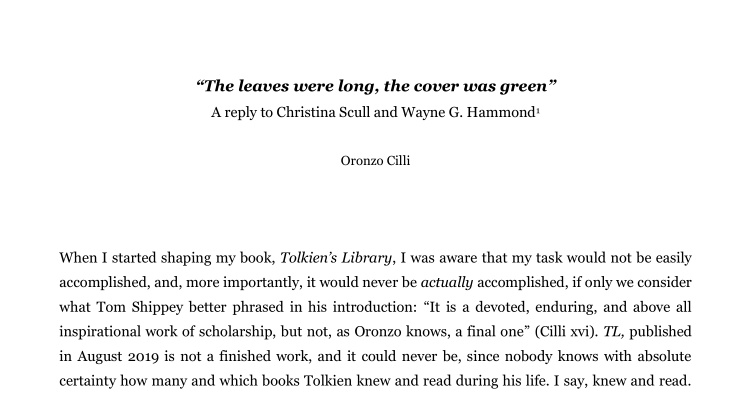
I see that the book Tolkien’s Library has been published and is rather chunky. The free 10% sample for Kindle readers gives the introduction and the first 90 entries (and curiously, no table-of-contents). There appears to be no dating on the entries re: when read. I assume there’s a date-ordered “book X was read in year Z (or decade Y)” table at the back, so that one can glimpse something of his intellectual progression.

“It’s yummy up ‘ere”

Stoke and the district seems to be getting a bit of a sweet tooth. Not only are the Cherry Bakewells made at Trent Vale in Stoke

“In the last five years, Premier Foods has invested more than £22 million at its Stoke-on-Trent facility to improve the production process, with the introduction of more automation and technology.”

But we’ll soon have a big fancy chocolates factory too…

“Daniel’s Delights now employs 22 staff at the former Royal Doulton works in Fenton, Stoke-on-Trent. … The company has doubled its turnover to almost £2m in the past two years … The £440,000 in funding from Lloyds Bank will allow the business to buy its existing four-storey premises, along with the property next door to allow space for its expanding team.”

There are also quite a lot of edible nibbles being produced out at the old Cadbury’s milk chocolate factory, near Eccleshall. Now run as Knighton Foods. Apparently they produce a whole range of powdered yummies, of the Angel Delight packet type.

The Cherry Bakewells are on the telly tonight in a documentary, if you’re still a live BBC watcher. It’s not going to make up for years of the mainstream media slagging off Stoke, but it’s a start. Let’s just hope they don’t frame the factory footage with the usual stock footage of grotty Stoke back-alleys.

First things first

A new report from the UK’s Office for Students finds 34% of Staffordshire University students now get ‘first class’ for their final degree classification. At nearby Keele it’s 27.8%. A little further away, at the nearly-closed MMU Crewe campus it’s 32.3%.

The Mail reports…

“The Department for Education has now said that universities have been given a ‘stark warning'” on this grade inflation.

Of course these are aggregate percentages per institution. To really make sense of things you’d need to see it all broken down by degree area and weighted by the comparative stringency of the admissions policy for that degree area. But perhaps such figures are already posted on each degree’s recruitment page, these days, and I’m just unaware of that. Though I don’t see such things on a sample degree page at Keele, just a vapid ‘student satisfaction’ number.

For those readers of this blog who have little contact with education, I should point out that 27-34% is highly abnormal. The true figure should be about 8-12%, even accounting for a slight general up-skilling in students when balanced against the current state of secondary education.

In the old days before about 1996, back when ‘a first was a first’, if you had generally high-quality recruitment onto a degree, and had the usual moderate drop-out from the course at the end of the first-year, then at the end of a three-year degree you should expect no more than about four first-class degrees. That would be in a final-year class of around 40 students. 8 to 10% of students getting firsts is about right, and reflects the essentially fixed distribution of such abilities in the degree-capable population.

It used to be casually assumed that it was just duffers such as Wolverhampton University that had this grade-inflation problem. But the curious uniformity of the rises is now fully revealed, across everyone from Wolverhampton all the way up to Durham. This suggests to me that it’s not only some occasional institutional laxity or management-driven rankings-pressure on lecturers that’s at the root of the problem. The Office for Students finds a big chunk of this widespread rise to be simply “unexplained”, despite their casting around for suggestions from those on the ground.

One thus wonders what part the take-home essay and coursework has to play, as that must increasingly enable the easy use of informal and online ‘essay-writing services’ and other more undetectable methods such as translation-plagiarism for final dissertations. This suspicion of outright cheating seems at first glance to be backed up by a government comment, found in the media stories on the new report, that…

According to Education Secretary Damian Hinds, this increase is probably the result of “unfair practices”.

One might ask if these “unfair practices” happen at the bottom of the ability range, and thus (as a knock-on effect) they encourage university administrators to re-shape grade curves and thus make things easier at the top as well. Or perhaps the cheating is happening among marginal 2:1 students, who try to play the system with a few cheating third-year essays and a final dissertation in order to get a first. Or it may be a mix of both pressures.

If it’s mostly due to largely undetectable ‘contract-essay cheating’ then simply ‘toughening up the marking’ will have little impact. The essay-mills will scale accordingly. One way to get around the problem might then be to bring back sit-down exams. On my undergraduate degree, each year we had regular sit-down timed exams in large classrooms and halls, giving hand-written answers to a previously unseen sheet of exam questions. Something which one would almost certainly not encounter today as an undergraduate. We had the expected number of firsts — three in a class of about 40, and I still have a photocopy of the final noticeboard sheet that announced the final grades for the class.

End-of-year exams would pose certain organisational and logistics hurdles, given the sheer number of students today. It would also have to be introduced uniformly across all courses, or students seeking ‘easy’ choices would skew toward no-exam universities and a two-tier system would develop overnight. If done on a huge sports-hall scale there might also be a slight problem with ‘impersonation’ cheating, i.e.: where Dull Bill’s bright cousin turns up to take his written exam, pretending to be Bill. But if end-of-module exams were done on a small per-class basis and supervised by the class tutors in the usual classroom, then there would be no chance for that to happen.

There are likely to be emerging technical possibilities to prevent cheating. I don’t read the trade newspapers these days but, off the top of my head, I imagine that one might run timed date-limited exams online, with retina-scans enforcing identity, though that’s probably not ideal for a range of reasons. One of the best options might be to build an algorithmic ‘fingerprint’ of the student’s writing style and research-source types, from age 14 onward, which would flag up any coursework likely to have been written by someone else. By ‘research-source types’ I mean that if the quantity and range of sources for an essay suddenly expands, either Dull Bill just got really unexpectedly good at finding and reading research sources to pinpoint excellent supporting quotes, or else the essay may actually have been written by Dull Bill’s bright cousin. One of the problems here is that essay-writing services may ask to be sent three of your past essays, and then have an A.I. that re-shapes their cheating essay to conform to your personal style.

One further twist is likely to be added by the ‘all must have prizes’ brigade among leftist teachers. Customised personalised sit-down exam papers, thus making it impossible even for Dull Bill to fail. Provided he can be bothered to attend the exam hall, and has learned to read and write.

A new first* classification might also be a fix for the problem, although that would also inevitably become corrupted over time if the underlying problems were not fixed.

One very robust check on cheating would be if all job interviews for recent graduates were required, by law, to include a written sit-down exam component and basic intelligence test via an accredited test-centre. The centres would be completely independent from the educational system, under the control of industry and strictly monitored.

Libraries and books in medieval England – six-hour lecture series

A new lecture series by Richard Sharpe, from the “Libraries and books in medieval England: the role of libraries in a changing book economy”. Given April – May 2019.

1. Medieval libraries of Great Britain.
2. English medieval library catalogues.
3. Library books and personal books.
4. Turnover in medieval libraries.
5. Growth, competition, stability, loss, renewal.
6. Decay and closure of the libraries.

The Bodleian Libraries Podcasts. Regrettably they’re video-only and weigh in at a huge 1.2Gb each. The files are too big for online audio-only rippers.

Now online: Old Norse in Sir Gawain and the Green Knight: An etymological survey

Newly available online, Richard Dance’s final book-length edition of Words derived from Old Norse in Sir Gawain and the Green Knight: An etymological survey (2019).

* Table of Contents, Acknowledgements, Abbreviations.
* Part One (Introductory remarks, 238 pages).
* Part Two (The word-by-word analysis, 600 pages).

I trailed the book back in mid-April 2019.