Staffordshire Clogg Almanacs

Notes on a Staffordshire Clogg Almanac:

“Almanacs of a rude kind, known as clogg almanacs, consisting of square blocks of hard wood, about 8in. in length, with notches along the four angles corresponding to the [special] days of the year [in a perpetual calendar], were in use in some parts of England as late as the 17th century.” — Encyclopaedia Britannica, 1902.

They do not seem to appear in Cheshire or Shropshire or further south than the Trent. Raven’s book The Folklore of Staffordshire claims of these that…

“The Staffordshire Clogg Almanacs were in use at the time of the Saxon Conquest, and it is clear from the available evidence that the customs associated with the [special] day[s marked on it] are very old.”

Below is an engraving of a Staffordshire clogg almanac, formerly in the Lichfield Museum, drawn more graphically from a fine copy published in the Anastatic Drawing Society’s volume for 1860…

A full deciphering can be seen here.

This example was later described at length by the Rev. J. M. Gresley, in the Transactions of the Leicestershire Architectural and Archeological Society, Volume One, page 410…


There is also this useful later snippet from the 1899 Transactions of the Lancashire and Cheshire Antiquarian Society

“Mr. W.T. Browne, the governor of Chetham Hospital, exhibited two clog almanacs belonging to the institution, on which Mr. Yates made the following remarks: The two interesting clog almanacs, which are on the table, are two good specimens, and exceedingly rare. One of them was presented to the Chetham Library by Mr. Henry Finch in 1696, and the other by Mr. John Moss in 1711. They have been fully described by Mr. John Harland in [“On Clog Almanacs, or Rune Stocks” in] the Reliquary vol. V., 1865. Dr. Robert Plot, in his Natural History of Staffordshire (folio, 1686), gives an account of the clog almanac, which he found in popular use in that and other northern counties, but unknown further south, and which, from its being also used in Denmark, he conceived to have come into England with our Danish invaders and settlers many centuries before. The clog bore the same relation to a printed almanac which the Exchequer tallies bore to a set of account books. Properly it was a perpetual almanac, designed mainly to show the Sundays and other fixed holidays of the year, each person being content, for use of the instrument, to observe on what day the year actually began, as compared with that represented on the clog; so that if they were various, a brief mental calculation of addition or subtraction was sufficient to enable him to attain what he desired to know. The entire series of days constituting the year was represented by notches running along the angles of the square block, each side and angle thus presenting three months. The first day of a month was marked by a notch having a patulous stroke turned up from it, and each Sunday was distinguished by a notch somewhat broader than usual. There were indications — but they are not easily described — for the golden number and the cycle of the moon. The feasts were denoted by symbols resembling hieroglyphics.

Dr. J. Barnard Davis, in an elaborate article on “[Some Account of] Runic Calendars and Staffordshire Clogg Almanacs” in Archaologia, vol. xli., part ii. (1867 [pp. 453-478]), enumerates sixteen specimens known to him, including one in his own possession purchased at the sale of Mr. Charles Bradbury’s collection in 1864, the “Finch Clog” and the “Moss Clog” in the Chetham Library, one in the possession of the Historic Society at Liverpool, and another belonging to the Rev. J. S. Doxey, Rochdale. A fine specimen, recently in the possession of Messrs. Sherratt and Hughes, booksellers, Manchester, is now in the collection of Mrs. Robinow, Fair Oak, West Didsbury.”


Here is a simpler Staffordshire clogg almanac, in the British Museum (AN885002001)…

A more recent paper on Staffordshire clog almanacs was the presidential address delivered at the eighty-third annual meeting of the North Staffordshire Field Club, March 26th, 1949. Reprinted in Transactions of the North Staffordshire Field Club, 1948-49. Sadly this is not online. A bundle of papers, cuttings, and letters relating to the lecture is held at the Salt Library in Stafford.

It seems highly unlikely that the Vikings brought the notion of such almanacs to Britain, as seems to have been the common notion idea among scholars in the middle of the 19th century. Why would pagans bring calendars that ran according to the Julian and Christian years? We sent Christianity to them, not visa versa. There was counter-evidence to the unproven “Vikings” theory. For instance, Eirikr Magnusson (1877) suggested that the Danish cloggs actually originated in England, pointing to a runic calendar found in Lapland in 1866 that bore English runes. (Cambridge Antiq. Soc. Communications, Vol. X., No. I, 1877).


Staffordshire Clogg Almanacs. The full deciphering can be seen here.

It would be tempting to think that the ancient name of “Stafas”, meaning the smooth sticks on which such almanacs were cut, might have given rise to the name Staffordshire?

Folklore section from “Memorials of old Staffordshire” (1909)

A Web republication of:—

“SOME LOCAL FAIRIES”, from: Memorials of old Staffordshire (1909).

BY ELIJAH COPE OF LEEK.

WITHOUT making any attempt to account for the great amount of fairy lore in the moorlands of [north] Staffordshire, I will give a few typical examples and, where needful, what explanation seems necessary.

I stayed one night with an old woman named Grindy, who lived on a little farm near Mixon, in the hills east of Leek. After supper we had a long chat about old times and old people we had both known. We sat in a room she called the parlour, which was furnished with quaint old oak furniture, and some part of the room was wainscotted with oak panelling. As the weather was cold, and partly on account of my visit, a fire had been put in the quaint old grate. We sat till nearly midnight, and only a few pieces of wood glowed in the bottom of the grate. I was then startled by what seemed to be several raps on the table and one loud rap on the wainscot near the fire. The old lady did not pay so much regard to the noise as I did, but merely remarked that ” Old Nancy has come as usual.” I asked her who Old Nancy was. She replied that she was an old fairy who had been about there, goodness knows how long ; and that her mother told her about the fairies and counselled her to be good to them and always leave some bits of cake or other food either on the table or other convenient place in the house. Her mother had said that fairies were good and honourable little folk and would never steal anything so long as people were kind to them, and that they would do many bits of work in and about the house in payment for food. I asked the old lady if she had ever seen “Old Nancy ” or any of the fairies. “No,” she said, ” I don’t know that I have, nor have I any wish to see them. They don’t like people to watch them nor to interfere with them in any way.” […]

On the following morning we had an early breakfast, and I walked about the farm buildings, and tried to get up a conversation with a servant-man who was busy amongst the cows, but to all my inquiries about fairies, ghosts, and witches he gave a vague and evasive reply.

As a worker amongst oak for very many years, I don’t think there is any great difficulty in accounting for the noises on the table and wainscot. It is the nature of oak to swell in a damp or even cold atmosphere, and to contract in a hot or even warm atmosphere. The fire in the room had caused the oak to contract, and the noise was caused by its pulling itself away from its cross-bands.

Towards noon I started on my way home by Mixon Mines. I called at a cottage to see a Mrs. Frith, whom I cautiously drew into conversation about fairies. She put a shawl or wrap over her head and walked about half a mile on the way home with me in the direction of Mixon Hay farm. When in the second field from the village she pointed to the lower part of the meadow, and told me that her mother had spent hours there watching fairies dance round a ring, and had described the different coloured garments they wore. She said she did not think they were so very honest, for she had missed many articles of clothing which had been forgotten and left out on the garden fence all night; but added sympathetically, “Poor things, they must have clothes from somewhere and of some kind.”

The late Mr. Billing, who, some years ago, lived on a little farm on the hillside between Moridge End and Hollinsclough, was a firm believer in fairies. He was one of the few people I have met with who had seen them dance in a ring, and also seen them about the farm buildings. I learned from him many strange stories about fairies and their habit of taking babies from their human mothers and leaving their own children in the place of them. Such children are called changelings, or children that have been changed. The following story is a type of many. Most children who were ill-shapen, dwarfs, cripples, or otherwise deformed, and especially if they were lacking in speech, were supposed to be changelings! Mr. Billing told me that when he was a boy a poor woman, who lived at a cottage near him, gave birth to a baby that was perfect in every way, but very small. When about a month old, its mother took it into a hay-field and laid it on a heap of dry hay. As the sun was very hot, she put an umbrella over it. After about an hour or so she returned and found the baby asleep, but she fancied its features had changed. The dreadful thought came into her mind that the fairies had taken her baby and left one of their own in its place ! Worst of all it did not appear to her, judging from what she had heard about fairies, to be well born or aristocratic, but a common ” Hobthurst,” which is a fairy of low birth, low habits, and by no means industrious, but fond of sitting by the fire and leaning against the hob. She decided, however, to take it home, to be kind to it, and to treat it in every way as her own.

The child grew but little, and never learned to talk. Still she was very kind to it, hoping that some day or some night fairies might snatch it and return her own a wish that was never realised. Compensation, however, came in another way. One day, when clearing out an old cupboard that had been built into a recess of the house, she found a large number of gold coins wrapped in a piece of old linen rag. She was overjoyed at her good fortune, and thankful she had kept the child and been kind to it; for she was quite satisfied that the fairy to whom the child belonged had put the money there. For over three years she found money occasionally hidden in various parts of the house, chiefly in the thatch. Eventually, however, the child sickened and died, from which time, though she diligently searched, she never found a coin of any kind.

When Billing had finished his story, I asked him if he believed it to be true. “Certainly I do,” he replied with some warmth and drawing himself up to his full height. “Certainly,” he repeated ; “don’t you ?” I had to admit that there were some difficulties in the way of accepting it as true. “In the first place,” I said, “where did the fairies get their coins from? They either had melting-furnaces and dies to stamp their gold or they stole it.” My doubts quite offended the old man, who told me plainly that I was an infidel, and that he made it a rule never to give shelter to an infidel, which I took as a broad hint that I had better be going. He positively refused to shake hands with me or to say Good-night, but quickly said in a low voice, “All things are possible to Providence.”

Most fairy dances that I have heard of have taken place in low boggy ground or damp and undrained meadows, principally the former. The following, however, though of a common type, took place in the Victoria Gardens, which lie on the lower part of Leek, sloping northwards from the old church. A working man rented a piece of garden on the lower part of the ground. After his day’s work in the silk mill, he went to spend an hour or so weeding some vegetables. When too dark to see the weeds he went to his little wooden shed, or summer-house as he called it, lit his pipe, and sat for sometime thinking. Eventually he fell asleep. How long he slept he did not know, but it must have been nearly daybreak when he awoke. Going to the door of his shed he was greatly astonished to see a number of little people dancing round a ring, dressed in most gorgeously coloured costumes. Their motion was slow at first, but after a little time grew rapid. The man became excited, and went a few yards nearer to the dancers to get a better view of them. Still the motion of the dancers became more rapid, and in proportion the man became more excited, till finally, losing control over himself, he went close to them, and, clapping his hands together in applause, he called out, “Well done, my little folks, the one with the blue frock dances best.” The spell was broken, the dancing fairies vanished, and the man, standing near the spot where the fairies had been, rubbed his eyes in utter astonishment.

I remember when a boy walking with my grandfather from Ipstones to Leek, by way of Basford, and through the fields where stand the remains of an old stone cross. My grandfather took me a little out of the footpath to a field to show me some rings where fairies were said to dance. The rings were a little larger than an ordinary cart wheel, and the ground of a different colour from the other part of the field. Some time afterwards I paid a second visit along with other boys, and found the rings were gone. The farmer had given the land a dressing of gas-lime, which had killed the fungus that had formed the rings.

Probably the district most inhabited by fairies lies near the Bottom lane leading from Ipstones to Bradnop. There are several farms, mostly of small acreage, called Lady Meadows. The subsoil is clay and the ground wet, except in dry weather. Most fairies of that district seem to have been of a very industrious race. For a piece of cake and a bottle of home-brewed ale they found and restored to their proper places lost iron pins that belonged to ploughs. They prevented hedgehogs from sucking the milk of cows in the night-time. They were encouraged to be about the house by presents of tobacco and little delicacies in the form of food. Their little tobacco pipes were sometimes found in the fields, and the ploughman who turned one up whilst ploughing was said to be lucky. The ill-natured housewife who would not encourage nor reward their industry was often in trouble. Her oven would not bake bread properly; her knitting needles fell out; the flat-irons were either too hot and burned the clothes, or they were too cold and would not iron clothes properly. The things in the house were put in disorder in the night-time. Even her garters refused to remain fastened, and her hair would persist in falling down. The worst mischief, however, happened in the night-time. The farm dog would bark; crockery was found broken or damaged ; the cream was taken from the milk; the wife’s Sunday cap torn to pieces; and the husband’s tobacco stolen. In the end it paid the housewife to be generous and kind to the little folks.

I have often found that witchcraft and fairy lore have been linked together. Some of the witches I have known have blamed fairies for mischief reputed to them; as, for instance, when people could not make a light with the flint and steel, the mischief was sometimes charged to the fairies and sometimes to the witches, and occasionally to both. I have known and been intimately acquainted with witches, and have known and seen their methods of work, and what are called their black arts, which no respectable and well-bred fairy would descend to.

On the whole, I have found that fairies are respectable and industrious little folk, very harmless if properly treated, and though occasionally given to little acts of roguishness are by no means wholly bad. They are rapidly dying out. Education and science are making their existence intolerable. When they are entirely gone the world will be poorer by the absence of many moral stories told of them, and many high and noble lessons learned from their characters and actions.

  [See also William Purcell Witcutt’s memoir “The Valley of Phantoms” (speaking of the late 1930s / early 40s in Leek).]

Jenny Green Teeth

Barafundle’s recent blog post made an interesting reference to a bit of North Staffordshire folklore not mentioned in Jon Raven’s The Folklore of Staffordshire (1978)…

* Jenny Green Teeth

I am originally from Stoke-on-Trent and these [marl] holes were a by-product of the [pottery and] brick-making industry left behind after the clay was extracted. The local marl hole was said to contain ‘Jenny Green Teeth’ who was rumored to drag children under the water if they got too close. I did not need any Grimm’s Fairy Tales. My imagination on this was enough to keep me wanting more. I would pester my father to tell me how his elder cousin, Arthur, plagued him with stories of her magical powers. For years I thought Jenny Green Teeth to be the sole product of Arthur’s fertile imagination. Then, one weekend, I listened to Claire Balding’s [BBC] Ramblings programme [29th Sept 2011, currently still online as “Listen Again” in the UK], which featured a walk through the Roaches area of North Staffordshire. During this programme, I heard reference to Jenny Green Teeth as a popular myth of the Staffordshire and Cheshire vicinity. On Googling I discovered she was a popular lady of English folklore. Her power extends to Shropshire and Lancashire.

Some possible archaic survivals in North Staffordshire folklore

This post is from 2011. See my more substantial The Folklore of North Staffordshire, version 1.8 (2023) free ebook.

Here are some mentions of the more unusual and probably archaic items of North Staffordshire folklore and folk practice, picked from an examination of Jon Raven’s The Folklore of Staffordshire (Rowman and Littlefield, 1978)…

1) House spirits:

The introduction to the book mentions of the north of the county…

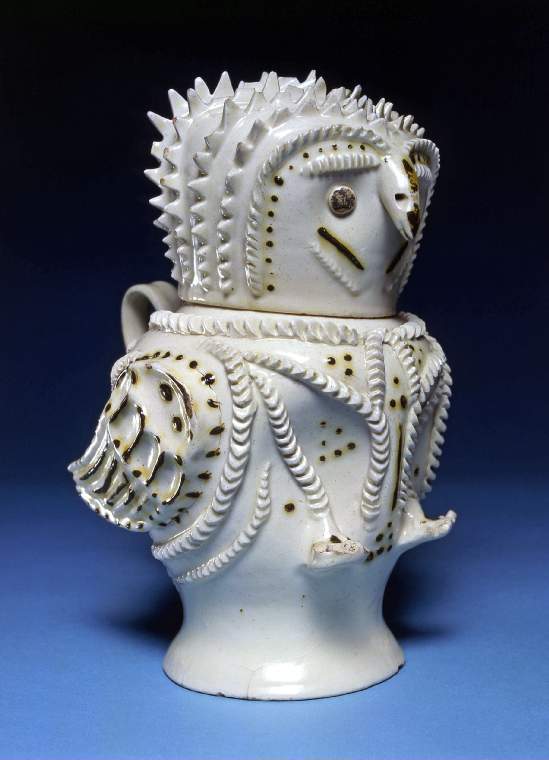
“the pottery bird-shaped whistles, built into old chimneys as a guards against evil spirits”.

One wonders if these might be linked with the Staffordshire dancing bear jugs and the grotesque early toby jugs?

But there were also more amenable house spirits which were deemed to live inside the home. A “hopthrust” or “hobthrush” was the name for a rough fairy, one of the lower orders of ‘working’ fairies. ‘Hob’ or ‘lob’ (as in ‘Lob Lie-by-the-fire’) was a common name for a ugly hearth spirit which worked for humans, commonly deemed to inhabit a nook near the main fire. The ‘o’ sound of these names re-occurs in the name of ‘knockers’, who are very similar ‘working’ spirits of the Staffordshire mines. The tapping of the ‘knockers’ in the mines was deemed by miners to presage a disaster. The antiquity of such names seems to be indicated by the similarity to the few very rare survivals of the language of the British Isles before the Romans — such as crock, noggin, gob, nook, and brock (brock being the folk name for a badger).

Interestingly, the name “toby” in “toby jugs” may then also be thought to be a relic of the very ancient “hob” — also ugly and likely to inhabit a hook in a nook by the fire. One of the key settings of my novel, Queen Street in Burslem, in reality continues the popular knowledge of this, since it’s now a shop called The Hobby Goblin.

2) The White Rabbit:

There is mention of a Kidsgrove boggart that frightens but “does not harm travellers” in dark and remote lanes, but which shrieks to warn of disaster in the nearby mines. Possibly this is somehow related to the white rabbit, mentioned several times in Burslem and Kidsgrove. Its sighting (outdoors/crossing a path) either predicted death, or else it was deemed to be a spirit of one already dead. A County Mayo man (of Ireland), who had lived at Golden Hill just north of the Potteries and near Kidsgrove, also reported the white rabbit, as recorded in Lady Gregory’s Visions and Beliefs in the West of Ireland (1920). In the memory of “shrieking” there may also be a faint echo of a memory of the ancient Irish “keening” songs sung at funerals, and of the Celtic idea that some souls inhabit animals (usually butterflies and moths, sometimes birds) for a while after death, if they cannot find their difficult way to the afterlife.

Down in South Staffordshire, at Bilston, during the late eighteenth century, the local colliers with cursed and haunted mines often resorted to a ‘cunning’ man (i.e.: a male herbalist and curse-remover, something which seems to have been common in Staffordshire) to cure them of the visitation. He was known to the miners as ‘White Rabbit’. The date of this report indicates that the name cannot have been influenced by Alice in Wonderland.

Possibly related is that Antiques Magazine (1955) recorded a rare ceramic…

“white rabbit sitting under the dome [which] was made of white salt-glazed stoneware about 1735 in the Staffordshire district”.

(I also wonder about a possible Cheshire folkloric origin for Alice’s famous White Rabbit. Since Lewis Carroll was from nearby Cheshire. But it appears that no such example has ever been unearthed by the eager scholars of Alice).

3) Clogg Almanacs:

“Almanacs of a rude kind, known as clogg almanacs, consisting of square blocks of hard wood, about 8in. in length, with notches along the four angles corresponding to the [special] days of the year [in a perpetual calendar], were in use in some parts of England as late as the 17th century.” — Encyclopaedia Britannica, 1902.

They do not seem to appear in Cheshire or Shropshire. Raven’s book The Folklore of Staffordshire claims of these that…

“The Staffordshire Clogg Almanacs were in use at the time of the Saxon Conquest, and it is clear from the available evidence that the customs associated with the [special] day[s marked on it] are very old.”

Here is an engraving of a Staffordshire clogg almanac, formerly in the Lichfield Museum, taken from the Anastatic Drawing Society’s volume for 1860. It was later described at length by the Rev. J. M. Gresley, in the Transactions of the Leicestershire Architectural and Archeological Society, Volume One, page 410…

For more on Clogg almanacs, see my longer article on them.

Final chapters of Spyders: what is historically correct?

What is historically correct in the final chapters of Spyders:—

NO PLOT SPOILERS!

The modern sport of rugby had indeed been recently invented.

Carbide lamps were not in use in 1869, but they were produced from 1900 onwards.

The details of the building of certain structures described as being in London are accurate.

Davy was indeed a friend of Thomas Wedgwood.

The technical limitations of a device described by Mr. Steel are correct.

The novel called the district newspaper “The Hanley Sentinel”. In actuality in 1869 it was called the Staffordshire Sentinel, becoming the Staffordshire Daily Sentinel in 1873.

The North Staffordshire Infirmary was indeed moved from Etruria to Hartshill in 1869.

A “phonautograph” was an early type of ‘record’ player that existed at the time, although it used the cylinder recordings of the time…

The abandonment spoken of in the final chapter did happen in reality.

The specific references to Buckley Litchfield’s biography of Thomas Wedgwood are correct.

Chapters 10 & 11 of Spyders: what is historically correct?

What is historically correct in Chapter 10 and 11 of Spyders:—

Of course the British Librarynth is an alternative world version of the British Library, its name merged with ‘labyrinth’.

“Mr. Pugmyre’s bath house” slips the living horror author Wilum Pugmyre into the novel. I’m not sure if there were dedicated bath houses at that time in Burslem? The first public baths opened in the 1890s…

“The public baths in Moorland Road [Burslem] were opened by the Corporation in 1894” — The Victoria history of the county of Stafford: Volume 8.

The Charge of the Light Brigade did indeed happen in 1854.

Prague is indeed the home of the golem myth.

An orrery looks like this…

Navigation Road is the road between Burslem and Middleport and is as described, and it often floods at the bottom. There is no Chapel Alley in Burslem, but there is a Chapel Lane.

The growing things mentioned by Steel in chapter 10 are all real names.

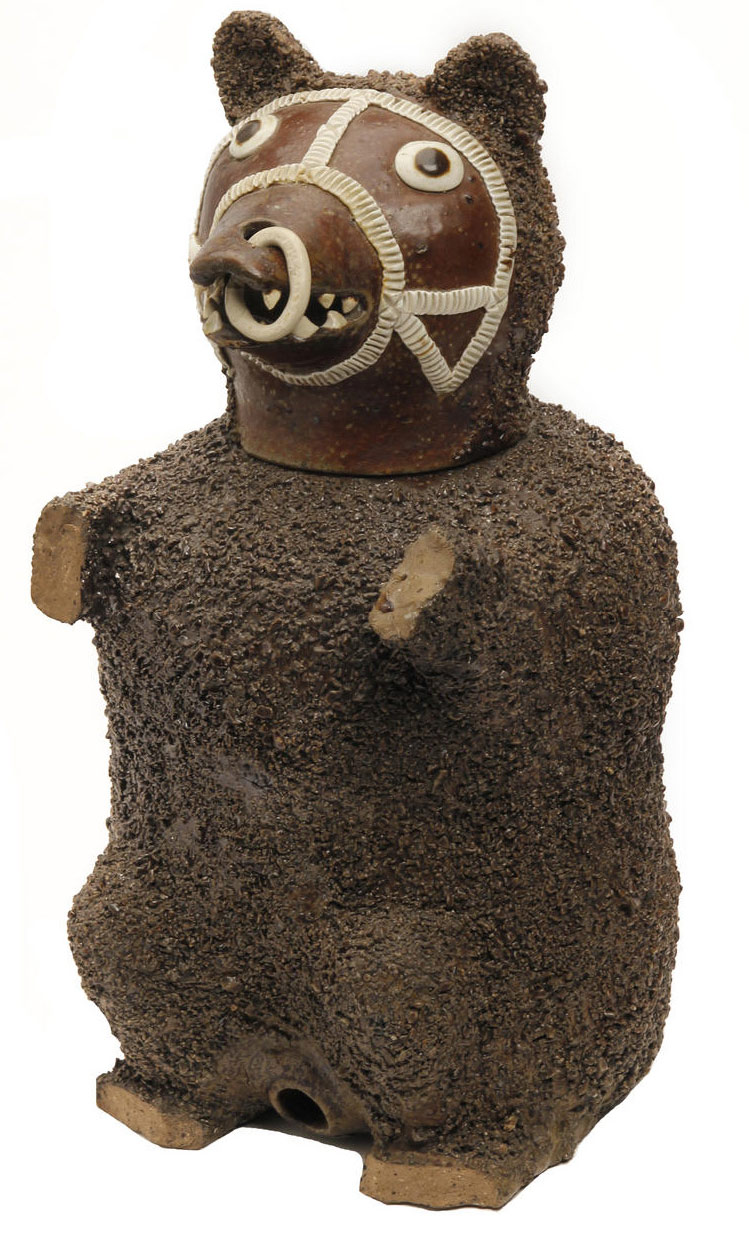
Dancing bears were indeed common into the 19th century, as they are depicted in the novel…

“Once, it was said, all the children of the town [Burslem] had run out early from their Sunday Schools to see a big blue eyed bear, all washed for his public dancing. The bear danced in the square to the soft pounding of a little steam organ and some musical clappers made from big butchers’ bones, to the sounds of which he added his own occasional moans and bellows. He danced for a lick into a big brown ironstone porridge bowl painted inside with thick treacle, before being goaded away from it for more dancing. Some girls danced with him, if they were brave enough, and must have remembered it in their pub tales all their lives.” — from The Spyders of Burslem.

These bears were once so common in Staffordshire that they influenced the design of pottery…

“The ‘Bear’ jugs witness to the vogue of the dancing bear, its itinerant owner leading it from village to village to delight the rustics with its terpsichorean skill. [Early] Crudely modelled pieces of this type came from both Staffordshire and…” — Ceramics for the collector: an introduction to pottery & porcelain (1949).

Mr. William Brown of Birmingham had indeed patented the modern ball-bearing roller-skate.

England was indeed commonly said by Germans to be “a land without music”, by which they meant we had no symphonic composers of any note at all. This was broadly true.

Staffordshire Folk and their Lore (1896) – some extracts and notes

Some notes on and interesting extracts from C.S. Burne’s Folklore journal article “Staffordshire Folk and their Lore” (1896)…

1) Male witches:

“Jack Rhodes the bank-ranger, he went to a witch in the Potteries about the mooney as he lost. […] I would draw your attention in passing to the use of the word witch for a male soothsayer. This is customary in that part of the county.” [In] “the Potteries […] The dark practices of magic are known among them; the simpler faith in apparitions [i.e.: ghosts] is comparatively less flourishing.”

This is relevant to the Jimmy Tunnicliffe character in the novel.

2) Trick or treat

Burne’s 1896 article also gives the lie to the modern idea that trick-or-treat at Halloween is an American invention and import…

“In the north [of the Midlands] (and also in Cheshire and North Shropshire), the festival of All Souls, November 2nd, is celebrated by parties of lads and children going round to all the principal houses begging for apples — and formerly for cakes and ale — and droning out:

  “Soul soul, for a apple or two If ye’ve got no apples, pears’ll do,
  Up wi’ the kettle and down wi’ the pan.
  Give us a big ‘un, and we’ll be gone.”

“He speaks puling [whimpering], like a beggar at Hallowmas,” says Shakespeare (Two Gent.),”

…from which we should infer that in his time this was also a Warwickshire custom.

Toffee apples do feature at one point in my novel. Though the time is Sept/Oct, not Oct/Nov, as I wanted to avoid actually setting it at Halloween (since that raises all sorts of unwanted modern connotations in the mind of the contemporary reader).

3) Friendly folk:

The article also notes the cheery and friendly reputation of Staffordshire people, for which they still have a reputation especially in Stoke, and their noted fluency of speech…

The cheery hospitable nature which distinguishes them [Staffordshire people] was noted in [Queen] Elizabeth’s time by Drayton in his Characteristics of Counties. Punning on the name, he says:

  “And Staffordshire bids ‘Stay, and I will beet the fire,
  And nothing will I ask but goodwill to my hire.’”

The same temper of “goodwill” and friendliness is met with throughout the county; and so is the same racy humour and readiness of speech.

4) Lyrical speech and turns-of-phrase:

Burne also notes the lyrical nature of the people’s speech, another feature of my novel…

“A stranger would suppose the people were continually quoting proverbs, but as often as not their epigrammatic sayings are the coinage of their own brain.” [He gives some examples] “When people naturally talk in this way, it is difficult for the folklorist to distinguish standard proverbs from improvised ones; here, however are two or three specimens. “Merry nights make sorry days.” “He’ll neither be satisfied full nor fasting.” “To get a wooden suit” — to be dead and buried. “To give a pea for a bean” — to give a present with an eye to future profits.”

Shakespeare’s character of Ancient Pistol probably gives a strong flavor of this sort of mellifluousness “speaking in proverbs”.

I also remember reading other accounts of the old “sing-song” nature of the pronunciation of the old North Staffordshire dialect.

Chapter nine of Spyders: what is historically correct?

This is a note about what is is historically correct in the North Staffordshire novel The Spyders of Burslem:—

The working-class outsider who inherits a great man’s fortune is one of the common ideas in Victorian novels.

Molded earthenware teapots had indeed been a Burslem staple, and would continue to be. Twyford had indeed invented modern sanitary ware at his Bath Works at nearby Cobridge, and later developed them at his purpose-built model factory at nearby Cliffe Vale.

Sissy Mint was a real chip-shop owner in Burslem, but he lived in the 1930s. He was one of the most well-known of the chip-shop men.

Herbalism still existed at that time. The Bibliotheca Staffordiensis (1894) talks of Culpers’s, a book not yet excised from Staffordshire’s libraries despite the many accounts of the alleged “occult” properties of the plants it described…

Culpeper’s Complete Herbal, and English Physician. Wherein several hundred herbs, with a display of their medicinal and occult properties”

See C.S. Burne’s fascinating 1896 article in Folk-Lore: A Quarterly Review, “Staffordshire Folk and Their Lore“, for more details of archaic survivals of herbal and other folk beliefs in the county. Sadly I didn’t see this article before I finished the novel, or I would borrowed a few names and phrases from it.

1768 was indeed deemed a “bad year”, of many eclipses.

There was indeed a Brewery in Zion Street, Burslem. Not mentioned in the novel is the fact that a young trainee manager there was once the Nottingham murderer and alcoholic William Horry. But by the time he was a killer, he had moved to Nottingham.

The southerly facing illuminated clock dial of the Burslem Town Hall was indeed illuminated, presumably at that time by gas.

The tradition of the “rat in the cider” is an old one, and I remember the BBC’s The Archers once spun a week’s worth of episodes out of it.

The ‘Green Man’ figure can still be seen in various places around Stoke. The artist Kate Lynch has done quite a bit of research on the topic, especially in Stoke old town.

The old Victorian ceramic-tiled underground toilets existed in Burslem town centre until very recent times. I went down into them myself, in the early 2000s. They were destroyed by the Council sometime in the mid 2000s.

Eugenics was then a current theory, and academically acceptable until the 1940s.

The ‘League of the Just’ did exist, although at a later date. In its later and more German form in the middle of the 19th century it was the place in which modern terrorism was theorised…

“Karl Heinzen was the first to provide a full-fledged doctrine of modern terrorism; most elements of latter-day terrorist thought can be found in the writings of this forgotten German radical democrat.” — Walter Laqueur, A History of Terrorism (2009).

…thus the novel’s fictional conflation of the group with The Terror of the French Revolution is somewhat justified.

What is historically correct in Chapter Eight of Spyders?

Some notes on the historical accuracy of Chapter Eight of the North Staffordshire novel The Spyders of Burslem:—

The Sytch is indeed just north of Burslem town centre, and appears to take its name from the old name for the Scotia Brook. There were such wastelands…

“The Burslem district, with its distinctive bottle ovens, a typical though vanishing feature of the Potteries scene, presents a built-up industrial landscape interspersed with several tracts of wasteland.” — A History of the County of Stafford: Volume 8 (my emphasis).

Here it is on the map of Burslem from 1800. There may be some confusion in the histories, because The Sytch appears to have been both a wasteland and the name of the road that ran alongside that wasteland…

Here is Paul Johnson on The Sytch, from his The Vanished Landscape autobiography of a 1930s childhood…

“The Sytch was the dark heart of the Potteries, an immense stretch of ground composed in almost equal parts of bare clay earth, black water, mud, industrial detritus both active and abandoned, and fumigerous furnaces, belching forth fire, ashes and smoke. […] The Sytch was desolation by day for, except when the wind was high, stagnant smoke clouds and a miasma of foetid mist which surged up from its black waters made sure that visibility was low and a semi-darkness prevailed.”

He may be mis-remembering somewhat, but the area was certainly the poorest in the district, and home to “fumigerous” small workshops that would not be tolerated elsewhere. The site of The Sytch is now said to be roughly on what is now the Trubshaw Playing Fields and the fields around the Brownhills High School, from there stretching up to the northern edge of Burslem…

BERT BENTLEY ARCHIVE - BURSLEM - Off Westport Road. The Sytch mill. The old mill house.

BERT BENTLEY ARCHIVE – BURSLEM – Off Westport Road. The Sytch and Sytch mill. The old mill house.

There were two parish surgeons in 1834, so it seems possible there was at least one resident town surgeon for Burslem in 1869. Medical training for women was not unknown at the time. For instance, America had the New York Medical College for Women by 1869. In 1887 Scotland opened the Edinburgh School of Medicine for Women, so the idea of Miss Craft going to Edinburgh to train enough to be a local part-time “jobbing” town surgeon is not as far-fetched as it might appear.

The efficient modern factory system of the division of labour, partly described in miniature in use at Craft’s workshops, has been said to have been the invention of ‘the Father of the Industrial Revolution’ Josiah Wedgwood of Stoke.

Some of the greatest grass engravers were indeed to be found at Wordsley in South Staffordshire.

Here are some visual examples of ocular devices of the type the novel envisages, although the simple middle one is closer to that in the novel…

Novels and fictions set in Stoke-on-Trent.

Following the publication of my own North Staffordshire novel The Spyders of Burslem, I thought an article surveying other fictions set in the Potteries might be fitting:—

The classic author of the Potteries is, of course, Arnold Bennett. The most approachable novels are generally said to be the serious coming-of-age novel Clayhanger (1910), the more comedic The Card (1910), and the women’s stories Anna of the Five Towns (1902) and The Old Wives’ Tale (1908). All Bennett’s work is now in the public domain, and can be found online in various formats including Kindle. The Card was filmed, partly on location in Burslem and Middleport, with Alec Guinness in 1952. There was a major ITV TV adaptation, the last of the great weekly costume-drama series. The Old Wives’ Tale was also filmed as the 1988 BBC six-part drama, Sophia and Constance.

Paul Breeze’s My Guitar Gently Weeps (1979) is a neatly structured tale of hard rock music and harder revenge, set in the industrial Midlands of the mid 1970s. It’s a portrait of the music scene just before punk, but with a whiff of the notoriously violent Action comic and of the skinheads of the times. A first novel, it was published by the major publisher Micheal Joseph. Here’s their blurb…

“In this gripping novel of revenge, a young musician turns implacable avenger when his whole reason for living — playing the guitar in a rock band — is ended by a brutal assault.”

The writing in My Guitar Gently Weeps is excellent. There was a sequel called Back Street Runner (1980), featuring the same character (but, given the plot of the first book, it’s perhaps unlikely that Back Street Runner was set in Stoke-on-Trent).

Wedgwood Butterflies (2003) is a mystery thriller novel by Peter Corbishley. Set in the Potteries in an indeterminate time period, the book stars Eric Rattlestone, a researcher in ceramics.

The contemporary novelist Stephen Foster set two of his works in the Potteries. It Cracks like Breaking Skin (1999) was a Faber and Faber first novel, set around families and football in Stoke…

“A novel about what it is to grow up. On street corners and market stalls, in back kitchens and swimming pools, across the walkways and the terraces of Stoke-on-Trent, Hewitt the man faces Hewitt the boy. Finding rare passion in the ordinary moments, he discovers what he is, who he might have been.”

Foster’s last publication seems to have been the Kindle-exclusive The Final (2011), set on Stoke’s big day at the F.A. Cup final match (14th May 2011).

Award-winning artist and writer Andi Watson made his debut with a Potteries novel of relationships. Breakfast After Noon (2001) is a substantial and powerful graphic novel set around the end of the 20th century, as many big ceramics factories and the giant steelworks at Etruria closed down, to be replaced by unemployment and family strife — while the New Labour government looked on and did little except scheme about how to demolish people’s terraced houses.

Necromantra (2005) is a novel by Phil Emery, a brooding Kafkaesque novel set in a dark fantasy version of the Victorian-era 1850s Potteries which Emery calls “The Hundred Towns”…

“In the Hundred, the working folk are kept in order by the masters who administrate the various mills, pits and manufactories. Strict records are kept in town halls, every death certified despite a crushing mortality. However, the old grim certainties face a new threat with the arrival of the necromancers — dark-skinned pilgrims who, by the chant of a strange mantra, are able to raise the recently dead, thus throwing the immaculate records of the town halls into chaos. In retaliation, the masters appoint a number of rectifiers to each town. Reviled and feared by most of the Hundred, their job is to ‘re-decease’ the ‘discrepancies’, as the risen are labelled.”

The Bonemill (2010) by Nicholas Corder is a short and fast-paced historical thriller novel set in Stoke in the 1820s, and intended for young teenage readers (i.e., the “young adult” market)…

“A teenage orphan, Joseph lives hand-to-mouth, keeping one step ahead of the workhouse. And he’s trying to contact his dead mother through his landlady and medium, Gerda. When offered a chance to earn a few extra shillings, Joseph jumps at the chance and is soon dragged into the deadly sideline business at the House of Recovery with the slimy local anatomist.”

The Green Stone (197?), by Graham Phillips, is only partly or tangentially set in Stoke. It was apparently one of those famous Panther paperbacks of the late 1970s, full of ‘earth mysteries’ and faux mysticism, and is said to have some scenes of…

“battling with the spirits of Victorian magicians in dank basements under Stoke-on-Trent”

Mel Sherratt’s crime novel Taunting The Dead (2011) is a gritty and atmospheric crime story set in Stoke-on-Trent.

There are also short stories. Such as “Garden of Forking Paths” by Jorge Luis Borges (to be found in his collection Labyrinths) which is set in “a suburb of Fenton” but which the narrator reaches by alighting from his train at a fictitious rural halt called “Ashgrove” and then walking through a countryside of “confused meadows”. I have a short essay on the story on this blog.

A more substantially “Stoke” short story is by H.G. Wells. His story “The Cone” (1895) can be found in The Country of the Blind and other Selected Stories, or for free online since it is in the public domain. It’s a macabre story, apparently inspired by a news report of someone throwing themselves into an ironworks melting-pot and by Wells’s own time in the Potteries. He vividly evokes the works at Etruria in Stoke. For details of Wells in the Potteries, see my book on the topic.

The novelist and pioneering werewolf scholar (The Book of Werewolves, 1865) Sabine Baring-Gould set his novel The Frobishers: A Story of the Staffordshire Potteries (1901) in North Staffordshire. The work is freely available online. However, the author of The Bibliophile Dictionary encyclopaedia thought it a piece of political propaganda: “A study of the hardships and oppressions of workers in the pottery districts of North Staffordshire, the details evidently ‘got up’ for the purpose of instructing public opinion.”

There are also apparently some unpublished works, such as Robert P. Clarke’s Five Gold Rings, a philosophical novel of Kantian ideas set in his terraced house in Longport, near Burslem.

Of note among autobiographies that evoke the poverty during the Great Depression of the 1930s are the major books by Arthur Berry (Three and Sevenpence Ha’penny Man), and Paul Johnson (The Vanished Landscape: A 1930s Childhood in the Potteries). Also heavily autobiographical is Arthur Berry’s book of stories The Little Gold-Mine. See also Tales of old Hanley (1992) by Fred Leigh.

Rhoda Broughton was the niece of the horror fiction pioneer Sheridan le Fanu. Broughton was once… “one of the most popular novelists of the second half of the nineteenth century”, but is now almost totally forgotten. She left Staffordshire (Eccleshall, a few miles to the SW of Stoke) as a young woman and lived most of her life in Oxford. A volume of her ghost stories was published in 1995, Rhoda Broughton’s Ghost Stories, and I suppose it may just be possible that one of these stories is set back in the Staffordshire of her youth, perhaps even in the Potteries?

Priscilla Masters’s short children’s book Mr. Bateman’s Garden (1987) is a fantasy set in the gardens at Biddulph Grange, North Staffordshire — although it seems unlikely that it includes a depiction of Stoke-on-Trent.

As for poets, Charles Tomlinson’s The Stoke Poems was published as an audio book by Keele. It collected all his Stoke and Staffordshire poems. So far as I know there has never been a print edition. Also see Arthur Berry’s 2007 collection Dandelions, and some of the poems of John Wain. Nov 2011 also saw the Kindle republication of the 1899 volume The Writings In Prose and Rhyme In North Staffordshire Dialect by the Potteries Poet by William Steele.

Oral storytelling is well represented by Alan Povey’s tales of his Owd Grandad Piggott character, set in the Potteries. LP albums and CD collections of the stories have been available in the past, and have been broadcast on BBC Radio Stoke — but the character doesn’t seem to have yet made the transition to podcasts.

In the local dialect, “A. Scott” (Wilfred Alan Bloor, 1915-1993)… “wrote over 400 Jabez tales in North Staffordshire dialect for the local Sentinel newspaper between 1968 and 1993.”

There was also a paperback book The Stoke Story: fiction and memoirs. This was published as a 2002 competition anthology. Despite being published by Stoke-on-Trent Libraries, it seems never to have been listed on book databases or on Amazon, and is now unobtainable as a purchase. I have placed the contents page online here.

(My thanks to Fred Hughes for pointing out three of these books).


Update: In late 2012, two new novels set in Stoke-on-Trent:

* Jonathan Taylor, Entertaining Strangers. Jonathan grew up in Trentham, and has used the city as a backdrop for a novel of eccentricity, obsessions, and fiery visions.

* A.N. Wilson, The Potter’s Hand. A historical novel of the interior life and work of Josiah Wedgwood, the famous pottery maker.

What is historically correct in Chapter Seven of Spyders?

This is a note on what is historically correct in Chapter Seven of the North Staffordshire novel The Spyders of Burslem:—

The Burslem Workhouse. The original local workhouse is imagined in the novel as lasting into the late 1860s, but in reality the old one became the Scotia Pottery in 1857 and soon after was sold to Bodley & Harrold…

“The old parish workhouse was sold by the guardians in 1857 for £1,000 after several unsuccessful attempts to secure more. It was bought by James Vernon who converted it into the Scotia Pottery” — A History of the County of Stafford: Volume 8.

The newer and purpose-built Wolstanton & Burslem Union Workhouse at Chell served a wider area than simply Burslem. It had 132 inmates in 1839. It had around 160 adult inmates listed in the 1881 census. This suggests that my estimate of about 100 Workhouse inmates from Burslem town (then a town of 22,000) would be about the right number for 1869.

The Lyme was a real local forest, although long gone by 1869. It gave its name to Newcastle-under-Lyme.

There was a North Staffs Fox Hunt. See the book: A History of the North Staffordshire Hounds and Country, 1825 to 1902. Also the 1995 updating by Simon P. Huguet, The North Staffordshire Hounds: a history of the North Staffordshire Hunt, 1845-1995.

Mrs. Mary Brougham the bookseller was a real historical figure. See the historical notes on the previous chapter for full details. She did indeed commission some fine ceramic Parian miniatures from local artisans.

The Free Trade Movement was real. See the book The Free-trade Movement and its Results for details.

The various trades of Birmingham, Burton, and Leek are correct. However, leather was more in Walsall.

The Cat Motor is an obvious invention. There was however much activity in this area in the mid 1800s, and Dr. Morton suggested that the history of static electricity in the UK could be…

“divided into three periods … the second, a period extending from 1800 to 1869”.

Earth currents had indeed only just been discovered in 1869. The Stoke inventor Oliver Lodge — a partial inspiration for Miss Craft (the inventor in the novel) — apparently made one of the first practical local demonstrations of electricity as a boy at Wolstanton in 1868. Like Craft he was a science prodigy, and later was a key player in the invention of radio.

Mrs. Brougham’s casual mention of Mr. Morlock Bones and his assistant Moriarty again shows the reader they are in an alterative history. Morlock Bones is, of course, a play on the name Sherlock Holmes. Morlock is my allusion to the ‘morlocks’ in H.G. Wells’s famous The Time Machine. Wells published a macabre story set in Stoke, in the same year that The Time Machine was published.

The description of the Rousseau psychographic portrait is correct, and is based on this painting of him…

Rousseau wore this type of dress in the Staffordshire Moorlands, and did indeed go hunting herbs on the moors. Erasmus Darwin did once try to meet with Rousseau in the Moorlands, but the paranoid Rousseau rebuffed him.

Rousseau did indeed give his five children into the care of the state. The extreme Jacobins of the French Revolution indeed adored Rousseau. And…

“The Jacobin leaders were explicitly disciples of Rousseau […] It was Rousseau’s followers who prevailed in the French Revolution, especially in its destructive third phase” — from Rousseau and the French Revolution.

The real Thomas Wedgwood was indeed interested in educational theory in his youth. See the biography for more details.