A hobbit-hill near Buxton, in the 1820s

On the hobbit-y inhabited ‘hill-warrens’ near Buxton, by Ebenezer Rhodes in his book Peak Scenery (1824 reprint)…


“The lime hills beyond Buxton have a curious and delusive effect [to the eye]; they appear like an assemblage of tents, placed on a steep acclivity, in regular stages one above another […] Many of them have been excavated, and they now form the habitations of human beings. Some of them are divided into several apartments, and one aperture serves to carry off the smoke from the whole. The roofs of these humble dwellings are partially covered with turf and heath, and not infrequently a cow or an ass takes a station near the chimney, on the top of the hut, amongst tufts of fern and thistles, which together produce a very singular and sometimes a pleasing effect. One conical hill that I observed, contains within it five or six different habitations, and to the whole there appears but one or two chimneys: by what contrivance these are made to answer the common purposes of so many families, I have not been informed. When Faugas St. Fond [the fossil-hunter] visited Buxton, he was astonished to see human beings entering into and emerging from these excavations in the earth, like rabbits in a warren.

Strangers beholding these places would never imagine them the residence of creatures like themselves. When I first saw them, I knew not to what uses they were applied, for I did not then recognise them as objects I had previously met with in description, and none of their inmates appeared at the threshold to mark them out as dwellings. [It is later revealed that this was “the first day of the shooting season”, so the inhabitants were likely being extra cautious of strangers…] On a second look, they [the inhabitants] had issued from their hovels as if by general agreement, and I found the whole hill was peopled […] with boys and girls, and men and women; who having gazed for a moment upon us, suddenly disappeared, leaving us to reflect at leisure on the unusual sight.”
Novacon 49

Novacon 49, the literary science-fiction convention for the Midlands. Great to see it still continuing (I was on the committee for a couple of years), but why the heck does the Birmingham Science Fiction Group continue to hold its convention over in Nottingham? Did Birmingham do something to irk them, back in the day?

On the hunt

Considering an expanded ebook edition of my June 2018 book on Sir Gawain, I undertook a quick hunt for the scholarly work produced since then. I came back with a plump catch-bag of new scholarly works on the (North Staffordshire) hunting scenes in Sir Gawain:

* ABSTRACT: The Hunting Scenes in Sir Gawain and the Green Knight Revisited

“this essay explores the hunt scenes in terms of the poet’s representation of the hunted animals — the deer, boar and fox — and demonstrates that the descriptions of the hunt are designed to arouse our compassion for the quarries. The sympathy for the hunted serves to both clarify and highlight the direct connection between Gawain and the hunted animals.”

* OPEN ACCESS: The human animal: strange transformations in fourteenth-century Middle English romance

“the second chapter explores the depiction of Sir Gawain’s courtly test as a hunting sequence all its own in which Gawain ultimately skins himself of his hide.”

* OPEN ACCESS: Sir Gawain and the Green Knight y la restauracion literaria de un heroe Arturico: de las artes venandi al romance caballeresco (in Spanish)…

“the narrative functions assigned by the poet to the long descriptions of the hunting adventures of Sir Bertilak, pointing to the close relationship that links it to the artes venandi composed during the period and the models of virtue and masculinity proposed by its texts.”

* SHORT ABSTRACT: Hunting and fortune in the Book of the Duchess and Sir Gawain and the Green Knight

“Some Middle English narratives juxtapose representations of hunting and histories of aristocratic loss. The Book of the Duchess and Sir Gawain and the Green Knight redirect anxieties about the contingency and precariousness of lordly advantage in a world that sometimes seems to be ruled by Fortune.”

* OPEN ACCESS: A detailed ‘in progress’ 2018 paper on the seasonal feasting that followed the hunt, Feasts and feasting in the fourteenth century — Gawain and the Green Knight at Christmas.

* ABSTRACT: Tangentially relevant to the topic is a new and partly Tolkien-related article which ambitiously considers… “to what extent Germanic mythology may inform the representation of magic, nature, and wisdom in Sir Gawain“, “Etaynez þat Hym Anelede of þe Heӡe Felle”: Ghosts of Giants in Sir Gawain and the Green Knight. (Broadly plausible on the ‘Thor and the giants’ — Gawain similarities, and builds on the 2013 article “A Scandinavian Link to Sir Gawain and the Green Knight?”).

* OPEN ACCESS: Also a 2017 article, Sounding the Hunt in Sir Gawain and the Green Knight on the sounds of Gawain.

Blue flashers in Stoke

“Mystery surrounds ‘strange’ flash of electric blue light in skies above Stoke-on-Trent”

“It was a green-turquoise flash. The lights in the house flickered”.

Yes, I noticed that too, a bit further down the valley at Etruria. Sometimes there’s the flash of an ambulance going past on the distant road, but it wasn’t like that, it was higher in the sky and more diffuse, a different colour, and not with such a regular pulse.

There was a possibly related phenomenon in 1896…

“The Earthquake of December 1896”: the North Staffordshire Naturalists’ Field Club, Annual Report and Transactions, 1897 offered a collation of reports from all around the district of the “earth-wave”. “Dr. McAldowie estimated that about two-thirds of the adult inhabitants of Stoke were roused [in their beds] by the shock.” Also reports of atmospheric disturbances, flashes of light like lightning. The Revd. G. T. Ryves was investigating the strange local reports of ‘lightning’, but he died before his investigations could be completed. A national report on the “luminous phenomena” was published by another researcher in the Meteorological Magazine, and a summary list is given of the observed phenomena noted in the article: at Bridgenorth the “streets seemed to be on fire”. A large collation of press notices of the earthquake is given, drawn from further afield.

Wilum Pugmire, rest in peace

This is a re-posting from my H.P. Lovecraft blog, Tentaclii. When posted the blog was private, but I thought this post should also be public. This seemed the most suitable place to post it in public.

S. T. Joshi’s blog has two new posts, both on the passing of Wilum Pugmire — delectable author and painstaking student of H.P. Lovecraft’s works. Joshi’s first post is a tribute, “My Friend, Wilum Pugmire”, and the most recent is “More on Wilum”.

The latter post brings news of a Memorial Event on Saturday 4th May 2019.

Joshi’s second post also usefully points to Brian Keene’s podcast ‘The Horror Show’, where the most recent episode is a “podcast full of tributes to Wilum”.

There are blog tributes to be found from his good friend David Barker, reporting the news that Lovecraftian author W. H. Pugmire has died. John D. Haefele sent an in memoriam statement to Don Herron’s blog and Herron himself posted Mort: Hopfrog Nevermore. Bobby Derie has penned the tribute W. H. Pugmire; and William Tea has posted a short goodbye. Possibly there are others, though I haven’t found them, and there will surely be more to come over the next few weeks and months.

The science-fiction news magazine Locus swiftly published a short obituary W.H. Pugmire (1951-2019) and his Wikipedia page has full details of his life and works. The Classic Horror Film discussion board has a less dry and, I’d like to think, rather more Pugmirish memory of him which seems fitting to end this post on. I only knew him through his audio interviews and some of his YouTube book reviews, and I don’t think he read my blog Tentaclii, but from hearing that audio I have the feeling that he might have enjoyed this being re-told (by one ‘Gef the talking mongoose’)…

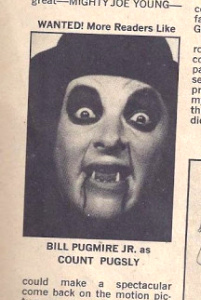
In probably his late teens & 20s he worked at an attraction in Seattle called Jones’ Fantastic Museum…

“For 13 years the museum featured a real live vampire named Count Pugsly who roamed around scaring children and adults alike, even outside the museum. Sometimes he would appear to be a mannequin, standing still until an unsuspecting visitor stepped in front of him. As soon as the realization struck the visitor that no activating floor mat was there, he would walk towards them, often eliciting loud screams of fright.”

That was Wilum.


The English-Speaking Peoples

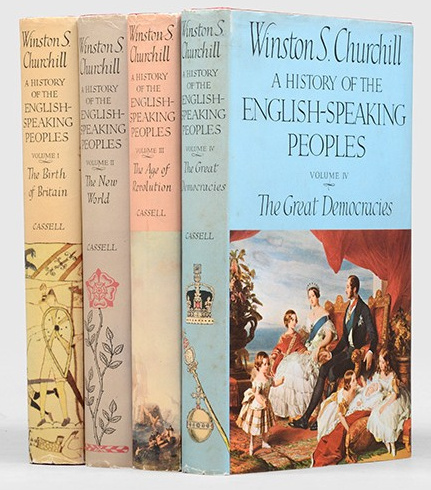
It’s always interesting to see what books looked like when they first appeared. Here’s Churchill’s masterpiece of popular history, the History of the English-Speaking Peoples

There are two abridged versions, the handsome The Island Race (1964) with copious illustrations, and History of the English-Speaking Peoples (abridged). They’re said to be just a bit dry, with a lot of Churchill’s personality and wit removed. Those who balk at the length might do better to try the four-volumes unabridged, in a good audiobook version.

Churchill’s set of books came to a halt as the year 1900 dawned. But a later masterly updating was accomplished with the further book A History of the English-Speaking Peoples since 1900 by Andrew Roberts. Roberts is coming to speak in Stoke-on-Trent this summer, at the city’s literary festival.

Incidentally there’s now a book which calmly and systematically rebuts all the myths and sly slurs about Churchill, Winston Churchill: Winston Churchill, Myth and Reality: What He Actually Did and Said.

Doff Bros., 1905

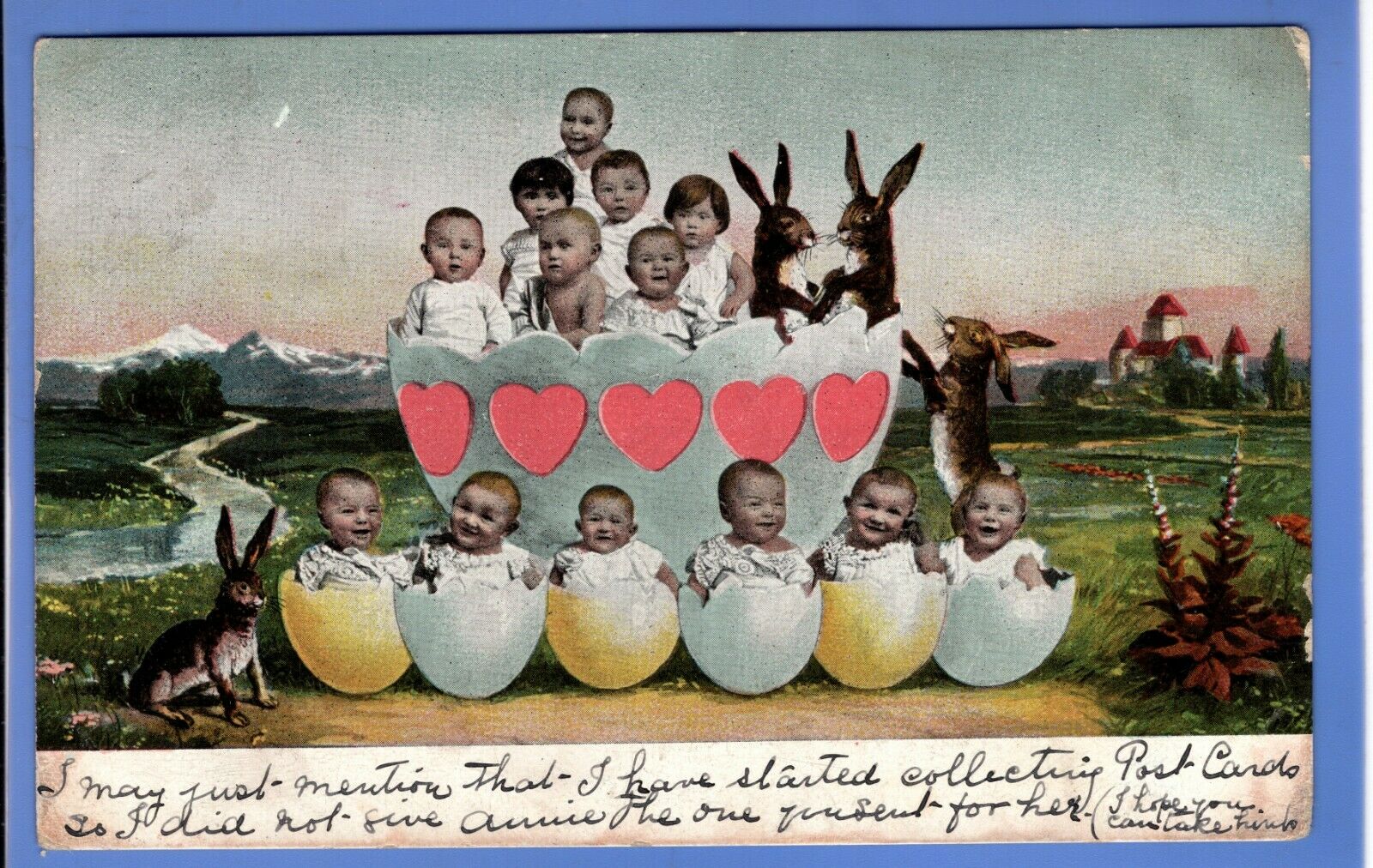
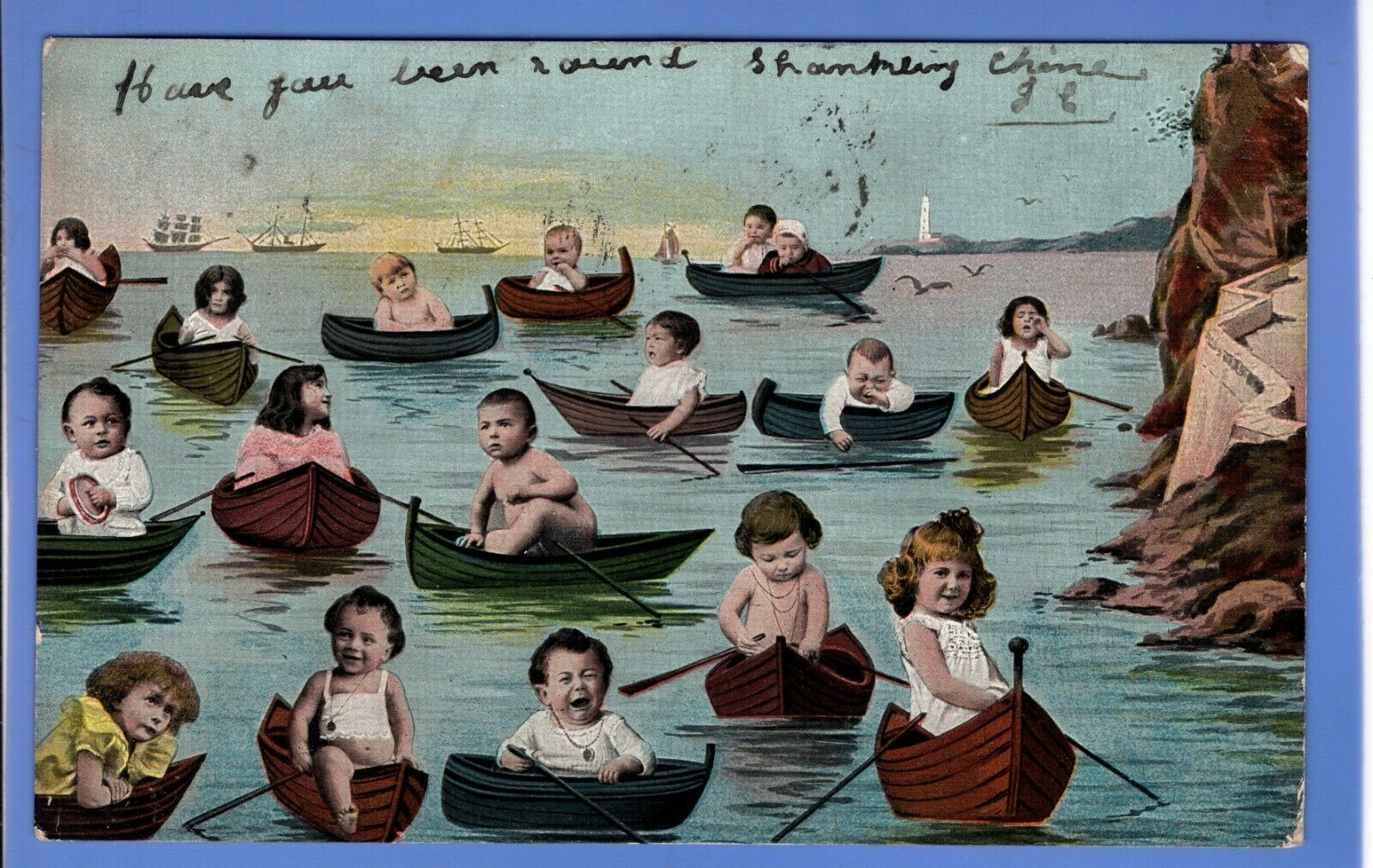
Early examples of photomontage from “Doff Brothers, Manchester”, both postmarked 1905. They show that early commercial photomontage for printed postcards wasn’t just something confined to the agricultural grassroots in America. The Americans were also making folksy cards like this at about the same time, but showing things like giant corn cobs, giant chickens and fish.

Major new Oscar Rejlander exhibition

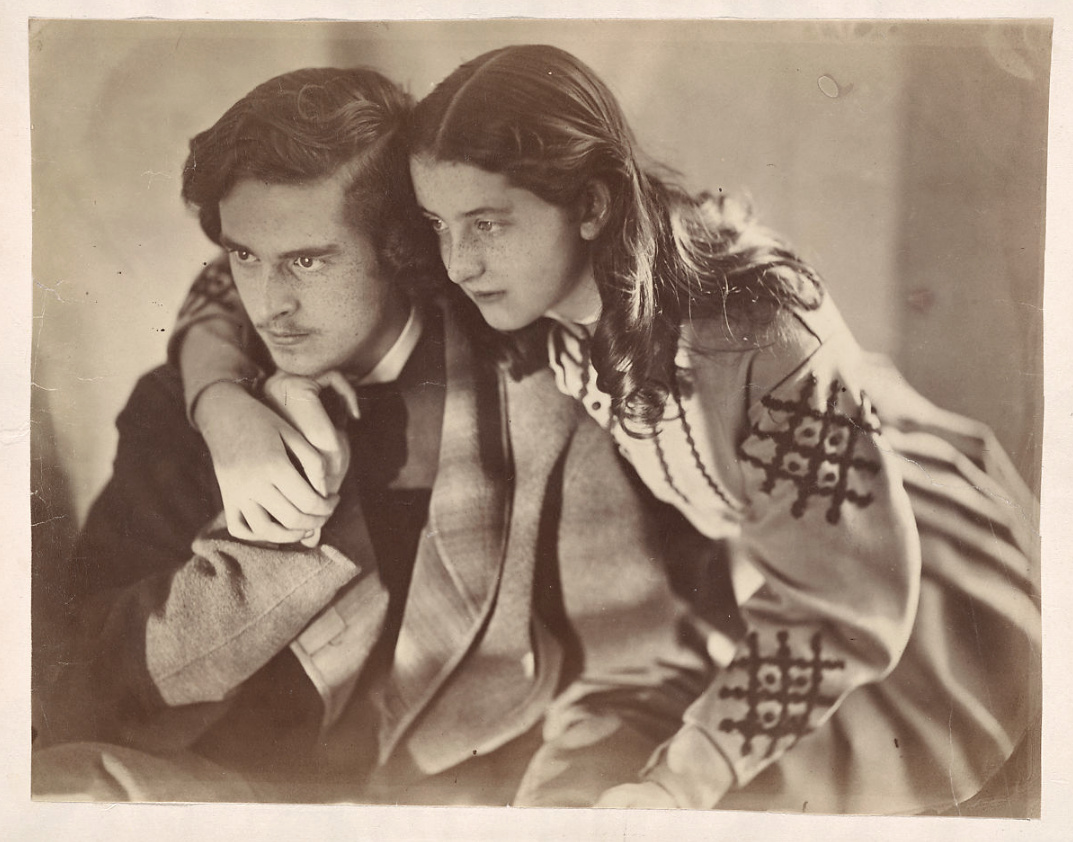
I’m pleased to hear that the Wolverhampton photographer Oscar Rejlander has a major exhibition at the J. Paul Getty Museum in Los Angeles, of all places. It appears to have travelled from its 2018 debut in Canada, so let’s hope it eventually crosses the Atlantic and reaches Birmingham. His work is far more human and warm than the cold and aloof psychotica made by Julia Margaret Cameron, with whom he’s commonly compared, and it should be a popular show.

Oscar Rejlander: Artist Photographer, on view 12th March – 9th June 2019 at the J. Paul Getty Museum, Getty Center, Los Angeles. … The exhibition features 150 photographs”

“Mary Constable and Her Brother”, 1866.

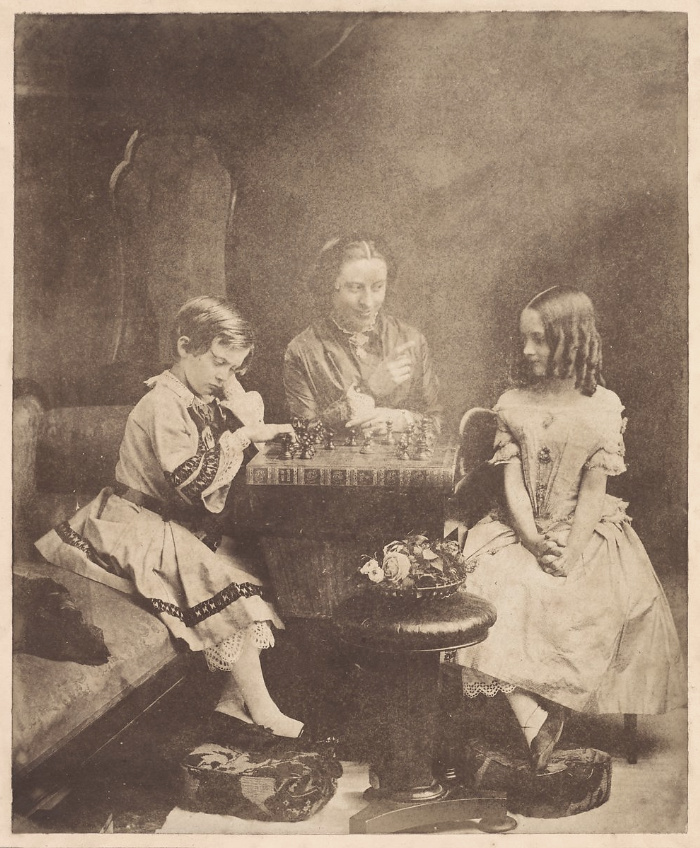
“The Scholar’s Mate”, c. 1855 exhibited 1856. The governess-tutor appears pleased and amused that her clever girl scholar is about two moves from checkmating her brother at a game of chess, and she seems to be quietly warning the girl to remain ladylike about it and not to gloat and snook when she wins. (Boys were commonly dressed as girls until they were abruptly “breeched” into trousers, in those days, thus one assumes she’s playing her brother even though he wears skirts).

One wonders if his pictures titled “Wolverhampton Fair” and “The Fortune Teller”, of the same 1855 date, survived. Also how many other Wolverhampton pictures have survived. He spent about 15 years in Wolverhampton before fame hit. He’s said to have employed the fairground sideshow girls of Wolverhampton as models (“Madame Wharton’s Pose Plastique Troupe”), which probably added to the scandal around his famous breakthrough pictures known as Two Ways of Life.

The new show is billed as “the first major retrospective on Rejlander”, and there’s a sumptuous Yale University Press book to accompany it. Which might make the West Midlands curators pause for thought, about why we couldn’t have got there first and are instead being beaten to a major show on ‘the father of art photography’ by distant Canada and Los Angeles.

War in Cheshire

Now we know something about the locations for one of the Tolkien bio-pics. Not quite my own Staffordshire, but somewhat near-ish in what’s technically Cheshire. A south Manchester suburb stood in for the battlefield scenes….

“Tatton Studios was one of their key locations, with war scenes being filmed on one of its 24-acre backlots … played host to a cast of 150 First World War soldiers, 30 cavalry horses and a 300-strong crew, which included a dedicated SFX team to manage activity such as night shooting and also construction experts, who spent three months building the battlefield.”

This is a useful behind-the-scenes movie-making article, though there also seems to be a great deal of mindless legacy media blather in advance of this first movie. Such as dismal headlines like: “The Untold Truth of JRR Tolkien” and “Will ‘Tolkien’ bring the Lord of the Rings trilogy back to life?”.

Er, when did it die…?

But there are also currently some good thoughtful articles arising from the New York exhibition, such as the new “You’ve Read Tolkien’s Books — But Have You Seen His Paintings?” and “Tolkien’s drawings reveal a wizard at work”.