Tolkien Gleanings #213

Tolkien Gleanings #213.

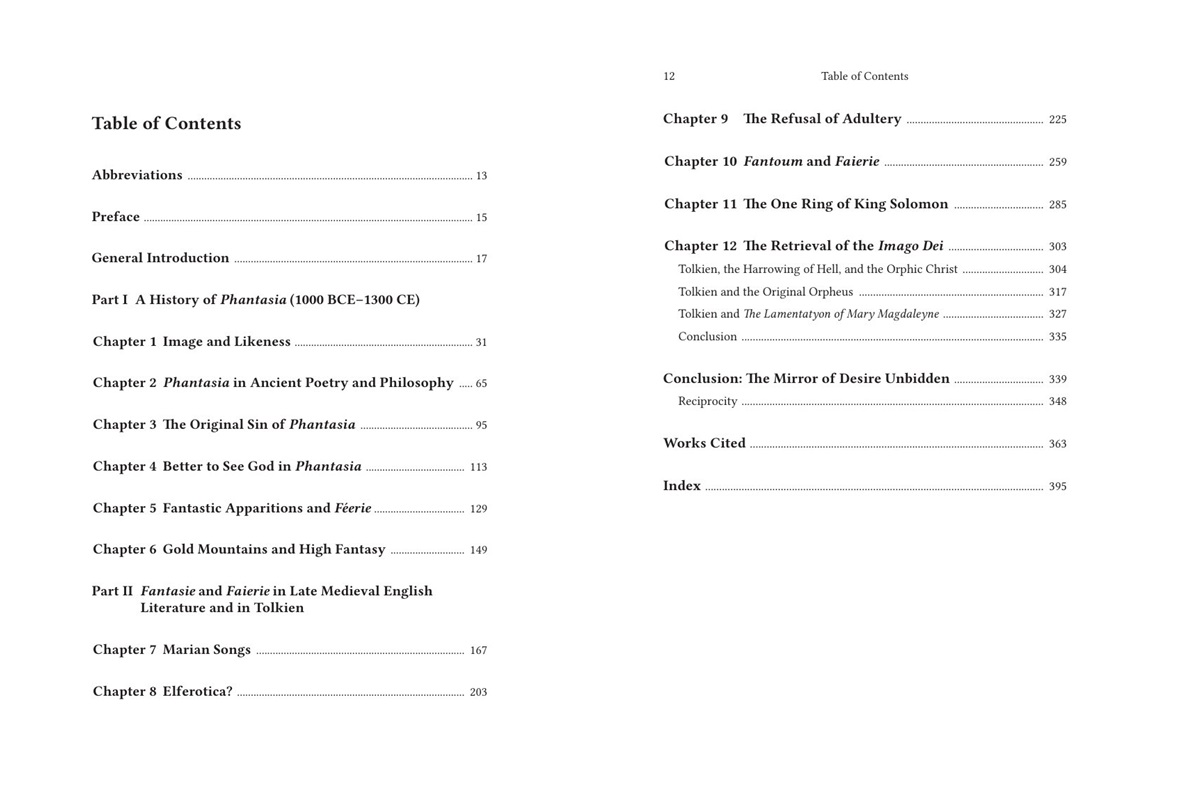
* A substantial new 422-page book, The Mirror of Desire Unbidden: Retrieving the Imago Dei in Tolkien and Late Medieval English Literature (2024). Generously available in open access and freely downloadable as an .ePUB or .PDF file. Also, note the Creative Commons Non-Commercial licence.
* Noticed at the back of the book Tolkien and Philosophy (2014), the chapter “Tolkien at King Edward’s School” in Birmingham. A review in Tolkien Studies reveals its contents…

a series of documents with brief commentary, [drawn] from Tolkien’s time at King Edward’s School, Birmingham (1900–1911). Canzonieri uses these archival records to attempt to illuminate Tolkien’s earliest study of philosophy. [The first] dating from 1906, describes the types of classes Tolkien would have taken [and this information] suggests that Tolkien would surely have been exposed to some of the Classical philosophers. [The second, a report on the Roman History class exams] noted… “Tolkien gave signs of a more acute and independent judgement than anyone else; his style was more matured, but he seemed to have no control over it and sometimes became almost un-intelligible”. Tolkien’s [exam room] enthusiasm is highlighted with the point that he attempted to answer four of the board’s questions when all he [was] asked to do was answer one.

* Phuulish Fellow blog examines Frodo’s choice… “via the lens of ancient Roman philosophy”.

* From South America, the Costa Rican university journal Comunicacion has a new Tolkien special-issue. Freely available online, as is the way with nearly all Spanish and South American journals.

   – Indoors, outdoors and hospitality in The Lord of the Rings.

   – The music of the Ainur and the problem of freedom.

   – The symbology of evil in Tolkien’s Middle-earth.

   – Songs of power in the work of J.R.R. Tolkien.

   – The garments of humility. [Tolkien’s depictions of humility vs. arrogance. In English]

   – Glimpses of barrow daggers. [The Roman pugio dagger, of Celtiberian origin, as possible inspiration for the barrow daggers in LoTR]

* The Children’s Literature Association Quarterly has a call-for-papers, for a forthcoming special issue on J.R.R. Tolkien & Children’s Literature. They hope to focus on: the first edition of The Hobbit (which would include its 1942 wartime reprinting at a vital time for the nation, I’d add); Tolkien’s fairy tales; his thoughts on illustration and book design for children; and influences stemming from his own childhood reading.

* Newly released on YouTube, episodes of the slick Catholic Theology Show from Ave Maria University, including one on “The Theology of Tolkien”.

* New in the latest edition of the journal Brumal, the essay “The Vengance of the Natural” compares John Wyndham’s triffids to Tolkien’s ents. Freely available online, though in Spanish.

* And finally, an art gallery exhibition this autumn on Ancient Trees. 12th September until 14th October 2024 at the Nature In Art Gallery, Gloucester, UK. “This exhibition is a unique collaboration between The Arborealists [a long-running group of tree painters] and Julian Hight, celebrated authority on ancient trees and author of Britain’s Tree Story among others”.
Tolkien Gleanings #212

Tolkien Gleanings #212.

* New thoughts from the venerable Tolkien scholar Verlyn Flieger, on “The Literary Power of Hobbits”

“Hobbits were no part of Tolkien’s original plan. They entered rather late and through a side door [ … Their addition] shouldn’t have worked. But it did. The world can be grateful.”

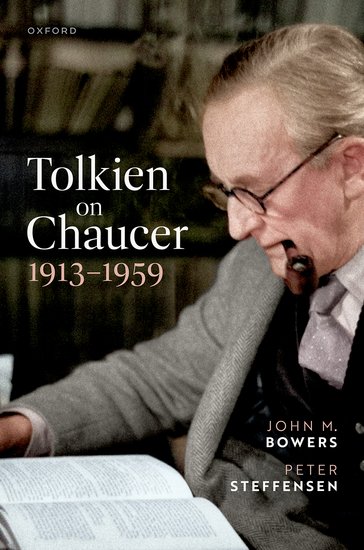
* Listings for the heavily delayed book Tolkien on Chaucer, 1913-1959 now show a pleasing cover.

“He lectured on Chaucer, edited Chaucer, and published essays on Chaucer. Tolkien on Chaucer, 1913-59 reprints many of these works for the first time, and documents Tolkien’s career-long engagement with the poet and traces [Chaucer’s] influence in Tolkien’s own works.”

* The Thoughts on Tolkien blog, exploring Tolkien’s use of a Latin phrase, sursum corda.

* The annual Aelfwine Essay Awards, for which the Spanish Tolkien Society invites entries. Essays can be up to 10,000 words and can be submitted in English, but must also have an accompanying Spanish translation. Deadline: 31st October 2024.

* Due 26th September 2024, and well-timed for the “back to university, got my grant-cheque” period, J.R.R. Tolkien: A Very Short Introduction. Part of the ‘Very Short Introductions’ pocket-book series from Oxford University Press. The author is a lecturer in Mediaeval Studies at the University of York.

* On YouTube, the Digital Tolkien Project has another monthly progress update, for June 2024.

* A YouTube recording of Holly Ordway on Tolkien’s Faith, speaking recently in a lecture at an American theological seminary.

* New on Project Muse, “The Character of Time in Sir Gawain and the Green Knight ($ paywall), which seems to me relevant to the development of Tolkien’s own thinking on time…

“Gawain elaborates its own vision of dynamic, social time in its descriptions of time and characters. Through its evasion of teleologies, the poem offers a critique of discourses of inevitability. Gawain complicates an already complex picture of medieval time-schemes”.

Talking of Gawain, I have acquired a crunchable copy of The Gawain Country (1984). I’ll hope to produce an expanded free edition soon, which will include the author’s later follow-on essays.

* A links-listing of Columbia University undergraduate prizes for 2024 dissertations. Note the list includes “The Enduring Impact of World War I in the Works and Lives of Dorothy L. Sayers, Agatha Christie, J.R.R. Tolkien, and C.S. Lewis, and on British Society between the World Wars”. Freely available online in PDF.

* Tolkien’s great nephew, Tim Tolkien… “will be sculpting a life-size statue of Cardinal John Henry Newman for Birmingham’s Cofton Park.” I’m fairly sure the article is a little misleading, in casually saying Newman was buried at the “Birmingham Oratory”. So far as I know his grave is still out at Rednal in the Lickey Hills, in the grounds of the Oratory’s Retreat House (which Tolkien knew well as a boy).

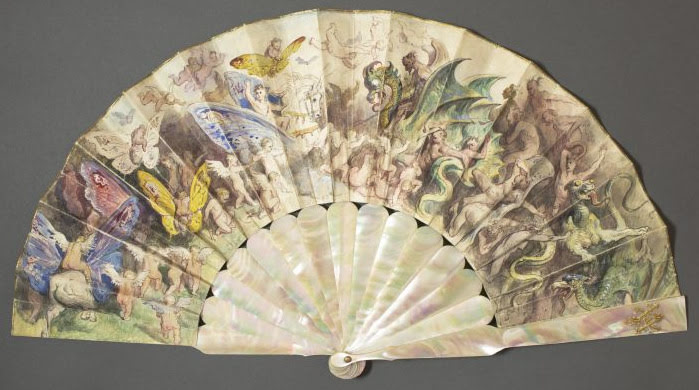
* And finally, a fantasy fan. No, really… Gustave Dore’s vision of butterfly-riding cherubs vs. dragon-riding demons, painted on a ladies’ flutter-fan. Now at the Fan Museum in London.

Tolkien Gleanings #211

Tolkien Gleanings #211.

* Fine Books Magazine reports “Tolkien’s Page Proofs in Folger’s New Special Exhibitions Gallery”. These are his hand-corrected proof-copies of The Lord of the Rings. On show until 5th January 2025, in Washington, DC, USA.

* The new Tolkien memorial in Oxford, in the artist’s local Stourbridge News newspaper (which covers the southern parts of the Black Country near Birmingham). With excellent pictures.

* Due in October 2024, a new book from the Catholic University of America Press titled Tolkien, Philosopher of War. Exploring Tolkien’s “philosophical and theological understanding of war”, the book appears to focus around the dangers of vanity in relation to militarism and war. Vanity is here seen as a key factor in the first emergence (Italian Futurism) of what would become the paramilitary political platforms of the inter-war years. Tolkien’s LoTR can thus be seen to… “dramatize[s] an aesthetic resistance to Futurism” and its “apocalyptic politics”.

* Talking of war, new on YouTube is a new 50-minute podcast aiming to present “The Real ‘War of the Rohirrim’, According to Tolkien”. This will be useful for many, as the mass marketing for the new animé movie starts to reveal a radically different and non-Tolkien plot. Skip to 18.15 minutes in the podcast/video to save yourself some time, and to arrive at the promised focus.

* Also new on YouTube, the podcast “Tolkien & Lewis & Wesley” in which… “Nick Polk of Tolkien [discusses] his involvement with Mallorn, the Tolkien Society journal”.

* In the second issue of the new journal Nexus, a short student essay on “J.R.R. Tolkien and Escapism”.

* Seemingly released under Creative Commons as part of Archive.org’s recent ingestion of newly Open Access books, Tom Shippey’s Beowulf and the North Before the Vikings….

“What follows is a challenge to a well-established consensus, which as I argue below was created in large part by Professor Tolkien. It is also in some respects a dialogue with Tolkien, and moreover points to a kind of dialogue between Tolkien young and Tolkien old — a dialogue which has hardly been noticed within the scholarly world.”

* And finally, a nerdy computerised comparison of the writings of Tolkien and Lewis. These are crunched…

mathematically by using an original multi–dimensional analysis of linguistic parameters, based on surface deep–language variables and linguistic channels. [This reveals] strong connections between The Lord of the Rings (Tolkien), The Chronicles of Narnia, The Space Trilogy (Lewis) and novels by [George] MacDonald.”

Tolkien Gleanings #210

Tolkien Gleanings #210.

* New on YouTube, the recent lectures “A Veritable “Middle Earth”’: Tolkien and the Palaeoanthropological Imagination” and “Riddles in the Grass: the characterisation and narrative value of landscape over the fields of Rohan”, both recent parts of the ongoing Oxford 50 series of public talks. Turns out the first talk is about the study of the anthropology of prehistory — prehistoric man etc — rather than (as I had idly supposed) a witty way of referring to the Victorian-era history of folk anthropology and ethnography as a field of study.

* A new book from France’s Le Dragon de Brume imprint, On Cartography, Maps & Locations in Middle-earth (2024). This joins their previous On Some Stars, Flowers & Places in Middle-earth (2023). Both are freely online. They contain translated essays selected from the publisher’s French-language journal (2011-2017). To see the PDF download button for each book, open the Google Docs preview in full-screen mode.

* Looking at Le Dragon de Brume’s French journals (see above), I see Leo Carruthers, “Homme elfique, peuple elfique: Sire Gauvain et le Chevalier vert”, (Elven man, elven people: Sir Gawain and the Green Knight) at the end of the final issue in 2017. This however is an issue only available in print, via Lulu.com. At a guess, though, it’s possible the essay was folded into his new book Pearl / Perle: suivi de “Tolkien et Perle”. Which apparently also presents some new ideas about Gawain.

* Note also that Le Dragon de Brume are still active in terms of planning new publications. There’s a current call-for-papers for a 2025 linguistics issue, with papers ideally to be sent in under Creative Commons (CC-BY-SA).

* The Oxford Mail notes “Letter J.R.R Tolkien wrote to boy in Oxford could fetch £20k”, and gives details of its contents.

* The forthcoming The War of the Rohirrim animated animé movie is now issuing some pre-release publicity. Whatever it turns out to be at Christmas 2024, one can’t blame the artists who worked on it. Their work is set be collected in the forthcoming artbook The Lord of the Rings: The War of the Rohirrim Official Visual Companion, due on 7th November 2024.

* I’m pleased to find “Middle-earth, Narnia and Lovecraft’s Dream World: Comparative World-views in Fantasy”, from the now unobtainable Crypt of Cthulhu No. 13 (1983). I was too poor to afford a set of Crypt when they were newly in PDF, and now… the older PDFs are no longer available to buy due to a falling out between publisher and editor. But at least this item is freely available online.

* And finally, the faery ‘dreamland’ tales of H.G. Wells. Yes, Wells, not Tolkien or Lovecraft. Three of these were published in his late prime in 1901-1906. These are carefully considered in the undergraduate dissertation “”I Have Dreamed a Dream…”: An Analysis of H.G. Wells’ Short Stories “Mr Skelmersdale in Fairyland”, “The Door in the Wall” and “A Dream of Armageddon”” (2008). The original dates make them of possible interest re: influence on Tolkien, and they were later to be easily found in book collections. Such as the Wells collection Tales of the unexpected (1924) which has all three. The dissertation is freely available online, as are the stories since they are now ‘public domain’.

Tolkien Gleanings #209

Tolkien Gleanings #209.

* An new oliphaunt-sized set of Tolkien Addenda & Corrigenda Updates from Hammond & Scull. Freely available online.

* In The Oxford Mail newspaper, the report “J.R.R. Tolkien memorial unveiled in Oxford by Neil Gaiman”. Freely available online.

* New on YouTube, the talk “A Grandson’s Reflections on J.R.R. Tolkien” (Michael G. Tolkien).

* Also new on YouTube, one of the Oxford 50 series of talks, “Tolkien and the Anglo-Saxon Calendar”.

* The annual Muriel Fuller Endowment for the Imagination and the Arts public lecture, now on YouTube. This year, “George MacDonald and the Prophetic Imagination”. Part of the Celebrating George MacDonald 2024 bicentenary events.

* A new repository record-page for “Tolkien, Shakespeare, Trees, and The Lord of the Rings”, a 2024 article from the scholarly journal The Explicator. Partly funded by the EU, and thus it looks like a one-year embargo (with a public download in September 2025).

* Public donations are invited to support the annual J.R.R. Tolkien Lecture on Fantasy Literature at Pembroke College, Oxford.

* New to me, The Inquisitive Biologist blog reviewed The Science of Middle-Earth: A New Understanding of Tolkien and His World (2021).

* The forthcoming U.S. conference Mythmoot XI: ‘The Resilience of Imagination’ now has a PDF of the presentation abstracts. Many Tolkien papers, and among these I especially noted “The Resilience of Imagination in Modern Academia: Tolkien as Master of the “Non-traditional Research Output”.

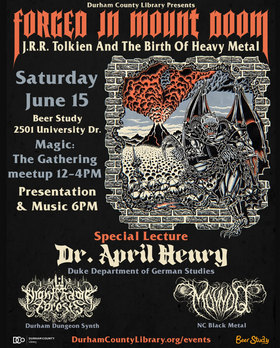
* And finally, a talk + gig which happened a few days ago, titled “Forged In Mount Doom: J.R.R. Tolkien And The Birth Of Heavy Metal”. The talk was by “Dr. April Henry, professor of German Studies at Duke University”. Supported by a ‘black metal’ (heavy metal) band, and a maker of doomy ‘dungeon synth’ electronica.

Litter in the 2024 manifestos, or not…

The latest Country Life magazine is a special ‘Green’ issue ahead of the General Election. Not that they’re trying to push readers to vote for the Green Party, just get real grassroots environment and countryside issues on the agenda for discussion. The magazine’s lead editorial is a strong one about litter. This doesn’t, however, look at what the party manifestos have to say on litter. I thought I’d take a look. Here are the results for a basic keyword search for “litter” in the relevant PDFs…

Conservative Party: zero mentions.

Labour Party: zero mentions.

Reform (they have a ‘Contract’ rather than a manifesto): zero mentions.

Green Party (two versions, I searched the long version): zero mentions.

Lib Dems: zero mentions.

I also search for “tipping”, as in fly-tipping. Only the Conservatives mention it: “We will make fly-tipping an offence that carries penalty points” on a driving licence.

So there we have it. Even the Greens can’t bring themselves to mention a dire problem that’s staring the British people in the face every day. Maybe we need a manifesto from the Clean & Tidy Party. 🙂

Tolkien Gleanings #208

Tolkien Gleanings #208.

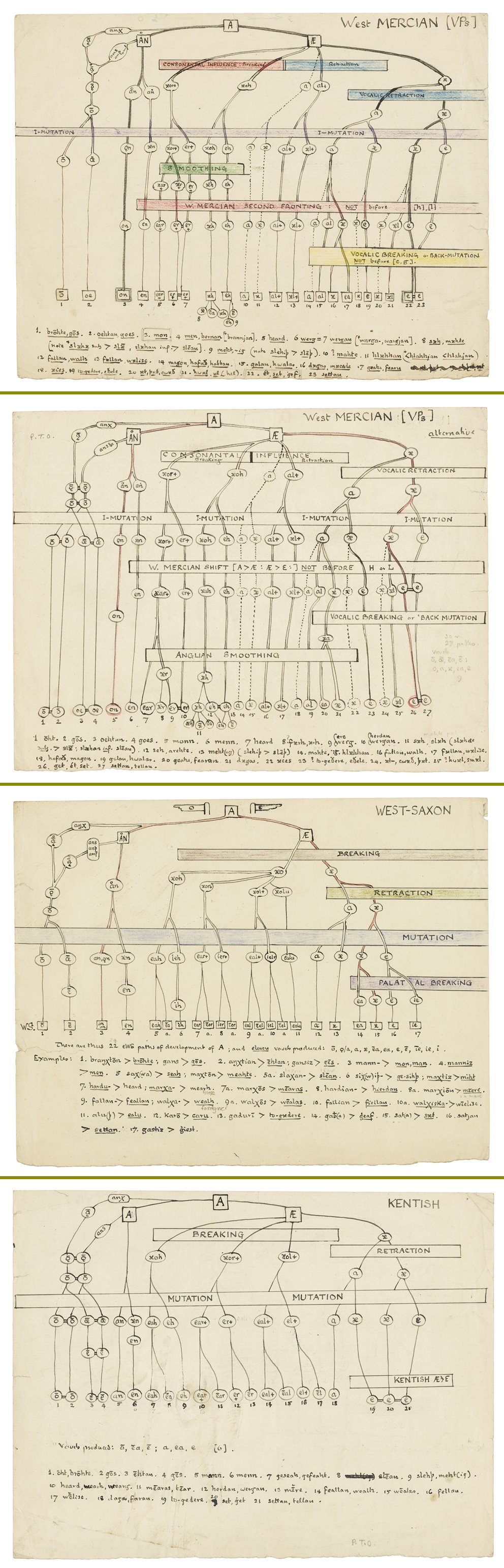
* Up for auction, Tolkien’s hand-drawn diagrams showing the changes in Old English speech over time. Drawn in 1942.

Also recently auctioned, for $24k, a short dash of Tolkien’s penmanship… “In all my works I take the part of the trees as against all their enemies.”

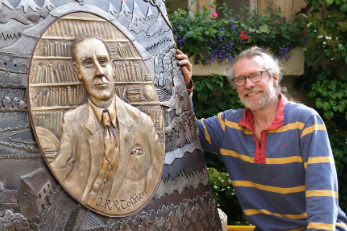
* A peep at the Pembroke College memorial to J.R.R. Tolkien, unveiled a few days ago.

* The Literary Role of History in the Fiction of J.R.R. Tolkien (2023) now has a more affordable ebook version. I’m fairly sure Amazon UK only had the £135 print version, a few weeks ago. The ebook gives the table-of-contents…

1. History in the Archives and on the Road.
2. Forehistories: Prehistory to the Pre-Roman.
3. From Ulfilas to Appendix F: How Tolkien Yearned for, and Gave Up, the Goths.
4. Interhistories: Tolkien, Byzantium, and the Worlds of Modern Fantasy.
5. Hobbits, the Rohirrim and the Modern Histories of Politeness.
6. Sylvan Historians: The Silvan Elves in Nature and History.
7. Philology and History: Tolkien, Auerbach, Said.
8. Afterhistories: Or, Why Moria Was Not Restored?

* There’s now a Kindle ebook edition of the book Tolkien e Lovecraft: Alle origini del fantastico. In Italian, a 26,000-word survey of similarities, mostly skating through the two men’s shared reading in fantasy during their younger days (Dunsany, Edgar Rice Burroughs, E.R. Eddison, with other writers also discussed but less certain). I’ve auto-translated the short book (who knew that a Kindle tablet would allow a Kindle ebook to be screenshot-ed?) and this gave me the gist of it. The author seems weaker on Lovecraft than on Tolkien, for instance mistaking W.H. Hodgson’s influence on Lovecraft’s writing — Lovecraft did not encounter his tales until 1934.

* Also from Italy but this time in English, the article “‘Suspension of disbelief’ vs. ‘Secondary Belief’: fictional worlds in Coleridge and Tolkien”. Freely available online, and part of a substantial new special-issue of the journal Between (Italian Association for the Theory and Comparative History of Literature), an issue which is themed around the idea of ‘Other Possible Worlds’.

* Another book review has been added to the latest Journal of Tolkien Research, a short review of From Imagination to Faerie: Tolkien’s Thomist Fantasy (2022). Freely available online.

* America’s only mediaeval art journal requires an editor.

* And finally, The Ring of the Niblung, free on LibriVox. Dramatised and with narration, drawn from Margaret Armour’s 1910 ‘plain prose’ translation. But here (oh bliss…) produced in audio without 7½ hours of incomprehensible operatic screeching and wailing. Amazingly, this seems to be the first time the Ring has been done this way. Because I went looking for a similar but more professional production, but could find none.

Tolkien Gleanings #207

Tolkien Gleanings #207.

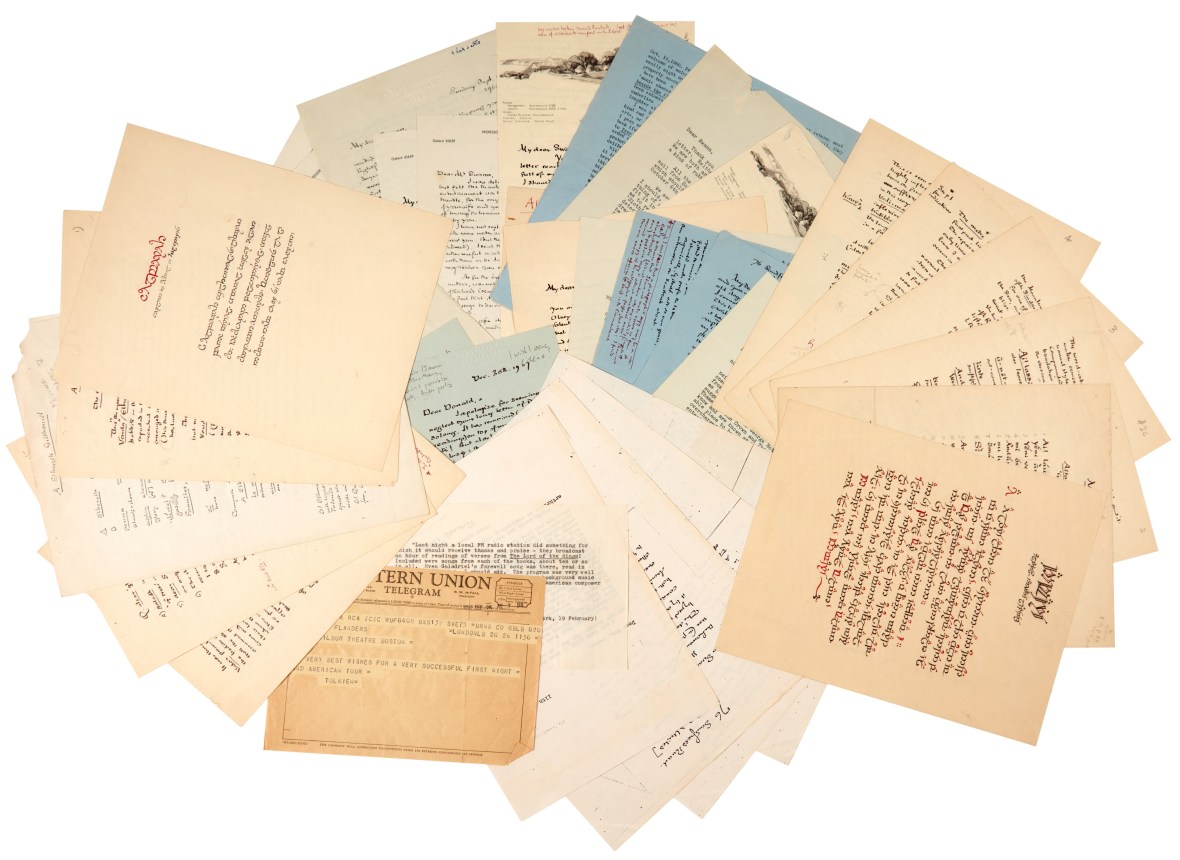
* The Times notes a forthcoming sale at the Sotheby’s auction house, of a large bundle of Tolkien’s correspondence with Donald Swann. Swann was a composer (The Road Goes Ever On: A Song Cycle) and also one half of the musical comedy duo Flanders and Swann. At present, Sotheby’s has no Web page or date for the sale. Forum commenters suggest the bundle has material not in the new edition of the Letters.

* Middle Moot 2024. 26th October 2024 at the World War I Museum & Memorial in Kansas City, and themed “Consolation, Recovery, & Hope in Faerie”. The call for proposals is now open, and closes 26th September 2024.

* The Moss Dreams blog homes in on a specific Tolkien health claim, in “Tolkien: Faery is Necessary for Your Health”.

* The VoegelinView blog reviews Myth, Magic, and Power in Tolkien’s Middle-Earth (2023).

* New at The Great Courses website, “Pilot Lecture: C.S. Lewis, J.R.R. Tolkien, and Their Circle”. Apparently there’s a new course of lectures from this leading online-learning company, coming soon.

* At Signum University, a new page for the proposed August 2024 online modules. These include: “Adaptations of Middle-earth: From Deitch and Bakshi to Jackson”; “The body in Tolkien’s legendarium”; and “Utopias and dystopias in The Fellowship of the Ring“.

* St. Bernard’s School of Theology on “Image of the Maker: The Theological Poetics of George Macdonald and J.R.R. Tolkien”. This article introduces a seven-week summer school course, set to run online from early July 2024. This appears to be eligible for anyone to ‘sit in on’ (U.S.: ‘audit’) as part of their One Free Summer Audit Opportunity.

* There is reported to be “a new Chinese translation of Tolkien’s biography” available inside China. This is Carpenter’s biography, nicely produced as a hardback but with “more than 100 pages” of updating annotations. These reference later information found in the first three volumes of HoME and the J.R.R. Tolkien Companion and Guide volumes. Though what edition of the latter was used is uncertain. The amount of censorship is also uncertain.

* The venerable Prometheus Awards welcome fantasy books. The organisers remind potential entrants that… “Many falsely assume that the Prometheus Awards are exclusively focused on ‘libertarian science fiction’ [but] fantasy has always been eligible for nomination”. Also worth noting is that, to give readers an idea of what’s eligible, the article offers a rich list of suggested freedom-loving titles in fantasy, sword & sorcery and more.

* And finally, what’s claimed to be the “U.S. premiere” of the stage adaptation The Lord of the Rings – A Musical Tale. Chicago, USA, running from July until at least October 2024. Booking now.

Tolkien Gleanings #206

Tolkien Gleanings #206.

* In The Oxford Mail this week, “Memorial to be unveiled in honour of J.R.R. Tolkien”

“The memorial created by sculptor Tim Tolkien, J.R.R. Tolkien’s grand-nephew, will be officially unveiled on 12th June before invited donors, guests, and members of the community.”

The memorial with a central “bronze relief” of Tolkien will be located somewhere unspecified within Pembroke College, Oxford. Thus it should be somewhat safer than otherwise from attack by activists.

* New in the journal English Studies, ““Sir Gawain and the Green Knight”, J.R.R. Tolkien’s 1953 W.P. Ker Memorial Lecture: An Updated Chronology and Related Findings”. Freely available online in open-access.

* New in The European Conservative, “Tolkien’s Secret”

“neither style, nor narrative, nor even invented languages can explain the charm of Tolkien’s stories” [it is perhaps rather because] people cannot live without true stories, without sacred texts, without myths” [and yet in Tolkien the grand sweep of myth has been firmly anchored in a hard-won centuries-deep English common-sense and natural joy, and thus we see that] “Our own lives are part of that perpetual tale that Sam describes” near the end of The Lord of the Rings.

* The Journal of Tolkien Research this week begins a new volume with a review of Theology and Tolkien: Practical Theology (2023). I must say the theme is not immediately enticing to me. ‘Practical Theology’ is an unfamiliar phrase, and what on earth are ‘theodicy’ and ‘koinonia’? But the short review makes it seem quite palatable, and (in a way) a source study for LoTR. Tolkien knew his Bible, and thus scholars who don’t are going to miss possible sources or allusive hints. Though, as the review reassures, the book avoids the usual tub-thumbing Biblical source parallels… “One of the strengths of this compilation is its avoidance of simplistic allegory and cliched parallels with Christian doctrine”.

* In the blog The Imaginative Christian, a blog new to me, a recent post on “Utopia, the Shire, and World-Building”. This also muses on dystopia…

“Tolkien’s genius expands even beyond the basic world-building, of an idyllic society of the Shire — to even include [… the Saruman] character within that world who in his own thoughts comes up with and puts forth in practice his own idea of a ‘perfect world’, albeit more of a dystopian world.”

* The annual New York C. S. Lewis Society Student Essay Contest with prizes. Deadline: 29th June 2024.

* And finally, an upcoming Tolkien Letters Livestream on YouTube… “Help celebrate the one-year anniversary of our launch of the Letters Guide this weekend — we will show some of the new letters [recently found]”.

Tolkien Gleanings #205

Tolkien Gleanings #205.

* Amon Hen #307 (June 2024) is now available to Tolkien Society members. Note they are looking… “for a Layout & Graphic Designer for Vingilot, with the potential to move up to Amon Hen as well with experience”. Vingilot being the relatively new digital magazine which seems to offer a home for longer linguistic or similarly technically-complex essays, while at the same time also soaking up some of the poetry being submitted. The latest Amon Hen also has details of a weekly art challenge for Society members, with theme-prompts for July through to September.

* In the April 2024 edition of Omnes, Giuseppe Pezzini, professor at Oxford, interviewed. He is…

“currently participating in the conference ‘Tolkien: the actuality of myth’, held at the Pontifical University of the Holy Cross in Rome. In this interview, he talks about fundamental concepts of Tolkien’s thought, such as subcreation or his theory of fantasy.”

* In the ground floor gallery of New York City’s Grolier Club until 27th July 2024, an exhibition on dictionary-making titled “Hardly Harmless Drudgery: Landmarks in English Lexicography”. This offers…

“more than 100 objects, from early printed books to CD-ROMs, that tell stories of the people who struggled to define English vocabulary […] The exhibition also features letters to lexicographers from dictionary aficionados [including one by] J.R.R. Tolkien”.

* Another pick from Archive.org’s ongoing ingestion of open-access books, From Clerks to Corpora: essays on the English language yesterday and today (2015). This has two essays on Tolkien, “‘Mythonomer’: Tolkien on Myth in His Scholarly Work” and “Reflections on Tolkien’s Use of Beowulf”.

* A further open-access book of possible interest is Northern Archaeology and Cosmology: A Relational View (2019). This seeks to place animistic–shamanistic cosmologies in the context of the landscapes, animals, weather, and skyscapes of the early North, all informed by the most up-to-date archaeology and finds in material culture. Most of the focus appears to be on Finland and its wider region.

* A new Manchester University Press academic-theoretical book A Book of Monsters: Promethean horror in modern literature and culture (June 2024) has a chapter on “Spectres of Marx in Tolkien’s Middle-Earth”. A copy can be yours for a mere £70, comrade. Though only when discounted by kindly woke megacorp Amazon. The capitalist fat-cats at De Gruyter would like to charge you over £200 for a copy.

* Due in August 2024, the French language book Allers et retours du Hobbit: Des mots aux images. Appears to be about the adaptation(s?) of The Hobbit. Traces the story of The Hobbit from its genesis, all the way to the world-premiere of the movie version.

* And finally, a Welsh nationalist press article this week on “Yr Hobyd: Tolkien’s The Hobbit to be published in Welsh”. With background information, publisher quotes, and a view of some interior pages of the forthcoming book. In English and freely available online.

How to pick up a parcel from an eBay ‘locker’ in the UK

I swore I wouldn’t use eBay again, due to sellers lying about sending by normal second-class mail (they rarely do except on tiny items, and sending ‘signed for’ or by courier can cause huge complications and hassle). But a nice hardback copy of The Journeys of Frodo map-book for The Lord of the Rings for just £15 was too much temptation. I thought that sending the parcel 2nd Class Royal Mail (as stated) to an eBay locker would solve the problem. Turns out that it was actually sent “Signed For” (grrr, but that didn’t matter in the end) not proper normal 2nd class, and that the local ‘locker’ I could see on Google Street View… wasn’t real!

ADVICE FOR FIRST TIME eBAY ‘LOCKER’ PICK-UP USERS:

eBay lockers seem to be just a sort of metal ‘advertising hoarding’ made to look similar to Amazon lockers. These pseudo-lockers don’t have instructions to first-time users fixed on them (at least, mine didn’t). Lack of instructions will confuse the heck out of 80% of the first-time users.

This is what those instructions should say, if they were fixed to the front of the supposed ‘lockers’:

1. Forget about this ‘locker’. It looks very real but has no screen, is not functional for pick-up and doesn’t work like an Amazon locker. Your parcel is not in here. The InPost screen adjacent has no connection with eBay deliveries.

2. What you actually need to do is go into the shop or petrol station, wait in a queue, and then ask at the checkout.

3. The assistant will have a loose pile of parcels somewhere behind the counter.

4. Let him scan the barcode and/or show him the pickup code.

5. He will then ask you your surname, and (hopefully) fish out and hand you your parcel.

Note also that:

1) The barcode image is only present in the email notification that the order is ready. Not in the website notification page. The notification page only has the pickup code. Simply showing a pickup code alone may not be enough, in some shops, according to forum chatter.

2) Cable transfer of the barcode image to a phone may be impossible from a desktop computer’s email software due to security. You may need to copy it to a tablet instead.

3) Also, to get the barcode in the first place you may need to access your email via Web mail, rather than a desktop email software — if the desktop security software blocks certain types of images (e.g. .PNG or .WebP) from displaying in email.

Finally, bear in mind that it may be impossible to send an International parcel to a pick-up, as eBay may only allow a home address delivery.

Tolkien Gleanings #204

Tolkien Gleanings #204.

* A new article from Oronzo Cilli on “Tolkien’s Proposed Translation of Old Norse Egilssaga”, aka ‘Egils Saga’ or ‘Egil’s Saga’.

* As part of Archive.org’s ongoing ingestion of recent open-access books, up pops Tom Shippey’s Hard Reading: Learning from Science Fiction (2016, Liverpool University Press). There’s no Tolkien, but the essay on “The Golden Bough and the Incorporations of Magic in Science Fiction” may interest some. Also newly ingested, and of possible interest to Gleanings readers, a book on the famous early videogames Myst and Riven, Myst and Riven: The World of the D’ni (2011).

* On 10th June 2024, the final public lecture in the current Magdalen College Tolkien lecture-series, John Holmes (University of Birmingham) on “A Veritable ‘Middle Earth’: Tolkien and the Palaeoanthropological Imagination”. “Palaeoanthropological” hopefully = Tolkien in the context of the British anthropology and ethnography of his time. I say “British” because, circa the 1890s-1930s, there were apparently very strong national barriers between schools of anthropology. (Update: no, it’s about study of the anthropology of prehistory — early man etc — rather than the early history of anthropology and ethnography as a field of study).

* The website of musical composer Paul Corfield Godfrey reports, in addition to the already-announced LoTR opera, a forthcoming album of his solo piano works…

“Also coming early 2025 [a new album with] the epic piano rondo Akallabêth, a solo piano version of the ‘Wedding March’ from The Fall of Gondolin and a new work composed specifically for […] this album – The Passing of Arwen.”

* In Poland, an event to discuss the history of Tolkien under communism. 7th June 2024 at what translates as the “Central History Station” in the city of Warsaw, and the “meeting will be broadcast on the IPNtv channel”. The event will ask how the tales of Middle-earth found their way to Poland, how a ‘Tolkien fandom’ arose, and how the tales were understood under the communist dictatorship. According to the Tolkien Encyclopedia (2006) The Hobbit and LoTR had appeared there 1960-63, in faithful translations — but ones subject to unspecified censorship. I also recall reading that Polish copies were sometimes smuggled into Russia prior to the 1980s, for those Russians who could also read Polish and were brave enough to put aside thoughts of the prison camps.

* My reading of the first 50 Mallorn issues is yielding up some interesting nuggets. One such is that in 1972 James Ead of Stone in mid Staffordshire wrote to Mallorn, giving his notes made from a face-to-face talk he had with one “Father C.J.R. Tolkien”. Ead and his local Smial had ventured a few miles north of Stone to visit Fr. Tolkien in his home at Hartshill, Stoke-on-Trent. By 1972 this was also where the elder Tolkien had spent many post-retirement holidays with his son. The elder Tolkien, it was reported, “knows the ‘language’ of trees as the wind sighs through the branches and the noises they make when moved by the wind.” (Mallorn #5, 1972, page 7). Recall here Anglo-Saxon ‘prognostics’, Tolkien’s uses of wind as a subtle sign of possible divine presence in LoTR, and also Tolkien’s “The Horns of Ylmir” (Spring 1917)…

‘Twas in the Land of Willows where the grass is long and green –
I was fingering my harp-strings, for a wind had crept unseen
And was speaking in the tree-tops,

Compare the German poet Ernst O. Hopp ably evoking the poignant Biblical event of Moses being shown the Promised Land (which he will never reach) while hearing the voice of god, in a poem of 1876…

So wie einst beim Abendstrahle
Moses von des Nebo Gipfel
Niederwärts im Jordanthale
Rauschen hörte leis die Wipfel,

So like that long-past glimpse at evening
Moses had from the Nebo Peak
Gazing out into the Jordan Valley
Quietly listening to the treetops speak,    (my translation)

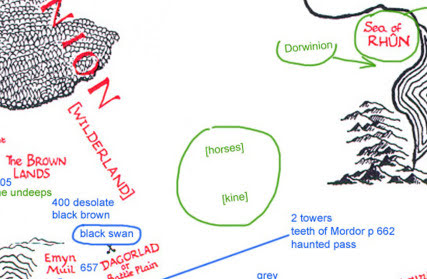
* And finally, from 2015 but new to me, Tolkien’s annotated map of Middle-earth transcribed… “a map of Middle-earth featuring annotations by J.R.R. Tolkien had been re-discovered in a copy of The Lord of the Rings owned by the late [Tolkien illustrator] Pauline Baynes.”

Tolkien places horses and cattle (kine) in the wide empty land between the desolated Brown Lands and the gardens and vineyards of Dorwinion. Presumably wild and un-tended, with ‘herds’ implied. This presence suggests that the desolation of the hills of the Brown Lands was only of limited extent, giving way to relatively dry grasslands (presumably dry, because no major rivers) most suited to ranging herds of horses and wild cattle. I imagine small shaggy steppe-like horses, with neutral-colour coats to blend with their surroundings. The cattle perhaps more akin to shaggy and long-horned Scottish highland cattle than to modern milkers. We can at least know something of the equine colouring and size because, in the years leading to the events of LoTR, Barad Dur could not find its desired large black horses in such nearby terrain. Instead Sauron’s orcs have to raid the battle-horse herds of Rohan for such beasts (as Eomer says: “choosing always the black horses”).