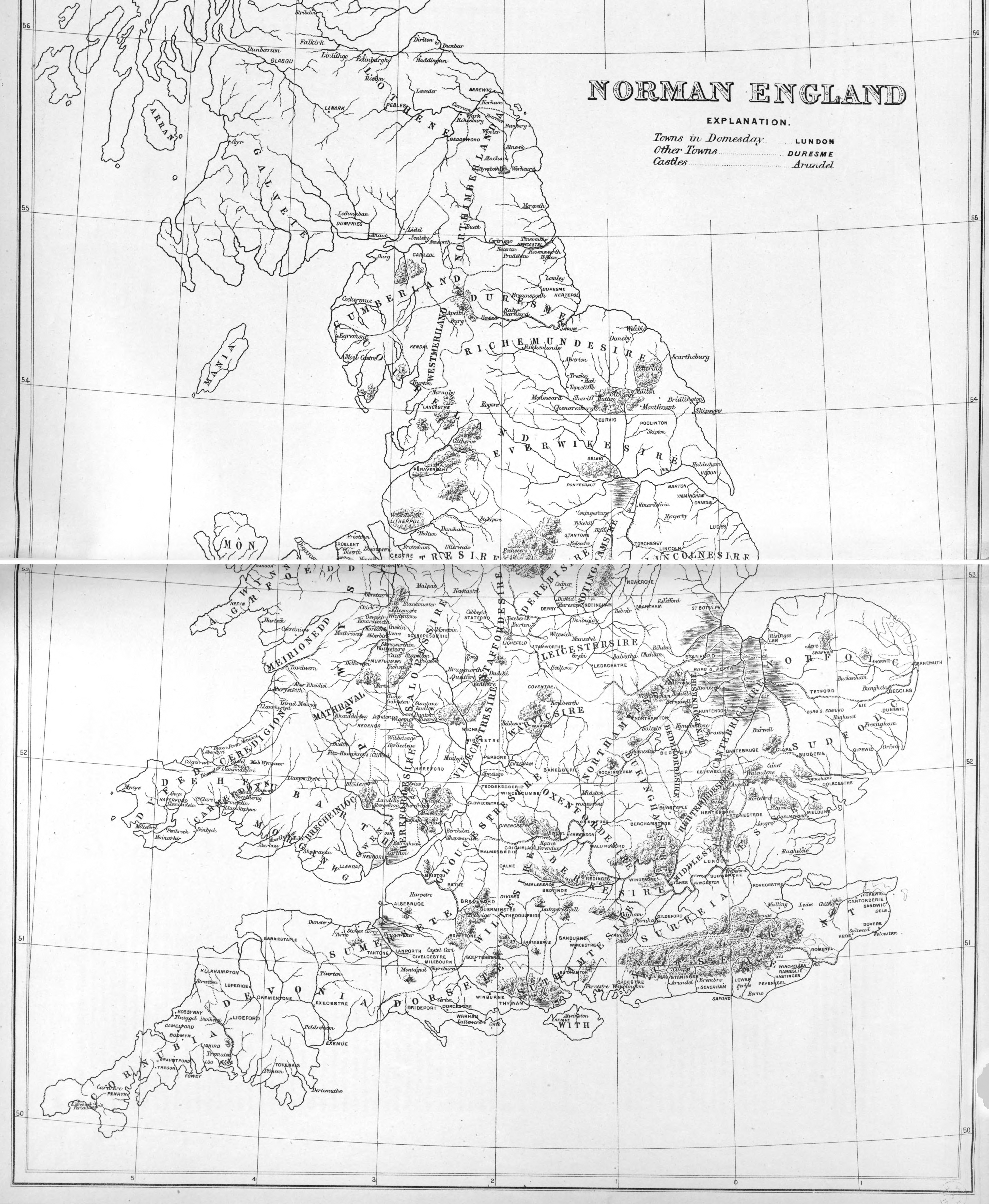
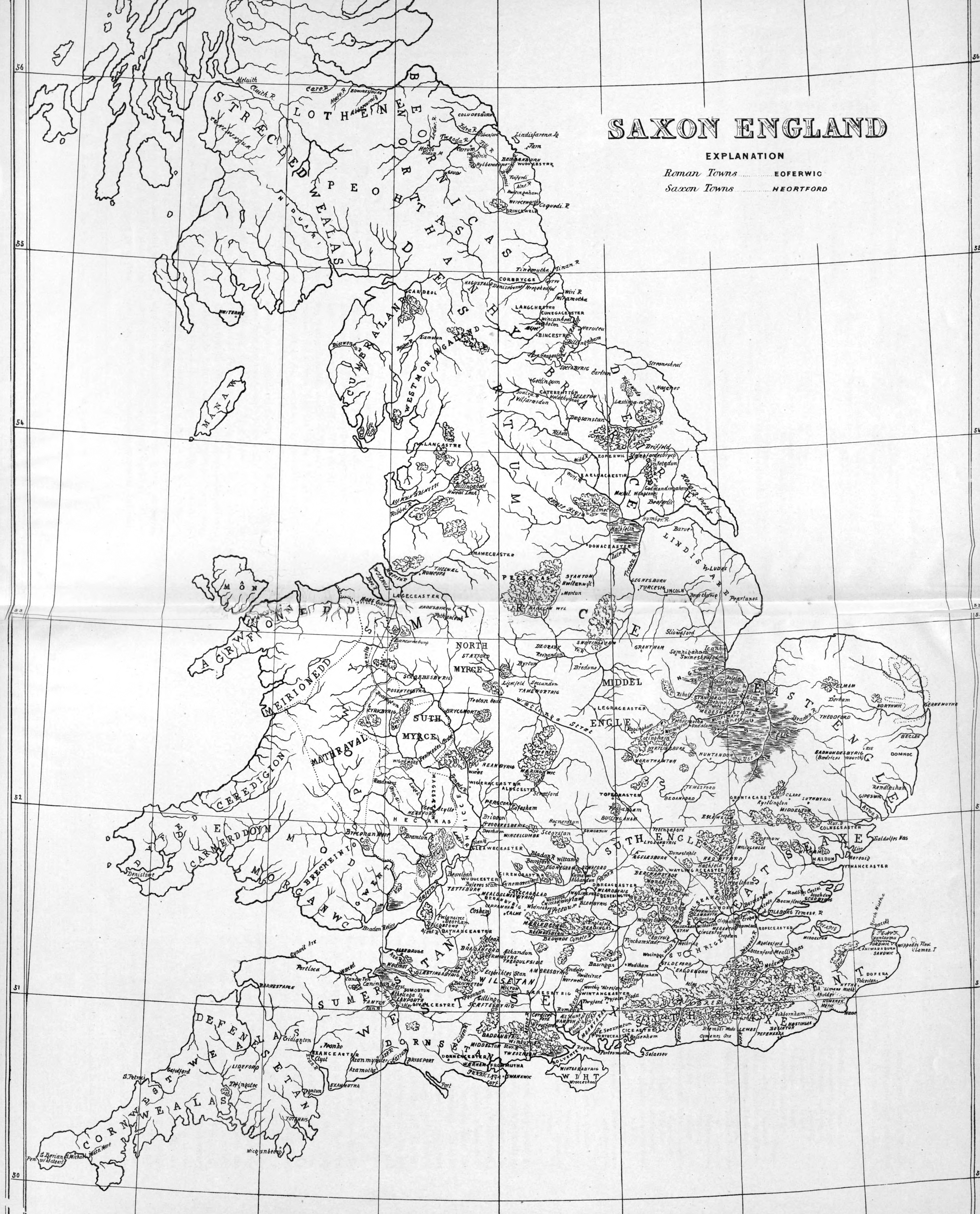
Maps for Saxon Britain and Norman Britain. From Charles H. Pearson, Historical Maps of England, 1883, third edition revised.
At the edge of The Peak, “Badecan Wyl” is ‘Badecan’s Well’, or today the town of Bakewell.
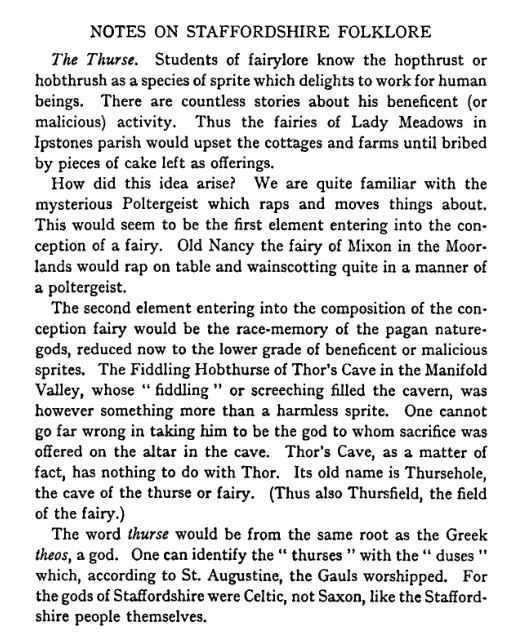
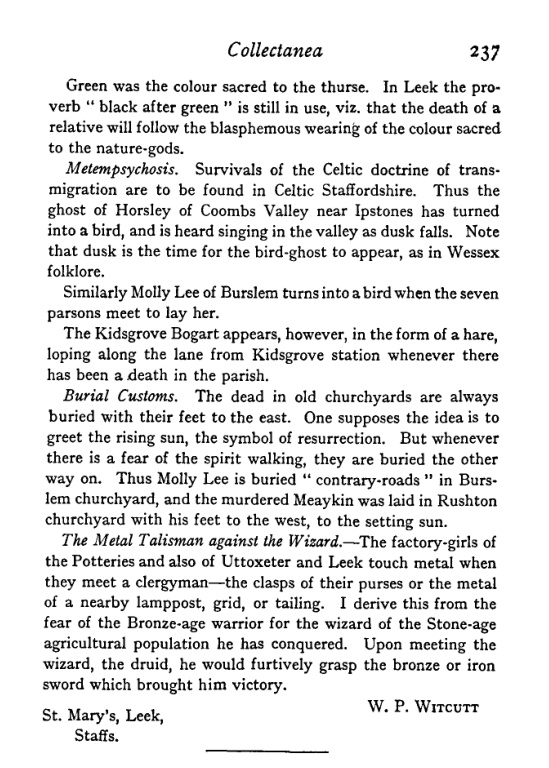
Witcutt’s “Notes on Staffordshire Folklore”, sent in and printed in Folklore, 1941, Vol. 52, No. 3, pages 236-237. He had had a similar short set of entries a year later in Folklore, though those were more ghost-y and not as interesting (Black Dog / Headless Horseman / Phantom Carriage / supposed Witches).
New Tolkien letter(s) at auction, with an interesting quote being given from one letter…
“I can only hope that the ancient proverb (attributed to King Alfred): ‘When the bale is at the highest, then the boot (betterment) is ever highest’ may prove in your case true.”
Old English bale appears to have been mostly a shorthand for ‘tormenting woe, caused by deliberate mischief and wickedness – usually arising from hate, envy and similar’. Could also include actual wounds and bodily binding arising from the same.
It was obsolete by the mid 1500s, but the use of baleful survived in poetry and today that word can still be used and understood in poetry and fantasy literature. Usefully in the descriptive context of a character or animal only having one eye, and that eye having a ‘baleful’ aspect to it. Or a star of ill-omen having a similar ‘baleful’ aspect to it.
Boot is interesting. We still have something like boot in the modern ‘booty’, meaning gathered-up and taken-away treasure. The getting of which would of course lead to betterment, enrichment.
But boot is not in Bosworth-Toller, and instead one needs to search for bót, ‘mending, repair, remedy, improvement’ (also compensation).
The original saying is found in the The Complete Harley 2253 Manuscript, Volume 3…
When the bale is hest,
Thenne is the bote nest.
Which indicates that it’s one of the sayings attributed to a wise-man named “Hendyng”, who thrived in the mid 1200s in what is now the West Midlands.
Some of the Hendyng translations at ‘The Complete Harley’ seem a bit off, seemingly skewed by the later interpretive verses that precede each saying. For instance, the horse one makes more sense and is wiser and more wryly Midlands-y as: “He is free of his horse, who never had one.” But the “boot” saying is translated there as:
“When the pain is highest,
Then is the remedy nighest”
The word bale here is presumably being translated as ‘pain’ due to the context supplied by the preceding words. But that seems only partly justified by the context, which is evidently using ‘pain’ as a shorthand for what is expanded a few words later as treye ant tene, ‘trouble and grief’, rather than as a precise pain-word meaning ‘bodily agony’. Thus the translation of bale as ‘pain’ risks misleading the modern reader. Given this, and Tolkien’s suggestion of ‘betterment’ for boot, a translation might better run:
When the woe is worst,
Then betterment is not far off.
In modern parlance, something like:
When things are really bad,
It can only get better.
Which means it’s not quite the same in sentiment as the similar modern saying…
“Every cloud has a silver lining”.
It’s a little more active that that. The ‘betterment’ here comes from the anticipation that there will soon be ‘action in-the-world’ to fix things and to actively restore things to how they were before. On the other hand the modern understanding of “Every cloud has a silver lining” suggests more of a time-delayed ‘mental reconsideration and re-framing’ of, and ‘learning from’, the misfortune. Something which then potentially leads to the discovery of a new unexpected element in the resolving situation. The addition of this unexpected element then actually makes things better than they were before.
The online English newspaper archives are locked down behind a paywall, but material was often syndicated widely (i.e. was pushed through a press syndication service, where any subscribing paper could run any of the stories or articles on offer at no extra cost). For the benefit of independent scholars and researchers, here are links to three free newspaper collections, useful for searching for syndicated material. The Welsh one is especially useful for the UK, as Welsh newspapers carried a lot of syndicated content.
Welsh Newspapers Online. 15 million articles, fast and easy to use.
California Digital Newspaper Collection. Freely Accessible Repository of Digitized California Newspapers from 1846 to the Present.
Library of Congress newspapers. Mostly to about 1923.
Doubtless family-history researchers will be aware of more, but these are the three big “go-to” ones I tend to use.
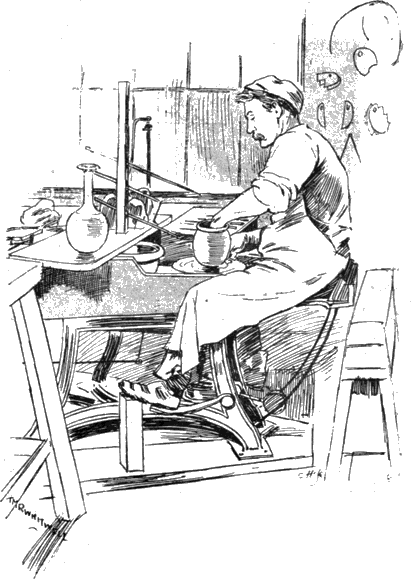
This may interest readers fascinated by Stoke-on-Trent pottery history. A tour of Doulton’s London factory in 1895, Lambeth. The process of making and the production line was much the same there as in North Staffordshire.
“the good folks in Lambeth … call it “Doulton’s place,” and the big gates and the palatial buildings that enclose and comprise it are variously inscribed “Doulton and Co., Lambeth.” … I gathered that Messrs. Doulton and Co. possess about half-a-dozen “Pottery-Lands” scattered about in Staffordshire, Warwickshire, and Lancashire, one at Paisley, and one in Paris.”
Offa’s Dyke Journal, with Volume 1 due 2019 as a new Open Access scholarly journal.
Four handy online dictionaries or lookups, for those studying historical aspects of the British Isles…
Bosworth-Toller Anglo-Saxon Dictionary online.
Digital Index of Middle English Verse.
Peasant houses in Midlands England…
“It used to be thought that only high-class houses had survived from the medieval period. Radiocarbon and tree-ring dating has now revealed that thousands of ordinary medieval homes are still standing in the English Midlands.”
Smell of heritage: a framework for the identification, analysis and archival of historic odours, Heritage Science Vol. 5 No. 2, 2017…
We… “create[d] the Historic Book Odour Wheel, a novel documentation tool representing the first step towards documenting and archiving historic smells.”
Also rather a useful quick ‘smell lookup-tool’ for fantasy writers with characters who frequent ancient archives and suchlike, I’d suggest.
A new local novel on Amazon: A Potteries Boy: a story of friendship and adversity set in smoky pre-war Stoke-on-Trent.
Coming in June 2018, Humphrey Carpenter’s J. R. R. Tolkien: A Biography done as an unabridged 10-hour audiobook.
And at the start of August, Tolkien: Treasures, a 144-page coffee-table book from the Bodleian Library… “that showcases the highlights of the Tolkien archives held at the Bodleian”.
Then later in August, The Fall of Gondolin.
New on the National Catholic Register: “J.R.R. Tolkien and the Birmingham Oratory”.
“Arriving in Birmingham, England’s second city — population in its metropolitan area in excess of 3 million people — I was dismayed to find that the city did not possess a Tourist Information Centre. Not a formal one, at any rate — there is an informal one in the City Library though. It was there I asked for information on the “Tolkien Trail.” The answer I received only increased my dismay: “Is that in Birmingham?”
Yup, that’s Brum city centre and the local council apparatchiks, alright. Apparently it’s been like that for years, with the default position (before the current utter unknowing) being: get the Tolkien freaks on the bus to south Birmingham…
“…when I sent media graduate Alma Sanz Fazio in there recently as a test, she was told to catch a bus to either Sarehole Mill (even though it doesn’t reopen until the spring) or Hall Green Library. What a welcome for a first time visitor from Madrid.”
Difficult to avoid the feeling that some of this attitude from the Council is snidely political. Anyway, the lesson is: do your research before you arrive at a place, including virtually ‘walking the route’ by using Google StreetView.
What are ‘the Tolkien basics’ of the West Midlands, then, if you don’t have much time? This is how I’d do what’s still there and is worth seeing. Given that so much has been swept away, there are some ‘maybe’-places and substituted ‘equivalents’.
1. Early morning train from London to Birmingham. Walk from Birmingham New St. station to the Birmingham Museum & Art gallery for the Pre-Raphaelite and Burne Jones collections, Birmingham city centre. (There’s no proof that he and the TCBS were influenced by this world-class collection, as schoolboys. But the long-gone school was at the other end of the street from the gallery, and how could a group plotting a resurrection of the English spirit never have seen this collection?)
I’d skip Moseley in the south of Birmingham entirely, especially if you have to struggle to get there by a bus grinding down the main road (very bad idea). Though the Moseley Bog can ‘have its moments’, if visited in a sunny springtime on a quiet weekday.
2. Uber from the city centre out to the Birmingham Oratory and perhaps a peep at the nearby 4 Highfield Road site. (I have found one mention, as aside in a blog post, that as a boy the young “Tolkien served Fr. Morgan’s Mass daily”, but I’ve never seen any scholarly reference to that apparent fact or its source). The devout may also want to then go on to the Catholic Cathedral. Again, no proof I know of that he was ever actually at the Cathedral, but how could he not have ever been there?
3. Train from Birmingham New St. to Stafford. Once beyond Wolverhampton, you’ll get a flavour of the mid Staffordshire lowland countyside from the windows. Then at Stafford you’d walk away from what has to be ugliest train station in England (sorry!), and through the pretty and safe adjacent river-park, for lunch at The Soup Kitchen. This is on the principle that the Soup Kitchen is about as close as you’ll get, in wood-panelling / atmosphere / uniformed waitress service, to the long-gone Barrow’s Stores tea-rooms in Birmingham in which the TCBS would meet. Then an Uber from Stafford out to the nearby Great Haywood in mid-Staffordshire.
4. The sites of his First World War camps on Cannock Chase, near to Great Haywood. The Essex Bridge, though trees now mean that Shugborough Hall can no longer be seen from the bridge approach.
5. Uber back to Stafford train station then on north to Stoke-on-Trent train station. An Uber for a quick look at 104 Hartshill Road in Stoke and perhaps the pleasant back part of the Butts where he learned to shoot live rounds with his rifle. Then hop back in the Uber and out of Stoke and up into ‘The Gawain country’ around Wetton Mill and up onto Cauldon Low for a sunset look at the barrow-downs in the west of the Peak District (don’t get trapped by the fog!). Again, there’s no proof he was ever there. But it seems difficult to imagine that (if he thought the North Staffordshire claims for Gawain worth considering) he didn’t venture up there during his holidays in Stoke, to see the landscape of the Gawain text he’d spent much of his life working on.
6. Back to Stoke-on-Trent in the dusk and catch the direct two-hour inter-city train to Oxford. Do Oxford the next day (perhaps two days), then back to London.