Son of mega-Tolk

Another batch of new writing on Tolkien and around-about. Not quite compiling to form a ‘mega-Tolk’ PDF this time, but still substantial…

* “Subtle Speech and Pronouns in Tolkien and Old English”… “in Old English poetry … dialectal ability is as important as valour, where “the hero has to prove he is a talented speaker in order to be acknowledged”.

Related is the new undergraduate dissertation “The comparative impact of Old English and Classical language on the poetics of modern fantasy”. There are thoughtful and well-sourced central sections on Tolkien… “as a lens through which to view the dissemination of the [poetic] structures of antiquity and to justify” [their re-use in fantasy literature].

* A book review of The Gallant Edith Bratt. This Journal of Tolkien Research review is a different and rather more barbed review than the Inkings journal one already mentioned here a few posts ago. Incidentally, for the sake of American readers, I note that the Inklings journal’s review has Warwick as a “city”. It’s a town, albeit with a substantial castle. As for the new JoTR review, it raises what would appear to be pertinent questions about the young Edith’s supposed status as a wealthy heiress. Her mother’s… “probate document records a healthy value for her estate, [but] we do not know if there were liabilities to set against it, or what fees were charged by its trustees, or what level of income Edith’s investments produced, or what became of them over time.”

* A book review of Switzerland in Tolkien’s Middle-earth.

* A book review of A Wilderness of Dragons: Essays in Honor of Verlyn Flieger. See previous reviews linked here. The new review refers several times to Smith of Wootton Manor, which should of course be Major.

* “Cirdan the Shipwright: Tolkien’s Bodhisattva Who Brings Us to the Other Shore”. Whatever you may think about the Buddhist comparisons used here, a central section has a useful scholarly survey of what can be known about Cirdan.

Also noted is a call for papers (deadline now passed) for the workshop event Tolkien and Antiquity: Antiquities of Middle-earth on 3rd June 2022 in Paris. This seems to want to discover “several Tolkienian antiquities” buried in-world in Middle-earth, periods that are presumably un-named in the texts but which are assumed in-world and have broad formations akin to our ‘antiquity’ and ‘medieval’ periods, since… “We detect in [Tolkien’s fiction] an in-depth knowledge of ancient authors, Virgil … Plutarch … Tacitus … The list is not exhaustive, and Homeric inspiration, in particular, is found”.

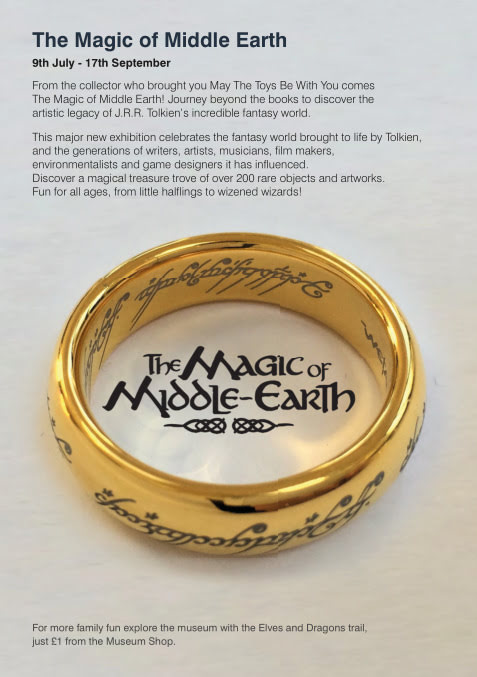
“The Magic of Middle-earth” at Worcester, summer 2022

“The Magic of Middle-earth” at Worcester Museum, in the West Midlands of the UK, this summer.

All 200 items are from a local toys specialist / collector, by the sound of it. As such I’d guess that it’s a chance to see, nicely assembled and lit by a regional museum, not only art books and suchlike items but perhaps also a range of the better toys, figures and merchandising items produced for The Hobbit and The Lord of the Rings.

On the meanings of ‘totty’

Wild Yorkshire today muses on Totties. In Anglo-Saxon, Wild Yorkshire notes…

‘tōta’ was a lookout post

Interesting. Bosworth-Toller has it only as the root tot, ‘a projection’. A quick look at other sources does suggest ‘lookout (post)’. The implication is that the post’s watchers look about or ‘project’ their gaze about ‘here and there’, turning their heads in a way that is uncertain to the distant viewer. An old dictionary suggests a root in Old Norse totter (still understood, as in ‘she tottered about here and there’) and there was also apparently a similar ancient Belgian word with similar meaning. ‘Tootling about’ then appears to be the more modern car-inflected form. One could today talk about a tall old person ‘tottering about’ the town on legs, but the same person would ‘tootle about’ in a small car — with the ‘toot’ part of the word implying also a certain giddiness of driving that means the horn has to be tooted more often than not. Which might cause heads to turn.

‘Unsteady, dizzy, tottering about giddily’ seems to be the broad older meaning. The 1913 Webster’s had…

Totty (?), a. [Old English toti. Cf. Totter.] Unsteady; dizzy; tottery. [Obsolete or Provincial Engish], [used by] Sir W. Scott.

“For yet his noule [head] was totty of the must”. Spenser.

In the full text of the quote we can see this relates to wine…

Then came October full of merry glee:
For, yet his noule [head] was totty [dizzy] of the must [fresh fuming juice from the wine],
which he was treading in the wine-vats see,
And of the joyous oyle [oil], whose gentle gust
Made him so frollick and so full of lust.

— Edmund Spenser, The Faerie Queene, Book VII (1605), Canto VII, Stanza 39.

Consider also the use of “tot” for drinking, as in the famous British naval “tot of rum”. One is giving the seaman not only the gulp of hard liquor (the ‘tot’), but also the ‘tottering’ effect it will have on the head and gait.

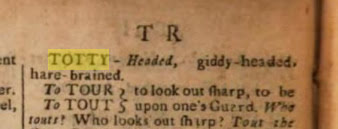
Yet the word is not just relevant to dizziness caused by wine or rum or (in a few Middle-English military examples) a sharp blow to the head. “Giddy, hare-brained” is a definition from the Universal Etymological English Dictionary (1720s/30s) and shows it can imply a general colt-ish giddiness of manner.

Which brings me to the modern meaning of totty (as ‘attractive nicely-dressed girls, tall and frisky and a bit giddy’). This meaning is not understood by all, curiously. A colleague was once showing a workman round a 16-18 college, and he later reported in the staff room that he had been utterly baffled by the man’s frank man-to-man exclamations about the vast amount of ‘totty’ to be seen in the place. He assumed the workman was referring to some kind of builder’s putty that had been used on the building’s fabric. Only later was the poor fellow told the meaning which every working-man in the Black Country knew. It is a class-based word.

One can see how this meaning might broadly relate to the Old English which Wild Yorkshire and dictionaries mention. Both a tower and a ‘frisky female’ totty being, by implication, ‘tall’ and also something to which one’s eye is immediately ‘drawn to’. They are head-turners, in other words. Consider also that a tall thin watch-tower is also something which one might ascend in a dizzying spiral manner, and at the top of which one might have a dizzying head-turning view.

All of which is perhaps interesting re: Tolkien, when you consider both the old disused watch-towers at the edge of the Shire and that in The Lord of the Rings Aragorn was originally to have been Trotter. Having wooden prosthetic feet, his name might initially seem to some to have implied ‘unsteady’, ‘tottering about’. And yet Trotter implies both a pig’s trotters and a horse’s trot, which are both very firm and steady things, quite the opposite of tottering. Tot- (giddy movement, elevated, head) and trot (sure steady movement, grounded, foot) look to me like similarly-named opposites.

The Gallant Edith Bratt

The latest Journal of Inklings Studies is now online. In public full-text is a bumper crop of Tolkien related book reviews. Books such as: The Gallant Edith Bratt: J.R.R. Tolkien’s Inspiration, and The Nature of Middle-earth. Who knew she was supposedly an heiress? Although I guess someone else wangled the fortune, rather than her and Tolkien. This fact seems to add some back-context for the period at the end of her life, when she was pleased that she could at last act as a relatively grand ‘lady hostess’ to visitors.

The Burslem Bulletin

In his latest Sentinel column, historian Fred Hughes reveals the existence of a long-running illustrated publication titled the Burslem Bulletin

Doulton’s contribution to Burslem’s prosperity was palpable. And the relationship between town and factory was richly featured in its house magazine, Burslem Bulletin. First published in 1947 as an irregular publicity journal, it quickly grew into an illustrated monthly newsletter promoting the activities and social life Doulton employees, most of whom were Burslem residents arriving here straight from school and remaining until old age retirement eased them out. […] I have a full set of these monthly publications telling the story of Burslem more comprehensively than any established social history book I have in my library. The whole is an archive of information that shows how well the workplace and social life blended together to make an organic community.

Sounds like a job for a crowd-funder on IndieGoGo or suchlike, to get this scanned and onto Archive.org. Otherwise there may be a risk that things like this will go into the Keele local archives and never be catalogued for decades let alone scanned and made public. For instance, look at the fate of the Proceedings of the North Staffordshire Field Club and similar local journals.

Another mega-Tolk

Another ‘mega-Tolk’, being my regular big ‘combo PDF’ made by combining various interesting-looking recent papers on Tolkien…

* A review of a book I was completely unaware of, which slipped out just before Christmas 2021, A Sense of Tales Untold: Exploring the Edges of Tolkien’s Literary Canvas. There’s a leftist review in Journal of Tolkien Research. The extended tub-thumping about academic working conditions is, as usual with leftists, ‘preaching to the converted’. This aspect of the review might better have been stripped out and made into a more public article with quotes, for somewhere like the THES. There’s another review in Mythlore which is more straightforward.

As for the book itself it’s a Kent State University book and is thus too expensive for me though at least is not one of those £120 tomes. It’s 150 pages and judging by the reviews it treads Silmarillion territory and hardly touches LOTR. There’s no preview of it on Google Books, and even Amazon refuses to load the ‘Look Inside’ for it, so I can’t see if my The Cracks of Doom: Untold Tales in Middle-earth (2018) is mentioned. Judging by the two reviews, it isn’t.

* Another review of Tolkien and the Classical World in Mythlore, and another in Lembas which usefully names the German scholars identified by Burton as having influenced Tolkien: Victor Hehn and Otto Schrade. Also a review of Tolkien and the Classics in Finfar.

* “Possible Analogues of Invented Plant Species of Tolkien’s Middle-Earth in Earth’s Current Flora”.

* “Commentary on “Musings on Limlight”” (Elvish etymology of the name of the river Limlight) (See also the section ‘light’, in the new Commentary on The Nature of Middle-earth from the same authors).

* Birds of Creation in the Old English Exeter Book (paywall, abstract only).

* Review of Tolkien and the Sea: Proceedings of the Tolkien Society Seminar 1996. (Now re-published as an affordable edition).

* “A Lost Tale, A Found Influence: Earendel and Tinuviel”. (The lost tale of Wade as a model for Tolkien’s ‘lost’ Tale of Earendel)

* “Seeing Double: Tolkien and the Indo-European Divine Twins”.

* Historykon review of the 2020 Polish book Mitologia Polnocy a Chrzescijanstwo… “An equally interesting figure is Earendel, who is compared by researchers and the author with the morning star and also with Mary, John the Baptist or even Jesus. The mysterious mythological figure becomes even more mysterious, and this mystery also inspired J.R.R. Tolkien to The Lord of the Rings. In my opinion, the sub-section is the best part of the book. Renata Lesniakiewicz-Drzymala makes here a great analysis of the mythological figure and then gives the answer what it could have been and what it could symbolize in the Christian world.” (On the topic see also the recent French La Terre du Milieu: Tolkien et la mythologie germano-scandinave).

The publisher’s TOCs show this as covering pages 134 – 167:—
2.0. Earendel – the brightest of the angels.
2.1. Variants of the name Earendel and their mythical connotations.
2.2. Earendel and the O Oriens.
2.3. Earendel – Christ, Mary or John the Baptist?
2.4. Earendel and Christianity.

Sounds good, but I’m not sure how one would squeeze even the briefest survey of all that into just 32 pages. I can’t really afford it, but I suppose I shall have to get a copy of the book to scan and translate. Amazon UK knows nothing about it, but thankfully it is relatively cheap at £10 via the ‘Polish books to the UK’ service ksiegarniainternetowa.co.uk. Despite not appearing to offer PayPal, they do… with a 50 pence surcharge. Ah well, there goes a third of the income made so far from my emergency Tolkien in Cornwall ebook production. Thankfully I’m now slightly better placed on cash, than I was just before Christmas.

Update: I now have the book. The earendel section actually covers pages 97-116, 20 pages.