The Potteries Post has updated with new local news and opportunities.

The Potteries Post has updated with new local news and opportunities.
Tolkien Gleanings #108.
* A new Tolkien Society one-day seminar event, Secondary Believers, Secondary Worlds: Tolkien and Religion in the Twenty-First Century. Set for 26th November 2023. The call-for-papers is now live, with a 8th September 2023 deadline. The organisers of the….
“seminar welcome fresh and innovative treatments of the generative interactivity between Tolkien’s fiction, Tolkien’s faith, and the faith (or lack thereof) of the readers [who draw on Middle-earth].”
* New in Fields: journal of Huddersfield student research, “How Architecture Expresses Character Traits in Middle-earth: analysing the great dwarven cities of Moria & Erebor”.
* The Guild of St George offers “A Tolkien reading walk” in early September 2023. It’s said that this is just one event, as… “the Bewdley Museum and Ruskin Land are holding a Tolkien weekend in Bewdley, in collaboration with the University of Birmingham”. But there are no further details at present, other than the walk. Bewdley is a town in the Worcestershire countryside, about six miles the other side of The Black Country, in the West Midlands of England. The event is not listed on the Museum’s “What’s On” page, and I don’t see any associated exhibition (yet). Though I guess there may well be scope for a small regional show which celebrates Tolkien’s connections with Worcestershire, and then tours the county’s libraries and museums.
* I see that a recent series of online lectures has been and gone. “Tolkien, Christianity, and Art” was offered by the Lumen Christi Institute, 18th – 22nd July 2023.
* A call for papers for a pre-Halloween meeting on Medieval Monstrosities (Illinois Medieval Association). Submissions are due by 15th September 2023.
* And finally… new on Archive.org to borrow, the book Fantasy and Science-Fiction Medievalisms (2015). This includes an opening survey of “Low-culture Receptions of Tolkien’s High Fantasy”. And, by sheer co-incidence, the new Tolkien Pop! on Substack. The author discusses Tolkien’s influence on “various pop cultural artefacts”.
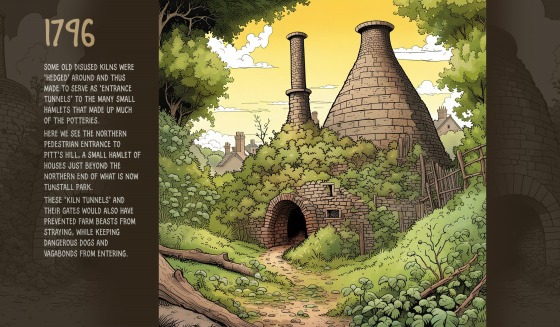
Available now, the comic-book “The Lost Bottle-Kilns of Stoke-on-Trent”. Free at Gumroad as a tablet-friendly PDF, though you can ‘pay what you want’ if you want to offer a small donation.
Tolkien Gleanings #107.
* Newly released by the Tolkien Society, “Obituary: Charles Noad”.
* News of a forthcoming book, The Literary Role of History in the Fiction of J.R.R. Tolkien. Due 2nd January 2024, and pre-ordering now at a whopping £130 ($170). Erm, it’s a three-volume set, then? Nope, just a standard academic book with a standard robo-cover. It’s from the usually-leftist publisher Routledge, which is also a bit off-putting — but the contents do sound interesting…
While most criticism has concentrated on Tolkien’s use of historical traditions of northern Europe, this book argues that Tolkien also valued Southern and Mediterranean pasts and registered the Germanic and the Scandinavian pasts as they related to other histories as much as his vision of them included a primeval mythic aura.
The TOCs suggest that the author will have chapters on Ancient Rome, the Goths, and Byzantium, and I see he has previously published Barbarian Memory: The Legacy of Early Medieval History in Early Modern Literature (2013). Which again sounds encouraging. I’d hope for a complex explication of exactly how Tolkien’s Northern sources could have sometimes reflected or been influenced by sources from the Near East, beyond the obvious influences from the Bible and perhaps from Virgil? Definitely one for the Wish List, by the look of it.
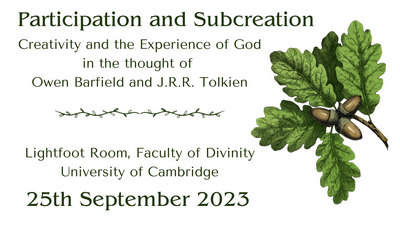
* Cambridge University’s Centre for the Study of Platonism is to host a conference on Participation and Subcreation in September 2023.
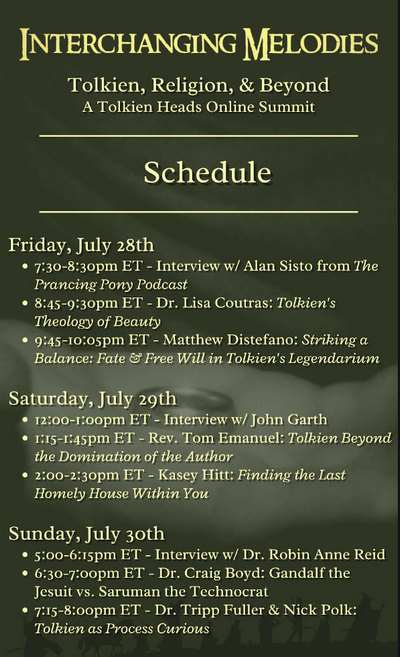
* A three-day “online summit”, Interchanging Melodies: Tolkien, Religion & Beyond. Has a good roster of speakers but not much notice is given, since it will run 28th – 30th July 2023. But it seems that tickets can still be had…
The cost? A course like this is typically offered for $99 or more, but contribute whatever you can to help make this possible for everyone. No human is turned down for lack of funds. If you would like to sponsor someone or host a group let us know. […] The complete summit content collection will be available on the password protected resource page. The downloadable audio and video of each session will be uploaded there and available for at least a year.
* New in French, but easily auto-translated, the open-access article “Tolkien et l’art des differentes echelles cosmiques” (‘Tolkien and the art of different cosmic scales’).
* And finally… “Dorothy L. Sayers’ Copy of Tolkien’s First Appearance in Book Form” came up for auction a few days ago. Which at least provides the rest of us with a look at the cover…

Surprisingly, the volume is not on Archive.org as a scan.
Finally, after many decades… a reason to go to Liverpool. There’s to be a major Ken Dodd exhibition, at the Museum of Liverpool. Opens on 9th September 2023, and runs until 3rd March 2024. Could be a tickle-some treat to liven up one of those grey weeks after Christmas / New Year. Tickets £5, for what sounds like a huge exhibition. Booking now.

An AI knows who Ken Dodd was and what he looked like. What a day to be alive… Thankfully, it can’t yet write the jokes.
Tolkien Gleanings #106.
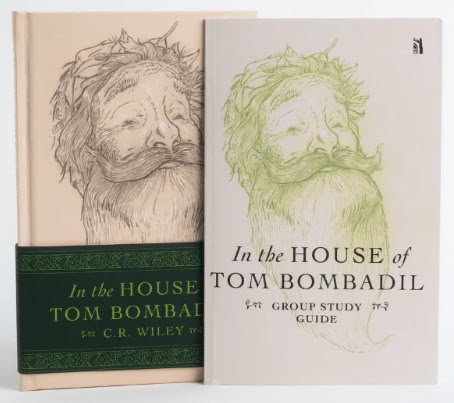
* The recent book In the House of Tom Bombadil now has a Group Study Guide and bundle. The Journal of Inklings Studies had an open-access review of the book.
* The Tolkien Society posted 14 new YouTube videos last week. These are talks from their recent conference on Numenor and its fall, by the look of them.
* Freely online, a PhD thesis for Marquette University, The Fantastic and the First World War (2019). Argues that what we would now recognise as modern fantasy was “an essential means of representing and responding” to what had happened, and was an attempt by soldiers to communicate wartime experiences to a wider public.
* New to me, the University Press of Kentucky book Ents, Elves, and Eriador: The Environmental Vision of J.R.R. Tolkien (2006). It places, in the words of the Foreword, strong emphasis on “the old-fashioned language of stewardship” and has a short Afterword by Tom Shippey. Both of which sound promising. I also see that one of the two authors has a substantial bookstore talk “The Medieval Roots of Tolkien’s Philosophical Ideas” (2012) in audio at Archive.org.
* A new blog-post considers The Battle of Maldon…
“[there is a] tendency of a certain kind of historian to doubt or dismiss any story that has even the rudiments of a literary shape. [They fear] the intrusion of fiction into reality, or perhaps some shadowy figure reshaping raw material to suit a literary design. At worst, it represents deliberate falsehood with a political purpose — that is, propaganda. Tolkien here correctly inverts that suspicion.”
* And finally… “Contribute to Tolkien Gateway this month [July 2023] and you will be entered to win one of multiple prizes courtesy of [publisher] HarperCollins.”
Tolkien Gleanings #105.
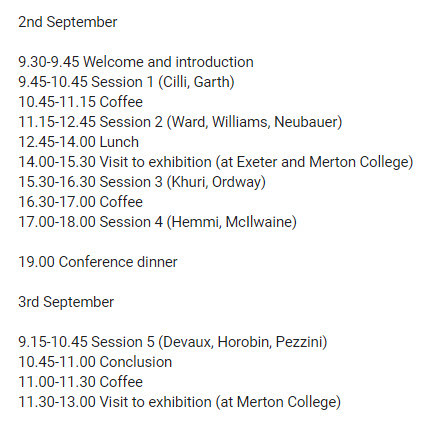
* In Oxford, Tolkien’s Words and Worlds: An Academic Conference to Mark the 50th Anniversary of Tolkien’s Death. Set for 2nd–3rd September 2023, at Corpus Christi College, with exhibitions at Exeter and Merton College. Registering now. Looks like about £125 would get you an overnight room + lunch/refreshments, then your rail fare on top. Many people in the UK might do it for under £200.
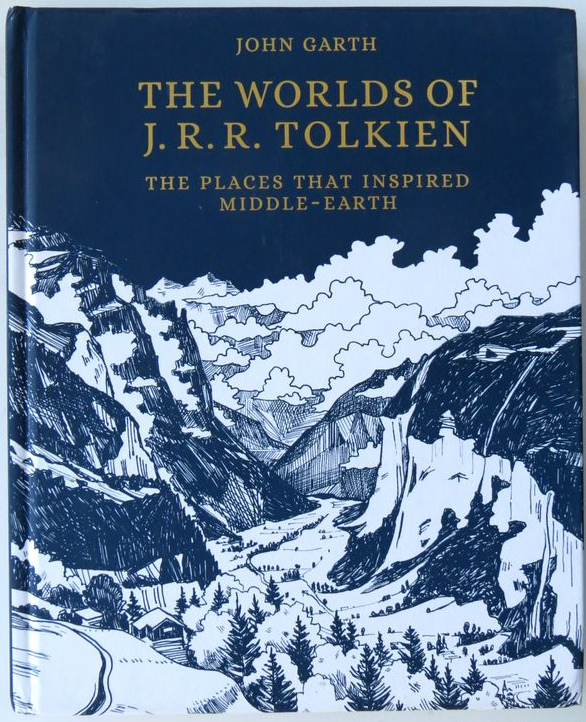
Ugh, what a clash of unsuitable fonts. Pick better, next time.
* New on YouTube from the Thomistic Institute, “The Catholic Vision Of J.R.R. Tolkien’s The Lord Of The Rings”. Professor Paul Gondreau’s… “talk was given on 14th March 2023 at Brown University” in Providence, New England. A bit slow to get going, and at the end de-railed by student questions about the screen adaptations (tip to lecturers: invite questions about the books only), but otherwise rather good.
* Tolkien scholar Charles E. Noad has passed away.
* On YouTube, Joseph Pearce newly interviewed on “How G.K. Chesterton Influenced Narnia & Middle-earth”.
* An International Congress on Chesterton, Tolkien and C.S. Lewis in Buenos Aires, Argentina. 20th-23rd July 2023, seemingly with a large Mexican contingent flying in.

Interesting for the use of AI-gen portraits on the Congress flyer. AI tell-tales: sinister fantasy-painting like figures in the background of the Tolkien picture, and his nose is pointy/drooping; Chesterton’s glasses are not round and his neck-tie is not properly fitted under the collar; and the ear is too big on Lewis (unless he really did have huge ‘hobbit ears’).
* The Silmarillion Writers’ Guild — a leading Tolkien fan-fiction repository and forum — has just posted a call for an Assistant Art Editor (voluntary). Note that the site has a complete ban on AI assisted works.
* Descriptions for the Tolkien Collection at Marquette University in the USA. I hadn’t realised it was also effectively a Tolkien secondary research library, with fairly large sub-collections of choice “Secondary Material Relating to J.R.R. Tolkien, 1938-2015” and “Periodical Literature on Tolkien and Related Fantasy Writers, 1960-“, plus several large fandom collections. A library search of the Marquette Libraries catalogue will show you the titles of most published books there, via searches for ‘Tolkien’, ‘Middle-earth’, etc.
* And finally… a new Tolkien creature, the ‘bicycle-horse’, as found in part of a letter newly extracted from the book Wheelbarrows at Dawn. However Lovecraft did it first, as usual, when in middle-childhood he imagined himself a “bicycle-centaur”.
Tolkien Gleanings #104.
* Non-subscribers can learn what’s in Amon Hen #300, since Tolkien Gateway now has the TOCs. The 300th issue included, among others… “Memorable Moments in my Fifty Years in the Tolkien Society by Jessica Yates” and “My Father the Artist by Priscilla Tolkien”. I’m uncertain if that last has been seen before, or not.
* A call for papers for the U.S. Hybrid Kalamazoo, 9th-11th May 2024… “The ‘Tolkien at Kalamazoo’ area will be organizing six sessions for the 2024 conference: three are in-person, and three are virtual. The proposal deadline is 15th September.”
* On the University of Maryland YouTube channel, Book Launch: The Battle of Maldon by J.R.R. Tolkien (May 2023)… “Join [editor] Peter Grybauskas as he discusses [the new Maldon book] with Verlyn Flieger and Chip Crane” in a one-hour discussion.
* New on Archive.org to borrow, An Anglo-Saxon and Celtic bibliography (450-1087). Published in 1957 and thus perhaps useful to Tolkien scholars, being a snapshot of the available literature prior to The Lord of the Rings.
* New to me, The spiritual Tolkien milieu: a study of fiction-based religion (2014). The thesis is open-access under Creative Commons Attribution, and the PDFs are chapters to be found in a long sidebar. It finds that the attempt at forming a primary-world “spiritual Tolkien milieu is tiny”, and that these pioneering practitioners appear to focus on the elves.
* And finally… “First edition of J.R.R. Tolkien’s The Hobbit found in a charity shop” in the UK. It went to eBay and raised £10,000 for cancer research.
Tolkien Gleanings #103.
* A new issue of the journal An Unexpected Journal is themed “King Arthur Legendarium: Prose, Poetry, & Scholarship”. This latest issue being Vol. 6, Book 2 (Summer 2023). This had a four-hour launch party on YouTube. Subscribe to the channel to hear about future events. Looking at the current journal contents I see it’s all Arthurian items in this issue, though some Gawain and some C.S. Lewis. But the appearance of this new issue spurred me to systematically look at what else is available in the list of back issues and contents. Of interest I see, free in PDF and here in date order…
A Holly Ordway special issue, including among others:
– “An Interview with Holly Ordway” and a review of her book on Tolkien’s Reading.
– “Peak Middle-earth: Why Mount Doom is not the Climax of The Lord of the Rings“.
– “A Passage to Something Better” (on Tolkien and virtue).
– “Gandalf: The Prophetic Mentor”.
– “Middle-earth and the Middle Ages”.
– “Thorin and Bilbo: Image Bearers”.
Then the 2020 and some 2019 issues are listed by theme but these are not online. Of these, “The Worlds of J.R.R. Tolkien” issue can be had in Kindle ebook at £7 UK (about $10). The listing on Amazon UK has the TOCs for this issue.
Moving further down the list of back-issues, the free PDFs return. I see…
– “The Imaginative Power of Sub-Creation” (Tolkien).
– “The Lord of the Rings and Consolation Concerning Death”.
– “The Heroism of the Ordinary in The Lord of the Rings“.
* Free on Archive.org, Songs for the Philologists (2023 Kyrmse edition). This was also noted a while back in Tolkien Gleanings. But this is newer… “This version (July 2023) has been revised, edited and set in the Gentium typeface by Ronald Kyrmse […] with one additional poem (“Grace”)”.
* A PhD for Vanderbilt University, free in PDF, Enduring Worlds, New Horizons: The Nature of the Gesamtkunstwerk in Three Re-Imaginings of the Nibelung Legend (June 2023). One of which is The Lord of the Rings. Considers that LoTR qualifies as an innovative and (in time) successful Gesamtkunstwerk (‘the total work’) alongside the works of Wagner and Fritz Lang. Finds that… “Tolkien’s work offers a valuable lens through which Lang and Wagner can be profitably explored”.
Yes, I can see how Tolkien’s stated desire to leave… “scope for other minds and hands, wielding paint and music and drama” could be understood as a desire for something approaching ‘the total work’, albeit not all by his own hand. A sort of dispersed and cumulative Gesamtkunstwerk. With Tolkien more akin to a slow preparative gardener of culture, than the impresario of a brief hill-top Ragnarok of a multimedia rock-opera. And with his ‘other hands’ comment said of a time when one might have justifiably trusted that other hands and minds could carry on a steady and sympathetic cultivation of his rich soil. In this he was somewhat akin to his contemporary H.P. Lovecraft, who shared his Mythos with an ever-widening circle of young writers and artists, a generous gift that in time spiralled out and then further out and made him the most influential writer of the 20th century — in terms of his vast and ongoing impact on popular culture. In 2023 it’s now increasingly possible to think that Tolkien is set to do the same for the 21st century, as his ideas move beyond the writers of doorstop fantasy trilogies and spread out into the wider culture. His grander ambition for the Legendarium was of course somewhat frozen in time by the Medusa-glare of copyright, but that won’t last for all that much longer.
* And finally… Arte.tv has a new short but well-made video preview of the current one-man exhibition “John Howe, l’illustrateur de Tolkien” in Brittany, France. Not on YouTube.
Tolkien Gleanings #102.
* A new Journal of Tolkien Research has begun to fill up. I was pleased to see “Weather in Middle-earth or Tolkien: The Weather-Master?”. This uses modern word-counting and tabulation software to study… “the use of weather in general and meteorological expressions in The Lord of the Rings”. There’s a statement on page 17 which is astray in time: “When Frodo and Sam arrive in Ithilien, they notice a statue of an old king, with a trailing growth of flowers around its head”. The “arrive in Ithilien” part should read “are about to depart Ithilien”. But it’s a good essay, and one comes away from with the impression that only a man of the English Midlands could have written about inland weather with such range and precision.
* The same issue also has two new Kristine Larsen conference papers rolled into one, as “Arda Remade (and Remade, and Remade…)”. A look at the changing scientific thinking on entropy and time during Tolkien’s life. Another excellent article by Larsen, as usual. She deserves her own book of collected essays and papers.
* “A Pilgrimage to the Wade Center”, with pictures…
“Tolkien most preferred this dip pen as his writing instrument, favoring it over cartridge pens or a typewriter. A close look reveals that the back end of the pen is charred and melted because of Tolkien’s habit of using it to tap and clean out the pipe he puffed as he wrote.”
And toward the end of his life he discovered, and greatly enjoyed, the new no-fuss “Biro” pens.
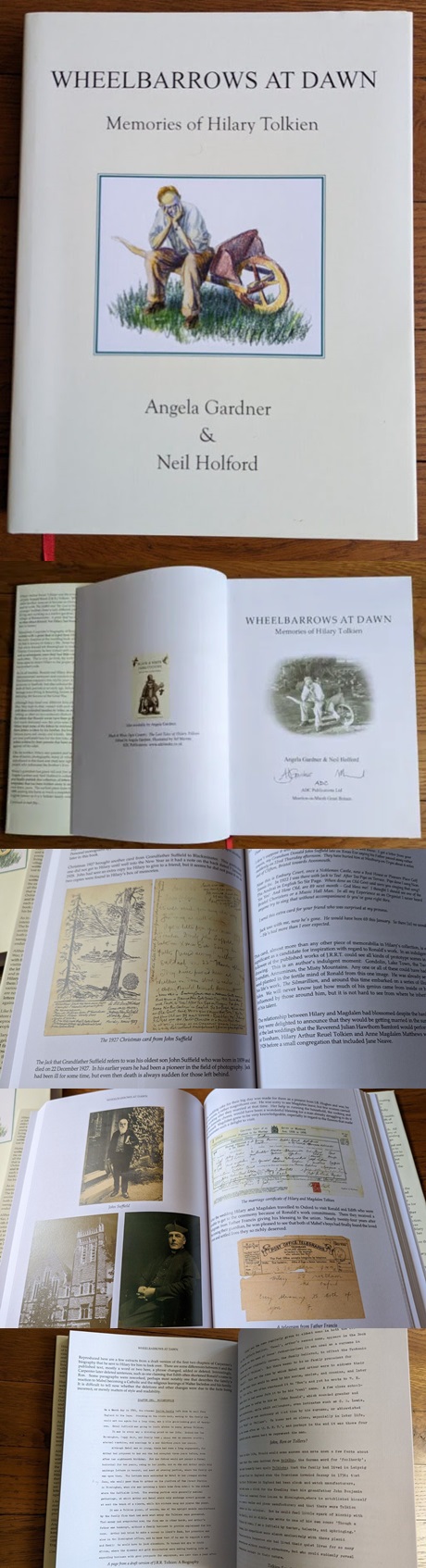
* I’ve never heard of the book Wheelbarrows at Dawn: Memories of Hilary Tolkien. But a few tickles of Google Search reveals it was cancelled at the last minute, due to action by the Tolkien Estate, even though the book was a work of many years. Yet a few proof copies evidently survive and there’s currently such a copy on eBay, with some naughty peeps inside.
* Free on Archive.org is “Some Backgrounds of Fairyland” (1932) by H.P. Lovecraft. This was an essay extracted from a rushed letter, written at a time when Lovecraft was very busy. But he took the time out to quickly write a 2,800-word overview essay on fairy for a young and curious correspondent, based on the sources he had to hand in his extensively weird library. As such it’s still interesting, being a clear account of the competing in-flux theories and assumptions of the time (though regrettably he does not give the names of the various proponents). His account is that of a hard-headed self-educated layman who was also an imaginative writer of more-or-less fairy tales (“The Cats of Ulthar”, “The Quest of Iranon”, etc). He made only one slip — “Paracelsus and the Comte de Gabalis” should have read “Paracelsus and the [Abbe de Villar’s] Comte de Gabalis”. Of course there is much here that we now know to be factually wrong — archaeology and other sciences have since swept away many of the suppositions. Still, the hasty essay is a ‘snapshot in time’ by a master and as such might interest Tolkien scholars. The above link is to the only copy currently online.
* And finally… found on a Polish site, a rather pleasing set of Middle-earth ‘travel posters’. Though apparently they ship from China, so beware. They might not be as good / large as they look in the room-sized mock-up pictures.
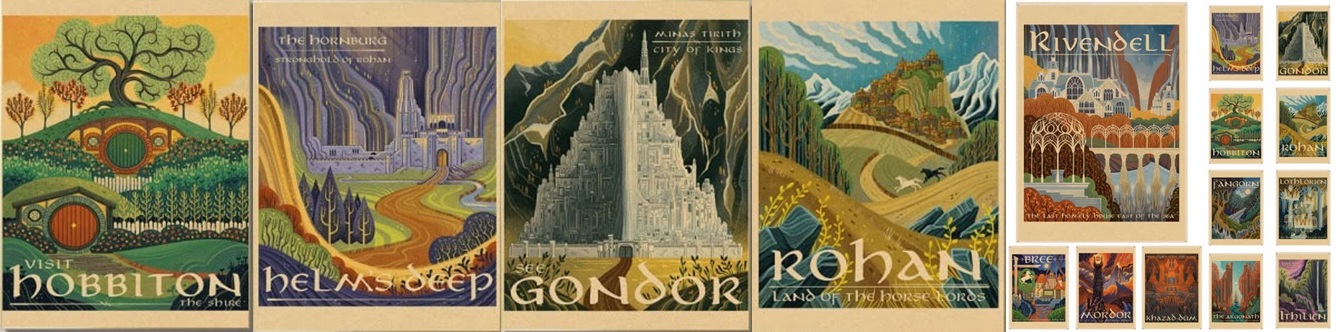
They don’t seem to be AI generated, to one with a keen eye for such things.
Tolkien Gleanings #101.
* The Art of Jay Johnstone, Part One, Part Two, and Part Three. These substantial free Substack posts offer extensive commentary on the art, which many will recall seeing an example of on the cover for the recent second edition of Tolkien’s Library.

* In France, the nation’s Museum of the Great War is set to host a one-day conference on ‘Tolkien and the war: experience and representation’. The venue is a large museum of some 70,000 items, about ten miles east of Paris. I can’t find the speakers and topics, but tickets for Saturday 22nd July are here if you can delve deep enough into the page.
* A free sample article from the latest paid-for Saint Austin Review (July/August 2023, Vol. 23, No. 4) is the two-page “Who is Tom Bombadil?”. The issue also leads with “Chesterton, Tolkien, and Lewis in Elfland”, and later in the same issue there are ‘new voices’ items titled “Galadriel’s Mirror” and “Anduril, Flame of the West”.
* Il Pensiero Storico: Rivista internazionale di storia delle idee reviews Tolkien, l’Europa e la Tradizione (2022) in its Italian translation. The short book is found to offer…
“an essay on the flavoursome soup of studies, readings, passions and professions that fed Tolkien’s existence; the taste of which Berger evokes in every step of his examination. [Though] we are not dealing here with a specialized study, but a taster. Yet it is a seasoned introduction to Tolkien’s world, garnished with mythological materials, archetypal symbols of the European tradition, the vision of heroism and the relationship between technique and nature, and links with the cultural heritage of the West. [The book] recalls that “carrying the weight of tradition” forward is basically a moral duty for all of us.”
* Popping up on Amazon UK, Theology and Tolkien: Practical Theology is a forthcoming single-author book of essays. Due in mid September 2023 and pre-ordering now with a £28 ebook. Has an endorsement from Thomas Honegger. Some of the essays also discuss the movie adaptation of LoTR. One advance reviewer usefully writes…
“the essays in Estes’s collection use Tolkien’s Middle-earth writings to explore everyday themes such as friendship, home, and food, as well as more obviously theological concepts, like apostleship, salvation, and theodicy”.
* In English in the latest edition of the Turkish open-access journal Milel ve Nihal, a paper by a University of Exeter PhD student, “The Understanding of Evil in British Romanticism: J.R.R. Tolkien and the Ring as “a running ambivalence”…
“there is a depth in Tolkien’s works, lost between the praise of his supporters and the criticism of his opponents, which exceeds what either group claims to have found.”
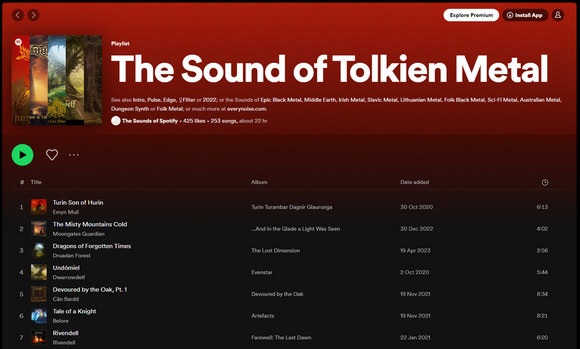
* And finally… “The Sound of Tolkien Metal”, a curated 22-hour playlist of what one has to assume is the best Tolkien-inspired heavy metal music. Google suggests it may date from the end of June 2023, and the dates on some of the 250+ tracks it includes seems to confirm this.
“the blasts of it smote the hills and echoed in the hollows, rising in a mighty shout above the roaring” (LoTR)
Two Stoke canal projects were today announced as being newly funded by ‘Levelling Up’ money…
1)
Trent Rivers Trust – £189,993 to run the “Rediscovering the Trent Valley Way in Stoke” project which will develop and deliver a variety of initiatives through Stoke-on-Trent along existing rights-of-way.
Interesting. ‘The Trent Valley Way’ is a ‘source to sea’ path for the Trent along public footpaths and canal towpaths….
Map One: Biddulph Moor to Hanley (OS map)
Map Two: Hanley to Trentham (OS map)
So the communities there are likely to be Birches Head, Abbey Hulton, Northwood, Shelton, Fenton.
Perhaps also Boothen and Hanford… since it looks to me like the route could now use the river rather than the canal at Stoke-on-Trent, now that the city has the Boothen Ground path giving the new link through to the long riverside path to Trentham. Here’s the part of the map showing the existing Way (red) along the canal, and my suggestion (green) for a new possible ‘beside the river’ route. This would however entail making the footpath from Hanford across to the canal passable and motor-bike proof. It wasn’t, last time I looked. Though that was some years ago now.

Anyway, it’ll be interesting to see what £190k does, and if it gets match-funded to do more.
2.
Canal and Rivers Trust – £109,633 to deliver a community-led placemaking project which will reach out to work across two waterside communities on the Trent & Mersey and Caldon Canals.
Again, interesting. The “two waterside communities” could be anywhere. But if it’s going to overlap with the above Trent Rivers Trust ‘Trent Valley Way’ project, and if the two communities are close together, then that would mean lower and upper Shelton. They take in the Trent & Mersey and the Caldon Canal, and align with local political priorities.