Some starting points on affectionate friendship in The Lord of the Rings

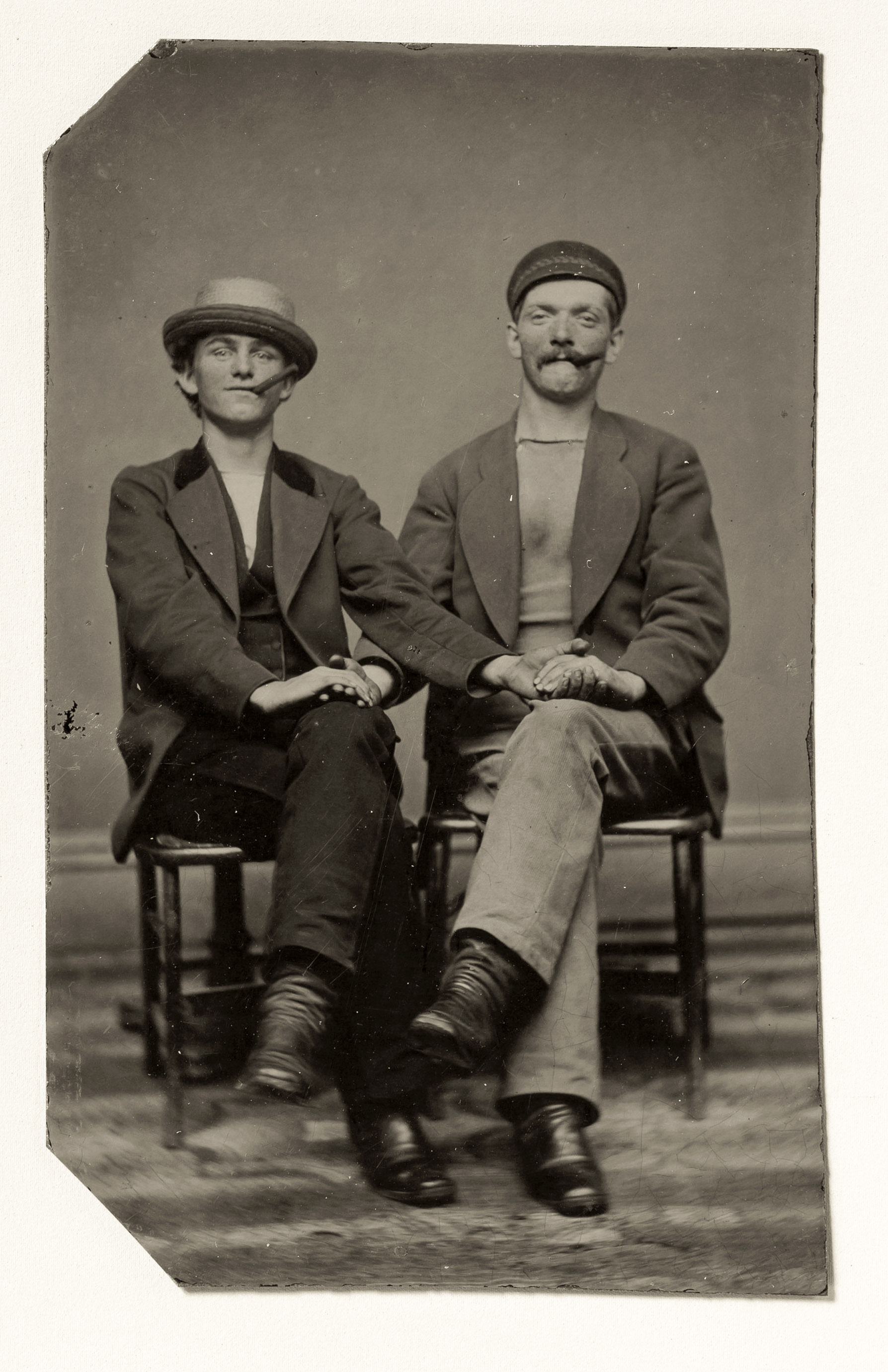
I’ve sometimes encountered comments from new readers of Tolkien’s The Lord of the Rings, in regard to their surprise and even shock at the book’s rising level of male-male affection, kissing, expressions of love, and also the book’s general celebration of un-neurotic and un-conflicted male bonding. It may seem curious to today’s readers that Tolkien felt free to so boldly portray these aspects of Middle-Earth, and also to launch such books into the cultural and emotional ice-age of the 1950s.
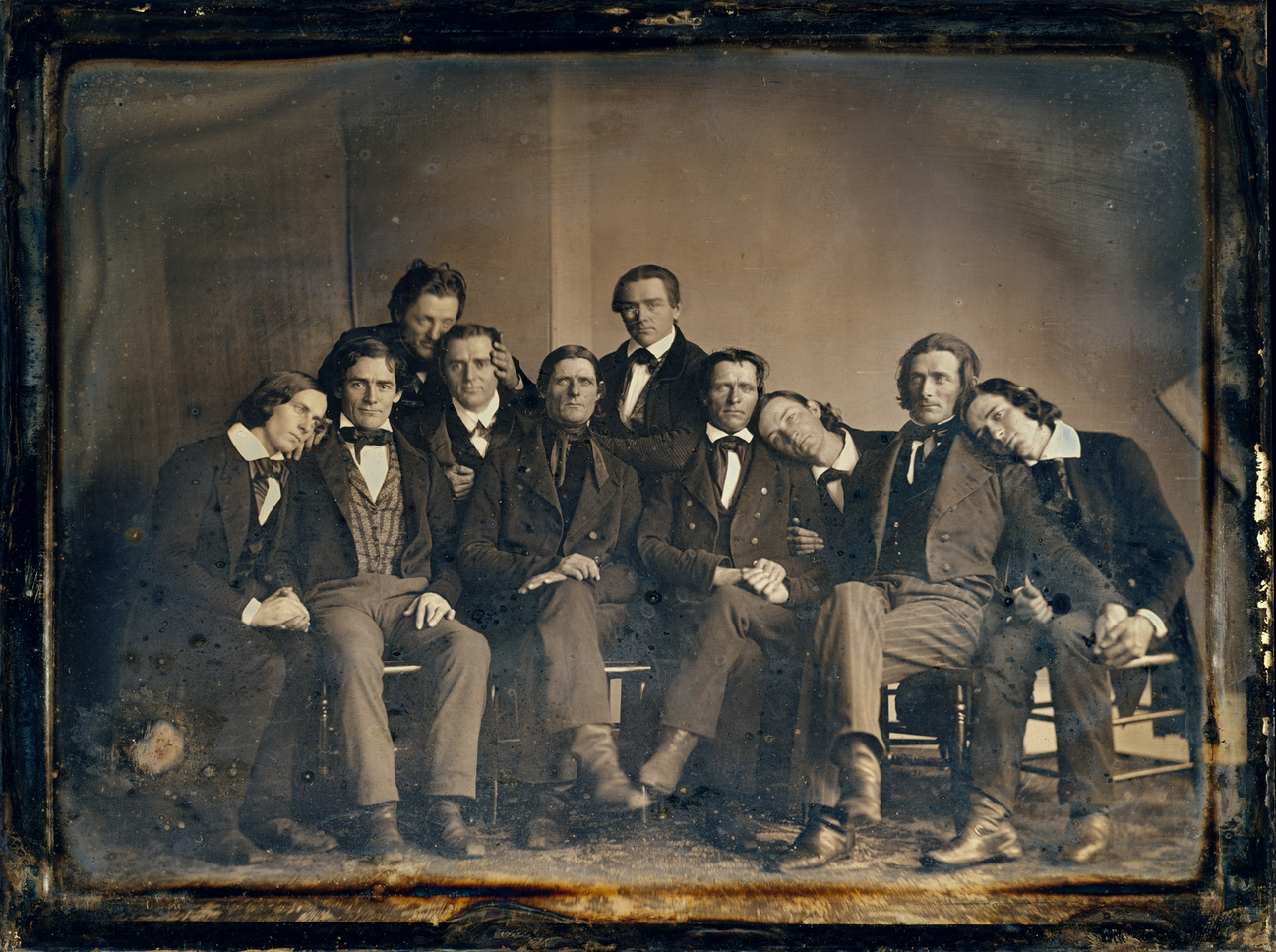
Probably it has something to do with the period in which Tolkien came of age, roughly 1908-1922.

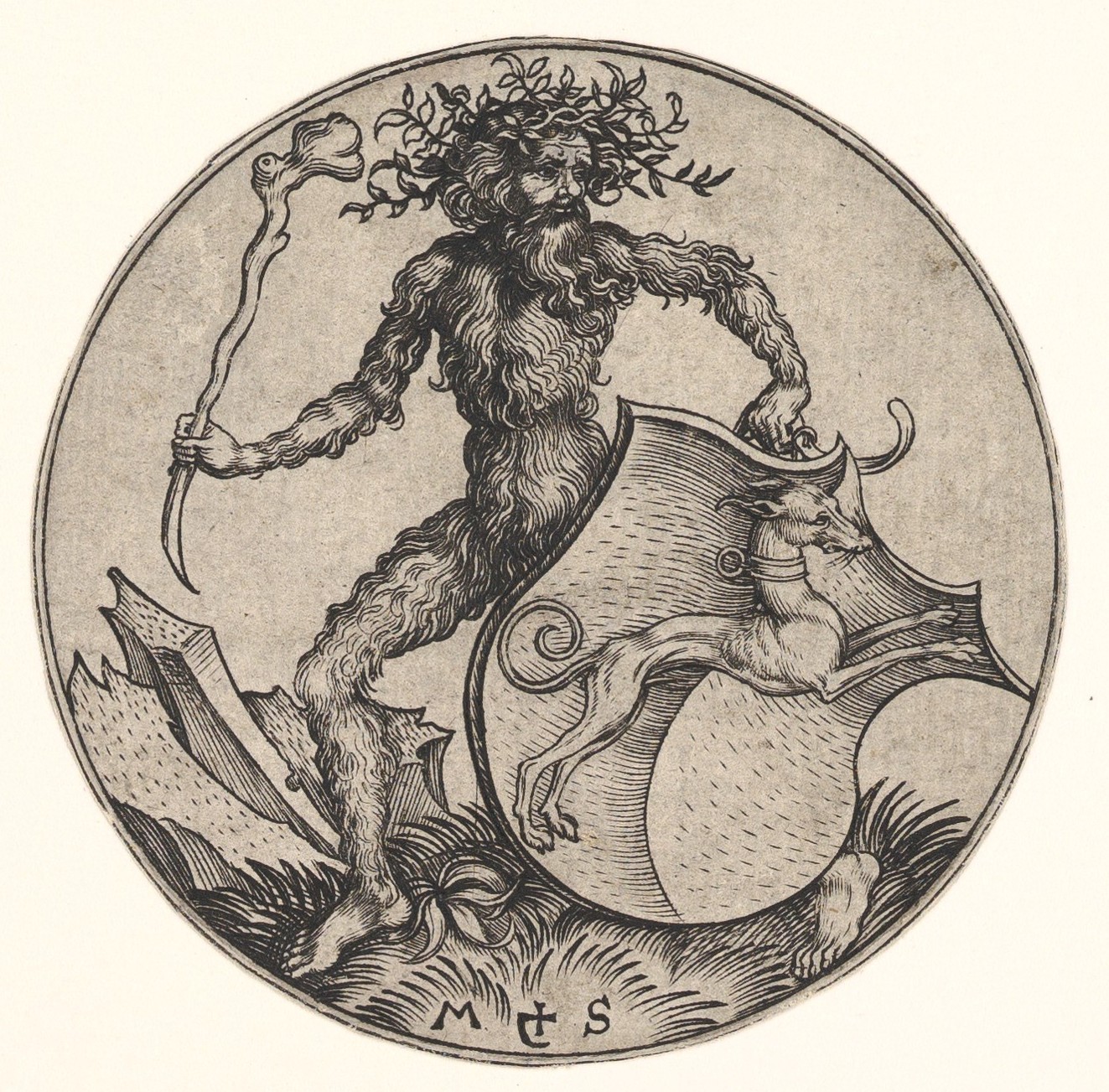
* Wilde and poetry. It was a post-Wilde world, in which previously open traditions of casual male-male affection in friendship (see above picture) were diminished and policed. But his youth was perhaps sufficiently distant from the immediate impact of the notorious Wilde trial, in time and also in space. He was coming of age in practical can-do Birmingham, rather than the overheated literary salons of London. One might perhaps also consider the ongoing impact of Whitman’s poetry among literary lads, in terms of celebrating affectionate male bonding in England at that time, though I don’t know offhand of any evidence that Tolkien thought highly of Whitman. Housman’s A Shropshire Lad seems likely to have had more impact in Britain, especially in the context of the First World War — when a copy was reputed to have been in almost every back-pack as our soldiers departed for the Front. For strong discussions of the war poetry and its portrayal of affectionate friendship in a post-Wilde context, one might look at Touch and Intimacy in First World War Literature (2005) and the seminal The Great War and Modern Memory (1975). For the modern student, it’s perhaps important to highlight that poetry was then vastly more culturally important than it is today, and also engaged in a far more active dialogue with art.

* Freud. Doubtful. Tolkien lived in a pre-Freud world as he came of age. Freud only became widely known among the intelligentsia in the English-speaking world from about 1919, and even then he was usually encountered through a lens of superficial re-interpretations and even ‘progressive’ charlatans and quacks. The fathers of Tolkien’s Birmingham Oratory were Catholics of a variety who were fairly open to the world, by the standards of the time, but one has to doubt they had any regard for the likes of Freud and his followers. Still less would they have had an affection for Freud’s befuddled leftist acolytes — of the sort who drifted around Greenwich Village and Bloomsbury, revelling in a heavily sexualised home-brew made from half-fermented bits of Alder, Jung and Freud. The type later became academics and plagued Tolkien with their detested attempts at early ‘literary criticism’ of his work. It’s true that such ideas did become increasingly fashionable in England in the 1930s, and the writings of Freud’s associate Jung were known to some of Tolkien’s circle. But it would be a huge mistake to claim that Tolkien was juggling psychoanalytical ideas on male affection while devising The Lord of the Rings.

* Service. Far more important for understanding Tolkien’s main work seems to be the forgotten history of the entangling affections which can grow up in an enduring master-servant relationship. Also the traditions and set of implicit boundaries which develop from that, within a stable and self-confident civilisation. Then the ways in which that tradition fed into, and was changed by, the experience of the First World War and the ideological ferment of the 1930s.

* Fraternity and fellowship. There is also the little-regarded history of ‘public friendship’ to consider, in which affection became embedded and expressed in the brotherly networks of civil society and mutual aid, often along lines of civic/political affiliation. One could even see Tolkien’s The Lord of the Rings as making an attempt at ‘working back’ to an idealised Christian form of this, as a reaction to the ‘politicised friendship’ developed by the proto-fascist left/right in Europe in the 1910s and 20s around hiking and the outdoors life, and which was later so ruinously militarised by the youth cadres of both national socialism and soviet socialism.

* Brotherly and knightly love. Asexual brotherly love and its traditions and standards within Christianity, would also prove a useful and fruitful line of enquiry. It was a strong tradition, in which gestures of love and affection were simply not culturally understood as diminishing one’s masculinity, or inviting an onlooker to cast aspersions about one’s innate erotic inclinations. The brotherly love tradition arose from The Bible’s examples, but was also deeply developed by the Christian monastic literary tradition which celebrated highly romanticised loving male friendships, often within a knightly tradition. On that, see Edward Joe Johnson, Once There Were Two True Friends, Or, The Idealized Male Friendship in in French Narrative from the Middle Ages Through the Enlightenment (Summa, 2003). I imagine that one may also be able to trace such ideas in Tolkien favourites such as the neo-medievalist fantasy novels of William Morris (there is no concrete evidence, but we can be almost certain he read House of the Wolfings, Roots of the Mountain, and Jason fairly early on).

* Within strands of old-school Catholicism there are said to be traditions of ‘spiritual friendships’, of ‘soul love’, related to the above.


My short and quick search for further print material reveals that the introductory book on ‘Loving asexual affection among male friends: a history’ has yet to be written. Many in our highly politicised Eng. Lit. depts. will think it enough to reflexively point the beginner to Sedgwick’s famous Between Men: English Literature and Male Homosocial Desire (1985). But that book assumes desire, and is now understood within a wider perspective which is very much entangled in discovering a history of casual gay sex and the wider project to back-date the modern post-1972 naffly rainbow-flagged gay identity.

A glance at the contents page for the book Sentimental Men: Masculinity and the Politics of Affect in American Culture (1999) suggests that none of the essays there are on-topic. The book The Overflowing of Friendship: love between men and the creation of the American republic (2009) looks much better. The British Empire and American ‘wild frontier’ experiences of male bonding are probably quite important in terms of feeding their structures of feeling through into the all-male ‘big landscape’ adventure novels of Tolkien’s youth (Henty etc). In that regard the article “Romantic friendship: male intimacy and middle-class youth in the northern United States, 1800-1900” (Journal of Social History, 1989) also looks like it might be a useful starting point.

The book Modernism, Male Friendship, and the First World War (Cambridge, 2003) is on the novelists Forster, Conrad and D.H. Lawrence and judging by Google Books it looks rather tedious (I was forced to read and study Lawrence and Forster at school, and as a consequence loathe both). But the book is on-topic in terms of the influence of the war and may prove to have some useful structuring ideas which are portable. But note that the author appears to come at this “neglected topic” via a modern leftist viewpoint, one which focusses on “institutional social power” and assumes “thwarted homoerotics”.


There is more to be found, lightly scattered among the Tolkien essays:

* Marion Perret, “Rings off their fingers: hands in The Lord of the Rings“, Ariel, Vol.6, No.4, 1975, pages 52-66. (Hands, fingers, touching are all recurring motifs in the book, and of course hands are an important means of conveying affection. Tolkien was also academically interested in the communicative role of hand gestures in combination with speech).

* Marion Zimmer Bradley, “Men, Halflings and Hero worship”, 1961. Severely truncated in Tolkien and the Critics: Essays on J.R.R. Tolkien’s The Lord of the Rings, 1968. Full version online in Niekas 16.

* A. Smol, “”Oh… oh… Frodo!”: Readings of Male Intimacy in The Lord of the Rings“, MFS: Modern Fiction Studies, 2004.

* A. Smol, “Male Friendship in The Lord of the Rings: Medievalism, the First World War, and Contemporary Rewritings”, 2005. (Conference paper).

* Magnús Örn Þórðarson, The theme of friendship in J.R.R. Tolkien’s The Lord of the Rings, 2012. (A short degree dissertation, in English).

New addition, June 2017: Kaufman, Roger: “The amplification and avoidance of homosexual love in the translation of Tolkien’s work from books to films”. In: Kapell and Pilkington (Eds.), The Fantastic Made Visible: Essays on the adaptation of science fiction and fantasy from page to screen, McFarland & Company, 2015.


This blog post is just my quick and rather flighty survey of the topic, a version of that undertaken for a friend, but it may help someone more interested than I am to get started on writing in-depth about the topic.
In the Potteries in the 1820s and 1840s

Two first-hand accounts of personal visits to the Potteries in the first half of the 19th century, extracted from books:

1823, letter to The Monthly Magazine:

“You pass, in two minutes, from a crowded street into a meadow or a corn-field; and, amidst shops and factories, you continually stumble upon what was not long since a farm-house, and which yet retains somewhat of its rural, cottage-like character, wholly distinct from that of the mercantile edifices which have sprung up around it. Figure to yourself a tract of country, the surface of which, cut, scarred, burnt, and ploughed up in every direction, displays a heterogeneous mass of hovels and palaces, farm houses and factories, chapels and churches, canals and coal-pits, corn-fields and brick-fields, gardens and furnaces, jumbled together in “most admired disorder,” and you will have a pretty correct idea of the Staffordshire potteries. Then pervade the space your fancy has thus pictured, with a suffocating smoke, vomited forth incessantly from innumerable fires, and the thing will be complete.

The people, however, who pass their lives amid this dingy atmosphere, this “palpable obscure,” this worse than Egyptian darkness, seem to experience no inconvenience from it; and, in fact, to be scarcely sensible of the existence of the evil. One of them asked me, with most amusing simplicity, “whether London was not a terribly smoky place to live in?” The inhabitants, nevertheless, I repeat, though not blessed with the rosy cheeks we generally see in country-folks, appear to enjoy good health, with the exception of the colliers [miners], and a few pallid mortals employed in the preparation of certain deleterious articles made use of in the manufacture of pottery.”


24th January 1850. Letter XXIX, given in the book The Victorian Working Class: Selections from Letters to the Morning Chronicle:

“As a whole, the appearance of considerable portions of the Pottery towns, is not very unlike that of the better parts of the iron and coal districts which I have described in the south of the county. The population, however, from the nature of their occupation, look clean and respectable. At meal times, or in the evening, they pour out from the manufactories — men, women, and children — with aprons and sleeves plentifully besprinkled with dashes as of liquid white clay. Here and there, however, you see a symptom of the neighbouring coal-mines, in the appearance of men and boys in coarse besmirched flannel clothing and wooden clogs, with faces and hands like [chimney] sweeps.”

Did Karl Marx ever visit the Potteries?

An article in the local paper today states, very much in passing, that Karl Marx once visited The Potteries district (Stoke-on-Trent, north Staffordshire). It’s news to me and I can find no reference to such a visit, via Google Books. Also, I did a keyword search in the full-text of all the major biographies of Marx — such as those by Werner Blumenberg, Francis Wheen (both titles, one on Marx, one on Kapital) and others. I searched their full-text for keywords: Stoke | Potteries | Hanley | and Staffordshire. The results reveal “no results” on all such searches.

Surely Marx’s major biographers, or some other book accessible via Google Books, would have mentioned Marx making a visit to the Potteries? Surely the venerable local historian and socialist Fred Hughes would have mentioned such a visit in print, at some time in the past thirty years? But no, it seems they didn’t.

I also searched the complete online archive of Marx’s letters at http://www.marxistsfr.org/archive/marx/letters/ for the keywords: Stoke | Potteries | Hanley | and Staffordshire. Again, no mentions. I even tried a search for Pottery. Again, no mention of even so much as a humble pot.

So I can only assume that the author of this rather slight article in the local paper was thinking of the use made by Marx of some questionable statistics on the Potteries, and that he was assuming that these figures must have been collected by Marx during a personal visit to the district. They weren’t.

Staffordshire as the area of the Trent headwaters

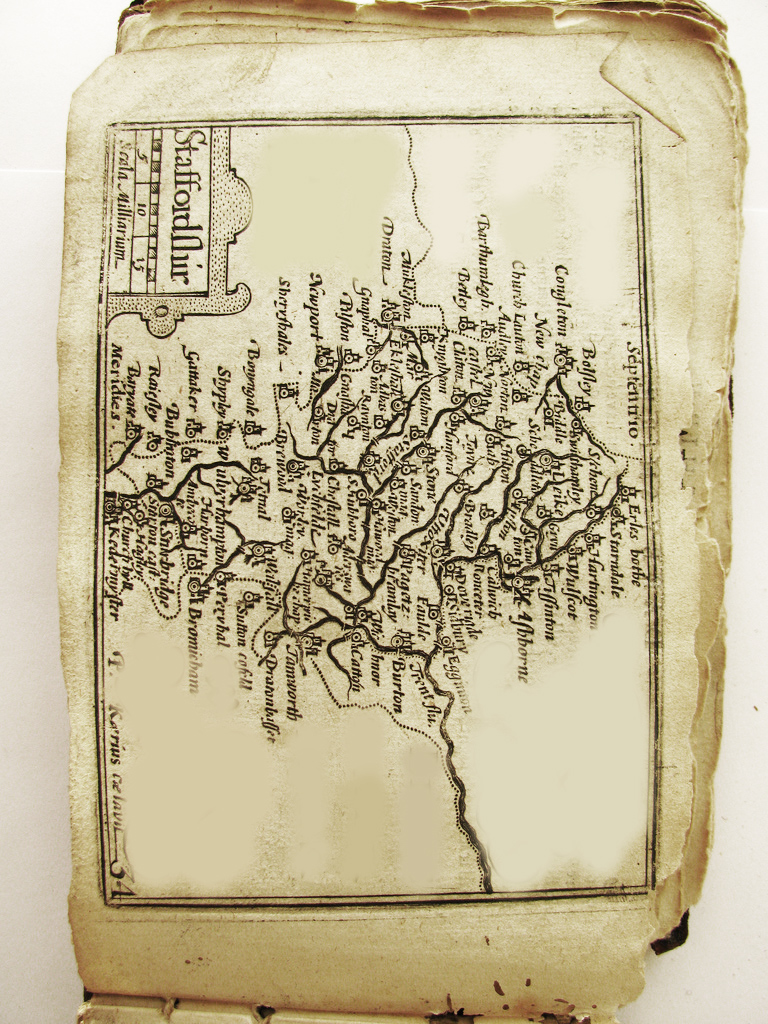
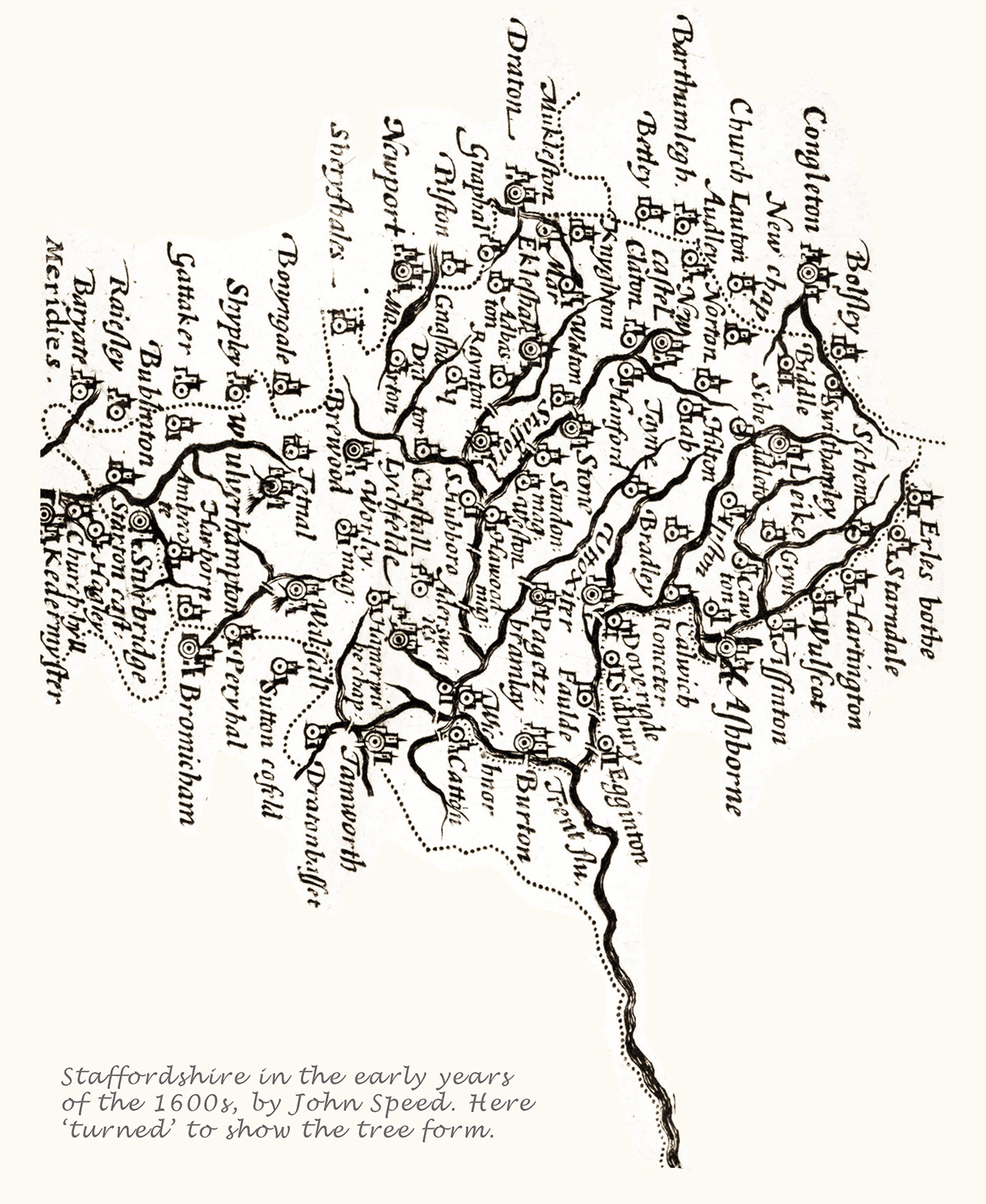
Some today may glance at a map and suggest Staffordshire’s shape doesn’t make much sense. ‘Just an arbitrary line on a map, surely?’ and ‘Why so long?’ However, turn the map around and look at it from a Trent waterman’s perspective, as the area covered by the headwaters of the River Trent and the goods portage road taking goods to the south-bound river systems around Stourbridge. Then the shape makes much more sense. With Tamworth / Lichfield being the strategic district which sits naturally between the two.

Picture: 1620s map, turned sideways and with some huge text overlay removed for clarity. From a military perspective this must surely have been how the Angles, coming up the Trent from the east and pressing west, understood the territory.

Thus, presumably the strategic nature of Stafford castle, and possibly Æthelflæd’s very nearby Saxon castle before that. “Why so big?” was the puzzled remark of an archaeologist restoring Stafford Castle in the 1980s, in a BBC 2 documentary. The answer to which should presumably have been: “because on the other side there’s 20,000 hairy angry Welshmen, who could link up there with a similarly sized army coming up the Trent from the other direction or down from Scotland”.

It rather resembles a tree, when seen turned to one side. I imagine that Tolkien might also have been rather charmed to learn that his beloved Staffordshire was shaped like one of his equally beloved trees, though I know of no evidence he ever spotted this map-turn / Trent tributaries perception of Staffordshire.

REED Online: Staffordshire + circus in Newcastle-under-Lyme

The new open access “records journal” REED Online has just released its first records set. The text archives for Staffordshire have been wonderfully trawled by J.A.B. Somerset, who found 186 records of early-modern popular performance, strolling players, maypoles and the like. These are now freely available and the individual records are also neatly geo-located.

The release comes alongside news that North Staffordshire will aim to be the national hub of the UK’s 250 years of circus celebrations in 2018. To achieve this, the New Vic Theatre in Newcastle-under-Lyme has just landed a Lottery grant of £749,000 via the Arts Council…

“to celebrate 250 years of modern circus … will include an ambitious programme of exhibitions and installations, spectacular performances and professionally-led community projects throughout the borough.”

On the curlew in North Staffordshire

The Curlew is the iconic bird in north Staffordshire. Remembering last summer’s national campaign on the curlew in the UK, I recently became curious (as a non-birder and layman) about the bird’s conservation status in North Staffordshire. March is also the time when there’s a surge of sightings of the bird, as they come winging in from the coast.

Yesterday I had a reply from Staffordshire Wildlife Trust, to my enquiry about the local conservation status of the curlew. They say that their North Staffordshire reserves at the Roaches and Black Brook… “are being managed to benefit Curlew and Snipe” and that on those sites these species are… “currently considered to be in favourable condition for breeding waders.”

So that sounds good, but it appears that the last time there was systematic field research locally was in the mid 1990s, which is 20 years ago now. The Trust told me that there was… “a decline of around 60% between 1985 and 1996 in the wider Staffordshire Moors area as a whole” (citing The New Birds of the West Midlands, 2005). But it appears to me that there’s now a need to fundraise for a spring 2018 local survey, to provide a twenty-year 1997-2018 re-survey.

That 60% level of decline would be congruent with the wider UK decline in such birds due to all the problems of the 1975-1995 decades, most of which were down to the move to intensive EU-subsidy farming and drainage installation, and possibly also to 1970s and 80s estuarine pollution of mudflats. The curlew over-winters around the estuarine coast of the UK, where the move toward mechanical dredging has apparently played a part in a recent 15% decline there. I’d also wonder what the huge increase in coastal dog-walking and estuarine walking paths / beach access in the last 20 years may have had, since the research suggests that regular dog-walking scares away a good proportion of all birds from an area. The same problem might be considered as a factor in the Moorlands during the nesting season. There has been a huge increase in the number of dogs on the UK in the last 20 years, and an increase in untrained/uncontrollable dogs. Combined with all the new paths, and with local councils nearly-always allowing dogs into what are supposed to be nature reserves, all those factors much surely have combined to have some effect on ground-nesting birds. There are multiple other ways in which dogs could be causing cumulative damage, especially in coastal and upland terrains. Splashing dogs churn up sediment in still waters, causing muddy turbulence and damaging fragile moorland plant-life in pools. Their fur-treatments for ticks, fleas and parasites wash off into watercourses, and are extremely toxic to invertebrates. Their shit and urine adds nutrients to moorland that should be naturally nutrient poor, causing a change in the flora. They may pass infections to wild animals.

The RSPB put the North Staffordshire curlew decline at a slightly more precise “decrease of 53% in the moorlands of north Staffordshire between 1986 and 1996”. So obviously 1985 was a good year for them, since its inclusion boosts the Trust’s figure from 53% to “around 60%”. But there’s probably a fairly wide margin of error on all such surveys. The RSPB also notes an additional factor for moorland decline: new and invasive species. Specifically being a rise in… “predation, particularly by mammals.” They don’t state the mammals concerned, but presumably they are involved in predation of the eggs and chicks from nests. Matt Ridley cites foxes and crows, though those are not alien species. They may however be ‘new to the areas’ because of the new woodland encroachment around moors that provides habitat for such egg-pilfering predators. This then raises the intriguing possibility that breeding pairs and nests will have become even harder to spot by humans, as the birds naturally adapt to avoid increased predation. Over-grazing by hill-farmers on moorland and high rough pasture during the nesting season may also contribute, leading to nest-trampling and reducing wind-cover by lowering the height of grass tussocks.

The fine blog Nature’s Parliament had a useful summer 2016 post on the history of the local study of the bird…

“The Birds of Staffordshire (1939) reported that Curlew were numerous on Morridge and the Roaches in the Staffordshire Moorlands during the summer”

I was also able to get a snippet of the 1982 edition of Birds of the West Midlands

“Curlew. Numenius arquata. Fairly numerous breeding species and passage migrant; not scarce, but very local, in winter. Prior to about 1920 the Curlew was virtually restricted as a breeding bird to the moorlands of north Staffordshire.”

Nature’s Parliament was also able to peruse the later 2005 (third) edition…

“The West Midland Bird Club book The New Birds of the West Midlands (2005) reports that the largest concentrations of Curlew have been observed at two spring roosts in North Staffordshire where birds gather in March prior to returning to their breeding territories. … in the north Staffordshire Moors in 1985, 1992 and 1996 surveys of Curlew revealed 418, 280 and 173 pairs respectively”

In their comment to me the Staffordshire Wildlife Trust suggested that locally the 1975-1995 historic decline is now “likely” to be “slowly recovering possibly due to better management”. Presumably this includes not just conservation and reserves, but also the now much-reduced need for farming inputs, more set-aside, and a host of interlocking conservation measures alongside new small-scale water-land habitat creation on the Staffordshire lowlands.

This BTO graphic also suggests that there are breeding increases located somewhat outside of the Staffordshire Moorlands, on the far north-east side of the Peak District…

The use of the word “Loss” on this map is somewhat misleading. “Decline” would be a better word, since otherwise one might look at the map and think that the North Staffordshire curlews had been totally “lost” and gone, whereas they are actually still there — albeit with a decline in the breeding population by about two-thirds from the 1910s.

The Nature’s Parliament blog post also notes a historic seasonal use of “lowlands” (locally?) by the birds…

“The Birds of Staffordshire (1939) highlights the fact that Curlew retired from the hills towards the lowlands about midsummer or soon after with almost all departed by mid-August.”

Incidentally, I’m pleased to discover that The West Midland Bird Report is online for free in PDF at: Archives 1934-2013. It can be searched via Google Search:

site:http://www.westmidlandbirdclub.org.uk/download/ keyword

At the West Midland Bird Club site I also discovered that Nick Pomiankowski of Stoke has recently undertaken “An Analysis of Staffordshire Bird Records 2005 – 2014 – Waders” and that this research is online for free. His section for ‘Curlew’ suggests an increase to about twice as many bird report sightings of curlews during that period, but perhaps no great increase in local breeding pairs in the county…

“Curlew is a breeding bird in the county, with a good presence during the summer months. The most notable feature of the monthly breakdown is the huge spike in March. This is due to the birds using some reservoirs, particularly Tittesworth, as a staging post on their return from their wintering grounds to their breeding grounds. The total records by year shows an upward trend, but this will be due to more wintering / passage birds being present, since the corresponding totals for just May and June – i.e. the breeding population – shows a fairly static picture. This latter chart is encouraging in itself given the national decline in breeding Curlew numbers.”

So, 221 Staffordshire sightings in the breeding season in 2014. But presumably that’s individuals and not “breeding pairs” sightings on the Moorlands? Compare to the local “173 pairs” which were survey-recorded as breeding in 1996.

So, on a quick non-birder perusal of the available evidence, it seems: i) that our local reserves and conservation measures are having a local effect, but perhaps not as large a breeding boost as would be liked; and that ii) on the other side of the Peak District the curlew’s breeding numbers appear to be doing much better than they are here.

UK City of Culture: the bookies’ odds

stoke

Perth is in Scotland, so I’m guessing it’s first because of a probable political need to placate the noxious Scottish nationalists re: Brexit? I can’t think of any other reason why it might be top.

Updated, October 2017:

We’ve done well to move from 10-1 to 3-1.

Updated: December 2017:

The last Ladbrokes snapshot from the Google cache. Stoke seems to have been knocked out of the top three, by the bookies…