Tolkien Gleanings #289

Tolkien Gleanings #289

* New in the first-issue of the new journal Studia Neophilologica, the article “J.R.R. Tolkien’s ‘Gawain’s leave-taking’: A composite translation of ‘Against my will I take my leave’ (Vernon MS 407v) and a door to further criticism”. The article can also be had free here.

“This article analyzes the manner in which the publication of the deluxe slipcased edition of J.R.R. Tolkien’s Sir Gawain and the Green Knight, Pearl and Sir Orfeo (2020) has helped to uncover some new evidence concerning Tolkien’s poem/translation ‘Gawain’s leave-taking’ (1925), and the possible early influence of Sir Gawain and the Green Knight (late 14th c.) on the initial stages of Tolkien’s Legendarium, in particular on The lay of Leithian (1925–1931). The article reveals, for the first time, the source for Tolkien’s poem/translation, namely ‘Against my will I take my leave’ (Vernon MS 407 v) as edited in Carleton Brown’s Religious lyrics of the XIVth century (1924), and the importance of ascribing the work by Tolkien to the year 1925 or earlier. It is my hope that this contribution nudges other scholars to examine the evidence with care and to propose enlightening analyses, especially considering that the influence of Sir Gawain and the Green Knight in Tolkien’s early writing remains unexplored.”

* In the new £92 academic book, Theology, Religion, and Dungeons & Dragons: Explorations of the Sacred through Fantasy Worlds (February 2025), the chapter “Tolkien’s Shadow: The Sub-Creating Influence of Middle Earth on Dungeons & Dragons“.

* The new listing of May 2025 online short-courses from Signum University includes “The Poetic Corpus of J.R.R. Tolkien: The Mature Years”, covering 1919-1931.

* A long review of the stage-play Tolkien by Ron Reed. This has just premiered in the USA and will run until 30th March 2025….

“At nearly three hours with an intermission […] it requires a thoughtful audience curious about interpersonal relationships more than about orcs and elves. A good comparison might be the film Shadowlands […] MaryBeth Schmid captures the period of the play with her excellent costume designs. Hendren creates subtle little flashes throughout that bring to mind imagery or characters from either the Narnia books or Tolkien’s Middle-earth.”

* A new Inklings Scholar Interview: Charles Franklyn Beach.

* A new article in The Imaginative Conservative, “The Exorcism of Bilbo Baggins”, examining Gandalf’s role as a kind of ‘exorcist’ in helping with the burden of the Ring. Written by a genuine exorcist, by the sound of it, but one doesn’t have to believe in such things to value some of the article’s points.

* And finally, new on YouTube, a recent “Tolkien Tour of Oxford”. Filmed on a hand-held camera, but with a reasonable amount of steady-cam — though viewers may still experience some sea-sickness.

Tolkien Gleanings #288

Tolkien Gleanings #288

* My choice of interesting-sounding papers due to be given at the forthcoming Medieval Congress 2025 at the University of Leeds

   – ‘One of my chief encouragements’: Tolkien as Tutor, Mentor, and Friend to W.H. Auden and Mary Renault.

   – Tolkien’s Interpretation of Sir Gawain and the Green Knight: From His Time in Leeds to His Late Years.

   – The Light of Learning: Medieval Scholar-Kings and Loremasters in the Line of Earendil. (K. Larsen)

   – The Thomist Legacy behind J.R.R. Tolkien’s Concept of Angelic Cognition.

   – Creating a ‘Red Book’: Hobbits, Tolkien, and Irish Monks.

   – Tolkien’s Early Work: Examining ‘Enȝlaȝesíþ’.

* In France, what is billed as a ‘conference-lecture’ on “Tolkien le mysterieux” (‘Tolkien and the Mysterious’), which seeks to peer into… “his most enigmatic texts”. Set for 8th April 2025 in Paris. Looks like there’s also a book launch at the same venue, and the book has an introduction by Leo Carruthers of the Sorbonne.

* A new conference paper in the growing current issue of the Journal of Tolkien Research, “Modes of Sauron: Wizard-Demon-Cat”, argues that Sauron is a “shape-shifter”.

* Set for June 2025, the new Oxford Handbook of Biblical Monsters.

* New in Portuguese and open-access, the Masters dissertation “J.R.R. Tolkien e a criacao de uma fantasia politica” (2025) (‘J.R.R. Tolkien and the creation of a political fantasy’). Has a long and cogent abstract in English. Examines Tolkien in relation to the then-emerging modernity of the inter-war period, and the various political strands of the time, suggesting that parallel views can be found in The Two Towers. See also the recent Portuguese Elementos antimodernos na obra de J.R.R. Tolkien: uma analise da obra Sobre Contos de Fadas (2024) (‘Anti-modern elements in J.R.R. Tolkien’s work: an analysis of his work on fairy tales’).

* Another interview on YouTube with the creator of the The Mythmakers book, which depicted the friendship of Tolkien & Lewis.

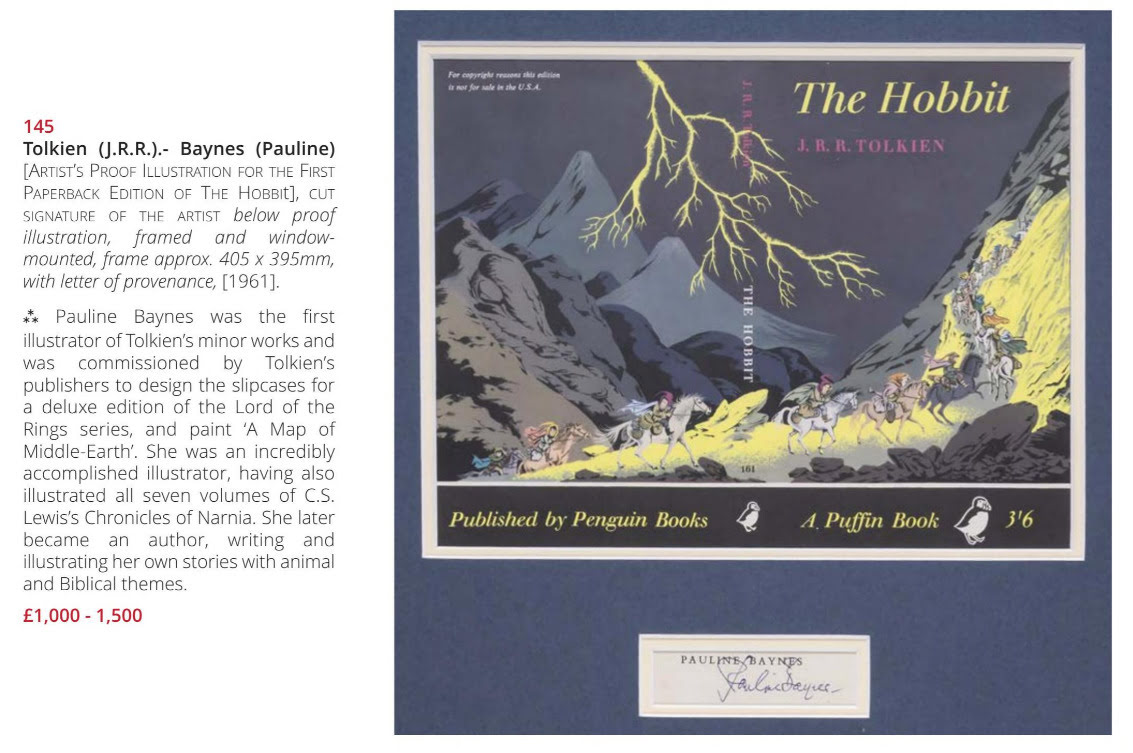
* Amazon UK is currently newly listing a hardcover edition of The Hobbit: A Graphic Novel (Revised and Expanded), with the release timed to wow the ‘back-to-university, got my loan payment’ crowd on 16th September 2025. Official and apparently to be… “revised and expanded with new art by illustrator David Wenzel, together with previously unpublished sketches and notes.” Possibly just some extra picture-galleries at the end, rather than additional pages of story? But the current paperback is 132 pages, while the forthcoming hardback is 192 pages. So there does seem to be room for a few additional pages of the story.

* “Tolkien’s Tengwar writing system has been mapped to Unicode”. Tecendil lets you see it digitally scribed. I see there’s also a guide for webmasters on how to embed Tengwar in your website.

* In English in the current Brazilian Unicamp Journal (magazine of the State University of Campinas), “Tolkien and magic outside the timeline”. Freely available online. A short and dense article, resulting from an interview with the writer of a recently completed PhD thesis in political science. He worries about Tolkien’s integration of older…

“literary genres into his work in an attempt to make it pass itself off as a work belonging to these genres”, and suggests that in this Tolkien “failed to maintain [the] authenticity [of the older traditions] created over generations and [which often had no firm] authorship. There is the issue of [these earlier works] being linked to that culture and that society. Tolkien, no. He recreates this whole apparatus artificially. This is not something authentic”.

But Tolkien states his very valid reasons for doing so, and anyway… what was the alternative in a society so denuded of its tales and lore? One of the great English traditions is the invention of tradition, and a master bard and wordsmith is perfectly entitled to weave fading fragments into a bright new tapestry of words. One might also consider that Tolkien was not only expertly drawing on ancient texts, tales and words. This is the fallacy of those academics who see only words and books. He also drew on the many then authentically-lived traditions of Englishness and Christianity, on the realities and traditions of battle, on local physiognomy and dialects, and on our very ancient landscape along with its distinctively rapid weather-changes amid steady seasonality.

Tolkien Gleanings #287

Tolkien Gleanings #287

* A 2025 Tolkien Colloquium, focusing on the poetry. 3rd to 5th April 2025 at Baylor University, Texas. Booking now.

* The long review of the book The Science of Middle-earth, which appears in the latest issue of the paywalled membership-journal Amon Hen #311, is now also freely available in open-access and under full Creative Commons Attribution. See also my correction of an erroneous statement given in the review, in Tolkien Gleanings #282.

* Paywalled in the first issue of the new journal Scrutiny2, “The Borders of War in J.R.R. Tolkien’s The Lord of the Rings”, which examines how Tolkien uses the hobbits to gradually introduce the reader to the wider war-scape of Middle-earth past and present. Also suggests that “the homecoming of Tolkien’s own sons in the Second World War” influenced the tone of the return to Bree and the Scouring of the Shire.

* The catalogue for the Tolkien & Donald Swann Archive, now freely available as an online flip-book. In one of the unpublished letters, Tolkien advises Swann on singing elves… “let him trill his Rs. All elves did that”.

* Programming details and booking alerts for the huge Medieval Congress 2025 at the University of Leeds in the UK. The 15mb .PDF programme reveals treasure-hoards of Tolkien papers and roundtables, which I’ll examine for a later Tolkien Gleanings.

* Press coverage in Italian of the opening of the Tolkien exhibition in Catania, Sicily. The article also reveals the name of the forthcoming final stop for the national tour…

The exhibition has now opened at the Palazzo della Cultura [Catania, Sicily], and will run there until until 31st July 2025. The show premiered in Rome and then toured to Naples and Turin. It will end its tour with a visit to Trieste in the autumn of 2025.

* And finally, newly released software of interest to writers. The desktop creative-writing assistance software NovelForge 3.x, now with full AI assistance. Formerly called CQuill, a one-man software creation. Still standalone and affordable, at $60 for a perpetual licence and with no wallet-gouging extra charges. In the new 3.x version you can plug in either the native AI-like ‘style assistants’, and/or local / remote LLM (‘chatbot’) AIs. Fonts can be enlarged, and dark mode is not native but can be enabled via Windowtop Pro.

A bit ‘o brick for Burslem…

A key part of Burslem is to get a £1.25m refurb. The £1.25m will fund Queen Street being dug up and re-laid with ‘anywhere’ paving, with trees planted. Not sure there’s really room for large trees, but they’re going to squeeze some in.

The new paving will also continue up the Brick House (aka Brickhouse or Cock’s Yard) pedestrian alleyway that goes through to the Town Hall, and there will be an unspecified “cleaning and refurbishment of Swan Square”, presumably the bit at the east end of Queen Street by the traffic lights.

It all looks horribly modern, forcing the place into being a naff ‘same as everywhere else’ retail plaza. That’s not what you should be doing with somewhere as historic as Burslem.

Tolkien Gleanings #286

Tolkien Gleanings #286

* A collection of largely unpublished Tolkien correspondence is up for auction soon, and could be yours for half-a-dozen bitcoins. Judging by the short article, the letters appear to arise from Tolkien’s late collaboration and friendship with musician Donald Swann. I believe just such an archive came up for auction at Sotheby’s last July, and they still have a page suggesting that it sold. So… perhaps this new sale might be letters from that auction, being re-sold? Or are these other letters, at auction for the first time? Unfortunately, the journalist didn’t inquire that deeply.

* Birmingham’s historical-fantasy / romance novelist Zen Cho has been chosen to give the 2025 J.R.R. Tolkien Lecture, set for May 2025.

* The Catholic University of America Press has a Christmas 2024 essay by Graham McAleer which makes an unexpected point about utilitarian ‘war topography’ in a Middle-earth dependent on horses. In which the beautiful and slowly-nurtured (gardens, hedges, managed woods and forests) can become inherently strongly defensive in time of war. Freely available online…

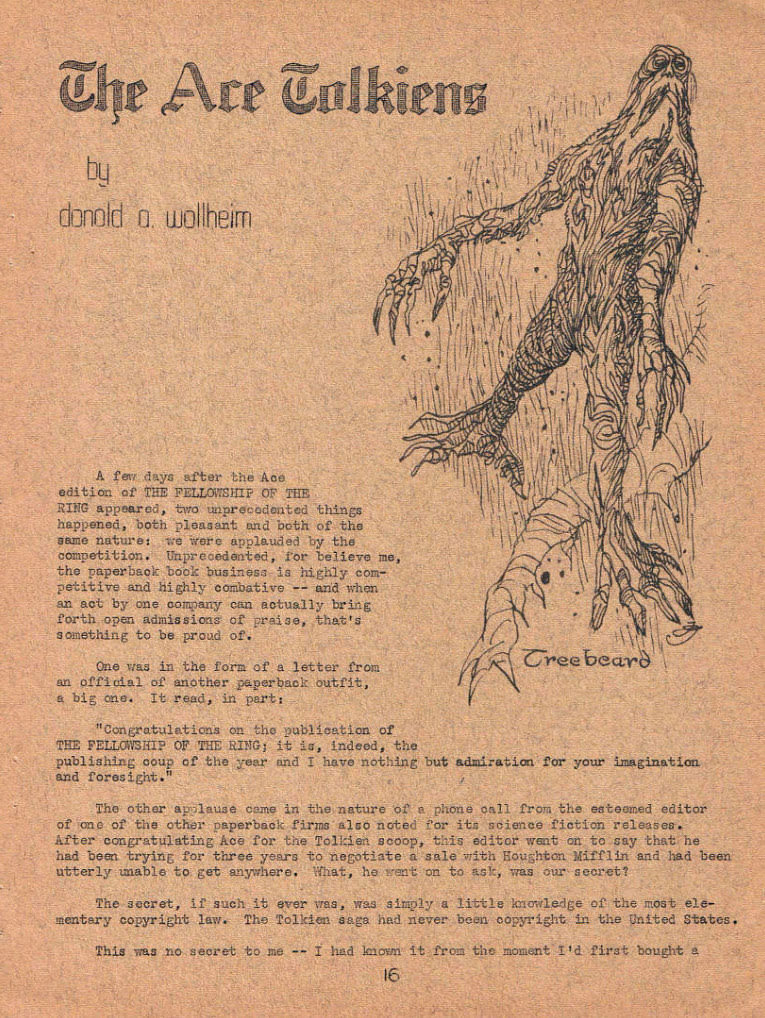
“Tolkien’s pastoralism is not escapism but strategic. Tolkien’s contemporary, the British geopolitical thinker, Sir Halford Mackinder argued that the great forests of Europe blocked the westward expansion of the Mongol cavalry. The cavalry could [only] flow unimpeded across the steppe. A comparable point is made by Clausewitz who argues that the highly cultivated farmlands of the west of Europe makes military manoeuvres especially tricky. It is notable that the lands of Mordor are barren, purposely, so they can offer no resistance to the ever probing and domineering Eye of Sauron. By contrast, the heroes of the West include Treebeard, Shepherd of the Trees, and Sam, Bilbo’s gardener.”

This observation might have interesting implications for various statements of regret made about the loss of forests and garden/hedge-lands in Middle-earth. The warriors and leaders who make these statements are not regretting only their loss, but also what their loss entails militarily. Not only hedges. One can also observe the irony that it is partly the feet of the hobbits that defeats the main force of ruffians in the Shire. Since they are ambushed in a cutting on the Bywater Road “sloping up between high banks”, presumably a sort of ‘sunken green lane’ worn down through the earth by many generations of hobbit-feet. Again, we see an unconscious defensive double-use for a rural market-trading landscape.

* A Pilgrim in Narnia reveals more spreadsheet sprinklings, generated by feeding Tolkien’s letters to a leading text-analysis software.

* Italian Jesuit Antonio Spadaro, the Vatican’s under-secretary for culture, has compiled a new book of the current Pope’s writings, letters and speeches on the subject of poetry and literature. The collection has now been edited and published in Italian by Milan’s ARES. The book reportedly has many texts relating to Argentinian writers, but also a few on Tolkien. How extensive or deep the Tolkien commentary is, I don’t know.

* Tolkien Gateway now has the contents-list for Parma Eldalamberon #23: The Feanorian Alphabet, Part 2 & Eldarin Pronouns (2024). Also note the review in Journal of Tolkien Research Vol. 20, Issue 2 (2024).

* New on Archive.org, a free scan of the Folklore Society’s Unlucky Plants: A Folklore Survey (1985). From a survey of living informants, something which it was still possible to undertake in the Britain of the late 1970s and early 1980s.

* Next in the current Oxford Tolkien Seminars series, “‘Alight Here for Middle-earth!’: Tolkien, Place, and the Past” on 7th March 2025. Possibly about Tolkien and railways and sense-of-place, given the title? Note the university’s page for the event says “members of the university only”. I thought these talks were also open to interested members of the public, since the Tolkien Seminar HT 2025 | Oxford Tolkien Network Web page has no such ‘uni only’ stipulation. But it seems I’m wrong. Though, recordings of these talks are eventually placed on YouTube for all to see.

* And finally, an article which overlaps with fantasy/SF fandom’s deep attachment to ‘zines and small journals. On the enduring phenomenon of British hobbyists and their print magazines

“the continued success of the hobby magazine [even in print, in these difficult days for sustainable print] can be attributed to a particularly British — and more broadly Northern European — genius for voluntary association. Whether centred around giant vegetables or antique fountain pens, little communities bubble up everywhere with no outside encouragement. I can’t help but wonder whether the British genius for immiseration also has a role to play. Lively minds will always find alternatives to decaying cities and nagging politicians.”

Great British Spring Clean 2025 – dates

Coming soon, the Great British Spring Clean, 21st March to 6th April (although note that the weather / wind is fine for it now, and may not be then).

Best place to get the best ‘Helping Hand’ litter picking-stick in Stoke, in person, is the AbleWorld superstore on the edge of Hanley. Sadly the sticks can’t be sent to Amazon lockers because they’re too long, though you can sometimes ‘Click and Collect’ via eBay. Stoke Council may be able to supply residents with sticks and also branded bags, or at least I’ve heard they have in the past. Not sure now, what with the bankruptcy/cuts and a likely high springtime demand.

Tolkien Gleanings #285

Tolkien Gleanings #285

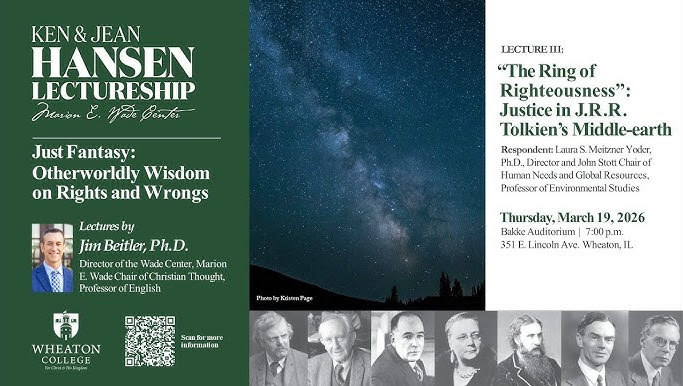
* At the Wade Center in the USA, “C.S. Lewis and the End of the World”, the 2025 Hansen Lecture series. Two of the lectures are now over, but freely available as video. The first was “Lewis and the Apocalyptic Imagination”, the second “Lewis and the Construction of the Monstrous”. The final lecture is due to be given on 10th April 2025, “C.S. Lewis, the End(s) of Desire, and the Construction of Hope”. Note also that the first event also saw a launch for the new book The Last Romantic: C.S. Lewis, English Literature, and Modern Theology (2025), this being “the eighth volume in the Hansen Lectureship series”. I see this book now has an audiobook.

* A new YouTube interview, part of a Philosophy for All’s growing ‘for beginners’ series, with Holly Ordway being interviewed on “The Philosophy and Faith of Tolkien”.

* Indiana University Library blog has an illustrated post on “Drawing Tolkien: Art Inspired by Tolkien’s Legendarium”. Specifically, the Library’s archives hold the Graham and Caitlin Mackintosh pen & ink illustrations for the book Tree by Tolkien (1974).

* My blog post on Sir Gawain and the Fellowship, in which I offer a few notes on the close similarities between the sequence of events in Sir Gawain and the Green Knight and early events in The Lord of the Rings.

* A new short Old English Core Literary Vocabulary, currently being regularly updated and freely available.

    aelfscyne, adj., beautiful as a fairy

* Staffordshire’s long-awaited new £8.7 million history study centre opened at the end of 2024 in the central county-town of Stafford, and is now fully up and running, and has just welcomed its 5,000th visitor. This free centre holds the County archives, and has new study-rooms and temporary exhibition spaces. This would be a useful archive and reference library if one were looking into Tolkien’s time(s) in Staffordshire. For North Staffordshire (Tolkien’s live-ammunition training camp near Keele, and later many retirement holidays with his son in Stoke) also note the large but little-known Local Studies collection at Keele University.

* Ablaze comics is to market a ‘J.R.R. Tolkien Genesis Collected Set’ in May 2025, this being a two-book bundle of graphic novels. One is the recent adaptation of the Kalevala (lovely painted pages, jarringly creaky dialogue), and the other is Tolkien: Lighting Up the Darkness which depicts some of Tolkien’s youth and battlefield experiences. Both books have already been released, and the comics-trade news of the forthcoming bundle doesn’t mention any special extras. Sounds to me like it’s just a marketing booster, to bring the titles back to the notice of trade journalists?

* And finally, the mooted big-budget movie of The Hunt for Gollum has now been pushed back to a December 2027 release slot, with the script reportedly yet to be written.

Sir Gawain and the Fellowship

I’ve been thinking more about the similarities between Sir Gawain and the Green Knight and the first parts of Fellowship in The Lord of the Rings. My thanks to Noelia Ramos and her new article “He Is the Master of Wood, Water, and Hill” for three of these items — she has observed that Bombadil (like Bertilak) is “acting as a guardian of the [ancient] forest” and likewise invites the unexpected traveller(s) to hospitality, and then guides them on their way.

Consider however that there are many more obvious parallels between the story-sequences:

A mighty birthday feast (Bilbo’s party / Camelot). The young hero accepts a near-suicidal journey to an uncertain place, in a race-against time, and is under a great burden of doom (Frodo and the Ring / Gawain and the Quest).

The quest is delayed, summer passes (Frodo tarries in the Shire / Gawain waits a year).

They have a lavish celebratory feast (Crickhollow / Camelot).

At the feast a mysterious ‘interloper’ appears (Sam, revealed / The Green Knight).

The traveller(s) are then well kitted-out for a journey on horseback (hobbits on ponies / Gawain on horseback).

‘Outside’ and entering a dangerous wilderness (The Old Forest / leaving Wales, passing through the Wirral).

Their way is barred by male aggression near water (Old Man Willow / the surly way-barring ford-keepers of the Cheshire plain).

An unexpected encounter with a fine high house in the wilderness (Bombadil’s house / Bertilak’s castle).

Meet a genial but very mysterious fellow who seems to ‘own/guard’ the country aroundabout, and who resides with a supernatural woman (Bombadil and Goldberry / Bertilak and Morgan le Fey). The latter appears to hold the house under some sort of enchantment (Goldberry / Morgan).

Dreams, and the voice of a fair lady (the hobbit dreams / Gawain’s dream).

After gracious hosting, the host sets the traveller(s) on their way with specific guidance (to the Barrow Downs / to the Green Chapel) but he does not accompany.

The traveller(s) leave with the blessings of a fair supernatural lady (Goldberry’s farewell atop the path / Gawain with his shield of the Virgin Mary and Green Sash).

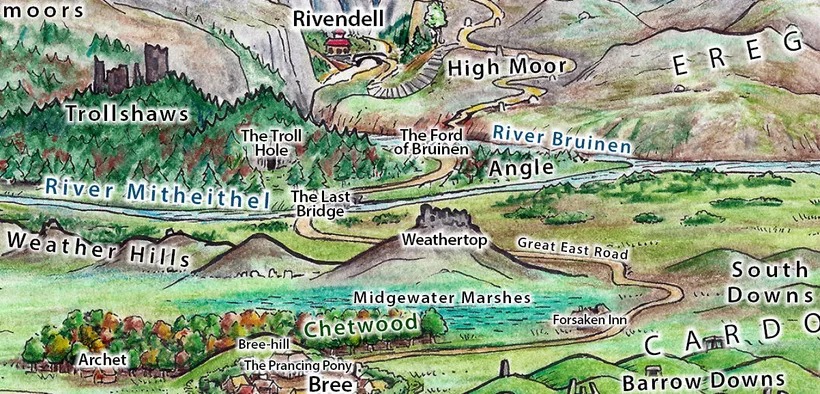
Leave the ancient forest, enter into an uncanny upland place of standing-stones and barrow burials, also encountering fog and heavy mists (the Barrow Downs / the Staffordshire Moorlands between Alton and Wetton).

A barrow-mound of some uncertainty (the wight’s barrow / the Green Chapel) (also note it has a “pale greenish light” in Fellowship).

Deadly edged weapons, grinding sounds (swords and the dragging of the bony hand on a stone floor / the Green Knight’s axe and the strange sounds of its sharpening).

Traveller(s) in great peril, near death, and many others have been slain here in the past.

There is a temptation to easy escape from the peril (Frodo thinks of putting on the Ring / Gawain has been tempted by the protection of the Green Sash)

The genial host reappears (Tom pops his head through an opening in the barrow / Bertilak – as the Green Knight – pops his head out of an upper part of the Chapel).

The traveller(s) are humbled (Gawain humbled, and the hobbits mysteriously lose their clothes and are naked).

Celebrations (Arthur’s court rejoices at the hero’s safe-keeping and to hear his tale / the revelry at Bree, Frodo gives a fantastical song)

Tolkien Gleanings #284

Tolkien Gleanings #284

* From Nepal, the journal article “Homely Pastorals versus the Unhomely Forest” in Middle-earth. Part of a special 2024 open-access journal issue on forests in literature. Freely available online…

“There are extensive studies of the forests of Tolkien […] However, the forests of Tolkien have rarely been studied as opposed to the idea of home”.

* A ‘Call for Papers’ for the annual German Tolkien Seminar 2025. The theme will be “Tolkien’s works on the book market”. Despite being called a seminar the event will actually run across three days from 31st October to 2nd November 2025. It seems likely to result in a Walking Tree book in due course, since the publisher is sponsoring.

* A new Michael Drout lecture, “Making I = Eye: How the One Ring Works in J.R.R. Tolkien’s The Lord of the Rings”. Set for 24th March 2025, near Boston on the East Coast of the USA. Possibly only for advanced students at the hosting university, though it is being advertised on a public Web page.

* A forthcoming lecture on “Tolkien and Dante”, on the YouTube channel of the Italian Fede & Cultura Universitas. I assume it will be in Italian, but YouTube can AI auto-translate to subtitles.

* The open-access Journal of Tolkien Research has begun a new rolling issue. First up is a very barbed review of Celebrating Tolkien’s Legacy: Essays (2024). I would question the reviewer’s statement that… “Beorn has no definable community during the time-period of The Hobbit”. He has his animal-friends. I would imagine that talking horses and ponies would be rather interesting company, and the presence of large structures to house them suggests a permanent (if fairly small) community…

    They can talk to him: “Some horses, very sleek and well-groomed, trotted up across the grass and looked at them intently with very intelligent faces; then off they galloped to the buildings. ‘They have gone to tell him of the arrival of strangers,’ said Gandalf.”

    And he can talk to them: “Beorn clapped his hands, and in trotted four beautiful white ponies and several large long-bodied grey dogs. Beorn said something to them in a queer language like animal noises turned into talk.”

    One might also consider Beorn’s apparent dances-with-bears festivities: “There must have been a regular bears’ meeting outside here last night. […] all dancing outside from dark to nearly dawn. They came from almost every direction”.

* Slipped into the previous issue of Journal of Tolkien Research, just before it finalised, “He Is the Master of Wood, Water, and Hill: Is Tom Bombadil the True Key Keeper of the Old Forest?”. Freely available online. There are some nods towards very vaguely-historicised ‘druids’, but the author more interestingly sees a connection with the Green Knight, who in Sir Gawain and the Green Knight was also “acting as a guardian of the [ancient] forest” and likewise invited the unexpected traveller(s) to hospitality, and then guided them on their way. A way which, I would add, in short order leads to a somewhat ‘Green Chapel-like’ situation for the hobbits — complete with a “pale greenish light”, deadly edged weapons, and a temptation to easy escape (Frodo thinks of putting on the Ring). Also Tom pops his head through an opening in the barrow. All very Gawain-like, I’d suggest.

* “Translating Original Languages: Knowledge Integration From Extended Nomenclature” (2025). A new Masters dissertation in Engineering, which… “investigates machine translation from the constructed languages Quenya and Sindarin into English.” Freely available online.

* On Archive.org ‘to borrow’, a scan of Masterpieces of Terror and the Supernatural: a treasury of spellbinding tales old & new (1985). Note that this volume of key short fiction reprinted the ‘old’ 1930s version of Tolkien’s “Riddles in the Dark”, which was later revised to bring it into line with the new Lord of the Rings.

* The large Italian Tolkien exhibition is now rolling south through Italy, and towards its third venue. The show will run from 7th March to 31st July 2025 at the Palace of Culture, Catania. This being the main town on the east coast of the island of Sicily.

* And finally, in the pictures for an eBay listing I’ve noticed that there was a musical aspect to the caves Tolkien visited in 1916, at Cheddar. Cox’s was actually one of two rival cave-systems open to the public at Cheddar, and Garth thinks Tolkien and Edith would have visited both in 1916. The details is in a book of what appear to be ‘Real Photo’ cards (photographic prints at postcard size, not screenprinted) is currently on eBay.

Tolkien Gleanings #283

Tolkien Gleanings #283

* John Garth spots Tolkien’s 1935 train-window poem on the Black Country landscape, in the new collection of Tolkien’s poetry. Garth’s new and long blog post “Mordor on the Oxford express” considers the journey and digs out the railway timetable with route. The poem definitely adds firm evidence that Tolkien saw the Black Country. Albeit through a train window, as Auden also did. But, so far as I know, we still have no evidence he ever set foot in the place. The named stops on the railway-line timetable suggest he would have had a fairly good look at the terrain, for instance passing through such dreadful places as Bilston and Wednesbury. Bilston is still fairly grim, even today. Garth’s post confirms my hunch of a year ago, that Tolkien may at least have seen the Black Country grimscapes from the train prior to writing LoTR.

I’d add that this encounter with the Black Country would have seemed even grimmer because, less than an hour before, Tolkien’s train would have been passing through the loveliness of the Shropshire countryside and villages in June. “Birmingham” is not elaborated on the brief timetable, but (given the approach stations) it would have been the old Snow Hill station (now demolished) rather than Birmingham New St. Thus Tolkien was on the old Wolverhampton Low Level route from Wolverhampton Low Level station (also now demolished) to Birmingham Snow Hill. He was therefore not entering “Brum” through the vast Egyptian-scale earthworks of the Galton Bridge cutting.

* In France, the College Les Bernardins – Events and Conferences page for spring 2025. Evidently, their Paris display of Tolkien tapestries has been greatly expanded on. Around it there are now lectures, events featuring music and song, film screenings, plus three evening mini-conferences and even a big three-day conference.

   – “Tolkien and Nature” 24th March 2025.
  – “Tolkien the Man” – 3rd April 2025.
  – “Tolkien and Mystery”, 24th April 2025.
  – “Christian [consonance??] in Middle-earth”, 16th to 18th May 2025.

* New in open-access, the book Horror in Classical Antiquity and Beyond (2025).

* Joseph Loconte’s website posts his previously paywalled 2024 article “The Meaning of J.R.R. Tolkien’s ‘Leaf by Niggle’”.

* Dune News reviews Finding the Numinous: An Ecocritical Look at Dune and The Lord of the Rings (2025).

* A free sample of a new book review, for the new Pearl translation into French by Leo Carruthers, reveals more about the introduction and its authorship claims…

“Carruthers addresses the problematic issue of the [Pearl/Gawain] author’s identity which can be partly established through his North Staffordshire dialect and may lead to the formulation of a plausible hypothesis for the aristocratic background of the poem, possibly composed at John of Gaunt’s request (pp. 20–21) to commemorate the death of his grand-daughter Blanche of Portugal.”

Ah, that Blanche. The distant grand-daughter Blanche of Portugal (1388-1389), who died as a tiny babe. Not Gaunt’s wife Blanche of Lancaster, who died in the Black Death of 1368, as I had previously suspected from a tiny snippet found on Google Books. Thus the new claim would make the writing of the poem about 11 or 12 years too late, by my timeline.

Tolkien Gleanings #282

Tolkien Gleanings #282

* There’s a new issue of the Tolkien Society’s Amon Hen (#311, February 2025), now available to members for download.

    – A short review of The Hobbit Encyclopaedia, plus a huge review of The Science of Middle-earth. The latter extending into a detailed consideration of the recent discoveries of tiny ancient human types (often called ‘hobbits’ by headline-writers and TV producers), and interbreeding of humans and elves. The review comes complete with an equally huge bibliography, tucked away at the back of the issue. There is one credulous error, repeating the book’s claim that… “if the current rate of hydrocarbon consumption continues, the concentration of CO2 could rise to 560 ppm by 2050”. This claim arises from the impossible ‘RCP 8.5’ future scenario. RCP 8.5 assumed a 10x increase in the use of coal for power, technological change slowing dramatically, global trade flows stagnant, agricultural development stopping… and yet somehow despite this collapse the global population heads towards a massive 15 billion in 2100.

    – “Tolkien Behind the Iron Curtain”. I don’t recall being aware that President Reagan’s famous 1980s “Tear Down This Wall” and “Evil Empire” speeches (as seen in the recent very watchable bio-movie Reagan) had halted the publication of The Lord of Rings in Soviet Russia….

“Subsequently, the publication of further volumes was stopped in the USSR. The second part of the trilogy, The Two Towers, was only published [after the collapse of communism] in 1990, and the third, The Return of the King, in 1991. […] In retrospect, it can be said that the suspicions and fears that the communist regime had towards Tolkien’s work and his fans were fully confirmed. [Along with a few other groups, they formed a] specific cultural milieu that was an alternative to the official communist culture and ideologies. Its members had an extraordinary elevated interest in activities of political dissent and in life in liberal Western societies.”

    – “One In The Eye For Peter Jackson?” considers Jackon’s ‘eye of Sauron’ movie symbolism.

    – AGM report, a round-up of some recent Smials activity, and various 2D artworks. One of the Smials reports notes a forthcoming Tolkien guide/walks booklet for Great Haywood in mid Staffordshire, and possible plaques.

* The British Fantasy Society’s members’ journal has a call for contributions for the Summer 2025 issue. The theme will be ‘The Green Fuse – Nature in Fantasy’. Regrettably, the call’s suggested items include mention of the pseudo-scientific leftist notion of ‘the anthropocene’ but the other suggestions may inspire. There’s still just about time to pop in a proposal — the deadline is 28th February 2025.

* New in the new paywalled journal Perspectives on Political Science, “‘The Sword That Was Broken’: The Role of Thumos and Pity in J.R.R. Tolkien’s Legendarium”. Specifically, four swords are investigated…

“For Tolkien, swords transcend mere instruments of combat; they possess their own births, histories, metaphysical inflections, and sometimes, personalities.”

* I had no idea that the PayPal payment option had been removed from all Gumroad accounts. Not just mine. A little research, just now, tells me that the Paypal option went away back in October 2024. I was wondering why all my sales and donations had collapsed from the Gumroad store. I had heard nothing from the company. But now… an email from them at the end of January 2025 says that PayPal has come back as a payment option…

“We’re thrilled to announce that PayPal is back on Gumroad! Our teams have worked together to restore both payment and payout functionality. You can count on PayPal being available on Gumroad moving forward. If you had a PayPal account set up before, everything has been restored and there’s no action you need to take. You may have already seen some PayPal sales come through!”

Glad to hear it. Thus you can now buy my recent book Tree & Star: Tolkien and the quest for Earendel again, using your PayPal balance.

* And finally, a new Medievalists.net article on “Laughing at Evil: The Hidden Purpose of Gargoyles” in churches.

Tolkien Gleanings #281

Tolkien Gleanings #281

* The Italian Tolkien Society has a new Call for Papers for a summer conference on the topic of ‘Orality and Writing in Middle-earth: Traditions of the Voice, Manuscript Transmissions and Interpretations of Tolkien’s Legendarium’. The focus of the 11th-13th July 2025 conference will be on oral tradition and written manuscripts in Middle-earth, rather than in the primary world. Proposals deadline: 30th April 2025. It appears that participants must give their papers in person in Italy, though attendance is free for presenters and they will also benefit from subsidised accommodation in Castelli Romani (said to be… “a popular retreat from Rome’s summer heat”). I assume the papers need to be in Italian, though the call does not specify language. The conference proceedings will later be issued as a book.

* From Brazil, Ecological faerie: J.R.R. Tolkien’s supernatural poetics (2024). The credits mention the author’s funded “doctoral degree”, so this and the length mean it is likely a completed PhD thesis. In English and freely available online. The work…

“analyzes his poetry as an ‘artistic seed’ for aspects that would come to form his prose, as well as something wholly unique within his oeuvre. The close reading of his poetry is divided into four different environments, insular, forest, rocky and watery”

The author find these closely adhere to older medieval “Celtic and Germanic molds”, but he winkles out a few ways in which they may have departed from these molds.

* A new paper on “Antiphons of Iron and Blood” examines one of the newly released Tolkien poems “Ferrum et Sanguis” (Christmas, 1914). Freely available online. Suggests that the…

“source for the poem is very likely found in the Advent Vespers of the days surrounding Tolkien’s writing of the poem, rather than the Catholic Tenebrae service, as the [Collected Poems] editors posit. […] In taking inspiration from the O Antiphons, he was doing the same sort of thing that the poet of Crist was doing when he composed the lines “Eala Earendel engla beorhtast”: responding to the inspiration of the Vesper Antiphons by applying them to his own situation and seeing the truth of the verse in a new way from a different perspective.”

See also my recent book, Tree & Star: Tolkien and the quest for Earendel, for a chapter on the matter. This paper, linking the newly released poem with the O Antiphons, independently serves to support my book’s arguments.

* Springtime 2025 brings another chance to hear and see the recreation of the children’s lecture ‘Tolkien on Dragons’ in Oxford. To be presented at The Story Museum on 26th April 2025. Booking now. Free, so tickets are likely to go fast.

* The county of Dorset is the next to host the popular British touring exhibition The Magic of Middle-earth. The ‘mostly memorabilia, merchandise, posters, and models’ show will run at the Dorchester’s Shire Hall from 29th March to 14th June 2025. Some sources say free, others say very expensive. The Wordland blog has just posted some interior photos from the earlier Chichester stop for the show.

* And finally, talking of exhibitions… just closed in the Italian city of Turin, the substantial exhibition “Tolkien: Uomo, Professore, Autore”. No news, as yet, about where it might go next.