The Potteries Post has updated. Timely ‘news you can use’ in the arts, history, and wildlife and conservation.
The Potteries Post has updated. Timely ‘news you can use’ in the arts, history, and wildlife and conservation.
More Sir Gawain and the Green Knight.
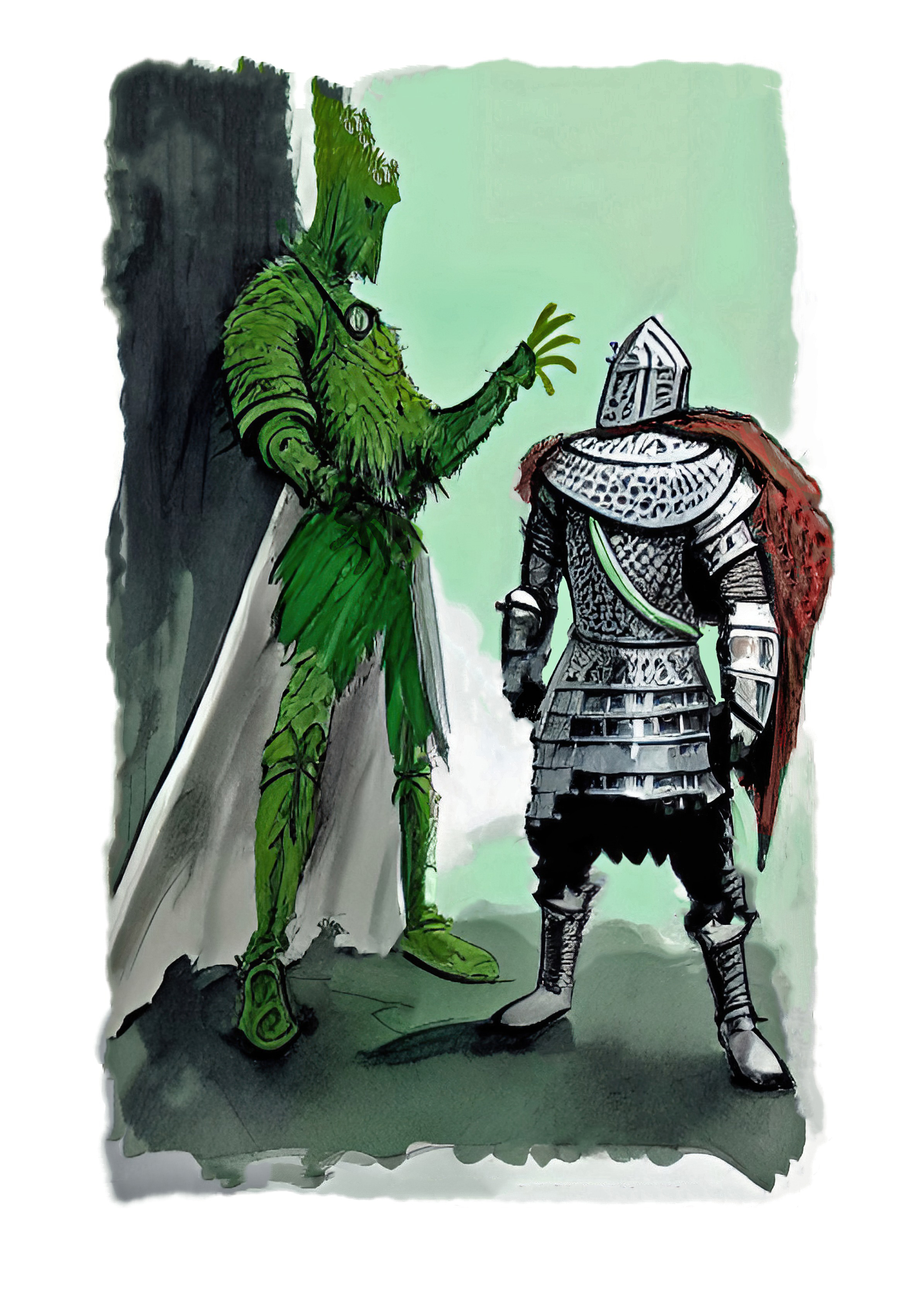
I place this illustration under Creative Commons Attribution.
Interesting discovery with YouTube. Searching for…
“sir gawain” -sonic
… does not work to remove Sonic the Hedgehog videogame crap from results.
Nor does…
“sir gawain” NOT sonic
But using both together…
“sir gawain” NOT -sonic
…does work.
Even more Gawain. Andrew Charles Breeze’s book The Historical Arthur and the Gawain Poet: Studies on Arthurian and Other Traditions (Studies in Medieval Literature) is set to be released in hardcover for circa £80 on 15th January 2023.
The blurb reveals that it is partly Arthurian, and states that the first part will offer…
evidence for the Arthur of film and legend as a real person, a Celtic commander (not a king) who fought battles in North Britain during the terrible volcanic winter of 536-7, before dying a hero’s death in a conflict on Hadrian’s Wall.
The second part…
uses arguments of the U.S. scholar Ann W. Astell to date the text to 1387 and name the poet as Sir John Stanley (d. 1414), a Cheshire and Lancashire grandee.
The date given seems curious, since Astell states “my argument necessitates dating Gawain after 1397” (in her Political Allegory in Late Medieval England, page 188). This is slightly expanded when she gives “1397-1400” elsewhere in the same book, the date being drawn from reading Gawain as a mirror-like political allegory of events — claimed by her to be inspired by the beheading of Richard of Arundel in 1397. But I guess the arguments that Breeze takes from her must relate to something other than Astell’s own choice for the dating of Gawain.
Either late date seems doubtful to me, and the Stanley claim more so. But it will be interesting to see if the book has new evidence.
Update: Ah, I see that the dating is explained in Breeze’s latest paper. He notes Astell’s observation of… “line 678 of Gawain, on its protagonist as being made a duk or duke [which she sees as a coded reference to] Robert de Vere (1362-92), ninth Earl of Oxford, created Duke of Ireland on 13 October 1386. She adds that ver or spring, used in line 866 of beautiful clothing given to Gawain, is a dig or quiet joke at the expense of de Vere, favourite of Richard II and notorious for flamboyant dress.”
More than a bit tenuous, and seemingly an insight originally from McColly and not Astell. Let’s hope there’s more new evidence than that in the book.
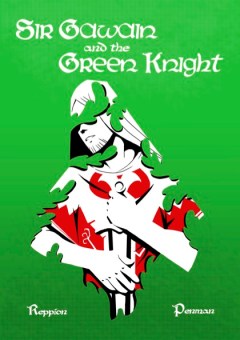
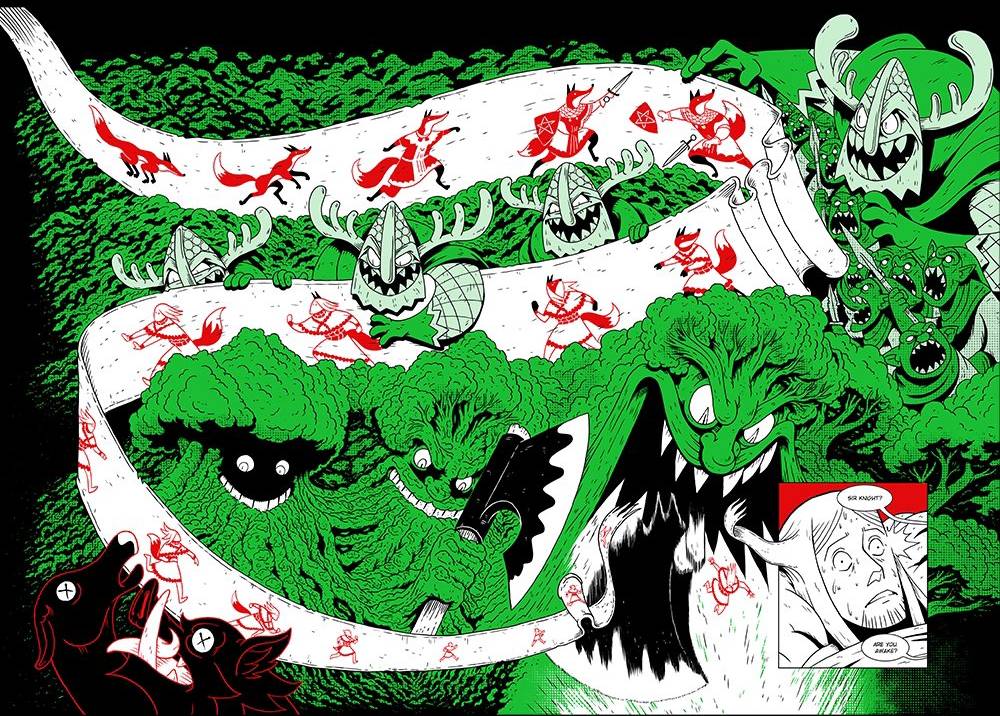
The comic of Sir Gawain, which was a limited edition a while ago now and sold out instantly, is going to have a mass market edition. Sir Gawain and the Green Knight is pre-ordering now, is set to ship for £15 at the end of November 2022. The new edition has a new introduction by Alan Moore.
A couple of local folklore talks, albeit in central London. London Fortean Society: ‘The Haunted Landscape: Folklore, Monsters and Ghosts’ event, set for 19th November 2022.
Includes:
* Dr. Victoria Flood – “Alderley Edge and the Dead Man”. (“Based on research undertaken as part of the Arts and Humanities Research Council-funded ‘Invisible Worlds’ project, this paper traces engagement with medieval prophecy at the Edge from the eighteenth century to the present”).
* Jeremy Harte – “Hell-Wrestling with the Magic Methodists” (who largely originated on Mow Cop).
‘Paying via PayPal’ has now been enabled on my Gumroad products, including my new Tolkien book.
One of the nice things about finishing and releasing my big Tolkien book, at last, is that I’ve been able to watch the recent ‘young Tolkien’ biopic film in its extended form (i.e. complete with 12 minutes of deleted scenes on the DVD version). I hadn’t wanted to watch Tolkien (2019) before now, due to the risk of skewing my book.
Here are some notes…
Update: These notes have now been replaced by my full polished review in the free Tolkien Gleanings PDF issue 1.
The Potteries Post has updated with new local opportunities, talks, jobs and more.
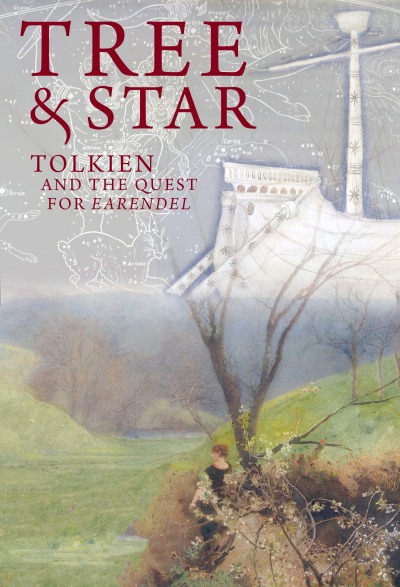
Phew! 458 pages, 200,000 words. Soon. Update: It’s here.
Updated, The Potteries Post. More timely “news you can use” from the city of Stoke-on-Trent, with a focus on wildlife and the arts and history.

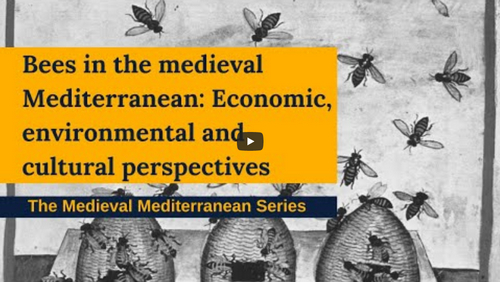
A new 53 minute YouTube seminar “Bees in the Medieval Mediterranean: Economic, Environmental and Cultural Perspectives”. Starts at 6:12 minutes.
Some of the accents are a little difficult, but if you listen closely and on headphones they’re not impenetrable. They’re giving an overview of a major pan-European project that’s been partly completed.
The short discussion of the religious aspect was interesting. The thinkers of the medieval world did not know how bees reproduced, even if perhaps the guilds of industrial-scale medieval bee-keepers came to discern something of this over the centuries. Thus bees were deemed “virginal” by the thinkers, and could then be closely associated in the minds of the religious with the chastity and sweetness of Mary and Christ. This made their wax especially suitable for church candles.
The seminar’s listener learns that the Baltic not only had amber, but also bees-wax as a major portable and durable export. One that went long distances across Europe. “Vast” bee-forests were created within the forbidding forests of the Baltic and Bavaria, leading to “vast” exports of wax to the Black Sea, and thence it found its way to the monks who specialised in making all sorts of religious church candles. The Bavarian wax was especially valued, since the white colour and non-smoky burning were deemed important in churches.
The project’s paper is “Beekeeping in late medieval Europe”, in open access. This adds some detail to the idea of the vast eastern bee-forests…
bee forests were created through hollowing out large spaces in tree trunks and allowing bees to naturally move from tree to tree as they swarmed, protected from the worst of the winter weather within the trees’ cavities.
Logs were also used in some places. One assumes that glades were also created, perhaps by controlled burning, for the flowers and shrubs required by the bees. Such methods obviously produced enormous amounts of wax for white candles. Apparently honey and wax production were quite different things, and such trades did not overlap.
This somewhat intersects with my Gawain book, since the Lord of Alton in North Staffordshire went to fight with the crusaders of the Teutonic Order in eastern Europe. The project’s article tells of how the vast bee-forests were pagan, and there was a quite a religious/political tussle with the highly efficient Order over their control and use. But it appears to have been normalised by the time of Gawain, or at least that is the impression I get from the article. It notes one aspect of the pagan beliefs of that area that I had not noted from the BBC In Our Time programme on the Teutonic Order — that the linden was an especially revered tree.
Ironically, it seems that medieval church candles came either from forests tended by the ‘nominally Christian’ ‘former’ pagans of the Baltic, or the Arabs along the coast of North Africa.
The speakers also touch on the British Isles at one point, and the fringes of the West Midlands. Apparently we know from Domesday and somewhat later census documents that the Welsh Marches were a big bee-keeping — and presumably even nationally exporting — area. For honey rather than candle-wax, was the impression I had from what was said. This was in hives rather than damp Welsh forests, and was likely not monastic in nature. The seminar suggests that northern monastic bee-keeping was often more for medicinal and symbolic purposes (i.e. to demonstrate to novices the ‘ideal community’ in connection with the heavenly, which the monastery should strive to be like), than for sale.
Neither the recording or paper has mention of the folklore of bees, re: the folk-idea that the bees woke and “sung” at Christmas “a drowsy echo of the angels’ song” in heaven. Or that one must go to quietly “tell the bees” of someone’s death. But this “heavenly messengers” old wives’ lore now makes a bit more sense to me, now I know of the long-standing Christian connection of bees with Christ/Mary.
See also the recent Kristine Larsen paper, “Tolkien’s Blue Bee, Pliny, and the Kalevala”.